Audience Research to Content Topics Workflow
Begin
14 pages · ~28 min
Audience Research to Content Topics Workflow
Learn a practical workflow to transform audience research into compelling content topics, ideal for content marketers seeking to improve strategy and relevance.
What you’ll learn
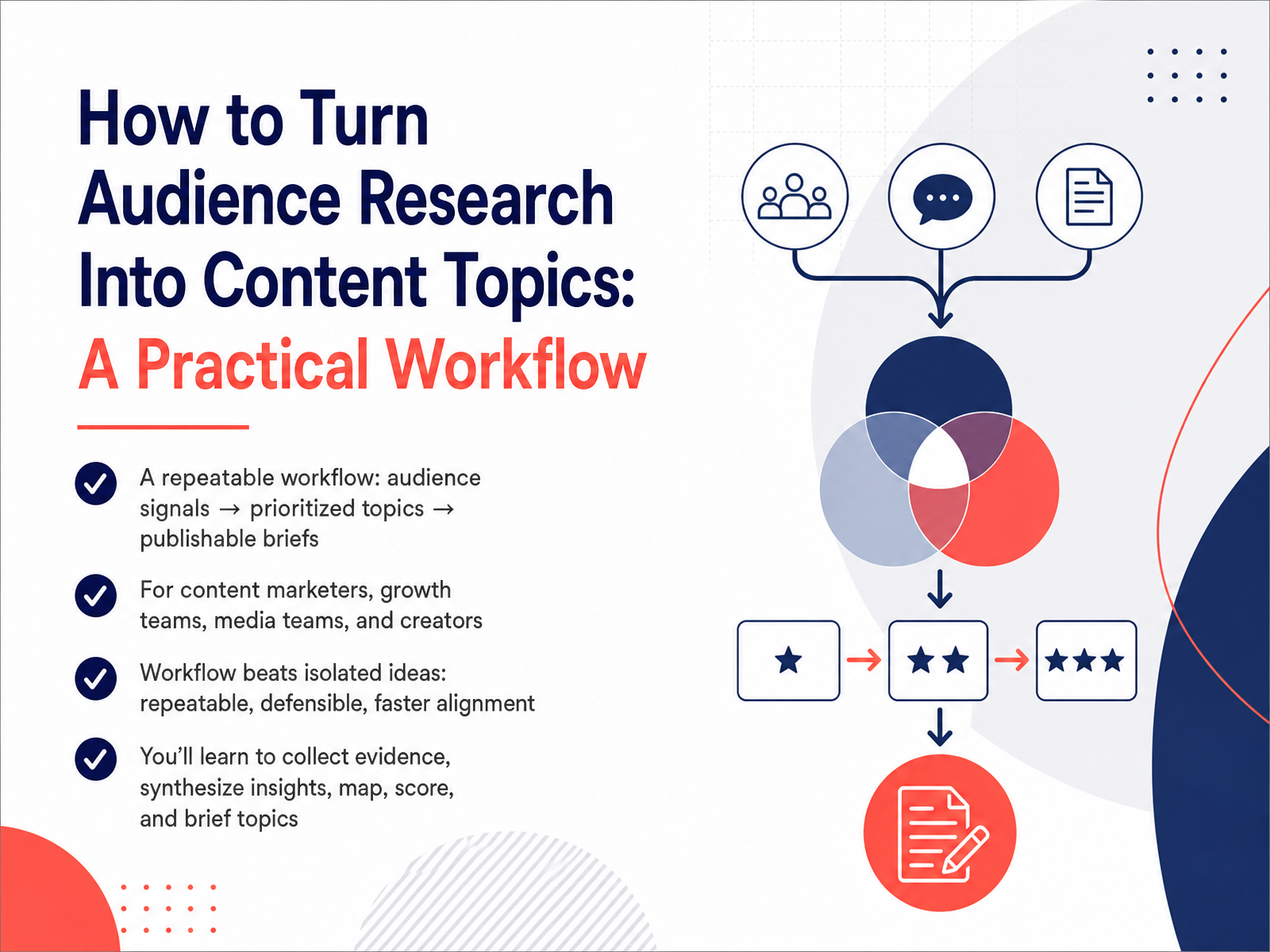
- 01How to Turn Audience Research Into Content Topics: A Practical WorkflowWelcome. If you've ever stared at a blank content calendar, you know the feeling: you're guessing. Guessing what your audience cares about, guessing what will actually perform. That stops today. This course walks you through a repeatable workflow that turns audience research into a prioritized list of topics and then into publish-ready briefs. No more isolated ideas that die in a spreadsheet. This is about building a system that is defensible, faster to align on, and grounded in evidence. Whether you're a content marketer, a growth lead, or a media creator, you'll learn how to collect audience signals, synthesize the insights, map them against demand, score the opportunities, and brief your team for execution. By the end, you'll have the confidence that comes from knowing why you're writing what you're writing. Let's get to work. First, we need to talk about why audience research should come before topic ideas in the first place.sqseo.comhootsuite.comsparktoro.com+21 min
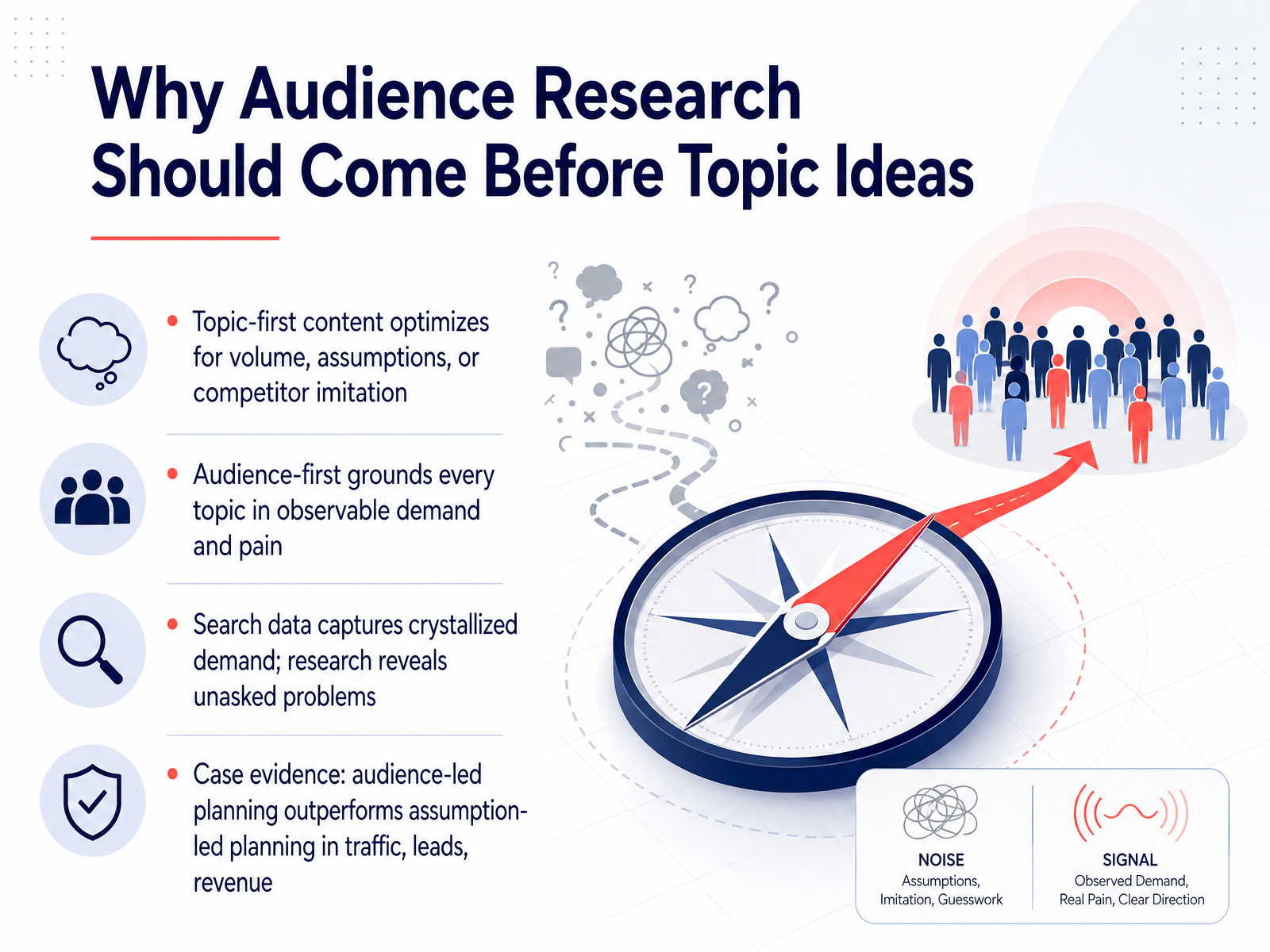
- 02Why Audience Research Should Come Before Topic IdeasLet’s start with a hard truth. Most content plans are built backward. Teams pick topics based on search volume, or worse, they copy what competitors are already ranking for. That’s optimizing for assumptions, not for people. Audience-first planning flips the order. You ground every topic in observable demand and real pain. Here’s the key distinction: search data captures demand that’s already crystallized into a query. Someone typed it into Google. But audience research—social listening, community mining, surveys—reveals the problems they haven’t even articulated yet. That’s where the real opportunity lives. And the evidence is concrete. Audience-led planning outperforms assumption-led planning across traffic, leads, and revenue. When you start with the human, the topics practically write themselves. Now, the next question is where you actually find this high-signal audience data.
 sqseo.comhootsuite.comsparktoro.com+21 min
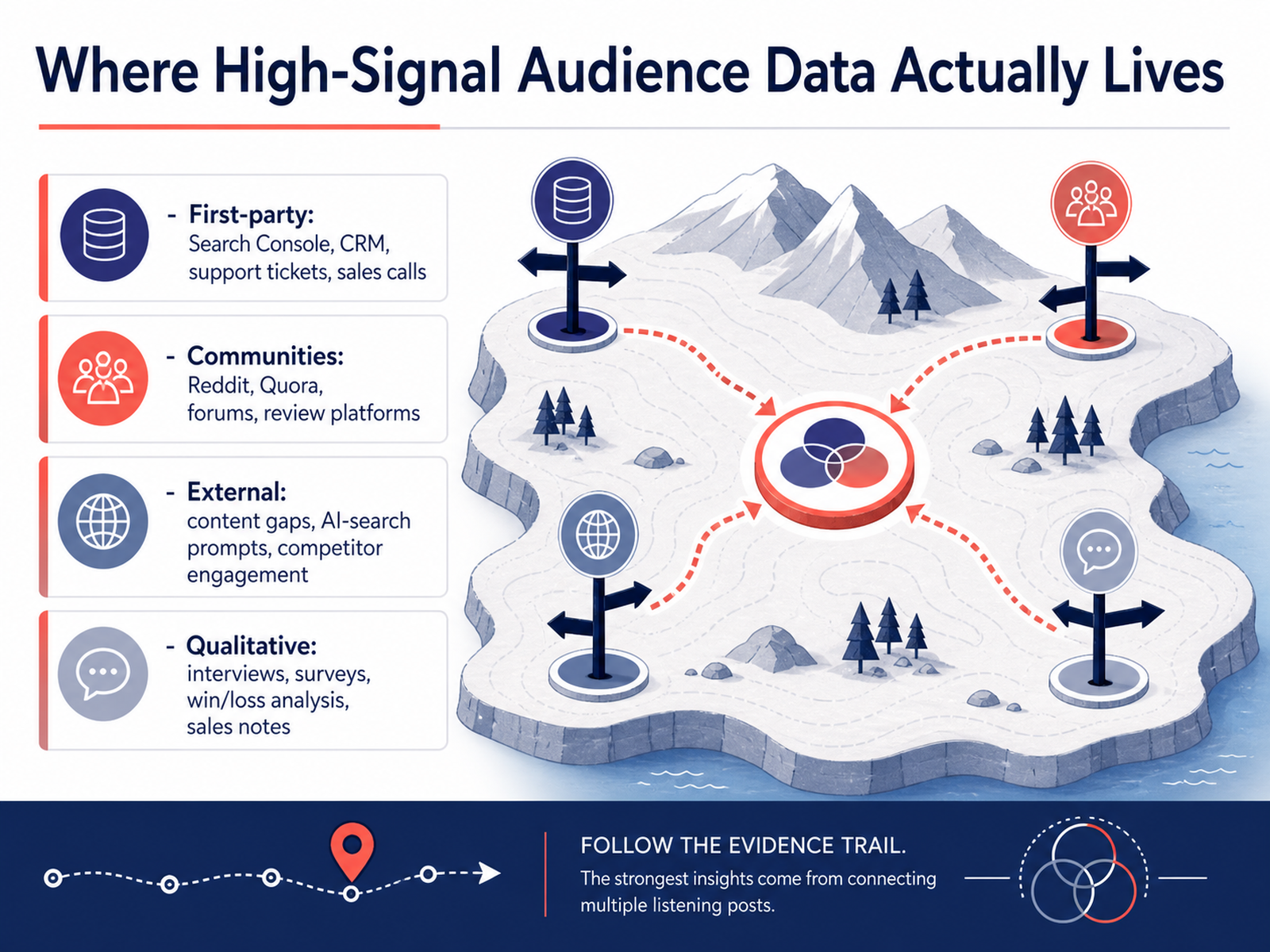
 - 03Where High-Signal Audience Data Actually LivesSo, where does high-signal audience data actually live? You've got four main sources. Start with your first-party data: Search Console reveals what people are actually typing, your CRM and support tickets hold their real questions, and sales calls are goldmines of objections. Then go where your audience hangs out unsupervised: Reddit, Quora, niche forums, and review platforms. That's unfiltered language and anxiety. Third, look outward at content gaps your competitors ignore, the AI-search prompts people test, and where competitor engagement spikes but content quality drops. Finally, don't skip qualitative work: interviews, surveys, win-loss analysis, and sales notes give you the why behind the what. Each source shows you a different slice of the demand picture. If you're only looking at one, you're flying blind. Now, let's talk about using 2026 tools to make this research faster and less manual.
 sqseo.comhootsuite.comsparktoro.com+21 min
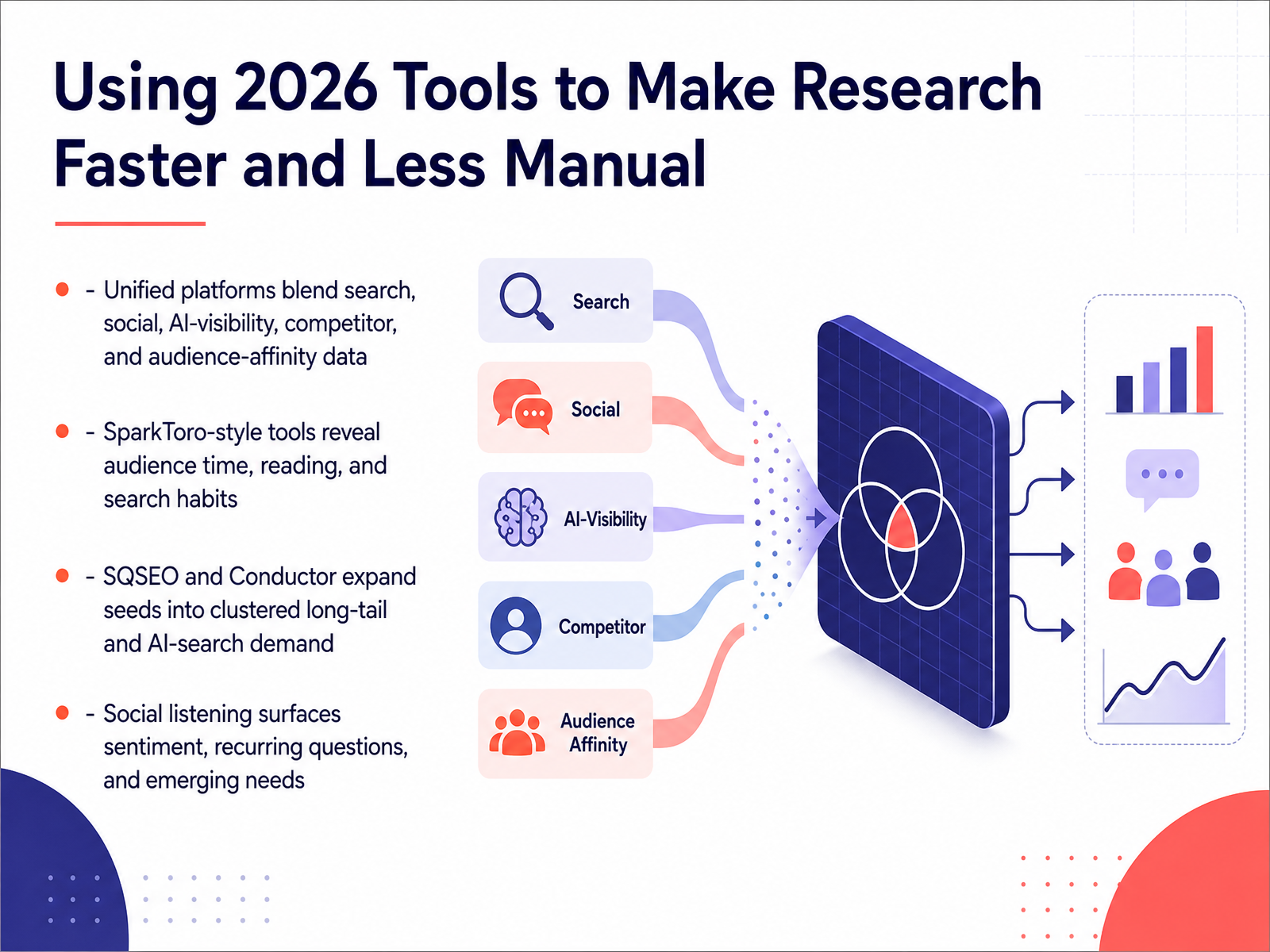
 - 04Using 2026 Tools to Make Research Faster and Less ManualLet’s talk about the tools that make this workflow less manual. In 2026, you don’t need to stitch together ten different spreadsheets or guess what your audience cares about. Unified platforms now blend search, social, competitor, and AI visibility data into one view. For example, tools like SparkToro reveal where your audience spends time, what they read, and even which AI chatbots they trust. Then you have platforms like SQSEO or Conductor that take one seed keyword and fan it out into hundreds of clustered long tail questions, plus the exact prompts people type into ChatGPT or Perplexity. That alone turns a blank page into a prioritized content plan in minutes. But don’t stop at search intent. Social listening tools surface the sentiment, recurring questions, and emerging needs your buyers won’t type into Google. That’s the qualitative layer that search data misses. So the practical takeaway here is simple: let the platforms handle the heavy lifting, and spend your brainpower on interpreting the signals, not gathering them. Up next, we’ll turn those raw signals into a structured audience insight model.
 sqseo.comhootsuite.comsparktoro.com+21 min
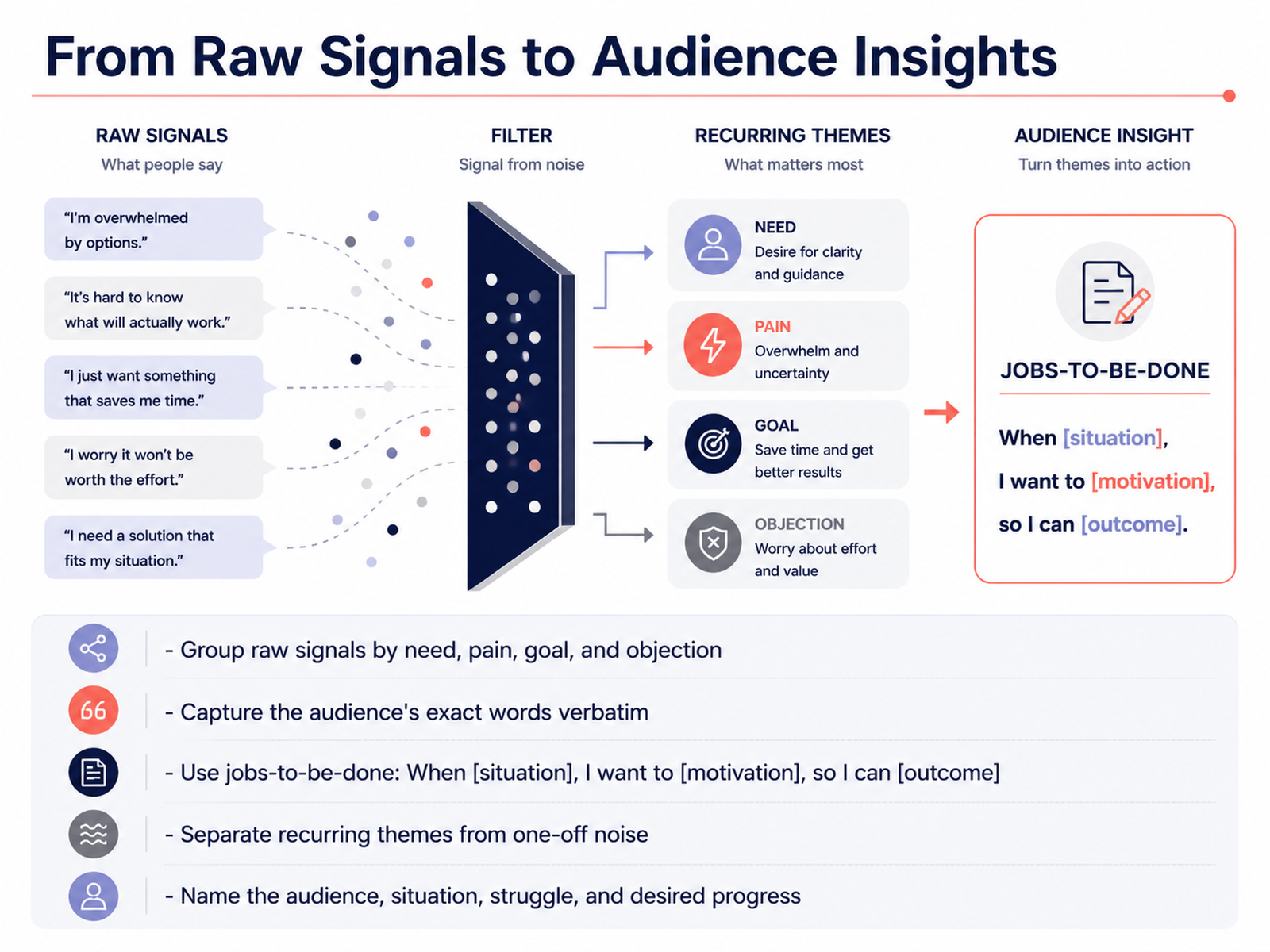
 - 05From Raw Signals to Audience InsightsSo you have all this raw audience data—now you need to turn it into something actionable. Start by grouping those raw signals. Sort them by need, pain, goal, and objection. Don’t clean up the language; capture your audience’s exact words verbatim. That phrasing is your future headline and your keyword research in one.
Next, use the jobs-to-be-done format to sharpen each signal: When [situation], I want to [motivation], so I can [outcome]. That forces you to think about the trigger, not just the demographic.
Now separate recurring themes from one-off noise. A question asked once is a whim; a question asked weekly is a topic with proven pull.
Finally, write a clear statement naming the audience, the situation, the struggle, and the desired progress. If you can’t fill in those four elements in a single sentence, you don’t have an insight yet—you have a data point.
Getting this synthesis right will prevent a lot of weak topics later, including some very common mistakes we’ll look at next.
 searchfoundry.co.uk97thfloor.comsearchengineland.com+21 min
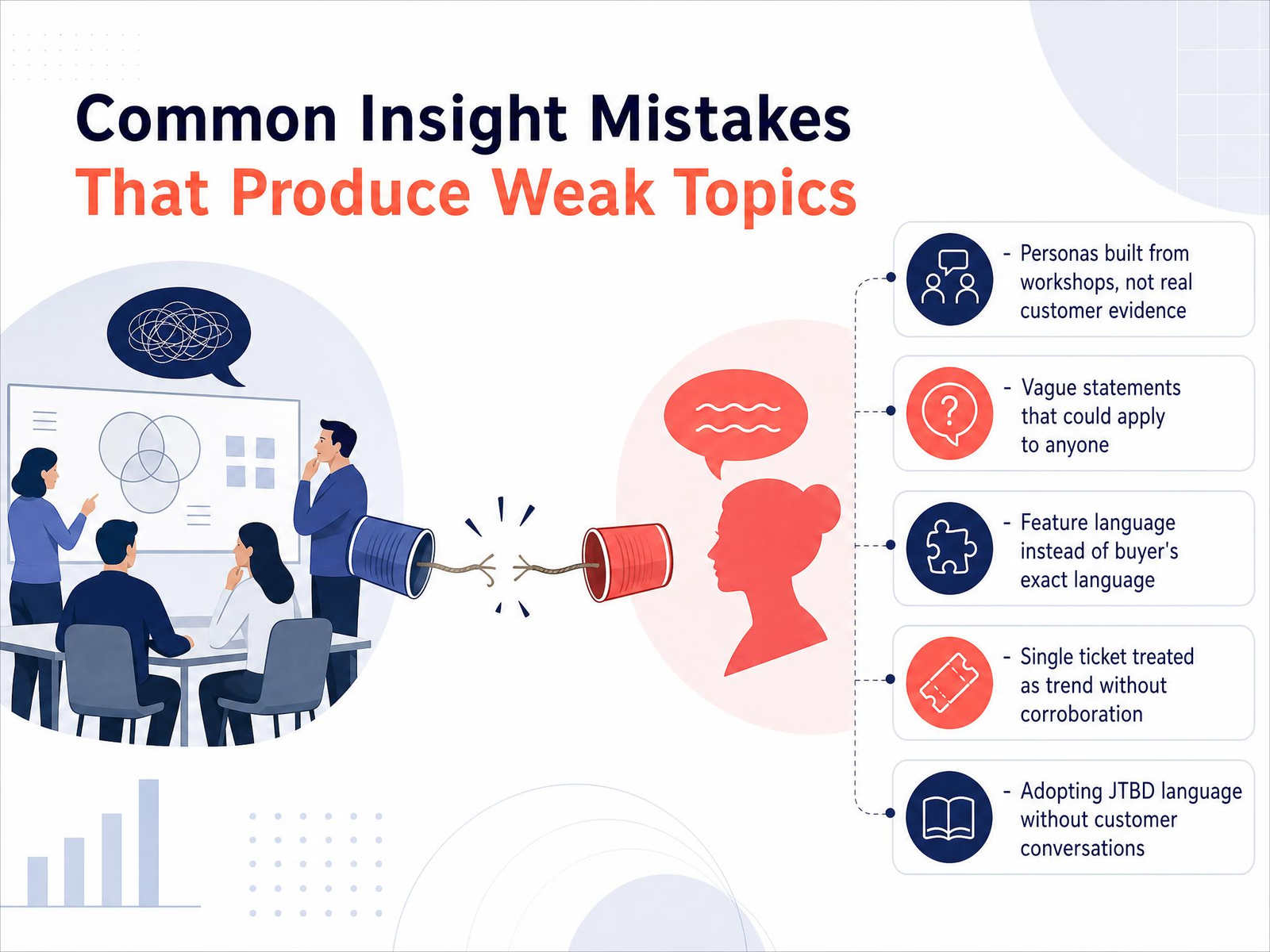
 - 06Common Insight Mistakes That Produce Weak TopicsBefore we map insights to topics, let’s flag the mistakes that produce weak content. First, personas built in workshops, not from real customer evidence. If your persona is a guess, your topics will be guesses too. Second, vague statements that could apply to anyone. “Struggles with productivity” tells you nothing. You need the specific frustration, like “spends four hours a week on manual reporting.” Third, using your own feature language instead of the buyer’s exact words. If they say “fix my funnel,” don’t write “optimize conversion architecture.” Use their vocabulary, verbatim. Fourth, treating a single support ticket as a trend. One complaint is an anecdote. Five tickets about the same problem is a signal worth building on. And last, adopting jobs-to-be-done language without customer conversations. JTBD works only when grounded in real interviews, not sticky notes. Skip those conversations and you’ve just renamed your persona doc. Now, with those pitfalls clear, let’s look at how to map validated insights into funnel-aligned topic categories.
 sqseo.comhootsuite.comsparktoro.com+22 min
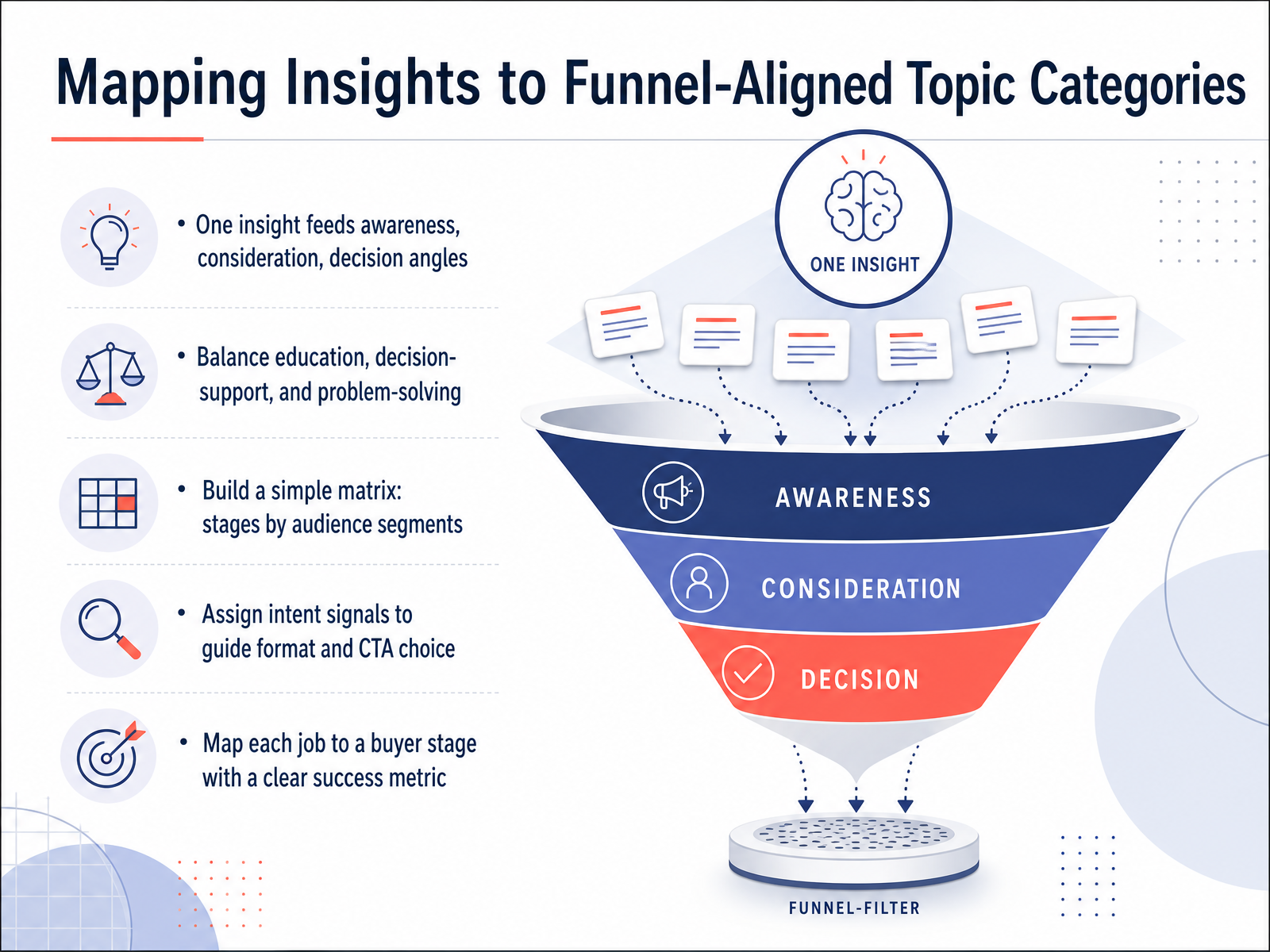
 - 07Mapping Insights to Funnel-Aligned Topic CategoriesNow let's turn those insights into a working map. The goal is simple: one insight should feed content for awareness, consideration, and decision stages. Don't lock an insight into a single funnel slot. Instead, ask what it looks like at each stage. An awareness piece educates on the problem, a consideration piece compares approaches, and a decision piece justifies the choice. To organize this, build a simple matrix. Put your audience segments on one axis and your funnel stages on the other. For each cell, assign an intent signal. That signal dictates the format and the call to action. A high-intent signal like a comparison query calls for a versus piece. A low-intent signal calls for an explainer. Then, map each job to a buyer stage and attach a clear success metric. Awareness might track engaged sessions. Consideration tracks content downloads. Decision tracks demo requests. This matrix is your execution tool. It removes guesswork from your content calendar and forces every piece to earn its place. Next, let's look at how to evaluate and prioritize the topic candidates that fill this map.
 blog.hubspot.comthemarketingjuice.comshopify.com+22 min
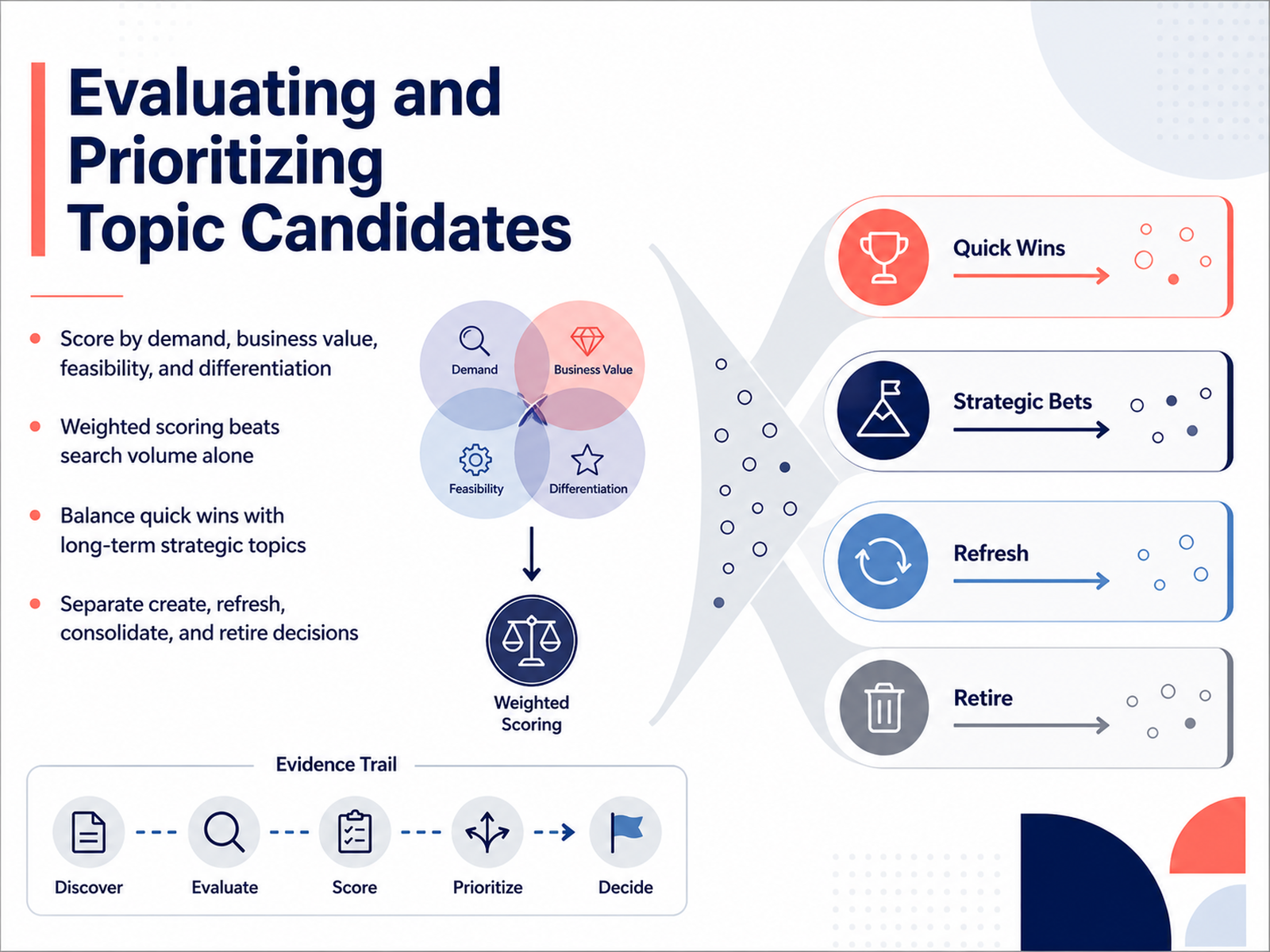
 - 08Evaluating and Prioritizing Topic CandidatesNow we move from gathering candidate topics to the hard part: deciding which ones actually make the cut. Your list is probably long. The trap is sorting it by search volume and calling it a day. Don't. Search volume tells you how many people search, not how many will convert. Build a weighted score instead. Score each candidate on four dimensions. Demand, business value, feasibility, and differentiation. Demand is the search volume and audience interest. Business value asks if the topic moves pipeline, signups, or revenue. Feasibility is whether you can realistically rank and produce it. Differentiation is about your angle. Can you say something unique, or are you adding noise? Weight these according to your goals. A demand-gen play weights business value higher. A new brand weights feasibility higher. Then balance your portfolio. Mix quick wins with long-term strategic topics. And remember, not every decision is create. Use the same scoring to decide what to refresh, what to consolidate, and what to retire. That keeps your library healthy. A weighted score forces the trade-offs your strategy needs. Next, I will walk you through a practical scoring model you can apply today.
 blog.hubspot.comthemarketingjuice.comshopify.com+22 min
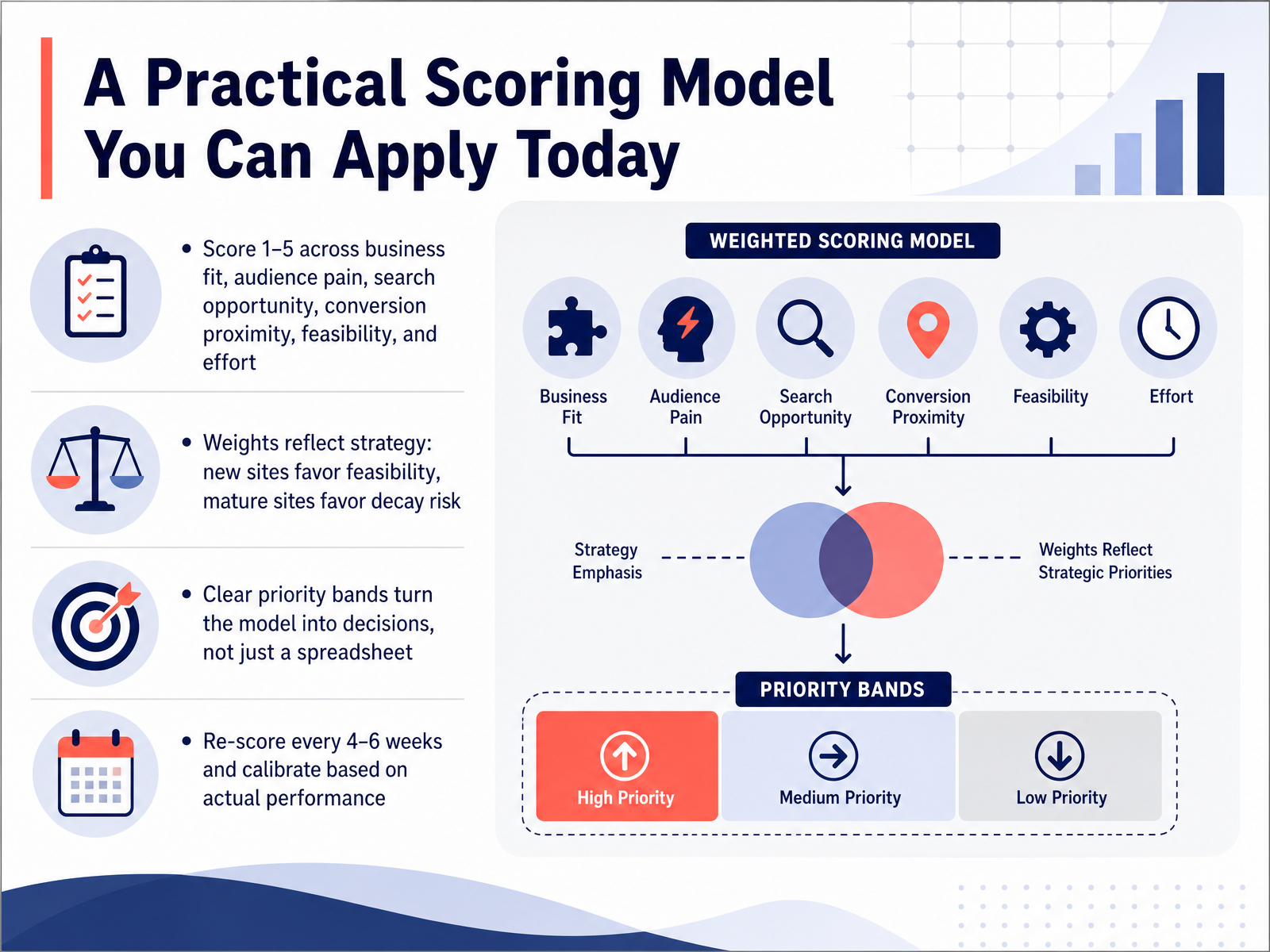
 - 09A Practical Scoring Model You Can Apply TodayHere is where the research becomes a working tool. The scoring model. Score every topic from one to five across the dimensions that matter: business fit, audience pain, search opportunity, conversion proximity, feasibility, and effort. The weights are the strategy. A new site should favor feasibility, because you cannot win unwinnable battles. A mature site should favor decay risk, because you already have assets losing value. The priority bands turn this from a spreadsheet into a decision. Anything above four point zero is high priority. Between three point two and four goes to the backlog. Below three point two, park it. Then, put a calendar reminder. Re-score every four to six weeks. The market moves, intent shifts, and your understanding of the audience sharpens. Recalibrate the weights based on actual performance. If your high scorers keep missing, the assumptions are wrong. This model is not about perfection, it is about making trade-offs explicit so the team stops debating and starts producing. Now, once the scores are set, the real work begins: building a topic brief that guides production.
 aicontent.marketingdemands.usthemarketingjuice.com+22 min
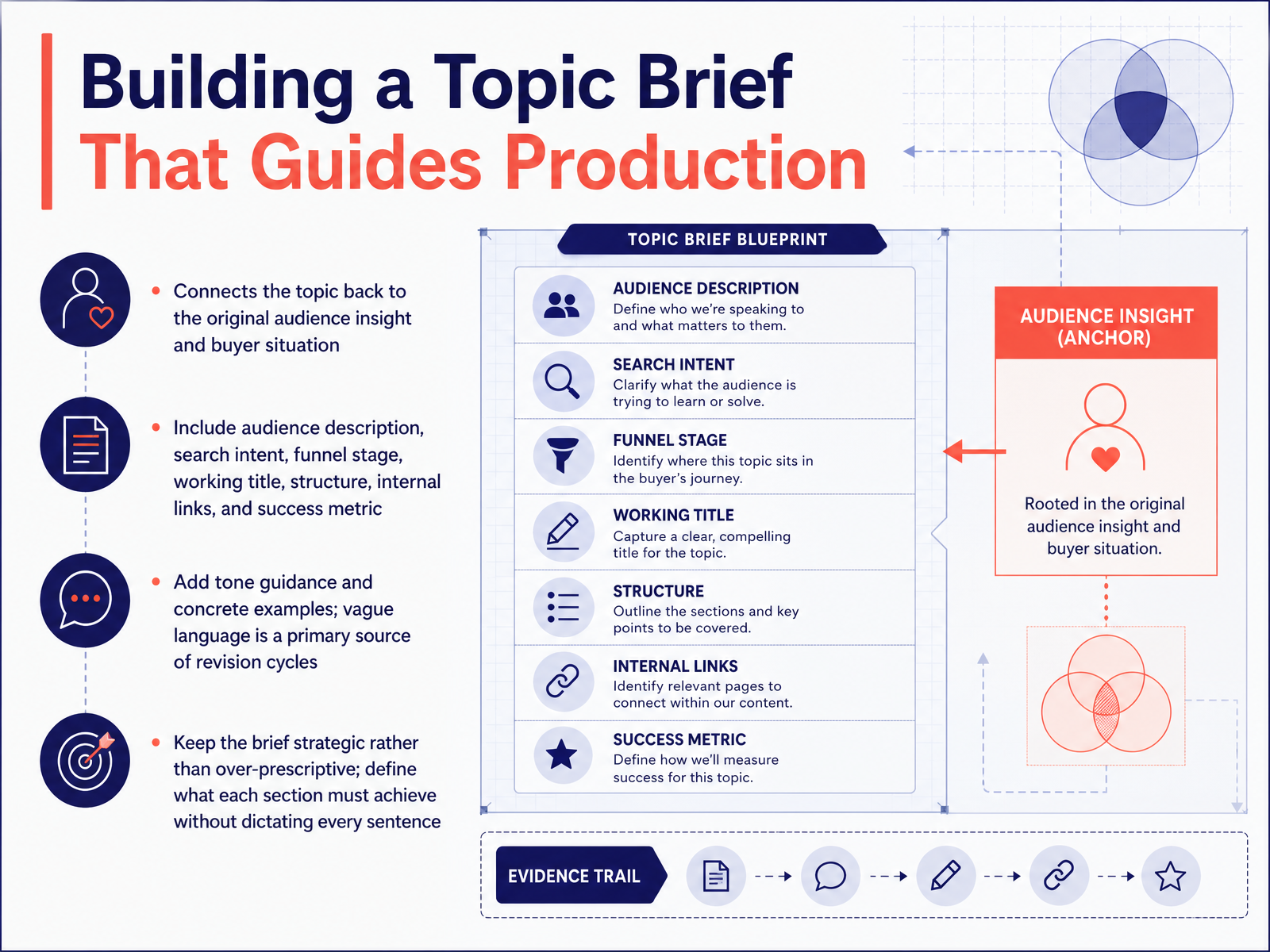
 - 10Building a Topic Brief That Guides ProductionNow let’s lock in the value of that research by building a topic brief that guides production. The brief is where your audience intel turns into concrete direction. Start by connecting the topic back to the original insight and the buyer’s situation—not just the keyword. Include a specific audience description, the search intent, the funnel stage, and a working title. Specify the structure, internal links, and the success metric so the writer knows what good looks like. Add tone guidance with concrete examples. Vague language like “professional” or “engaging” is the number one source of revision cycles. Instead, show a before-and-after sentence that captures the voice. Keep the brief strategic, not over-prescriptive. Define what each section must achieve without dictating every sentence. A writer who understands the goal and the audience will make better judgment calls than one who is just following a script. Get this right, and you’ll cut revision rounds dramatically. Up next, we’ll turn these prioritized topics into a working content calendar.
 searchfoundry.co.uk97thfloor.comsearchengineland.com+21 min
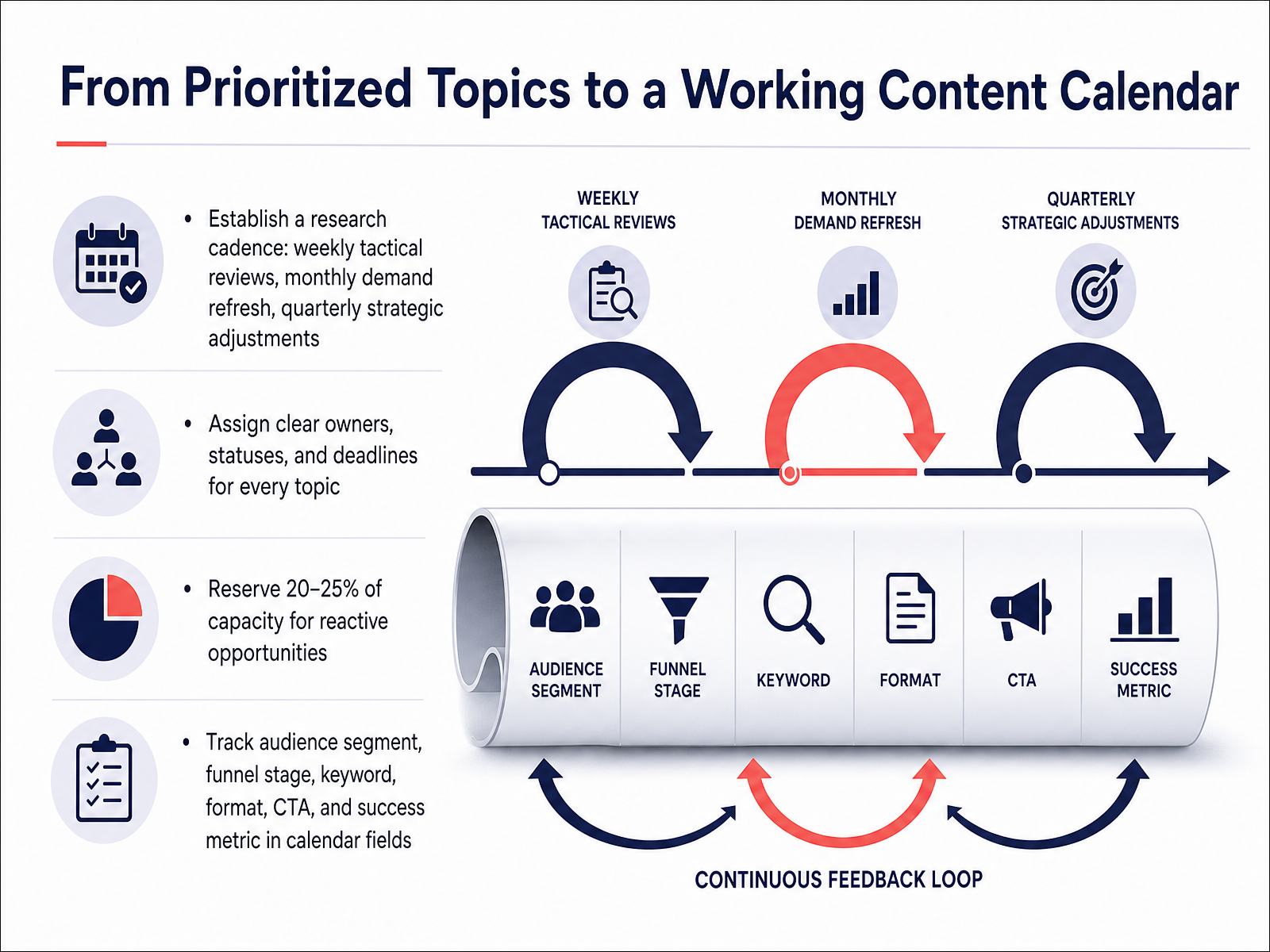
 - 11From Prioritized Topics to a Working Content CalendarNow that your topics are prioritized, let’s turn them into a working content calendar. This is where the research actually starts paying off. First, establish a research cadence. Weekly tactical reviews to check what’s in production. Monthly demand refreshes to see if search behavior has shifted. Quarterly strategic adjustments to rebalance your topic clusters. Second, every topic needs a clear owner, a status, and a deadline. No exceptions. If a piece doesn’t have an owner, it stalls. Next, and this is critical, reserve twenty to twenty-five percent of your capacity for reactive opportunities. Audience research is not a one-time event; it’s a live feed. When a new question pops up in your support tickets or a trend breaks, you need room to act on it without derailing the plan. Finally, build rich fields into your calendar. Track the audience segment, the funnel stage, the target keyword, the format, the CTA, and the success metric for every single piece. That way, your calendar isn’t just a list of dates. It’s a strategic map. Now, how do we know if this is working? That’s where metrics and feedback loops come in.
 blog.hubspot.comthemarketingjuice.comshopify.com+21 min
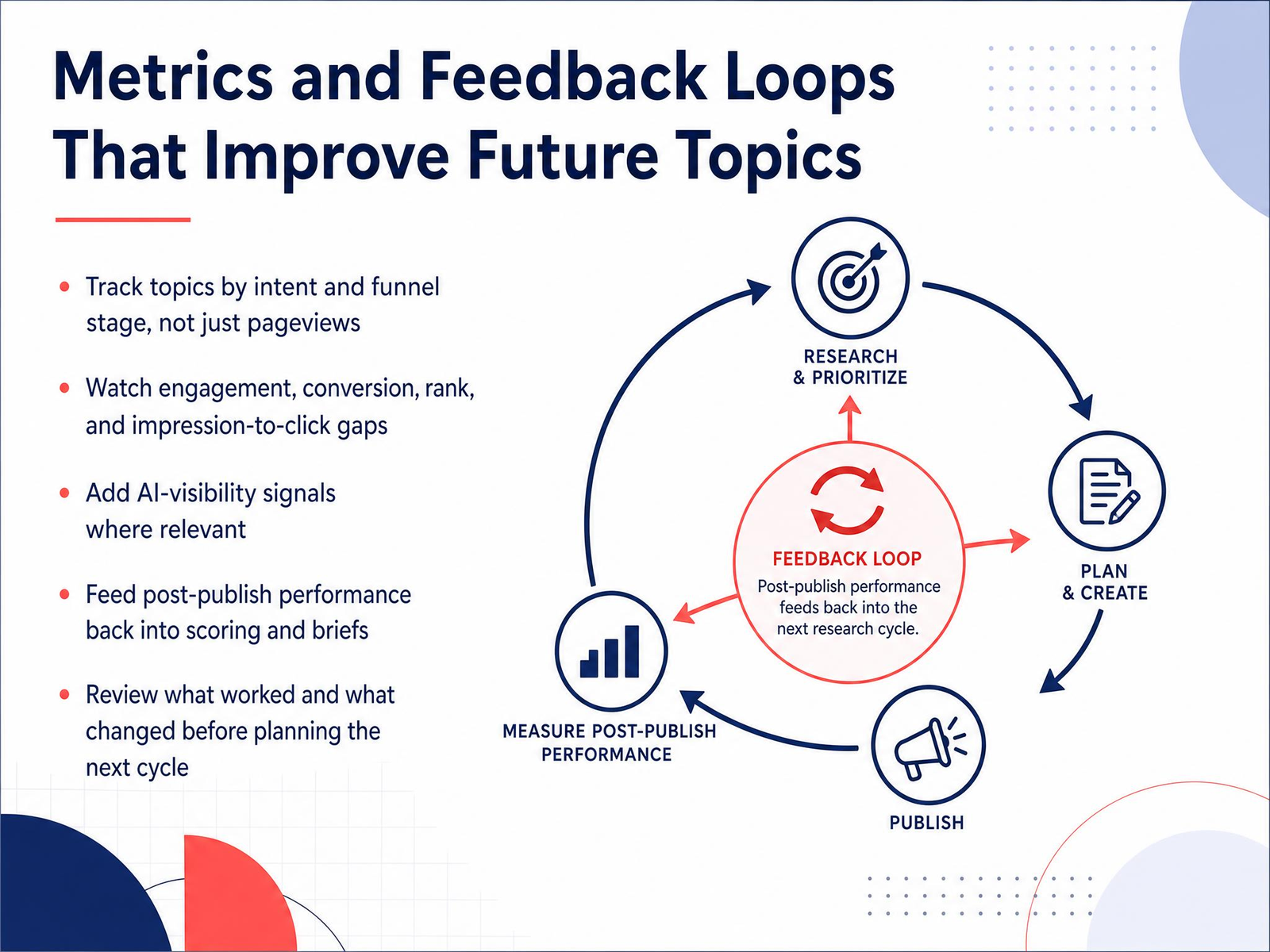
 - 12Metrics and Feedback Loops That Improve Future TopicsNow let's talk about closing the loop. Metrics and feedback loops are what turn audience research from a one-time exercise into a system that keeps improving. Here's the key: don't judge content by pageviews alone. Track topics by intent and funnel stage. A top-of-funnel awareness piece and a bottom-of-funnel comparison guide are doing different jobs, so measure them differently. Watch engagement time, conversion rates, keyword rankings, and the gap between impressions and clicks. If impressions rise but clicks lag, your headline or meta description needs work. And don't ignore AI visibility. Whether it's citations in ChatGPT or mentions in AI Overviews, that signal matters more every quarter. But the real payoff is the feedback loop. Feed post-publish performance back into your scoring model and your content briefs. A topic that over-delivers on conversions should score higher next cycle. A piece that tanks engagement should trigger a refresh or a retire decision. Set a monthly cadence to review what worked, what changed, and what that means for the next planning cycle. That discipline is what compounds. It's how your content library becomes sharper every quarter. Up next, we'll look at workflow adoption challenges and how to overcome them.
 searchfoundry.co.uk97thfloor.comsearchengineland.com+22 min
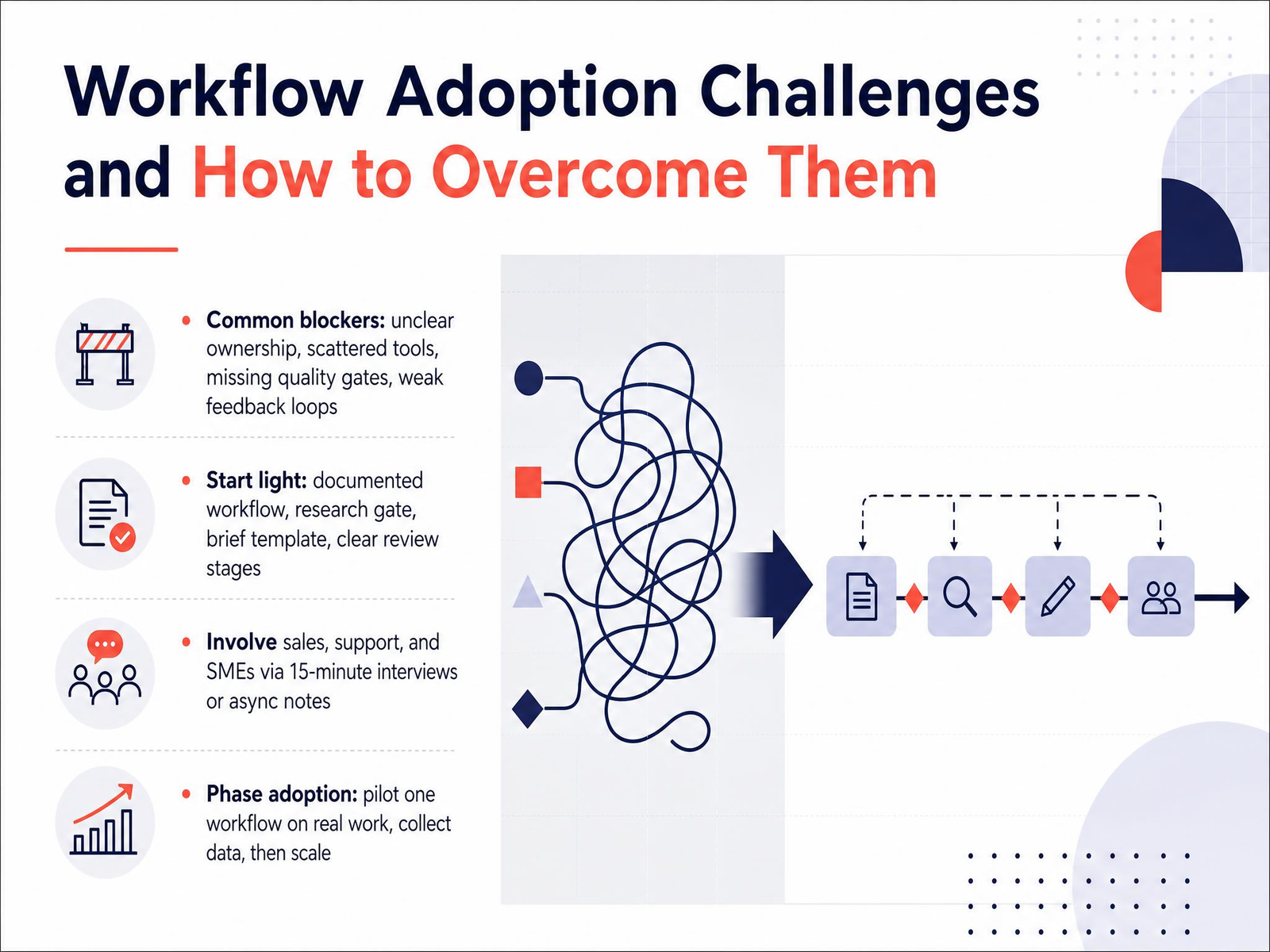
 - 13Workflow Adoption Challenges and How to Overcome ThemSo where does this workflow typically break down? Real-world adoption comes down to four blockers. Unclear ownership, scattered tools, missing quality gates, and weak feedback loops. If nobody owns the research stage, it quietly slips. If tools live in five different tabs, context gets lost. The fix is to start light. One documented workflow, one research gate, a brief template, and clear review stages. That gives you a spine without heavyweight process. Then pull in sales, support, and subject matter experts early. A fifteen-minute interview or async notes are enough to sharpen the brief before a word gets written. Finally, phase the adoption. Run a pilot on real content, measure where it stalls, fix those points, then scale. You will see resistance at first, but starting small, showing quick wins, and building the loop from there is how the workflow actually sticks. Next, we will walk through putting all of this into practice with a concrete rollout plan.
 tenspeed.io1 min
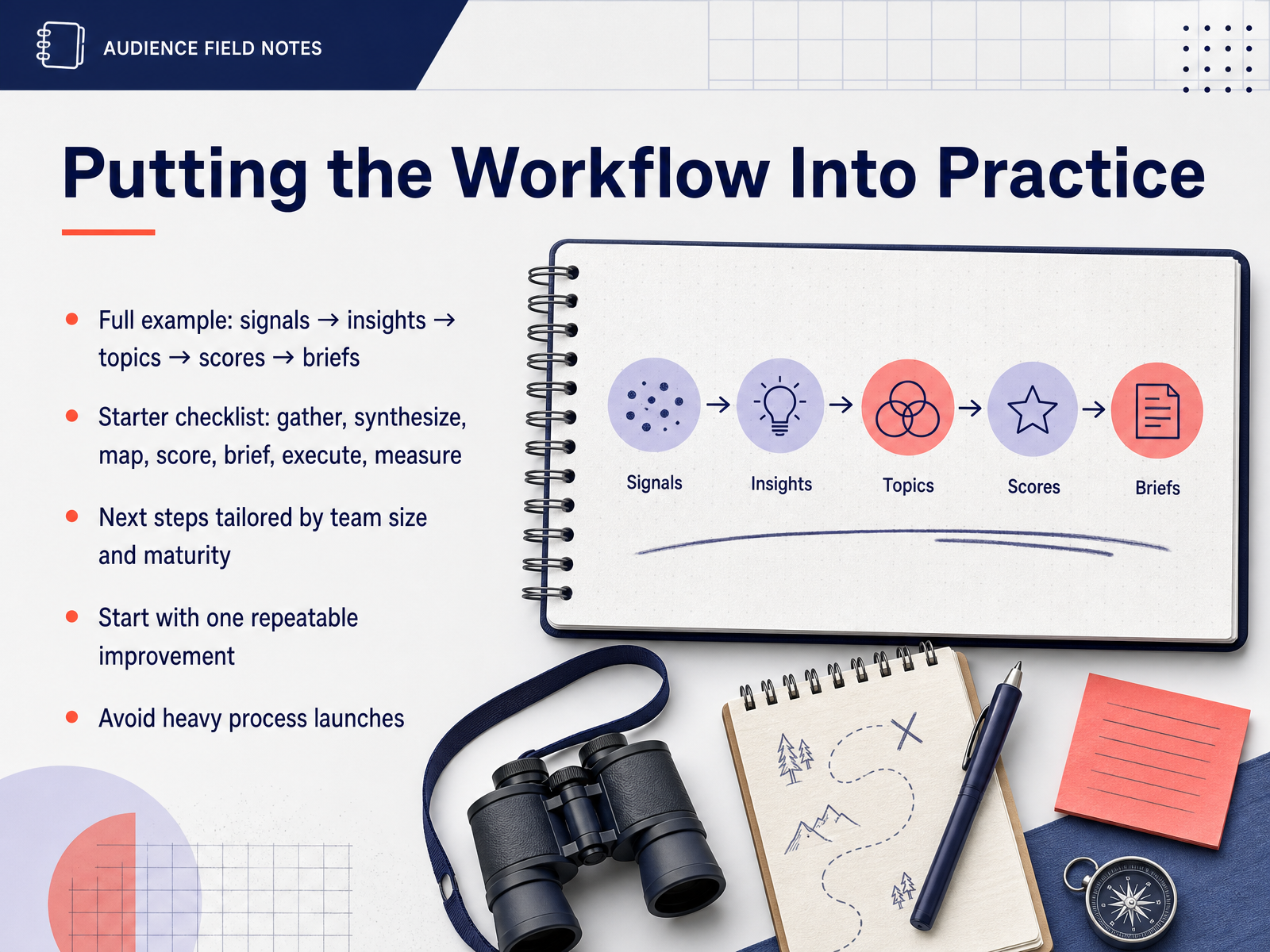
 - 14Putting the Workflow Into PracticeSo here's how you actually put this into practice. You've got the full chain: signals, insights, topics, scores, briefs. To make it stick, follow the starter checklist: gather, synthesize, map, score, brief, execute, measure. Now, here's the part most teams get wrong. Don't launch a heavy, all-at-once process. You don't need a new platform or a ten-page playbook this week. Pick one repeatable improvement. It could be mining one community for real questions, or scoring just your next five topic ideas. Run that loop, see the outcome, then add the next piece. Tailor the pace to your team size. A solo operator moves differently than a content team of ten. The goal is to make this workflow a habit, not a project. Your content will be sharper, and your topics will stop being guesses. Thanks for your time — now go turn one audience signal into a brief today.
 searchfoundry.co.uk97thfloor.comsearchengineland.com+22 min
Take the deck with you
Download this course as a file — free, no sign-up needed.
- PDF handoutEvery slide page, ready to print or share.15 pages · 3.4 MBDownload
- Narrated PowerPointThe deck that presents itself — every slide carries the digital human's narration video.15 pages · 14.4 MBDownload
- PowerPoint slidesThe full deck as a .pptx — open it in PowerPoint, Keynote, or Google Slides.15 pages · 3.3 MBDownload
Free to use in your own training — please keep the PersonWise credit page at the end.
Have your own deck? Turn it into a course
Sources consulted
Web sources consulted while building this course.
- SQSEO · Search Query SEO for Google and AI search — sqseo.com
- Market Research Software & AI Insights | Hootsuite — hootsuite.com
- https://sparktoro.com/product — sparktoro.com
- Audience Research Tools | Audiense — audiense.com
- KlipUp | AI Growth Suite for Search, Social & Marketing Intelligence — klipup.com
- The Ultimate Guide to Topic Mapping: Audience Research, Gaps, and SME Insights - The Search Foundry — searchfoundry.co.uk
- Keyword Research Is No Longer Step One. Here's the Process Behind Audience First. - 97th Floor — 97thfloor.com
- How to build content briefs around audience situations — searchengineland.com
- Content gap analysis in 2026: how to find the topics, formats, and answers you're missing · Kompozy — kompozy.io
- How to Build a Content Strategy Framework (2026) | Ten Speed — tenspeed.io
- How I use content mapping to deliver the right message at the right time — blog.hubspot.com
- Content Mapping: Align Content to Buyer Journey Stages — themarketingjuice.com
- What Is Content Mapping? How To Create a Content Map - Shopify — shopify.com
- How to Create a Content Map: Traditional Way & Ahrefs' Way — ahrefs.com
- The Content Map Template and a Worked Example - Content Cucumber — contentcucumber.com
- AI Content Prioritization: How to Score What to Create, Refresh or Retire Next - AI Content Marketing — aicontent.marketing
- Prioritize SEO Topics by Business Value — demands.us
- Content Scoring: Stop Publishing on Instinct — themarketingjuice.com
- Content Prioritization in an AI Search Era: A Framework + Worksheet - International SEO Consultant, Author & Speaker | Aleyda Solis — aleydasolis.com
- 6 Signals That Reveal Which Topic to Publish Next — nuanta.io