Begin
14 pages · ~28 min
Change Management Failure Principles
This training helps leaders and change agents understand why change initiatives fail and apply core change management principles to improve adoption and outcomes.
A digital instructor presents all 14 pages. Hold “Ask” at any point and ask out loud — the answer comes from this course. No sign-up needed.
What you’ll learn
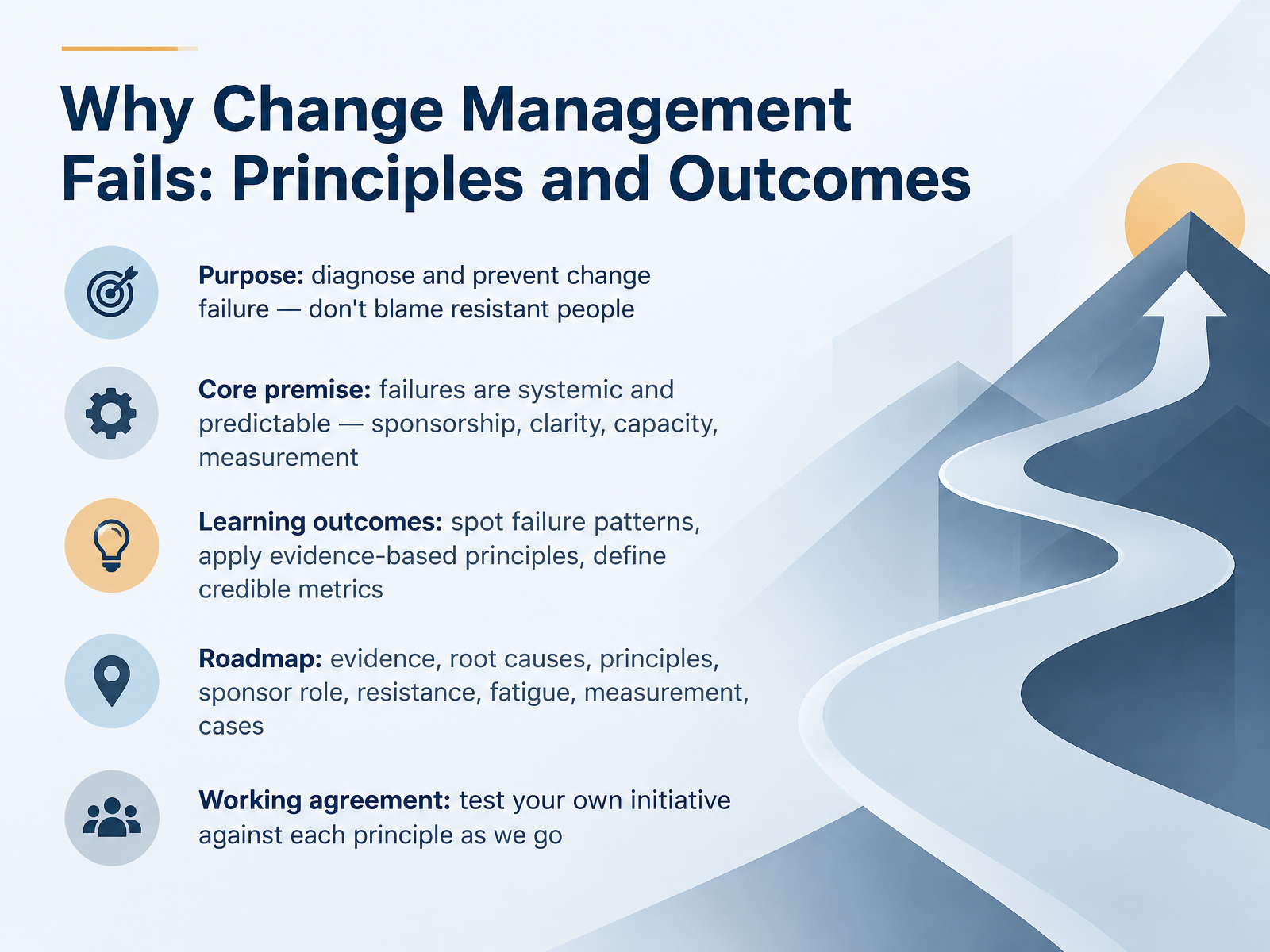
- 01Why Change Management Fails: Principles and OutcomesWelcome. This course is about why change management fails, and more importantly, what you can do to prevent it. Here is the core premise. Failure is rarely about resistant people. It is systemic and predictable. It usually traces back to weak sponsorship, unclear goals, overstretched capacity, or no credible measurement. You will see this when a sponsor signs off on a program, then disappears for two quarters, and adoption quietly stalls. Over the next slides, we will cover the evidence, root causes, operating principles, the sponsor role, resistance, fatigue, and measurement, then close with real cases. Here is our working agreement. As we go, test your own initiative against each principle. So let us start with the evidence, and what the failure numbers really mean.doi.orgprocessexcellencenetwork.comsalesforce.vml.com.co+21 min
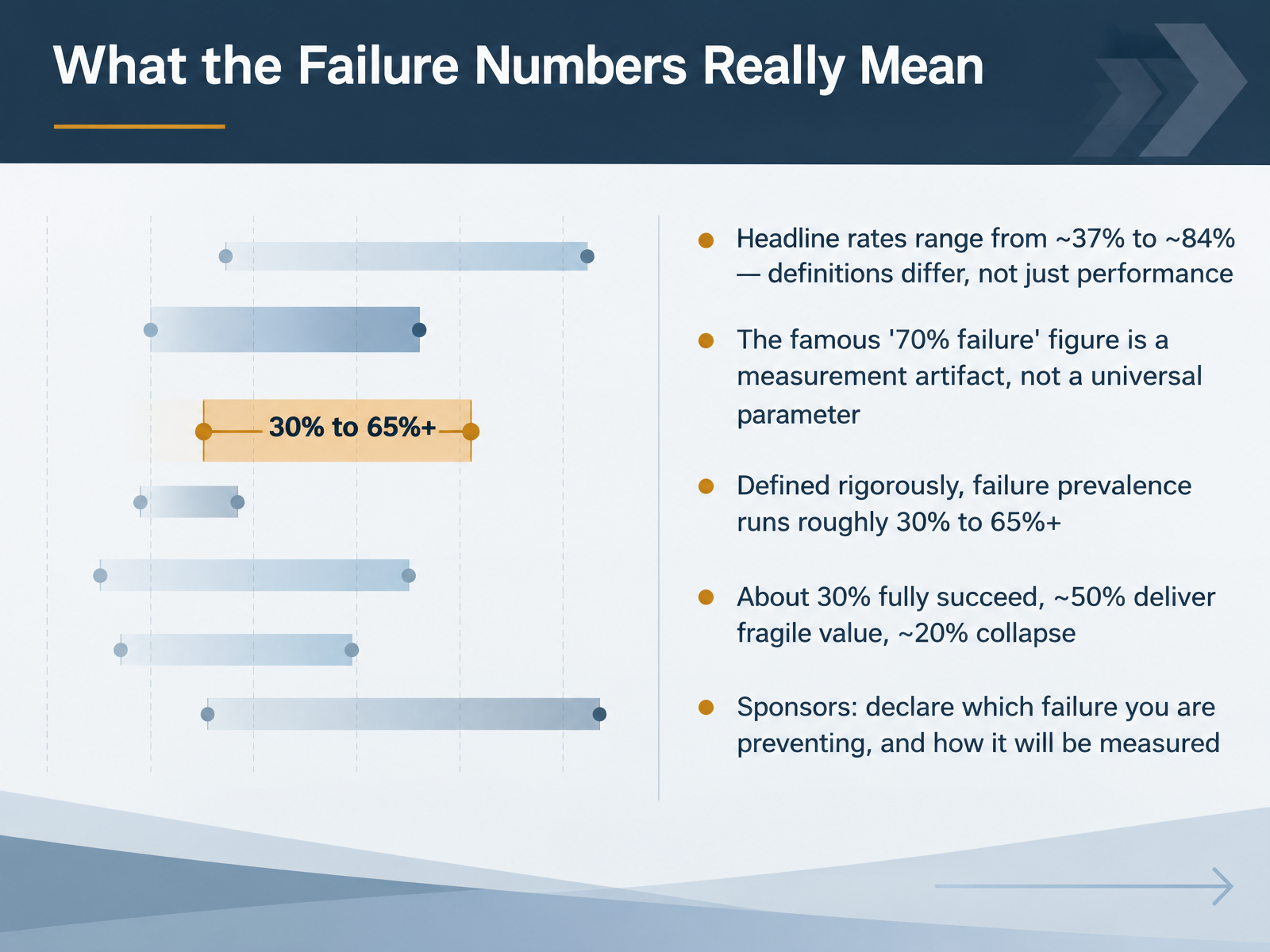
- 02What the Failure Numbers Really MeanLet us look at what the failure numbers really mean. Headline rates range from about thirty seven percent to eighty four percent, and most of that gap reflects different definitions, not different performance. The famous seventy percent failure figure is a measurement artifact, not a universal parameter. When failure is defined rigorously, prevalence runs roughly thirty percent to sixty five percent or more. A useful distribution: about thirty percent of initiatives fully succeed, around fifty percent deliver fragile value, and about twenty percent collapse outright. You will see this when two benchmarks disagree and neither states its denominator or time horizon. In your next sponsor meeting, declare which failure you are preventing, and how it will be measured. The Cost When Change Fails.
 doi.orgprocessexcellencenetwork.comsalesforce.vml.com.co+22 min
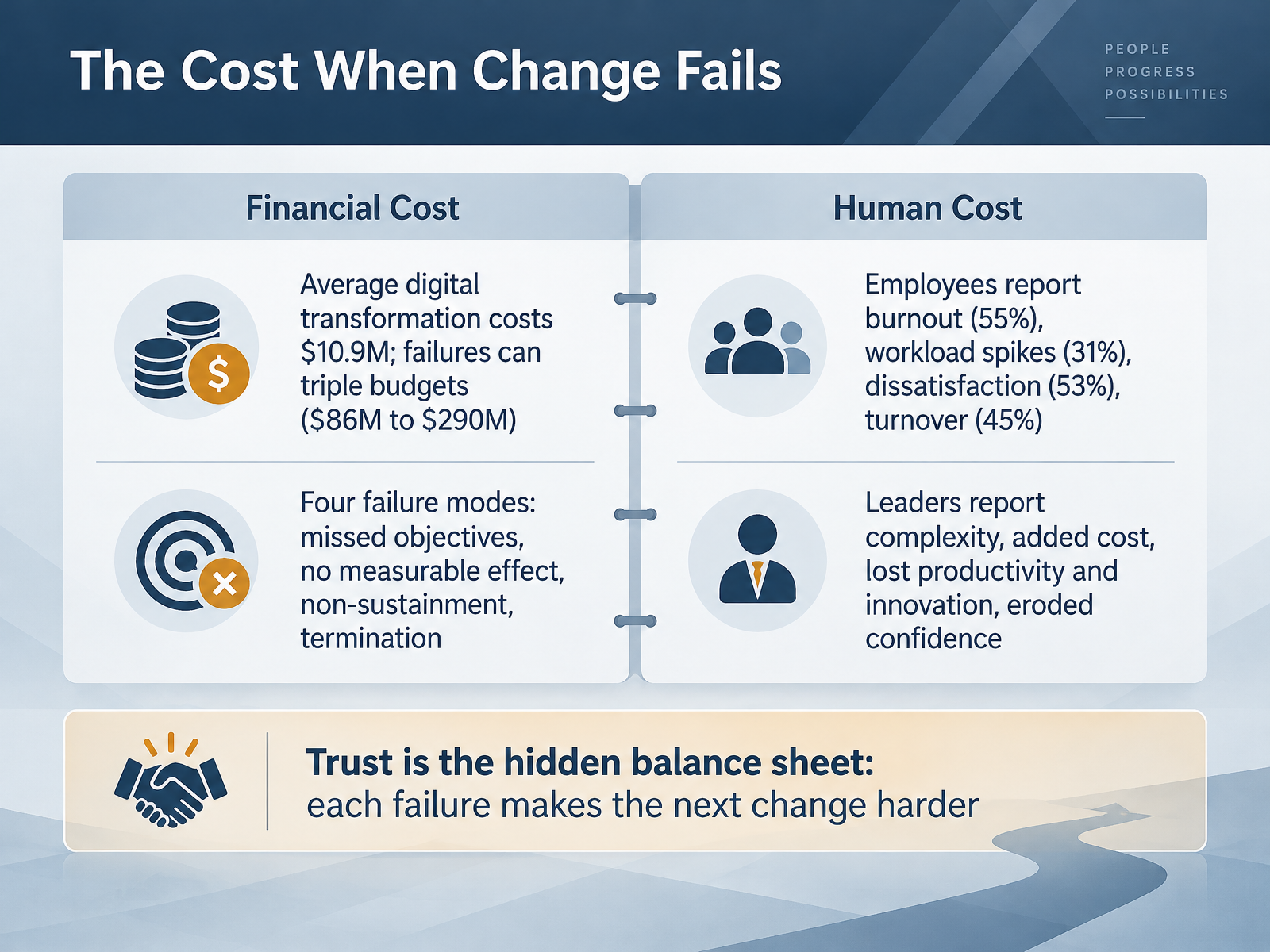
- 03The Cost When Change FailsNow let us put a price on failure. Change fails in four ways: missed objectives, no measurable effect, non-sustainment, and termination. Digital transformation averages about eleven million dollars per initiative, and failures can triple budgets. The human cost is just as real. Employees report burnout at fifty-five percent, workload spikes at thirty-one percent, dissatisfaction at fifty-three percent, and turnover at forty-five percent. Leaders report more complexity, added cost, lost productivity, lost innovation, and eroded confidence. Trust is the hidden balance sheet. Every failed change makes the next one harder, because people remember. Takeaway for your next sponsor meeting: agree on what success and failure mean up front, track people impacts alongside financials, and treat trust as a cost you are either building or spending. Next, we look at the root causes behind these failures.
 doi.orgprocessexcellencenetwork.comsalesforce.vml.com.co+22 min
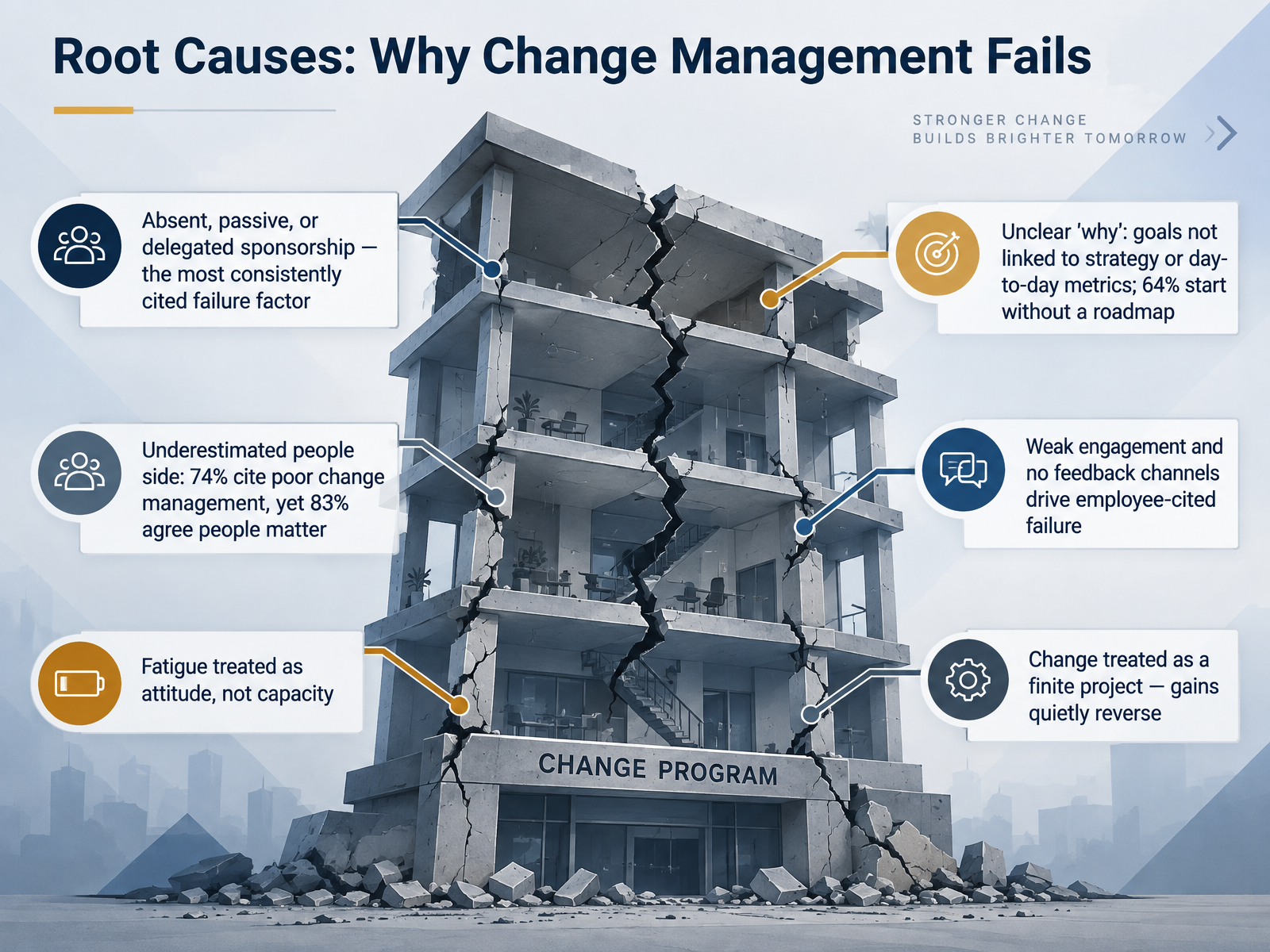
- 04Root Causes: Why Change Management FailsLet us look at the root causes behind these failures. The first and most consistently cited factor is sponsorship. When sponsorship is absent, passive, or delegated too far down, the change loses its mandate and momentum. You will see this when a program has a name but no senior leader visibly making decisions for it. Second, the why is often unclear. Goals are not linked to strategy or to day to day metrics. In practice, transformation goals compete with real business targets, and they lose. Third, the people side is underestimated. Most leaders say people matter, yet poor change management is still named as a leading cause of failure. Weak engagement and no feedback channels follow. And fatigue is often treated as attitude when it is really capacity. Finally, change is treated as a finite project, so gains quietly reverse. Takeaway: in your next sponsor meeting, confirm who owns the why, which metrics prove it, and how you will sustain it. Next, we turn to the principles that separate success from failure.
 cora.ucc.iegartner.commckinsey.com.br+21 min
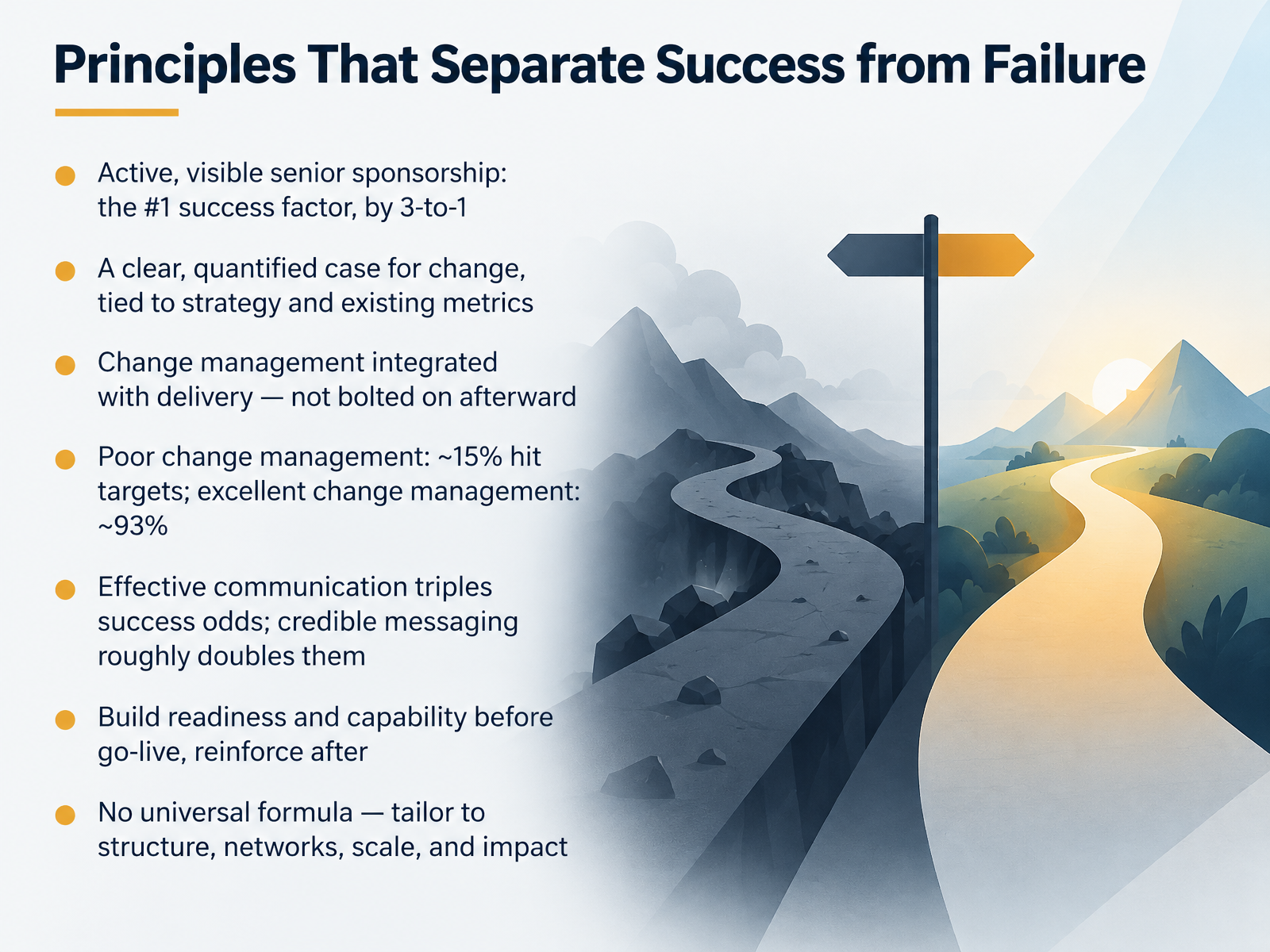
- 05Principles That Separate Success from FailureHere is what separates programs that succeed from programs that fail. Active, visible senior sponsorship is the number one success factor, by a margin of roughly three to one. A clear, quantified case for change, tied to strategy and to metrics you already track, is the second. And change management has to be integrated with delivery, not bolted on afterward.
The outcomes are stark. With poor change management, roughly fifteen percent of initiatives hit their targets. With excellent change management, that rises to about ninety three percent. Effective communication roughly triples your odds of success, and credible messaging roughly doubles them.
So build readiness and capability before go-live, and reinforce the change after it. There is no universal formula. You will see this when a playbook that worked in one business unit stalls in another, because structure, networks, scale, and impact differ. Tailor the approach.
In your next sponsor meeting, pick one principle here and ask what evidence proves it is in place. Next, we look at the sponsor's role, and why passive sponsorship fails.
 knowledge4policy.ec.europa.euutsystem.edupmc.ncbi.nlm.nih.gov+22 min
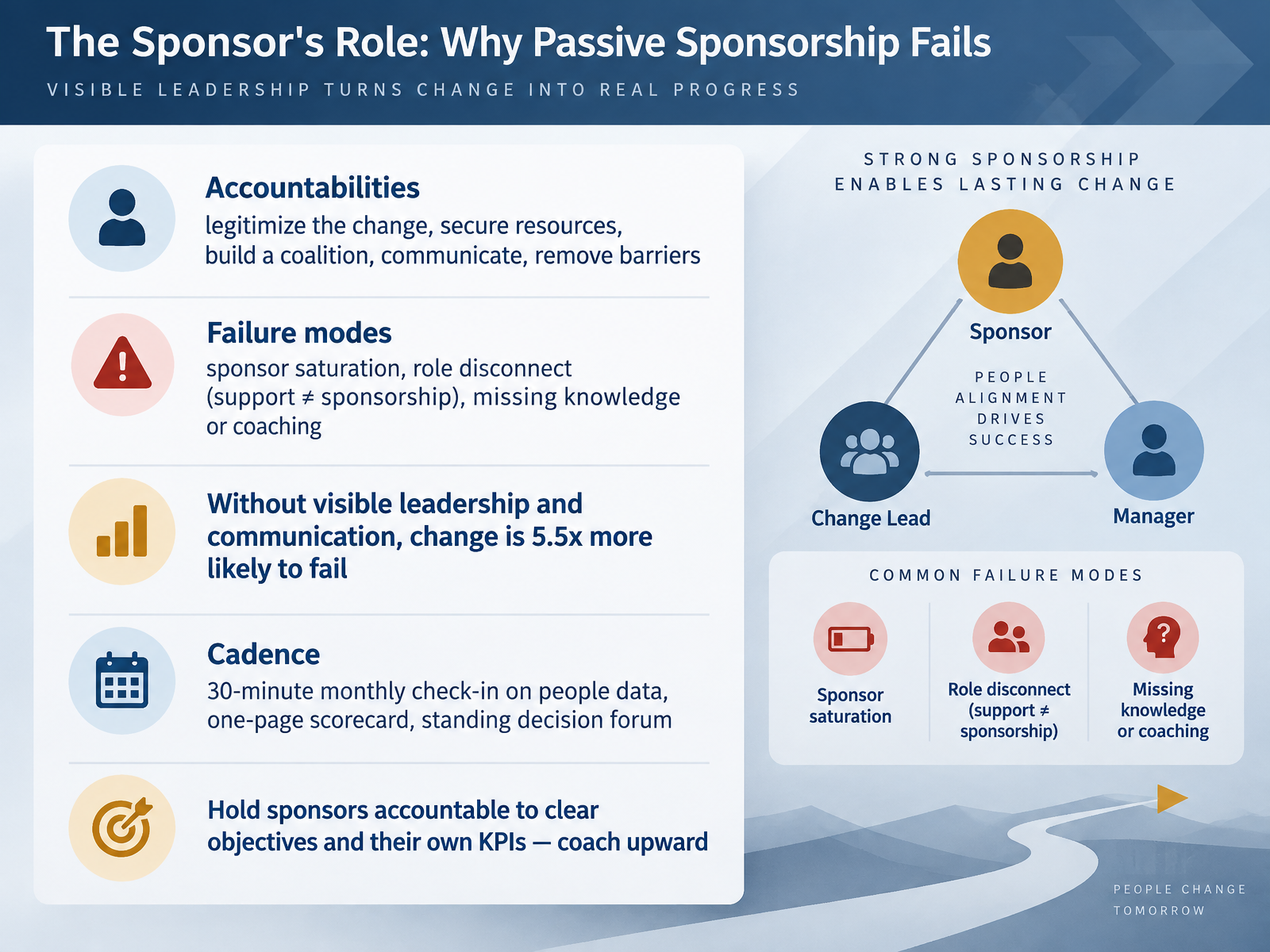
- 06The Sponsor's Role: Why Passive Sponsorship FailsNow let us look at the sponsor's role, and why passive sponsorship fails. Sponsors have five accountabilities. They legitimize the change, secure resources, build a coalition, communicate, and remove barriers. Support is not sponsorship. When a sponsor only signs off and leaves delivery to the project team, you will see this when decisions stall and employees wait for a visible signal that never comes. Prosci research identifies three failure modes. Sponsor saturation, where too many changes divide their attention. Role disconnect, where support is mistaken for sponsorship. And missing knowledge or coaching. Without visible leadership and communication, change is five and a half times more likely to fail. So set a cadence. A thirty minute monthly check-in on people data, a one-page scorecard, and a standing decision forum. Hold sponsors to clear objectives and their own KPIs, and coach upward. Takeaway: in your next sponsor meeting, agree on their specific accountabilities and book that thirty minute monthly check-in. Next, we turn to resistance and readiness, and how to diagnose both before you respond.
 socm.unssc.orgacmpmexico.orgprosci.com+22 min
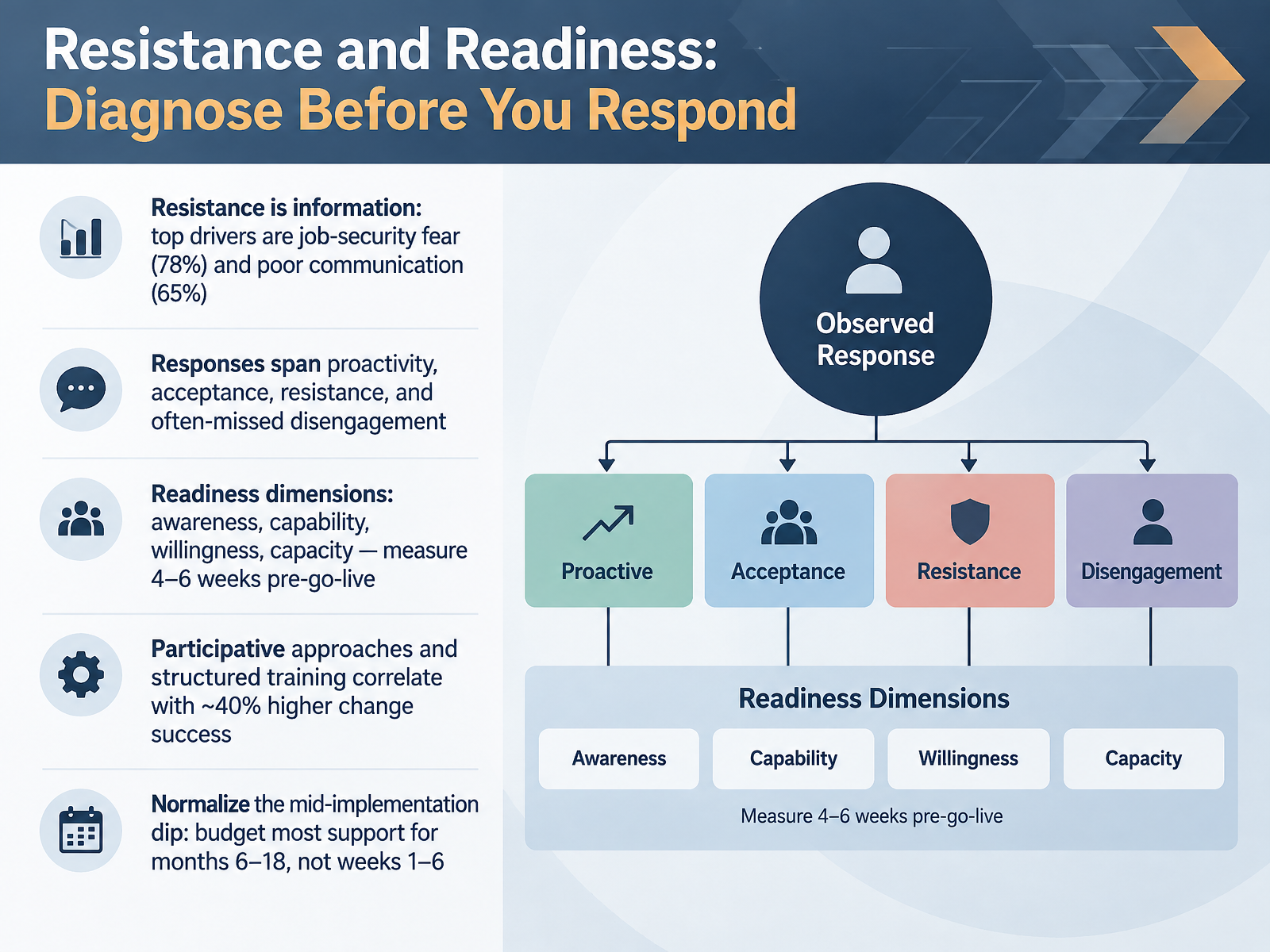
- 07Resistance and Readiness: Diagnose Before You RespondNow let us look at diagnosing resistance before you respond to it. Resistance is information, not obstruction. The top drivers are fear about job security, cited by seventy-eight percent of employees, and poor communication, at sixty-five percent. Responses fall into four types: proactivity, acceptance, resistance, and disengagement. Disengagement is the one most often missed. You will see this when a team goes quiet in briefings but never raises an objection. Readiness has four dimensions: awareness, capability, willingness, and capacity. Measure all four four to six weeks before go-live. Participative approaches and structured training correlate with roughly forty percent higher change success. Also normalize the mid-implementation dip. Evidence shows responses often worsen during year one. So budget most support for months six to eighteen, not weeks one to six. Your takeaway: in your next sponsor meeting, ask which readiness dimension is weakest, and shift support funding toward the middle of implementation. Next, we examine change fatigue and the manager bottleneck.
 acmpmexico.org2 min
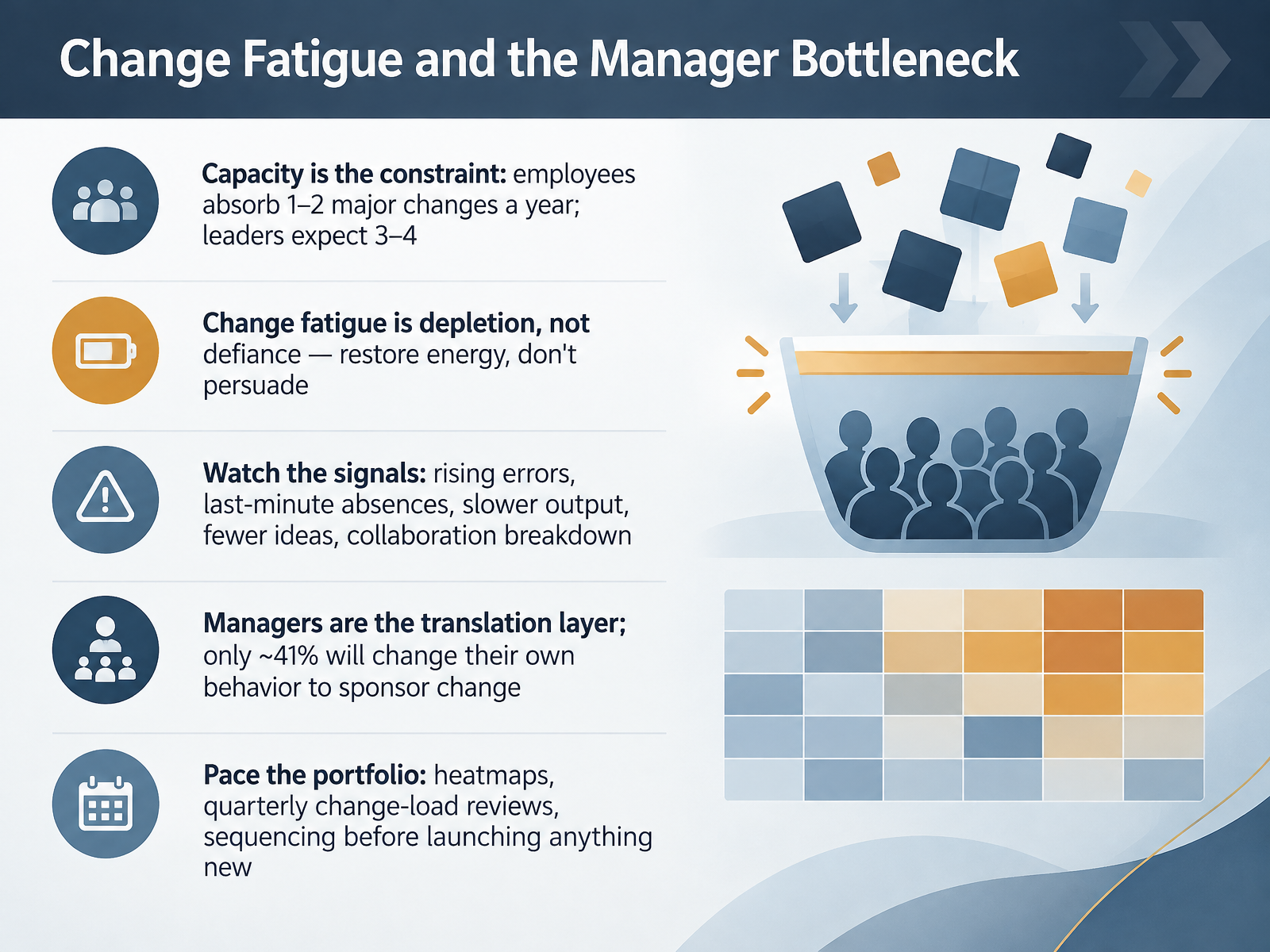
- 08Change Fatigue and the Manager BottleneckLet us look at why even well-run change programs stall. The constraint is capacity, not commitment. Most employees can absorb one or two major changes a year, yet leaders often plan for three or four. Change fatigue is depletion, not defiance. It shows up as rising errors, last-minute absences, slower output, fewer ideas, and collaboration breaking down. Treat those as energy signals, not attitude problems. Managers are the translation layer. Only about forty-one percent will change their own behavior to sponsor change, so enablement matters as much as communication. Pace the portfolio with change heatmaps and quarterly change-load reviews. Sequence before you launch. Takeaway for your next sponsor meeting: review the change load first, and restore capacity before adding anything new. Next, we turn to measuring outcomes: what success actually looks like.
 2 min
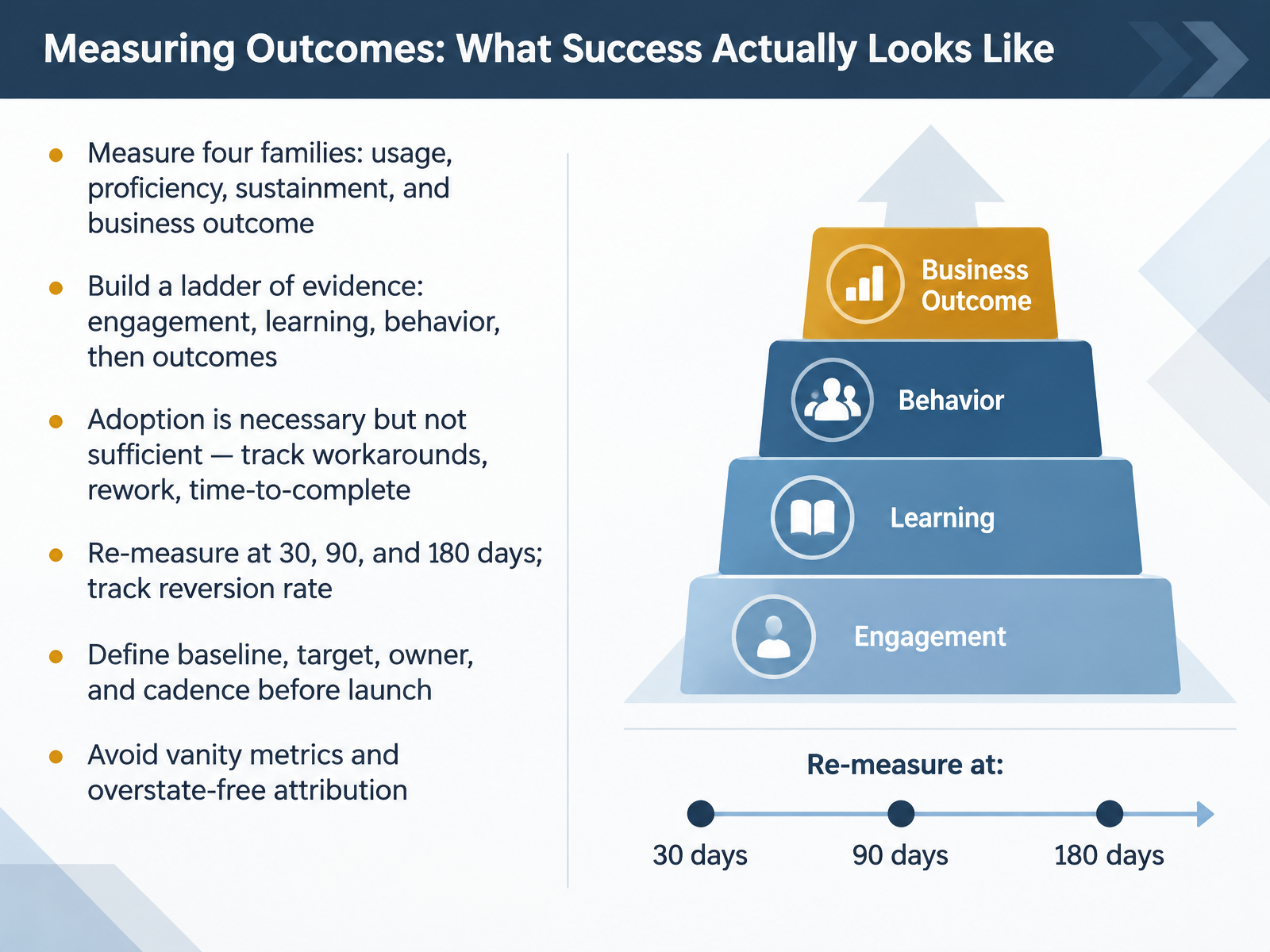
- 09Measuring Outcomes: What Success Actually Looks LikeSo what does success actually look like? Measure four families: usage, proficiency, sustainment, and business outcome. Each answers a different question, and each has a blind spot. Usage can be high while proficiency is poor. Now build a ladder of evidence. Engagement, then learning, then behavior, then outcomes. Adoption is necessary but not sufficient. Track workarounds, rework, and time to complete key tasks. A team can log in every day and still route work through the old spreadsheet. Re-measure at thirty, ninety, and one hundred eighty days, and track the reversion rate, meaning the share of work that has slid back to the old process. Before launch, define the baseline, target, owner, and cadence for every metric. And avoid vanity metrics and overstated attribution. Stick to a small core set, and only claim what you can credibly link. For your next sponsor meeting, bring one metric from each family, with a named owner and a review date. Next, case lessons, the anatomy of a failed change and a recovery.
 acmpmexico.org2 min
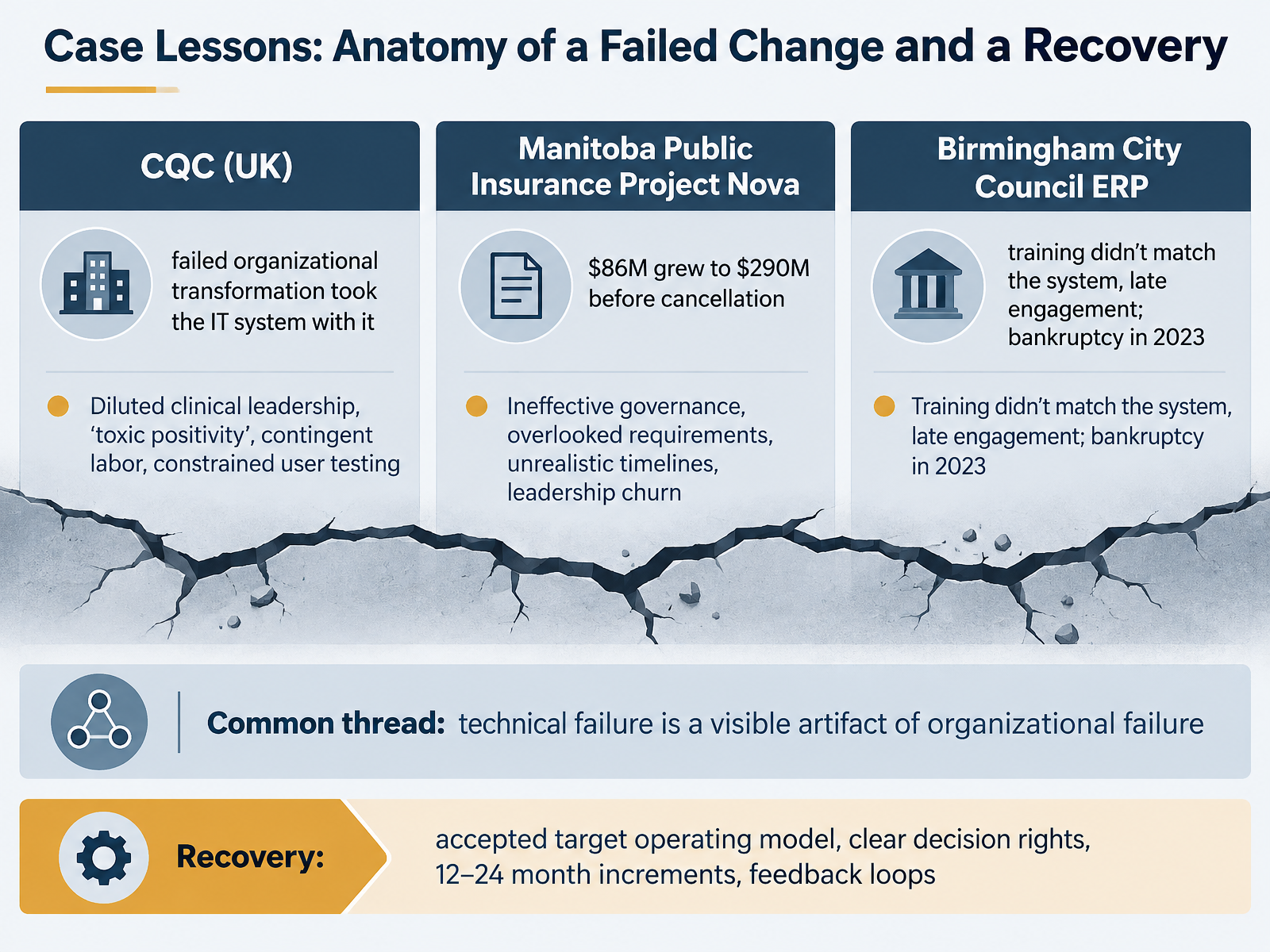
- 10Case Lessons: Anatomy of a Failed Change and a RecoveryLet us look at three failures and one recovery pattern. At the Care Quality Commission, an organizational transformation took its IT system down with it. Clinical leadership was diluted, leaders pushed what staff called toxic positivity, and user testing was cut so tight that poor software went live. Manitoba Public Insurance's Project Nova grew from eighty-six million dollars to two hundred ninety million before cancellation, driven by weak governance, missed requirements, and leadership churn. Birmingham City Council trained people on a system that did not match what was built, engaged stakeholders late, and declared bankruptcy in twenty twenty-three. The common thread: technical failure is the visible artifact of organizational failure. Recovery at Manitoba used an accepted target operating model, clear decision rights, twelve to twenty-four month increments, and feedback loops. Take that into your next sponsor meeting: confirm who owns the operating model and who holds decision rights.
 2 min
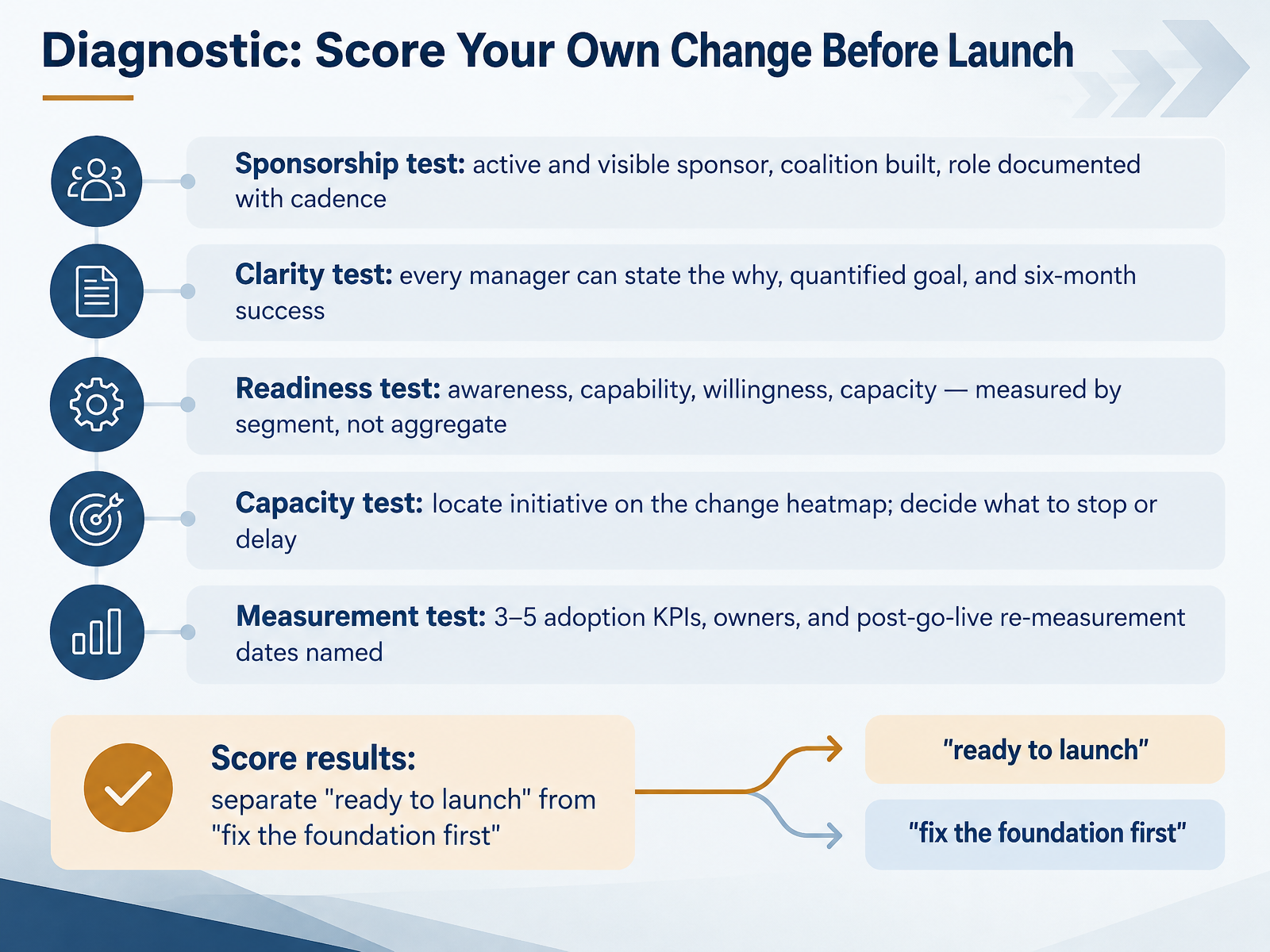
- 11Diagnostic: Score Your Own Change Before LaunchHere is how you diagnose your own change before launch. Run five tests and score each one honestly. Start with sponsorship. You want an active, visible sponsor, a coalition behind the change, and the role documented with a set cadence, such as a thirty-minute monthly check-in. Next, clarity. Every manager should be able to state the why, the quantified goal, and what success looks like in six months. If they cannot, the foundation is not set. Then readiness. Measure awareness, capability, willingness, and capacity by segment, not as one aggregate number, because averages hide the group that will stall you. Capacity is next. Place the initiative on your change heatmap and decide what to stop or delay. Every change competes with the last one. Finally, measurement. Name three to five adoption measures, their owners, and the dates you will re-measure after go-live. Score the results and separate ready to launch from fix the foundation first. That single decision protects your timeline and your credibility. Next, we will turn the diagnosis into action with a Minimum Viable Change Plan.
 acmpmexico.org2 min
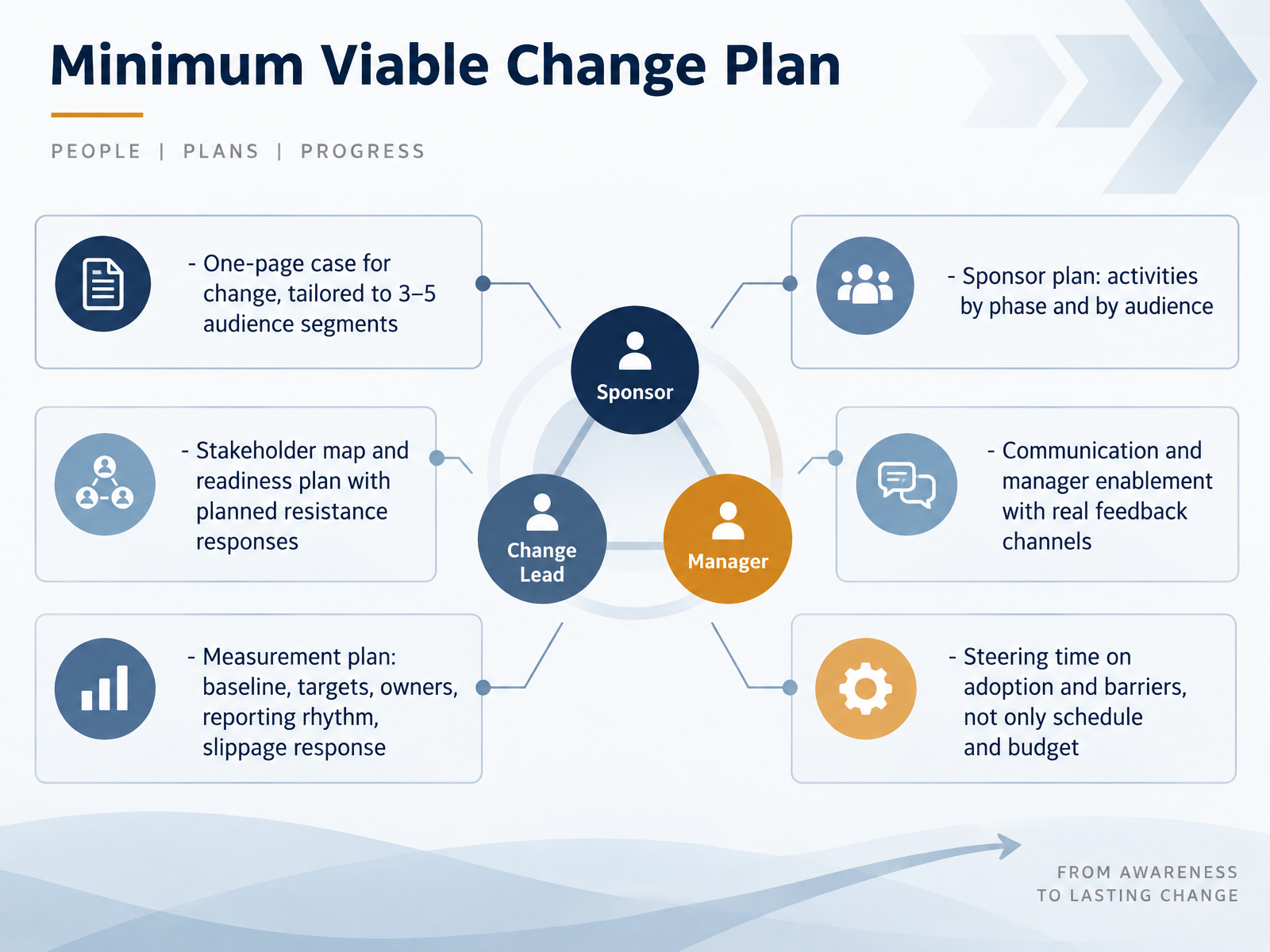
- 12Minimum Viable Change PlanNow let us define a minimum viable change plan, the smallest set of artifacts that still keeps a change on track. Start with a one-page case for change. Tailor that page to three to five audience segments, because the same message will not land the same way with frontline staff and with senior leaders. Next, build a sponsor plan that lists sponsor activities by phase and by audience. You will see this matter when a sponsor speaks once at launch, then disappears. Third, create a stakeholder map and readiness plan that names planned resistance responses before resistance appears. Fourth, plan communication and manager enablement with real feedback channels, not a one-way newsletter. Fifth, define a measurement plan with a baseline, targets, owners, a reporting rhythm, and a defined response when numbers slip. And sixth, give steering time on adoption and barriers, not only schedule and budget. Take these six artifacts into your next sponsor meeting and ask which two need the most attention first. Next, we move to role-specific next steps for change leads, sponsors, and managers.
 acmpmexico.org2 min
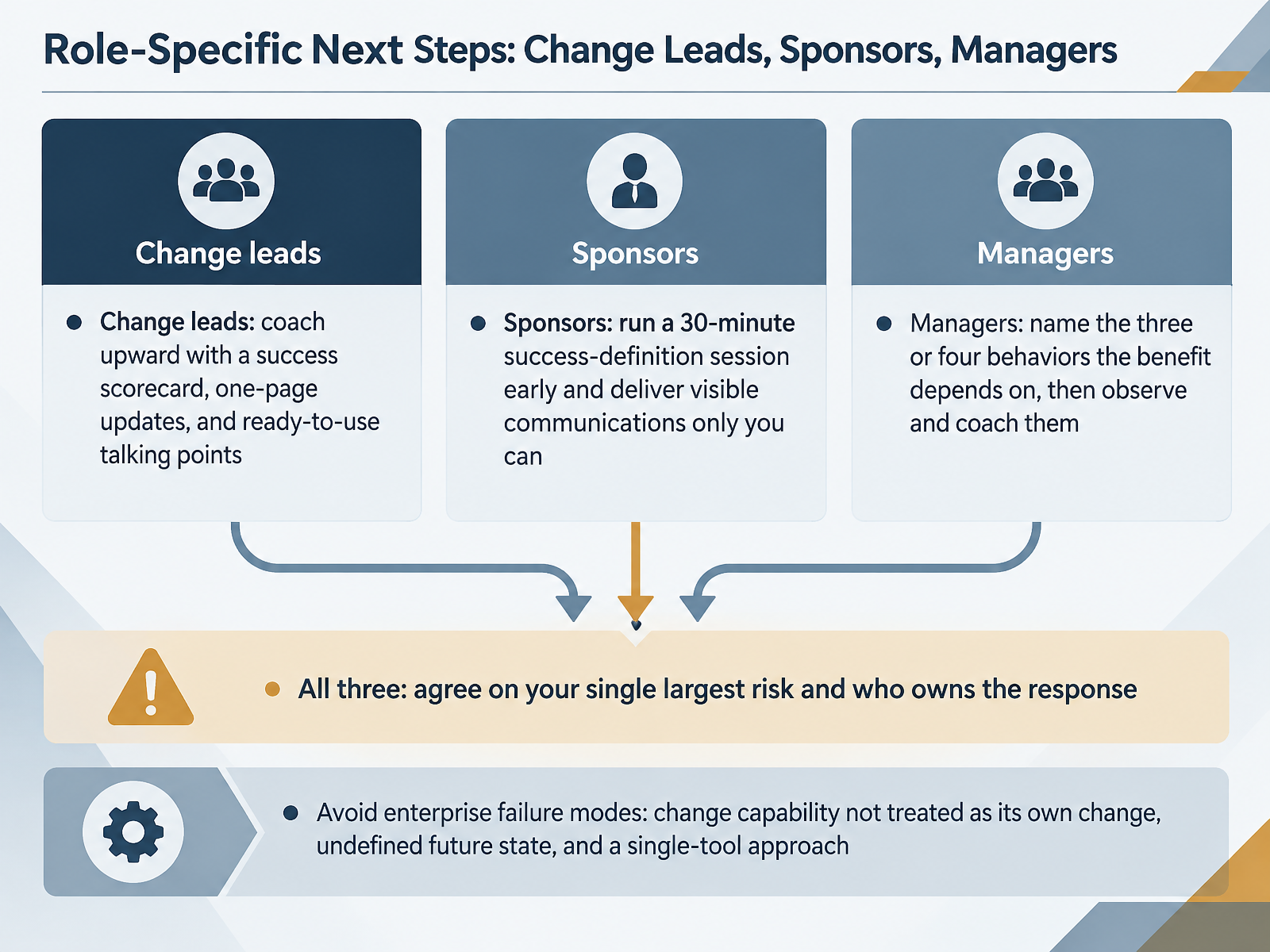
- 13Role-Specific Next Steps: Change Leads, Sponsors, ManagersSo what do you actually do next? Start with your role. Change leads, your job is to coach upward. Give your sponsor a one-page success scorecard, short written updates, and talking points they can use without edits. Sponsors, run a thirty-minute session early to define what success looks like, then deliver the visible communications only you can send. You will see the difference when your town hall message lands and managers stop hedging. Managers, name the three or four behaviors the benefit depends on, then observe them and coach in the moment. All three of you should agree on your single largest risk and who owns the response. Avoid three enterprise failure modes: change capability not treated as its own change, an undefined future state, and a single-tool approach. That sets up our final slide, Key Takeaways and 30-Day Commitments.
 socm.unssc.orgacmpmexico.orgprosci.com+21 min
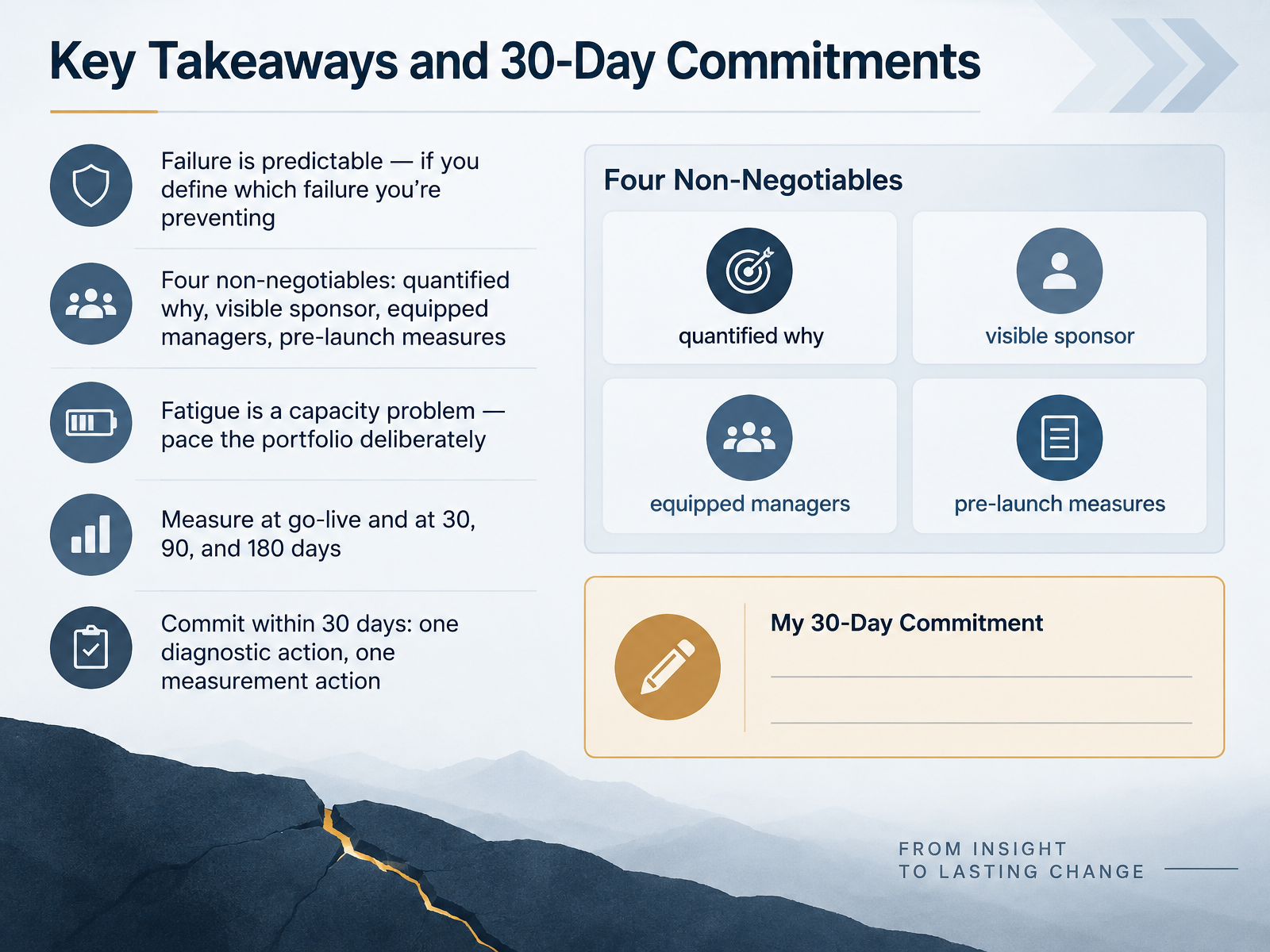
- 14Key Takeaways and 30-Day CommitmentsLet's bring this together. Failure is predictable, but only if you define which failure you are preventing: missed objectives, no measurable effect, or improvements that do not sustain. Hold four non-negotiables: a quantified why, a visible sponsor, equipped managers, and measures in place before launch. Treat fatigue as a capacity problem. Employees can realistically absorb only one or two major changes a year, so pace the portfolio deliberately. Measure at go-live, then at thirty, ninety, and one hundred eighty days. Within the next thirty days, commit to one diagnostic action and one measurement action, and bring both to your next sponsor meeting. Thank you for your attention. You now have a practical, evidence-based path forward. Go make your next change a deliberate one.
 doi.orgprocessexcellencenetwork.comsalesforce.vml.com.co+21 min
Take the deck with you
Download this course as a file — free, no sign-up needed.
- PDF handoutEvery slide page, ready to print or share.15 pages · 3.4 MBDownload
- Narrated PowerPointThe deck that presents itself — every slide carries the digital human's narration video.15 pages · 13.9 MBDownload
- PowerPoint slidesThe full deck as a .pptx — open it in PowerPoint, Keynote, or Google Slides.15 pages · 3.3 MBDownload
Free to use in your own training — please keep the PersonWise credit page at the end.
Have your own deck? Turn it into a course
Sources consulted
Web sources consulted while building this course.
- Beyond the 70% myth: What do we actually know about failure rates in improvement and transformation initiatives? — doi.org
- Digital transformation cost and failures - PEX — processexcellencenetwork.com
- https://www.salesforce.vml.com.co/assets/pdf/vml_enterprise_solutions_unlocking_the_power_of_digital_transformation.pdf — salesforce.vml.com.co
- [Research Report] The Change Tipping Point | The Grossman Group | The Harris Poll — yourthoughtpartner.com
- Comparative research on IT project failure rates: A 2025 longitudinal update — pmworldjournal.com
- A Review of the Success and Failure Factors for Change Management — cora.ucc.ie
- Why Change Management Fails to Deliver Sustained Outcomes — gartner.com
- Avoiding pitfalls in operating model transformation | McKinsey — mckinsey.com.br
- Change Management: an Empirical Study on Managing Employee Resistance to Organizational Change | Global Management: International Journal of Management Science and Entrepreneurship — management.ifrel.org
- The determinants of organizational change management ... — journals.sagepub.com
- Mastering Change Management: Evidence-Informed Insights for Successful Organisational Change | Knowledge4Policy (K4P) — knowledge4policy.ec.europa.eu
- Change Leadership Toolkit 2.0a: — utsystem.edu
- Change competence: An integrative literature review - PMC — pmc.ncbi.nlm.nih.gov
- From Change Management to Change Strategy | BCG — bcg.com
- Responses to Organizational Change: Evolution of the Concept, Established Findings, and Future Directions — doi.org
- Leading strategic change: Actions for change sponsors | State of Change Management in the UN System — socm.unssc.org
- Standard for Change Management — acmpmexico.org
- 3 Reasons Executives Fail at Sponsorship — prosci.com
- New Logo ACMP Navigating the Future 13 pages — static.showit.co
- From Buy-In to Partnership: Cultivating Executive Sponsors Who Champion Change | and Change — andchange.com