Begin
11 pages · ~22 min
Polymer Science: Long-Chain Molecules
This training explains how long-chain polymer molecules work, helping learners understand polymer structure and behavior.
A digital instructor presents all 11 pages. Hold “Ask” at any point and ask out loud — the answer comes from this course. No sign-up needed.
What you’ll learn
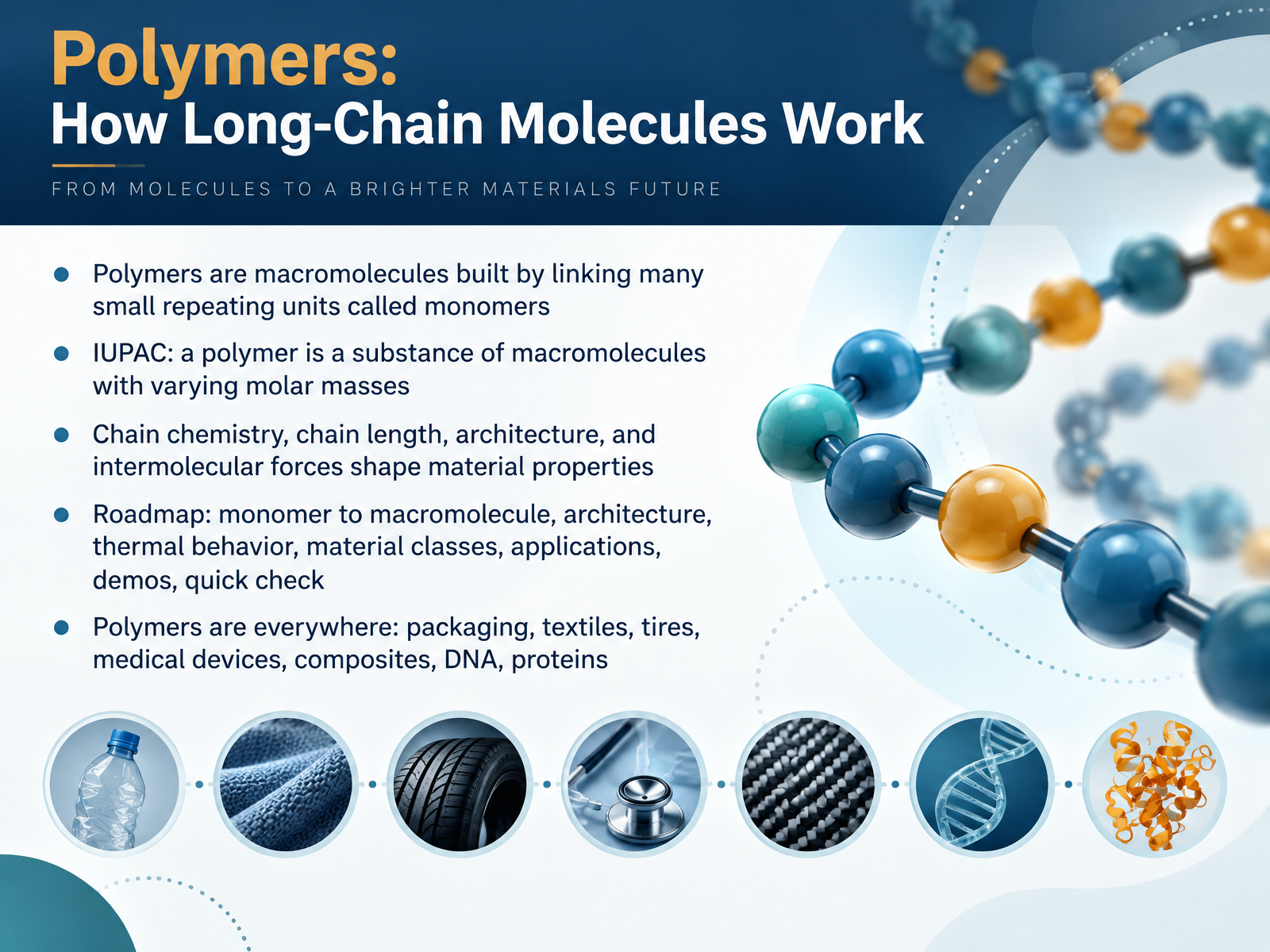
- 01Polymers: How Long-Chain Molecules WorkWelcome. In this course, we'll explore how long-chain molecules called polymers work, and how their molecular structure shapes the materials you use every day. Our goal is simple: by the end, you'll be able to connect what happens at the molecular level to properties you can actually see and feel. Let's start with a definition. A polymer is a macromolecule, meaning a very large molecule, built by linking many small repeating units called monomers. The International Union of Pure and Applied Chemistry, or IUPAC, defines a polymer as a substance made of macromolecules with varying molar masses. That word varying matters, because real polymers contain chains of different lengths. Four factors shape material properties: chain chemistry, chain length, architecture, and intermolecular forces. Here is our roadmap. We'll move from monomer to macromolecule, then cover architecture, thermal behavior, material classes, applications, demonstrations, and a quick check. And polymers are everywhere: packaging, textiles, tires, medical devices, composites, and even DNA and proteins in your body. Next, we'll look at how monomers join to form macromolecules, in our next slide, From Monomers to Macromolecules.doi.orgiupac.orgiupac.org+22 min
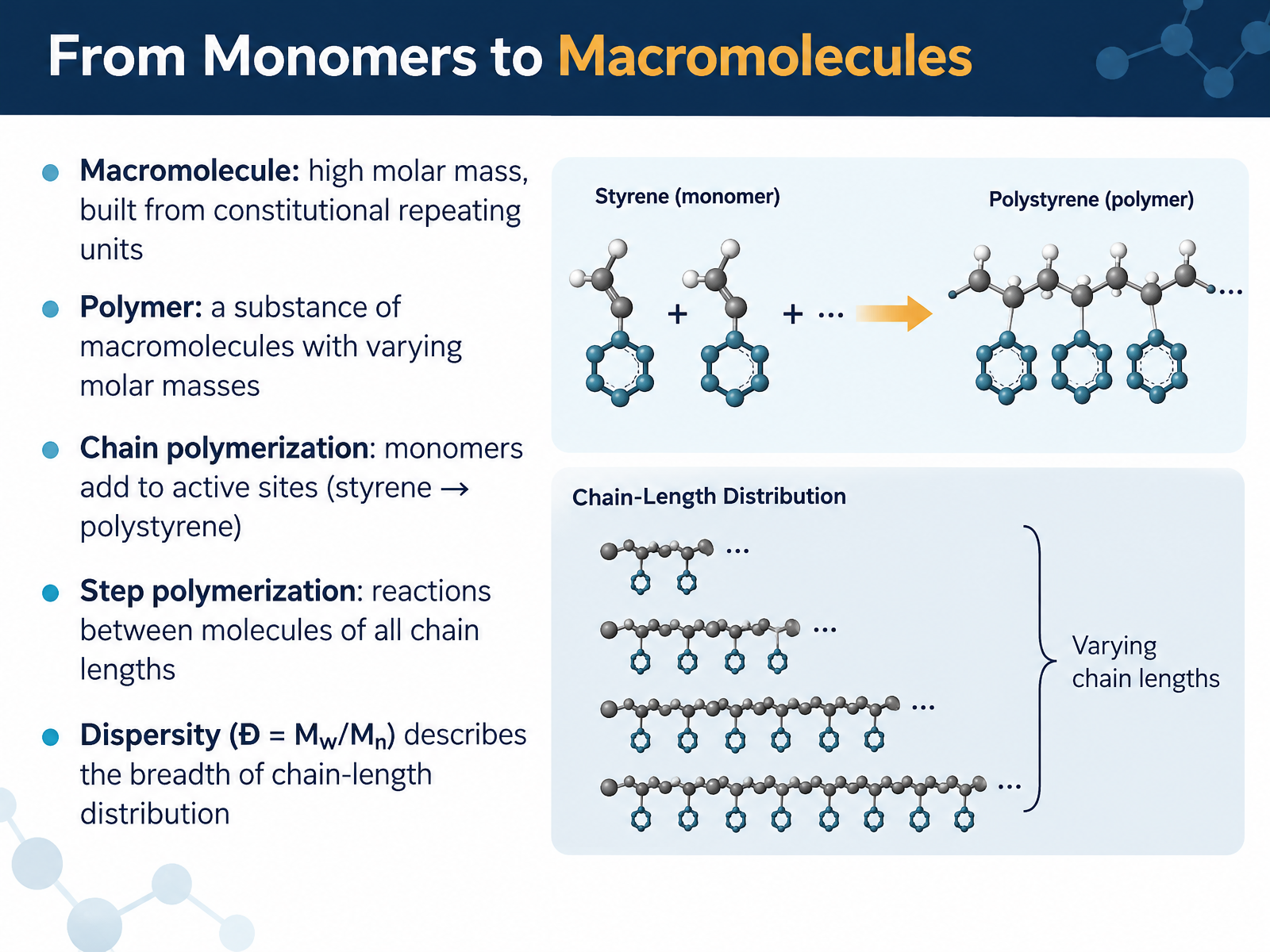
- 02From Monomers to MacromoleculesLet's move on and look at how small molecules become long-chain macromolecules. A macromolecule is a molecule of high molar mass, built from constitutional repeating units derived from monomers. A polymer, by contrast, is a substance made up of macromolecules of varying molar masses. There are two main routes to get there. In chain polymerization, monomers add one by one to active sites on a growing chain, which is how styrene becomes polystyrene. In step polymerization, growth happens through reactions between molecules of all chain lengths, not just the growing chain ends. Because chains come in many lengths, we describe the breadth of that distribution with dispersity, written as the mass-average molar mass divided by the number-average molar mass. A value near one means a narrow range of chain lengths, while higher values mean a broader spread. Keep that idea in mind, because chain length and its spread strongly influence real material behavior. Next, we'll examine chain architecture, including linear, branched, and cross-linked structures.
 doi.orgiupac.orgiupac.org+22 min
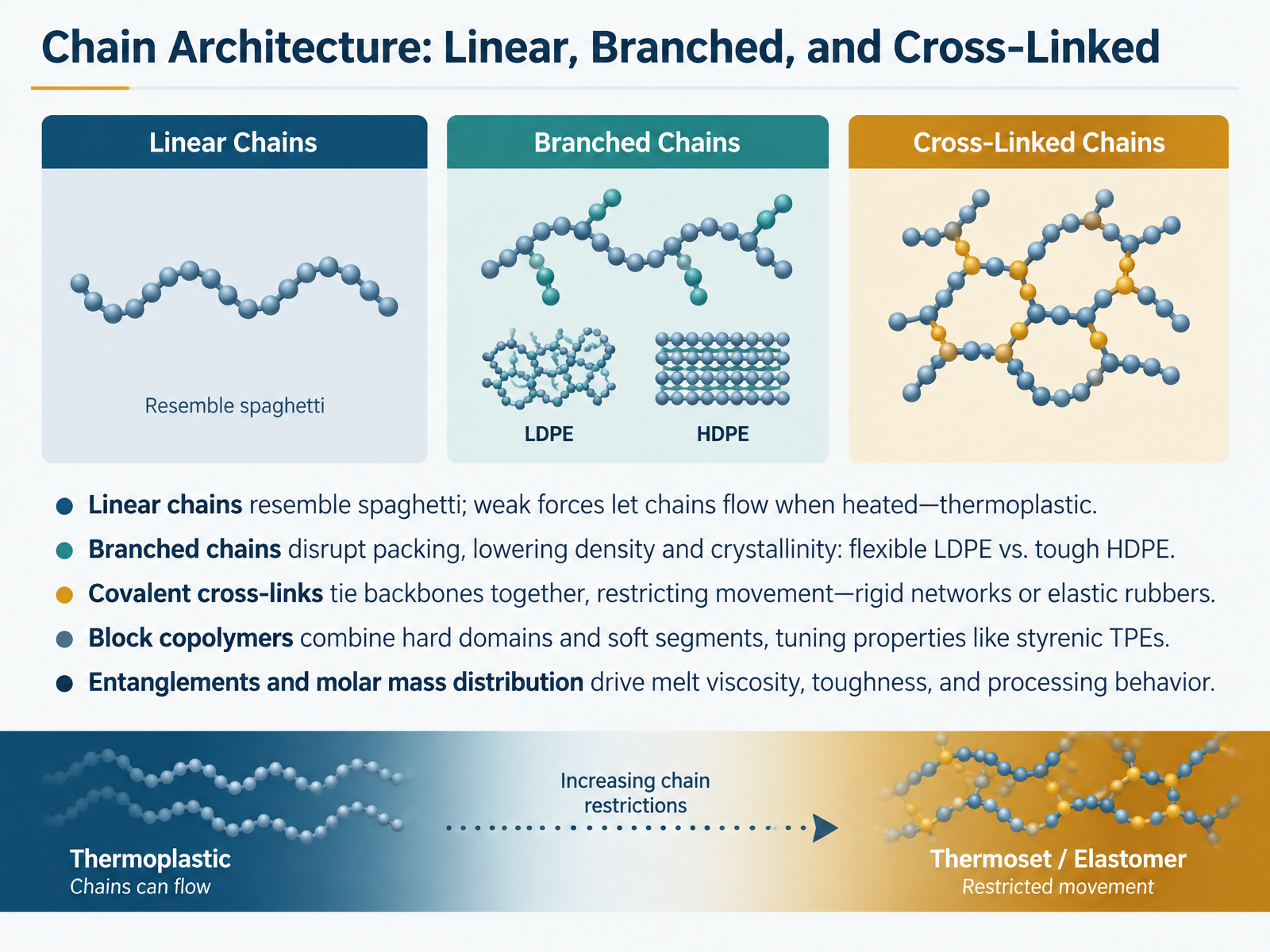
- 03Chain Architecture: Linear, Branched, and Cross-LinkedNow let's look at how those chains are arranged. A linear chain is an uninterrupted backbone, and the chains resemble spaghetti. They're held together by weak van der Waals forces, so when you heat the material, the chains slide past one another and it can be remolded. That's a thermoplastic, like high-density polyethylene. Branching changes things. Side chains hanging off the backbone disrupt packing, which lowers density and crystallinity. So highly branched low-density polyethylene is flexible enough for grocery bags, while the linear version is tough enough for bottles. Next, cross-links are covalent bonds that tie backbones together. They restrict movement, giving you rigid networks, or lightly cross-linked elastic rubbers like vulcanized tire rubber. Block copolymers take another route, combining hard domains with soft segments to tune properties, as in styrenic thermoplastic elastomers. And remember, entanglements and the distribution of molar mass drive melt viscosity, toughness, and how easily a polymer processes. In short, architecture is a design lever. Next, we'll connect this to intermolecular forces and chain behavior.
 cmu.eduweb.mit.eduopenstax.org+22 min
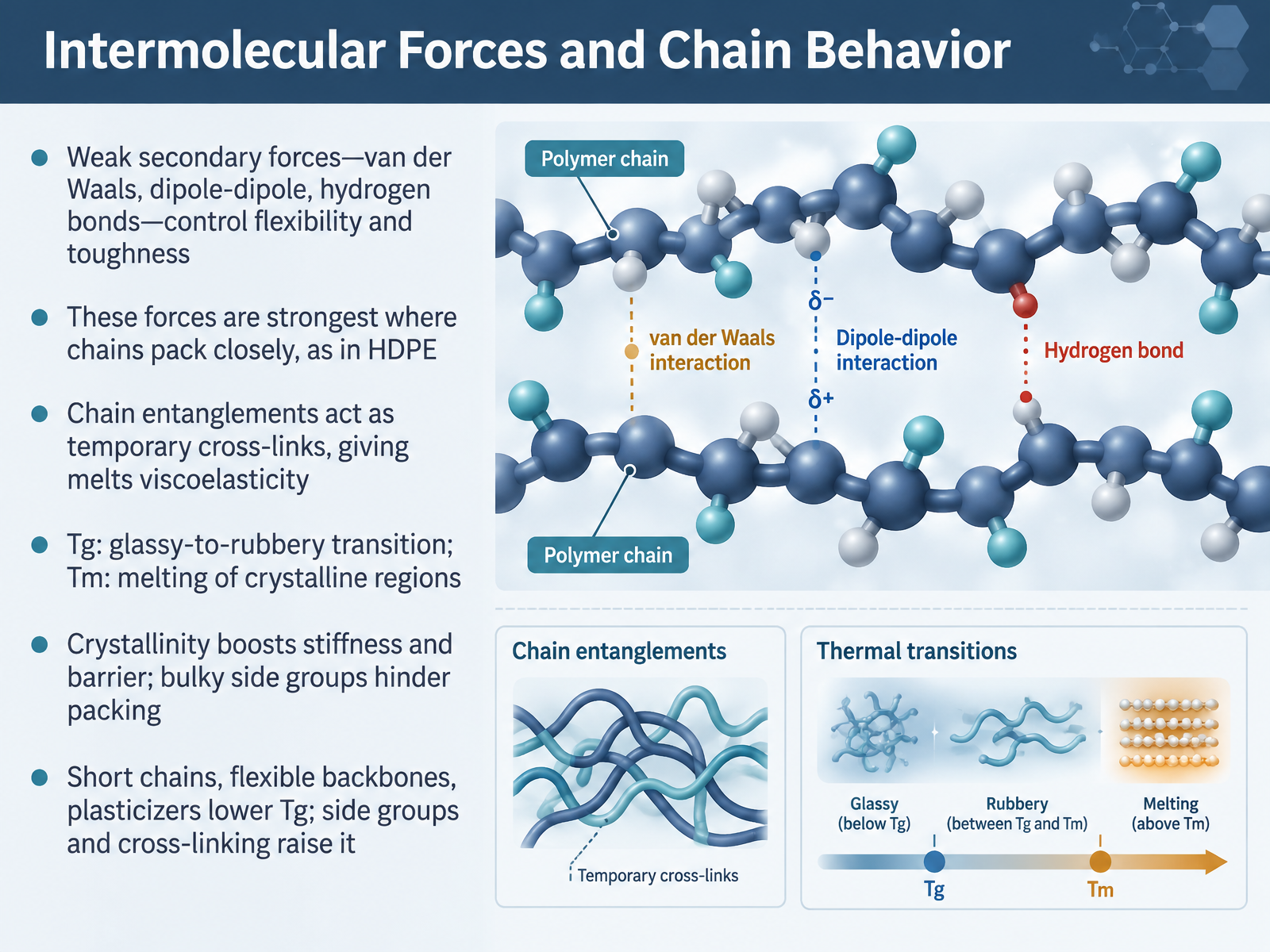
- 04Intermolecular Forces and Chain BehaviorNow let's look at what happens between the chains. Alongside the strong covalent bonds inside each chain, weaker secondary forces act between chains. These include van der Waals forces, dipole-dipole interactions, and hydrogen bonds. They may be weak individually, but there are so many of them that together they control flexibility and toughness. Because these forces only act at very close range, they are strongest where chains pack tightly and regularly, as in high-density polyethylene. In a melt, chains also become entangled. Those entanglements act like temporary cross-links, which is why molten plastic is viscoelastic: part liquid, part elastic. Two temperatures help you predict behavior. The glass transition temperature, Tg, marks the change from a hard, glassy state to a soft, rubbery one. The melting temperature, Tm, is where crystalline regions melt. Crystallinity generally raises stiffness and barrier performance, while bulky side groups hinder close packing. Short chains, flexible backbones, and plasticizers lower Tg, while side groups and cross-linking raise it. Next, we turn to thermoplastics, thermosets, and elastomers.
 openstax.orgeng.libretexts.orgopen.edu+22 min
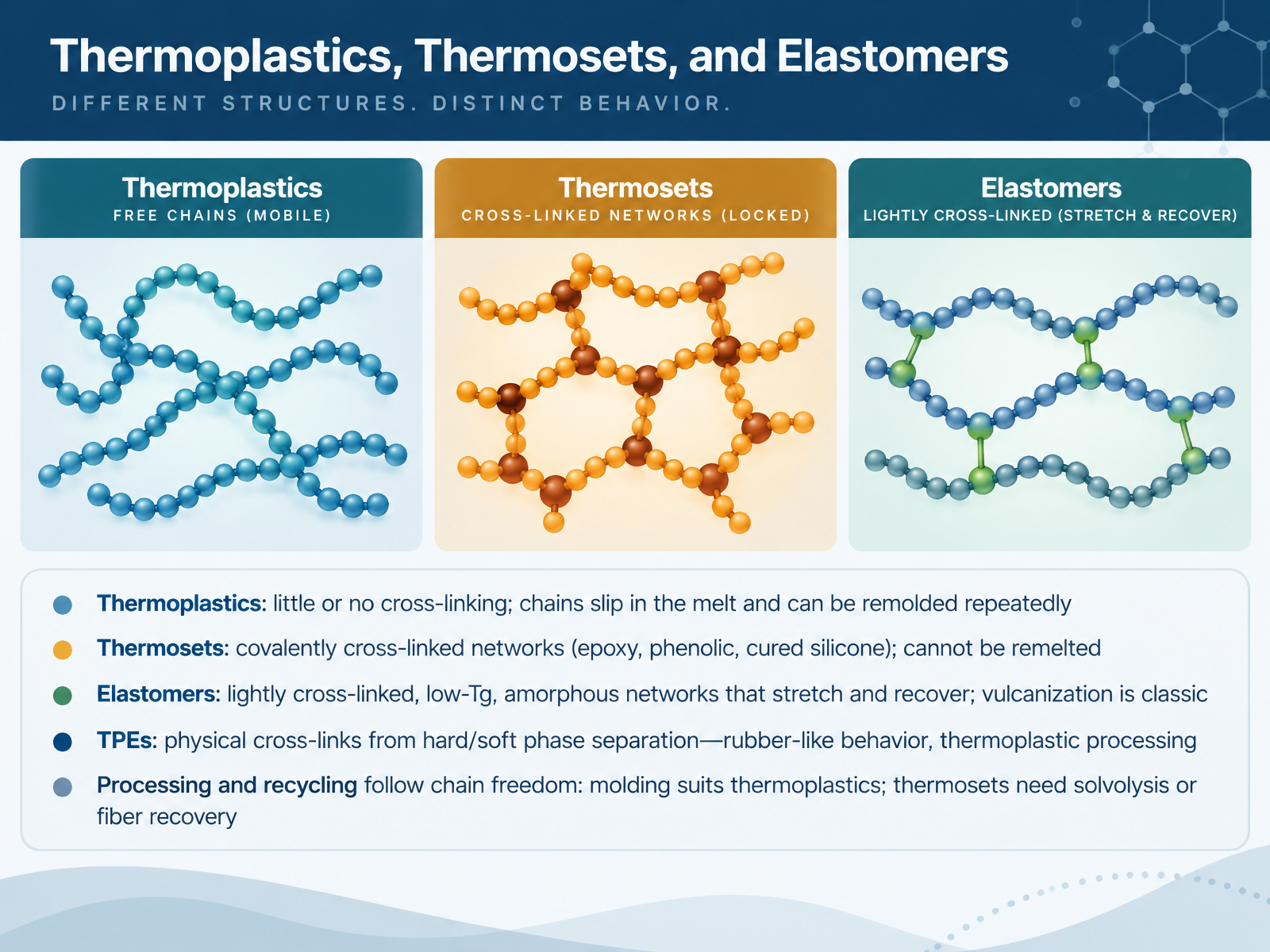
- 05Thermoplastics, Thermosets, and ElastomersNow let's connect chain structure to how these materials actually behave. Thermoplastics have little or no cross-linking, so in the melt their chains can slip past one another. That is why a thermoplastic can be remolded repeatedly, like a plastic bottle or a food container. Thermosets are different. They form covalent cross-linked networks, found in epoxy, phenolic, and cured silicone. Those permanent links mean a thermoset cannot be remelted. Elastomers are lightly cross-linked, low glass transition, amorphous networks. They stretch and recover, and vulcanized rubber is the classic example. Thermoplastic elastomers, or T P E s, use physical cross-links from hard and soft phase separation. They behave like rubber but process like a thermoplastic. Notice the pattern. Processing and recycling follow chain freedom. Molding suits thermoplastics, while thermosets need methods such as solvolysis or fiber recovery. Next, we look at structure-property relationships in everyday materials.
 doi.orgmdpi.comkraiburg-tpe.com+21 min
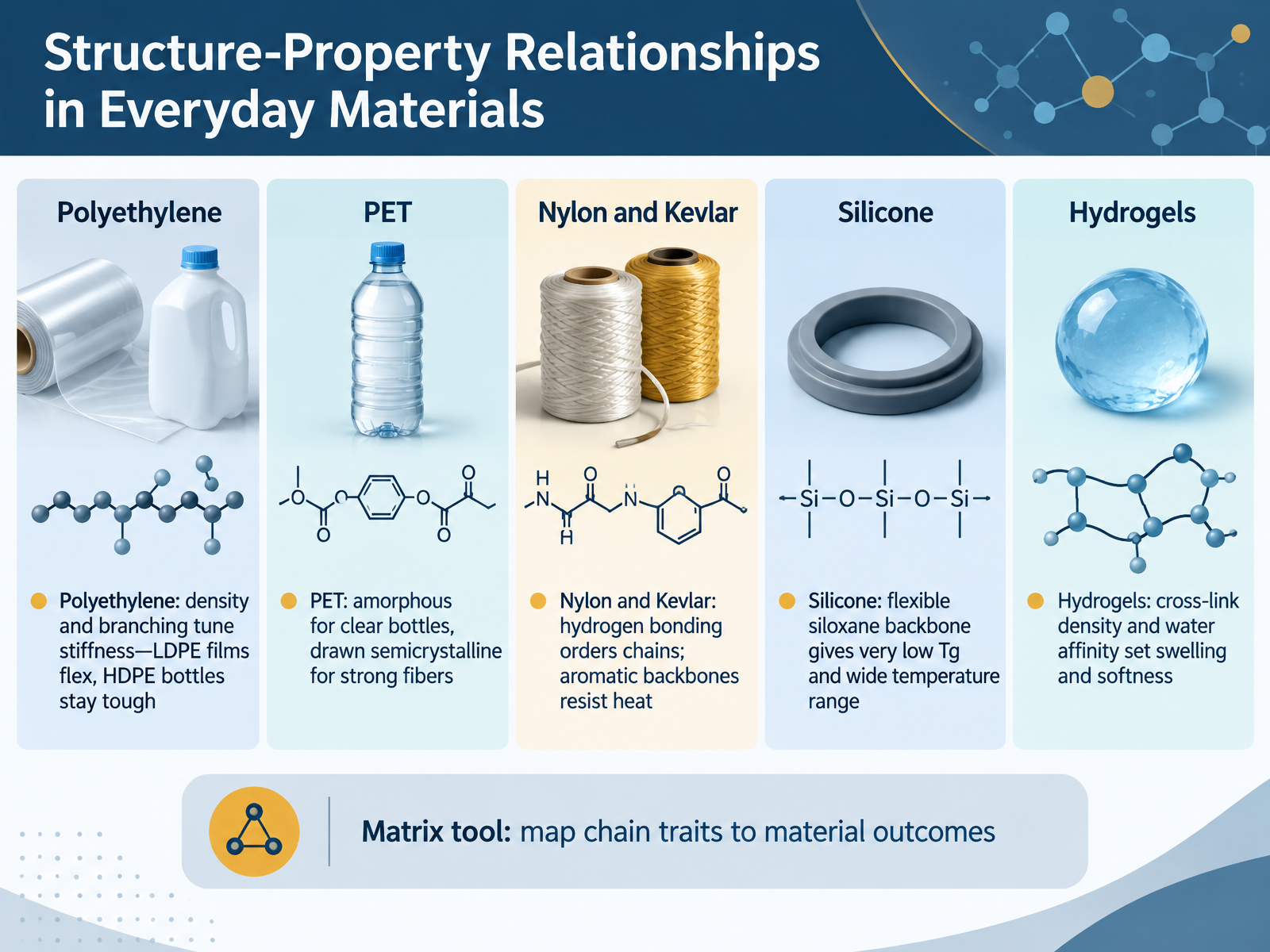
- 06Structure-Property Relationships in Everyday MaterialsNow let's connect molecular structure to the behavior you can actually see. Polyethylene shows how density and branching tune stiffness. Low-density polyethylene, with its branched chains, stays flexible, which is why it works for films and squeeze bottles. High-density polyethylene packs its linear chains tightly and stays tough enough for bottles. PET is the same molecule in two forms. You can make it amorphous for clear bottles, or draw it into a semicrystalline fiber for strong fabric. Nylon and Kevlar rely on hydrogen bonding, which orders chains and stops them from sliding past one another. Kevlar adds an aromatic backbone, so it also resists heat. Silicone has a flexible siloxane backbone, giving it a very low glass transition temperature, called T g, and a wide temperature range. Hydrogels are networks whose cross-link density and water affinity set how much they swell and how soft they feel. Use the matrix tool on this slide as your guide, mapping each chain trait, branching, crystallinity, hydrogen bonding, backbone flexibility, and cross-linking, to the material outcome you observe. Next, we'll look at how these choices play out in everyday products in Real-World Applications and Design Choices.
 ocw.mit.eduopenstax.orgeng.libretexts.org+22 min
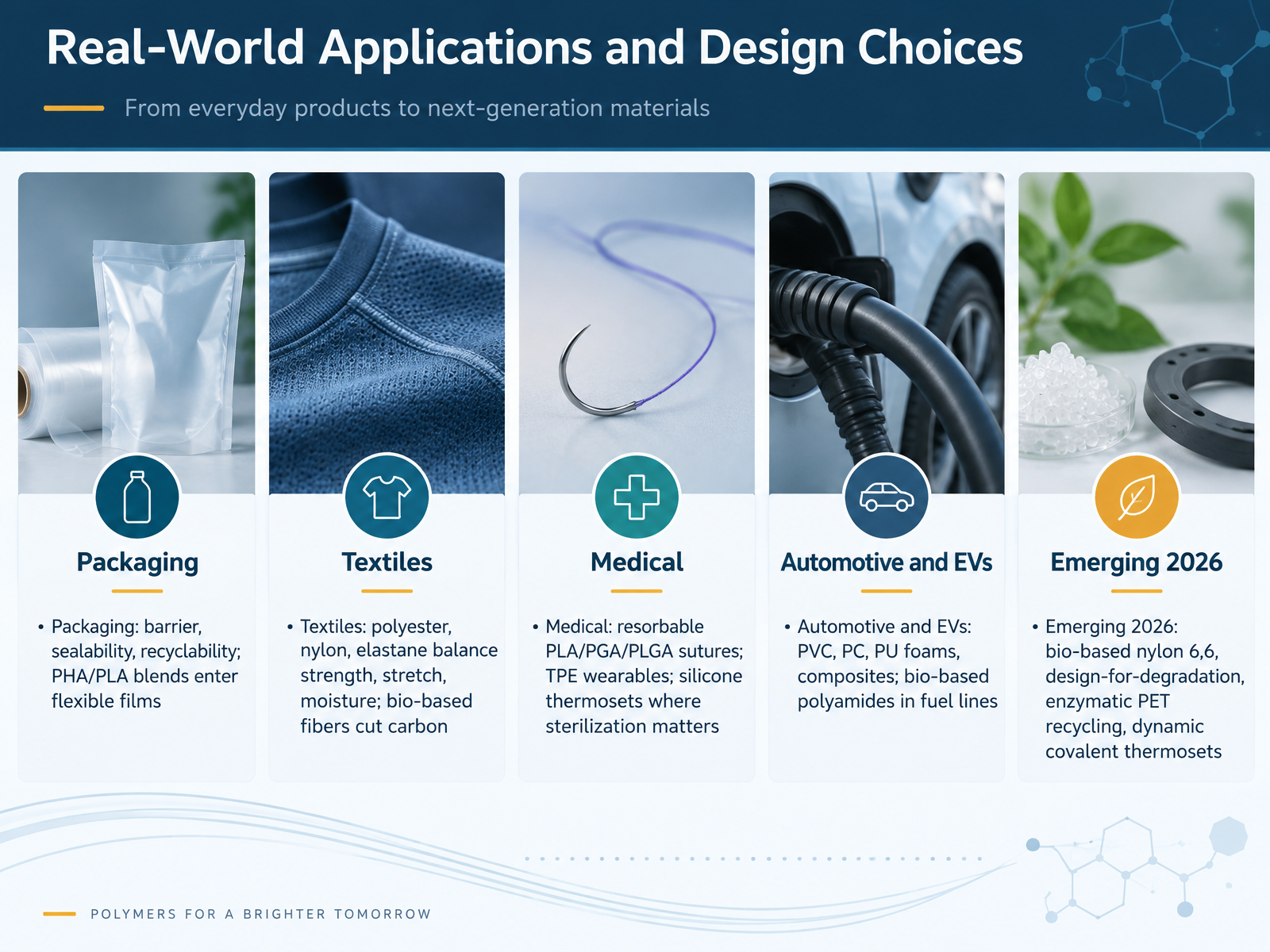
- 07Real-World Applications and Design ChoicesNow let's see how these long chains show up in real products, and how design choices follow from material structure. In packaging, you balance three needs: barrier, sealability, and recyclability. PHA and PLA blends, like those from CJ Biomaterials and NatureWorks, are moving into flexible films. In textiles, polyester and nylon bring strength, elastane adds stretch, and moisture handling often comes from fiber shape. Bio-based fibers can lower carbon, but check performance. In medicine, resorbable sutures made from PLA, PGA, and PLGA hydrolyze safely in the body, so no second surgery is needed. Thermoplastic elastomers suit wearables because they stretch and can be reprocessed, while silicone thermosets remain where repeated sterilization matters. In automotive and electric vehicles, you will find PVC, polycarbonate, polyurethane foams, and composites, plus bio-based polyamides such as PA11 in fuel lines. Looking ahead to 2026, watch bio-based nylon 6,6, design for degradation, enzymatic PET recycling, and dynamic covalent thermosets. The takeaway is simple: match the polymer's chain structure and end-of-life path to the job. Next, we will weigh those trade-offs directly in Design Trade-Offs: Performance, Process, Cost, and Circularity.
 doi.orgmdpi.comkraiburg-tpe.com+22 min
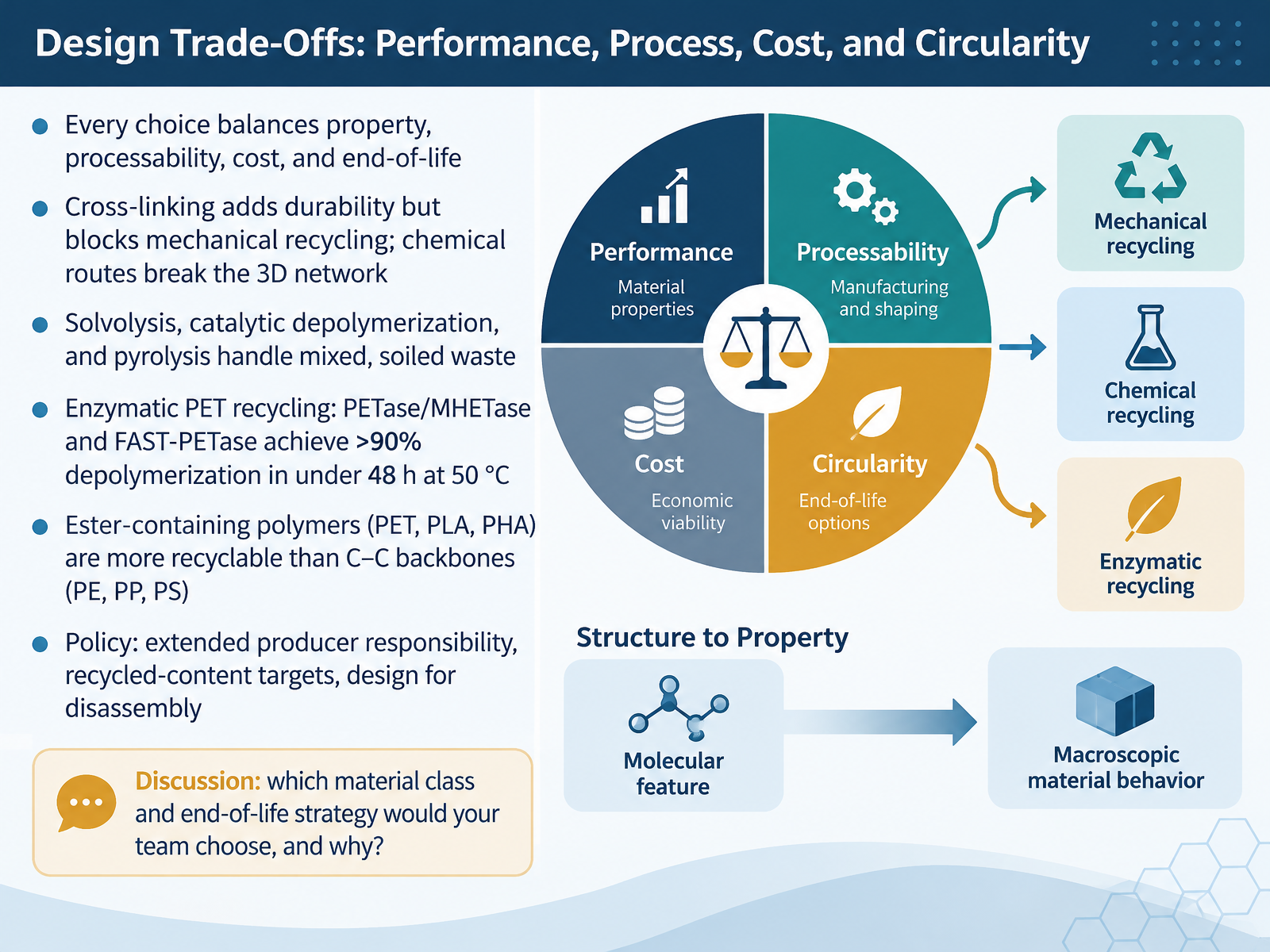
- 08Design Trade-Offs: Performance, Process, Cost, and CircularityEvery material choice is a trade-off between four things: performance, processability, cost, and end-of-life. Consider cross-linking. It adds durability and heat resistance, but it blocks mechanical recycling, because the chains can no longer slide past one another. Chemical routes, such as solvolysis, catalytic depolymerization, and pyrolysis, can break that three-dimensional network and handle mixed, soiled waste. Enzymes offer precision. Engineered PET enzymes, including FAST-PETase, reach more than ninety percent depolymerization in under forty-eight hours at fifty degrees Celsius. Notice a pattern here. Ester-containing polymers like PET, PLA, and PHA are far easier to recycle than carbon-carbon backbones like PE, PP, and PS. Policy reinforces this: extended producer responsibility, recycled-content targets, and design for disassembly. So for your team, which material class and end-of-life strategy would you choose, and why? Next, we move to Teaching and Learning Activities.
 doi.orgmdpi.comkraiburg-tpe.com+22 min
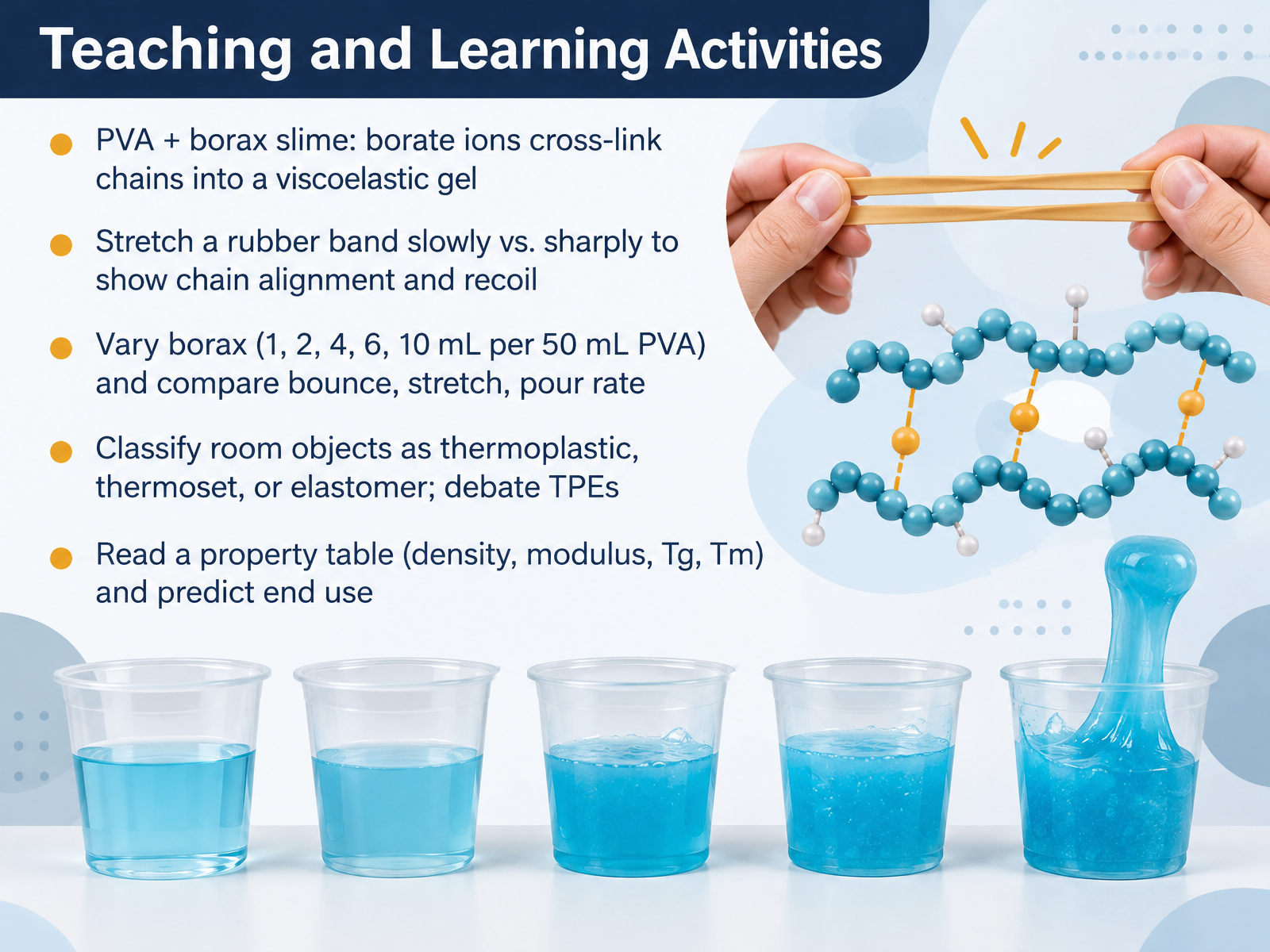
- 09Teaching and Learning ActivitiesNow let's turn these ideas into activities you can run. Start with the classic: polyvinyl alcohol plus borax makes slime. Borate ions from the borax form cross-links between PVA chains, turning a watery solution into a viscoelastic gel. Next, have learners stretch a rubber band slowly, then sharply. Slow pulling lets chains align and slide; a sharp pull meets resistance and recoils. Then vary the borax, using one, two, four, six, and ten milliliters per fifty milliliters of PVA. Compare bounce, stretch, and pour rate. More borax means more cross-linking, so the gel stiffens. Ask learners to classify room objects as thermoplastic, thermoset, or elastomer, and debate where thermoplastic elastomers fit. Finally, give them a property table with density, modulus, glass transition temperature, and melting temperature, and have them predict an end use. That table connects numbers to real design choices. Next, we'll look at safety, materials, and differentiation for educators.
 openstax.orgeng.libretexts.orgopen.edu+22 min
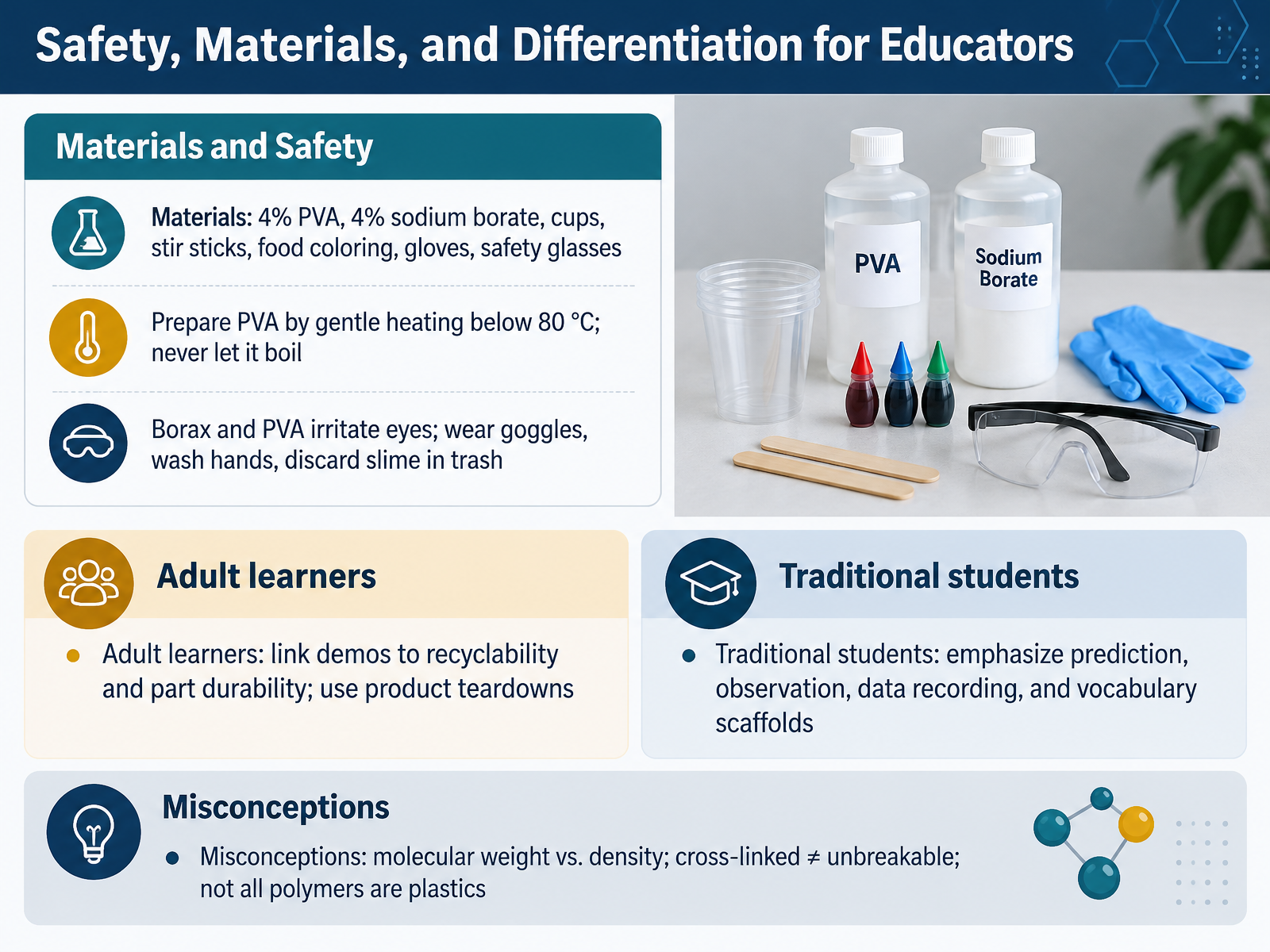
- 10Safety, Materials, and Differentiation for EducatorsLet's finish with safety, materials, and how to differentiate this for different learners. Your materials are four percent polyvinyl alcohol solution, four percent sodium borate solution, cups, stir sticks, food coloring, gloves, and safety glasses. Prepare the PVA by gentle heating below eighty degrees Celsius. Never let it boil, because boiling alters its properties. Borax and PVA irritate the eyes, so wear goggles, wash hands afterward, and discard used slime in the trash, not the sink. For adult learners, connect the demonstration to recyclability and part durability, and use product teardowns to make it concrete. For traditional students, emphasize prediction, observation, data recording, and vocabulary scaffolds. Finally, address three common misconceptions: molecular weight is not the same as density, cross-linked does not mean unbreakable, and not all polymers are plastics. Next, we'll move to Key Takeaways and Quick Check.
 doi.orgmdpi.comkraiburg-tpe.com+22 min
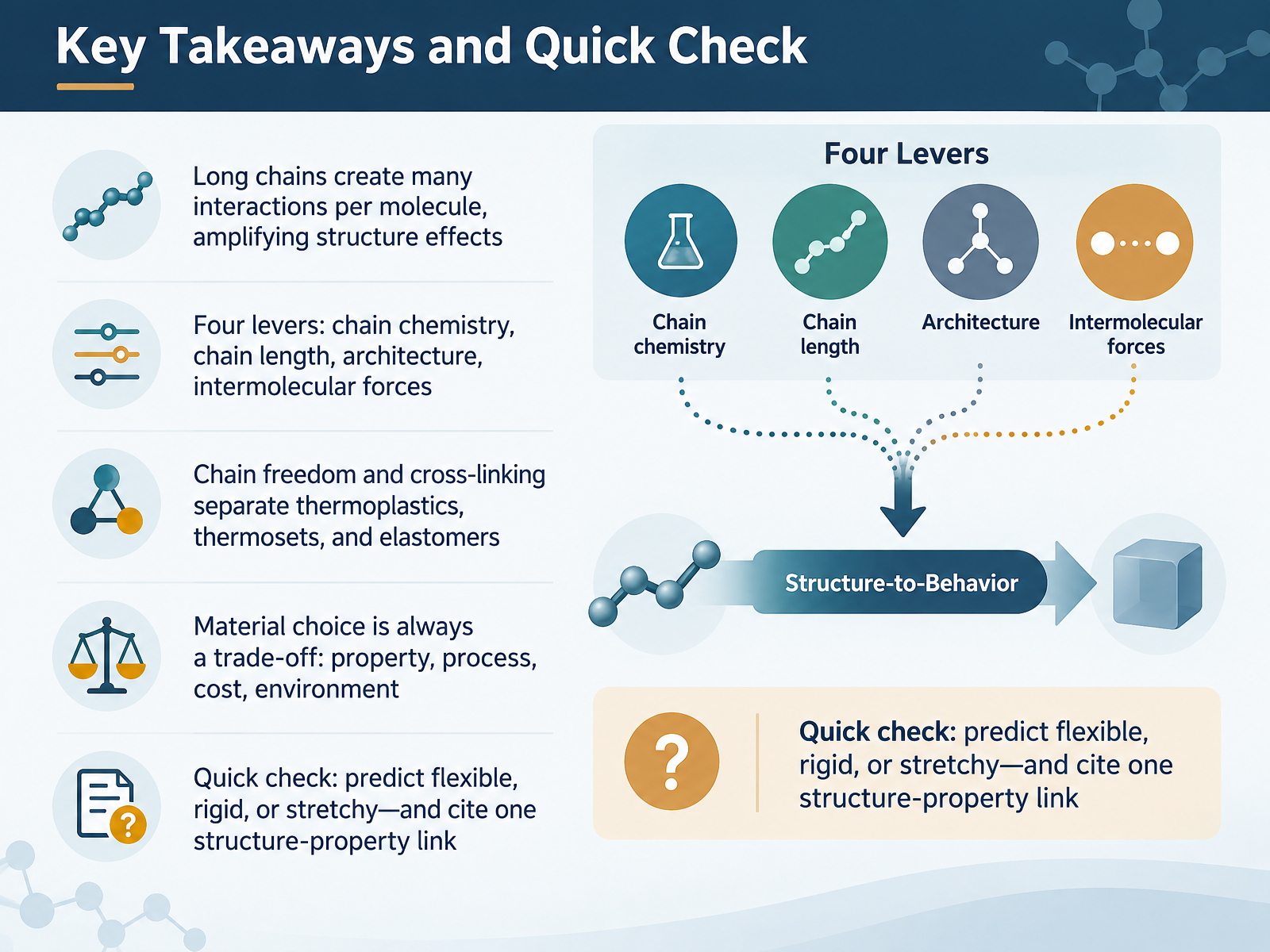
- 11Key Takeaways and Quick CheckLet's bring it all together. Long chains create many interactions per molecule, so small changes in structure produce big changes in behavior. You have four levers: chain chemistry, chain length, architecture, and intermolecular forces. Chain freedom and cross-linking separate thermoplastics, thermosets, and elastomers, which is why some melt and reshape while others stay locked in place. And remember, material choice is always a trade-off between property, process, cost, and environment. Here is your quick check. Pick a material, predict whether it is flexible, rigid, or stretchy, and cite one structure-property link to justify it. Thank you for working through this course with me. Keep asking how structure drives behavior, and you will read materials with real confidence.
 doi.orgmdpi.comkraiburg-tpe.com+21 min
Take the deck with you
Download this course as a file — free, no sign-up needed.
- PDF handoutEvery slide page, ready to print or share.12 pages · 3.0 MBDownload
- Narrated PowerPointThe deck that presents itself — every slide carries the digital human's narration video.12 pages · 21.6 MBDownload
- PowerPoint slidesThe full deck as a .pptx — open it in PowerPoint, Keynote, or Google Slides.12 pages · 2.9 MBDownload
Free to use in your own training — please keep the PersonWise credit page at the end.
Have your own deck? Turn it into a course
Sources consulted
Web sources consulted while building this course.
- A brief guide to polymerization terminology (IUPAC Technical Report) — doi.org
- Polymer Education - IUPAC | International Union of Pure and Applied Chemistry — iupac.org
- Basic Classification and Definitions of Polymerization Reactions (IUPAC Recommendations 2025) — iupac.org
- Basic Classification and Definitions of Polymerization Reactions - IUPAC | International Union of Pure and Applied Chemistry — iupac.org
- Basic Classification and Definitions of Polymerization Reactions - IUPAC | International Union of Pure and Applied Chemistry — iupac.org
- Gelfand Center — cmu.edu
- 5.33 Lecture Notes: Introduction To Polymer Chemistry — web.mit.edu
- 31.7 Polymer Structure and Physical Properties - Organic Chemistry | OpenStax — openstax.org
- https://vtechworks.lib.vt.edu/server/api/core/bitstreams/4e68b31b-cee1-4e63-b14d-8fc5c398b2c4/content — vtechworks.lib.vt.edu
- Educational series: characterizing crosslinked polymer networks | Polymer Chemistry | The Royal Society of Chemistry — pubs.rsc.org
- Chapter 10: Amorphous and Semi-Crystalline Polymers - Engineering LibreTexts — eng.libretexts.org
- 2.5.3 Structure and the glass transition temperature — open.edu
- 8.3: The Glass Transition - Engineering LibreTexts — eng.libretexts.org
- Glass Transition Temperature (Tg) - an overview | ScienceDirect Topics — sciencedirect.com
- Thermoplastic Elastomers — doi.org
- Polymer Recycling: A Comprehensive Overview and Future Outlook — mdpi.com
- What is TPE? (Thermoplastic elastomer material) | KRAIBURG TPE — kraiburg-tpe.com
- Thermoplastic Elastomers for Wireless, Skin‐Interfaced Electronic, and Microfluidic Devices — doi.org
- Sustainability-Driven Material Selection in Rubber Manufacturing: A Comparative Assessment of Vulcanized Rubber and Thermoplastic Elastomers — doi.org
- 29. Polymers: Synthesis, Properties & Applications | Introduction to Solid State Chemistry | Materials Science and Engineering | MIT OpenCourseWare — ocw.mit.edu