Begin
14 pages · ~28 min
The Mole: Counting Atoms by Weighing
This training teaches chemistry students how to use the mole concept to count atoms by weighing substances, connecting mass measurements to atomic-scale quantities.
A digital instructor presents all 14 pages. Hold “Ask” at any point and ask out loud — the answer comes from this course. No sign-up needed.
What you’ll learn
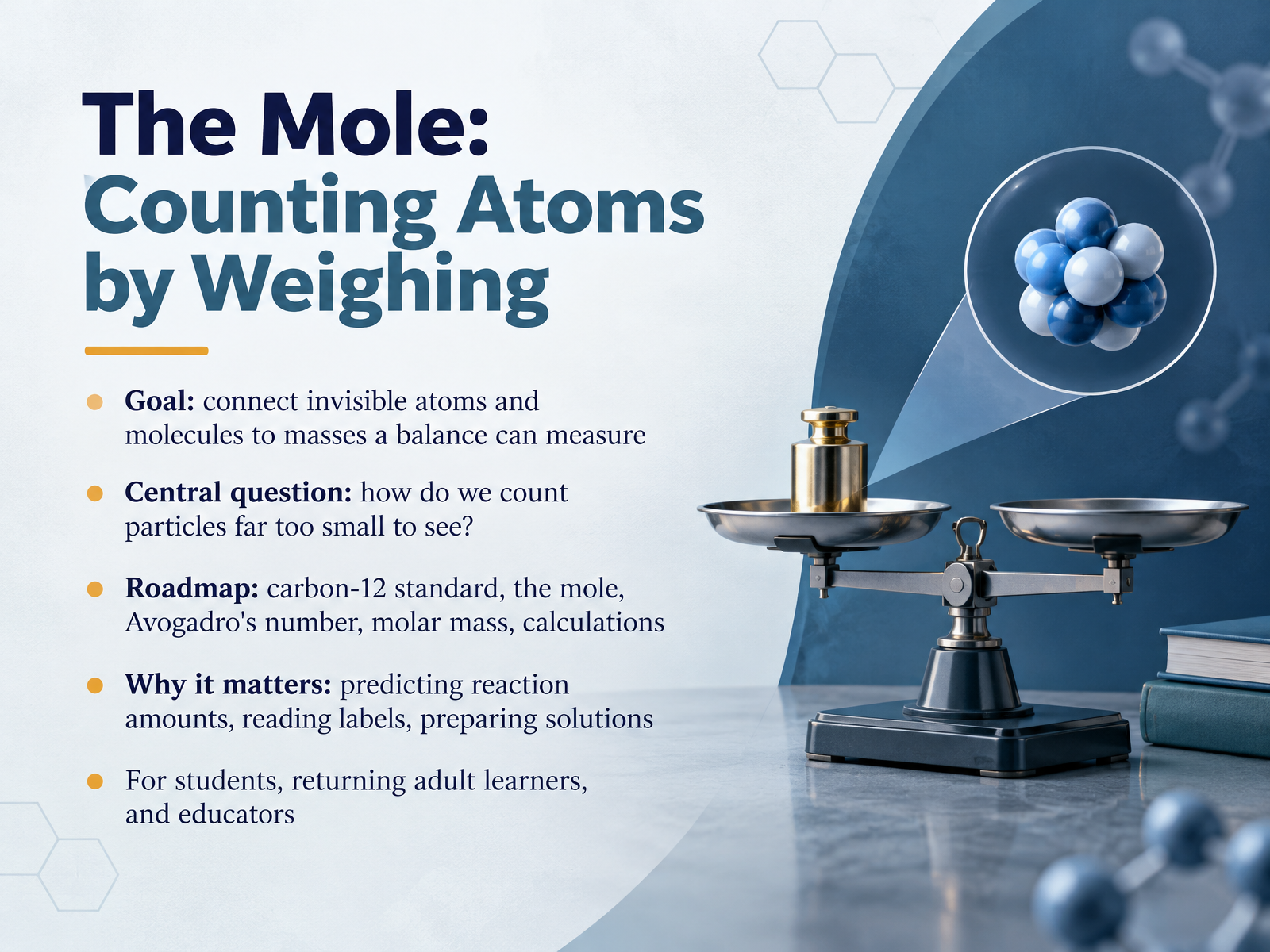
- 01The Mole: Counting Atoms by WeighingWelcome. I'm glad you're here. Today we're tackling one of the most useful ideas in all of chemistry: the mole. Here's our goal. We want to connect the invisible world of atoms and molecules to masses you can actually measure on a balance. So let me ask the central question up front. How do we count particles that are far too small to see? That's the whole puzzle. On a balance, you can only read a mass, but reactions happen particle by particle. You cannot count atoms one at a time. So how does the mole solve that? Here's our roadmap. We'll start with the carbon twelve standard, the reference point for atomic mass. Then we'll meet the mole itself, and Avogadro's number, that enormous number of particles in one mole. From there, we'll build molar mass, and practice the calculations that turn grams into counts and counts back into grams. And why does this matter? Because these skills let you predict how much product a reaction will make, read a chemical label with real understanding, and prepare solutions with the right concentration in the lab. This course is built for students, for adults returning to chemistry, and for educators who teach it. So whether you're learning this for the first time or reviewing, you're in the right place. Let's begin with why chemists count by weighing.goldbook.iupac.orggoldbook.iupac.orgen.wikipedia.org+22 min
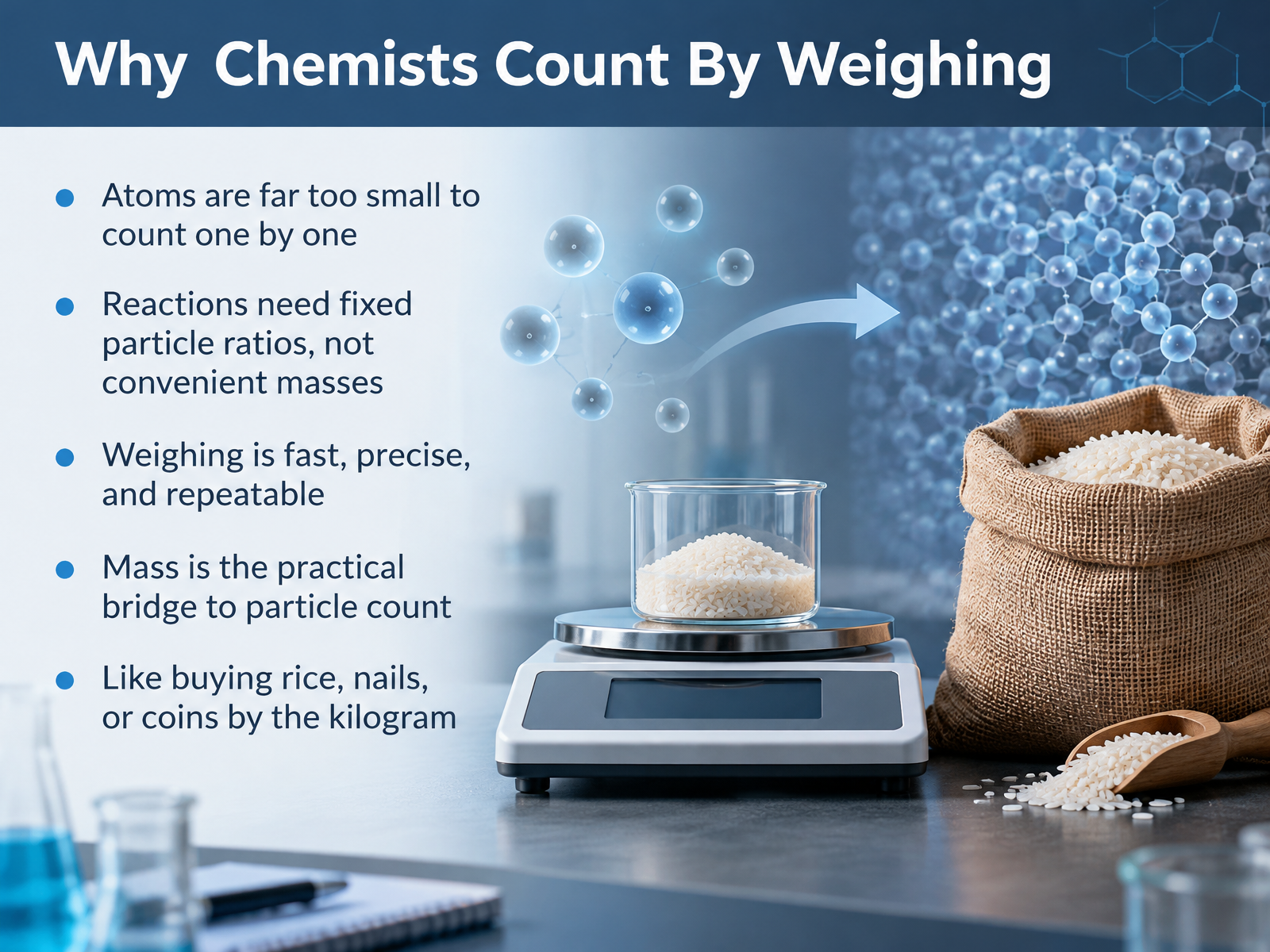
- 02Why Chemists Count By WeighingLet's get into why chemists count by weighing in the first place. Atoms are far too small to count one by one. In a single pinhead of copper, there are more atoms than grains of sand on every beach on Earth. So counting is out of the question. And that matters, because reactions need fixed particle ratios. Two hydrogen molecules react with one oxygen molecule, never with one point seven of one. But the only thing you can actually do in the lab is put a sample on a balance and read a mass. Weighing is fast, precise, and repeatable. That makes mass the practical bridge to particle count. Think of it like buying rice, nails, or coins by the kilogram. You trust the count inside the weight. Does that make sense? So the real question becomes how to turn grams into particles. That brings us to the next idea: relative mass and the carbon twelve standard.
 learningcentre.vcc.capdesas.orgthenational.academy+21 min
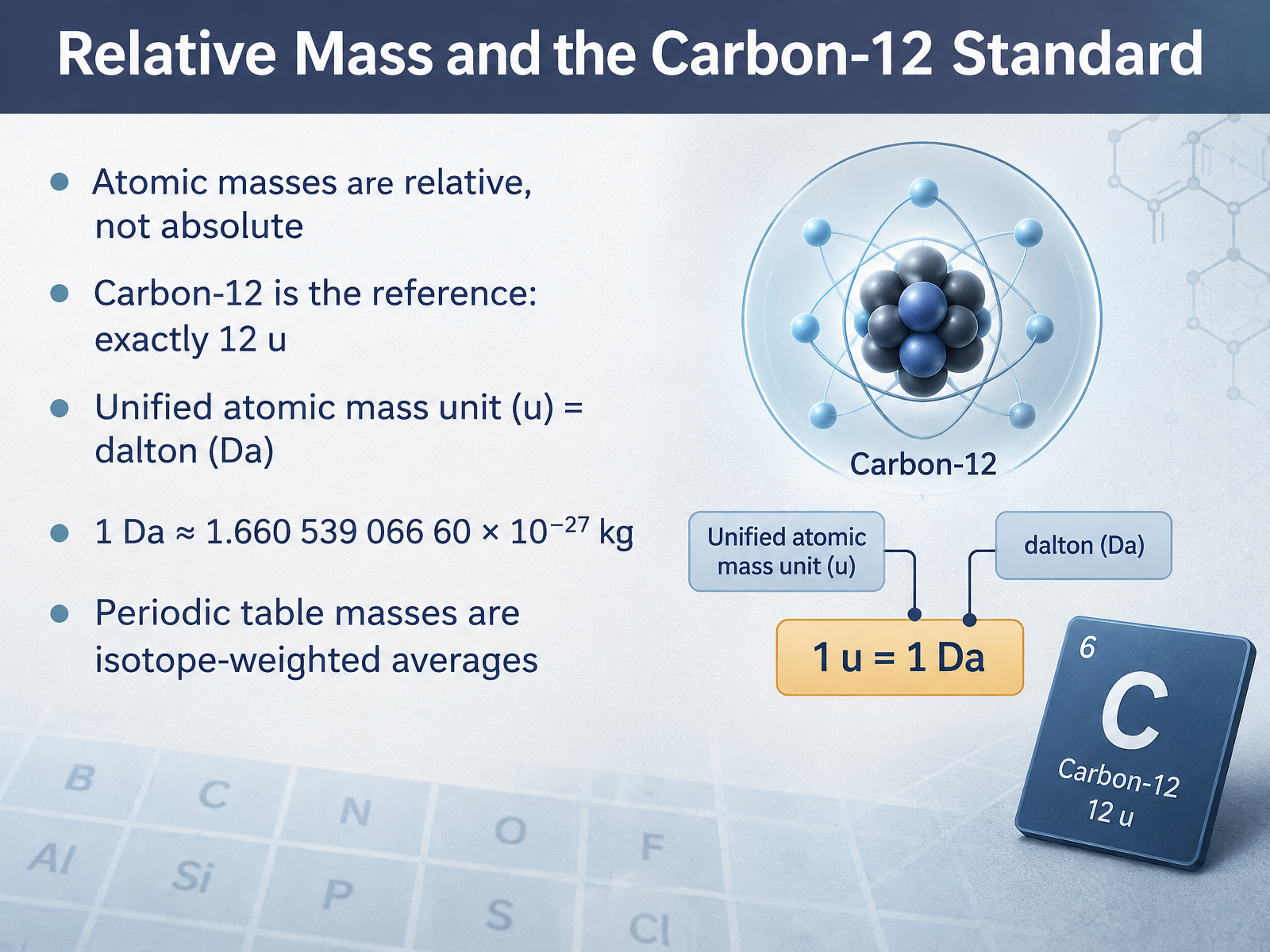
- 03Relative Mass and the Carbon-12 StandardNow let's talk about relative mass and the carbon-12 standard. Here's the key idea. Atomic masses are relative, not absolute. Instead of measuring a single atom's mass in kilograms, chemists compare every atom to one chosen reference. That reference is carbon-12. By definition, one atom of carbon-12 has a mass of exactly twelve unified atomic mass units, or twelve u. So when we say helium is about four u, we mean it is one third as massive as a carbon-12 atom. The unified atomic mass unit also goes by another name, the dalton, symbol D a. They are the same unit. In kilograms, one dalton is approximately one point six six zero five three nine times ten to the minus twenty-seven kilograms. That is an incredibly small number, which is exactly why the relative scale is so useful in the lab. One more thing. The masses printed on the periodic table are not single isotope masses. They are isotope-weighted averages, based on how abundant each isotope is in nature. For example, carbon's average is about twelve point zero one one, not exactly twelve, because a small fraction of natural carbon is carbon-13. So remember, carbon-12 is our anchor at exactly twelve u, and everything else is measured against it. Next, let's see how to read those masses straight from the periodic table.
 goldbook.iupac.orggoldbook.iupac.orgen.wikipedia.org+22 min
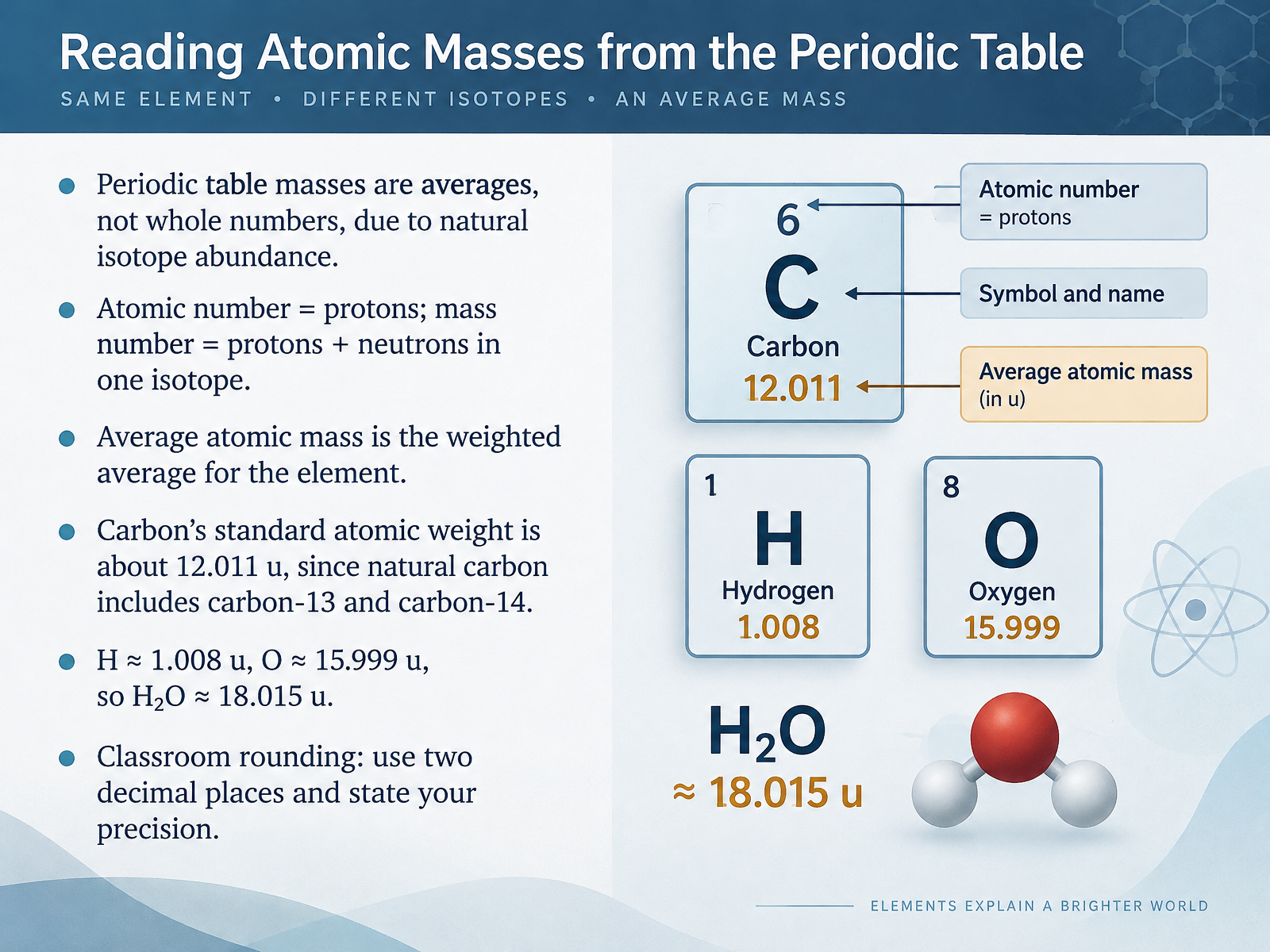
- 04Reading Atomic Masses from the Periodic TableLet's look at how to read atomic masses from the periodic table. Those numbers are averages, not whole numbers, because elements exist as mixtures of isotopes. Remember three terms. Atomic number equals protons. Mass number equals protons plus neutrons in one specific isotope. And average atomic mass is the weighted average across all naturally occurring isotopes. Carbon is a good example. Its standard atomic weight is about twelve point zero one one u, because natural carbon includes carbon thirteen and carbon fourteen. Hydrogen is about one point zero zero eight u, and oxygen is about fifteen point nine nine nine u. So water, H two O, comes to roughly eighteen point zero one five u. Here is a practical tip for the lab or classroom. Round to two decimal places, and always state the precision you are using. That keeps your calculations honest and reproducible. Now let's take the next step, introducing the mole as a counting unit.
 goldbook.iupac.orggoldbook.iupac.orgen.wikipedia.org+21 min
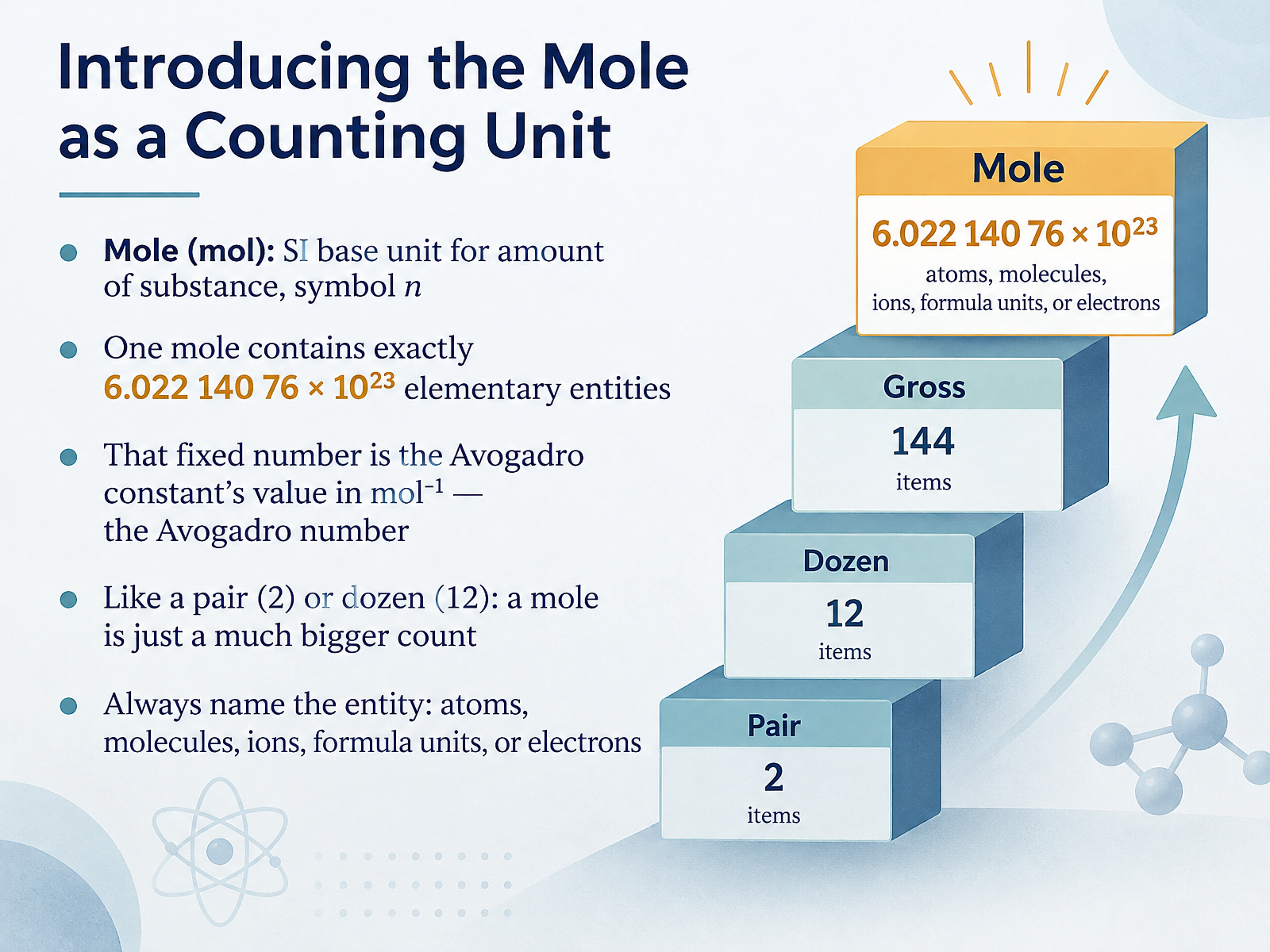
- 05Introducing the Mole as a Counting UnitNow let's meet the mole itself. The mole, symbol m o l, is the SI base unit for amount of substance, and its symbol is n. Here is the key number. One mole contains exactly six point zero two two one four zero seven six times ten to the twenty third elementary entities. That fixed number is the numerical value of the Avogadro constant, expressed per mole, and it is called the Avogadro number. Think of it like a pair, which means two, or a dozen, which means twelve. A mole is simply a much bigger count. And one last practical habit. Always name the entity you are counting. Atoms, molecules, ions, formula units, or electrons. That naming keeps your units honest. Coming up next, we will look at the SI redefinition of the mole in twenty nineteen.
 bipm.orgnist.govnvlpubs.nist.gov+21 min
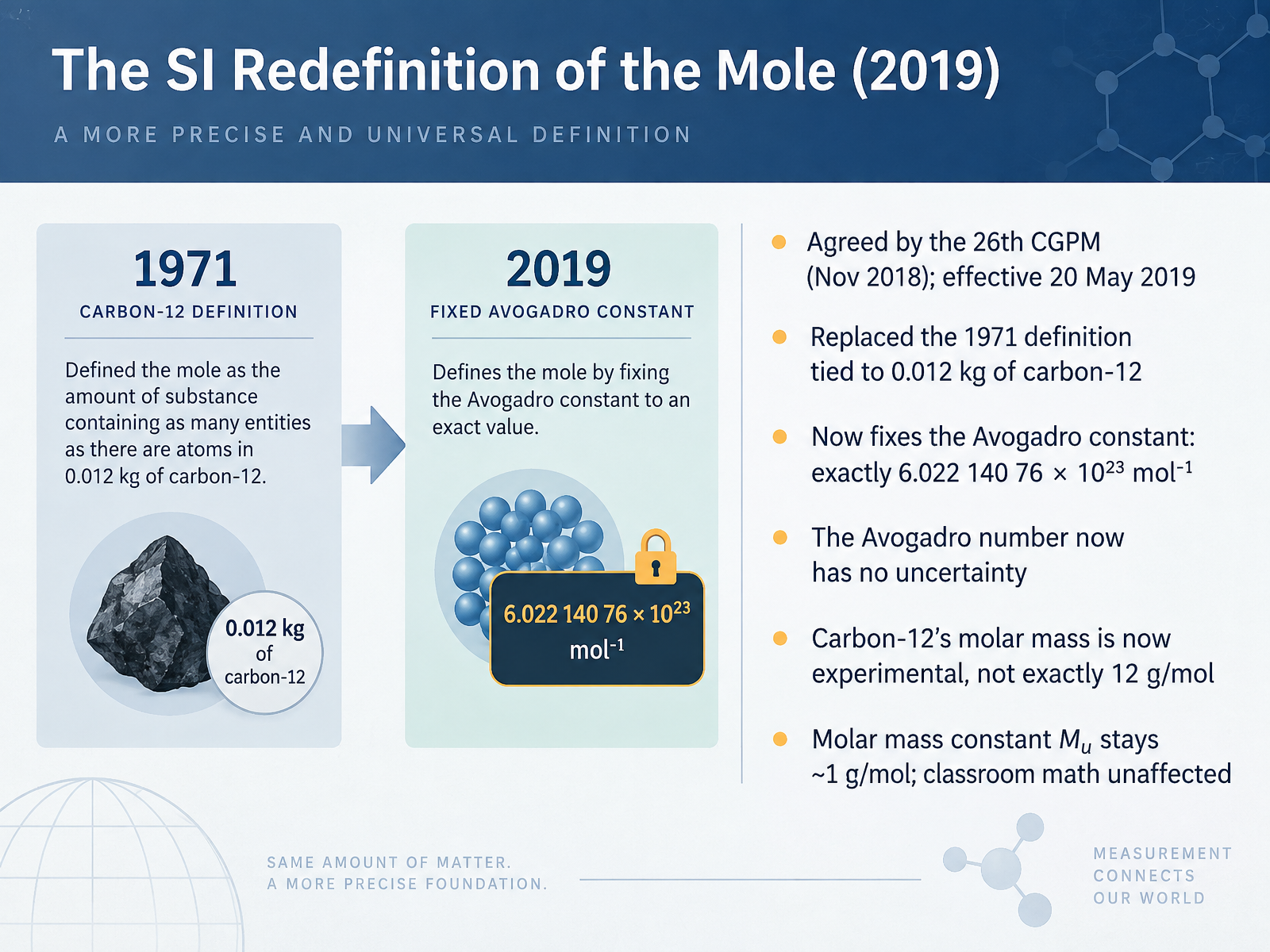
- 06The SI Redefinition of the Mole (2019)Let's talk about why the mole changed in 2019. In November 2018, the twenty-sixth General Conference on Weights and Measures agreed on a new definition, and it took effect on May 20, 2019. This replaced the 1971 definition, which tied the mole to zero point zero one two kilograms of carbon twelve. The new approach fixes the Avogadro constant at exactly six point zero two two one four zero seven six times ten to the twenty-third per mole. Because that value is now fixed, the Avogadro number has no uncertainty. Here is the trade-off. Carbon twelve's molar mass is no longer exactly twelve grams per mole. It is now an experimental value. But the molar mass constant stays very close to one gram per mole, so your classroom calculations are unaffected. Does that make sense? Same math, better foundation. Next, let's look at Avogadro's Number: Scale and Meaning.
 bipm.orgnist.govnvlpubs.nist.gov+21 min
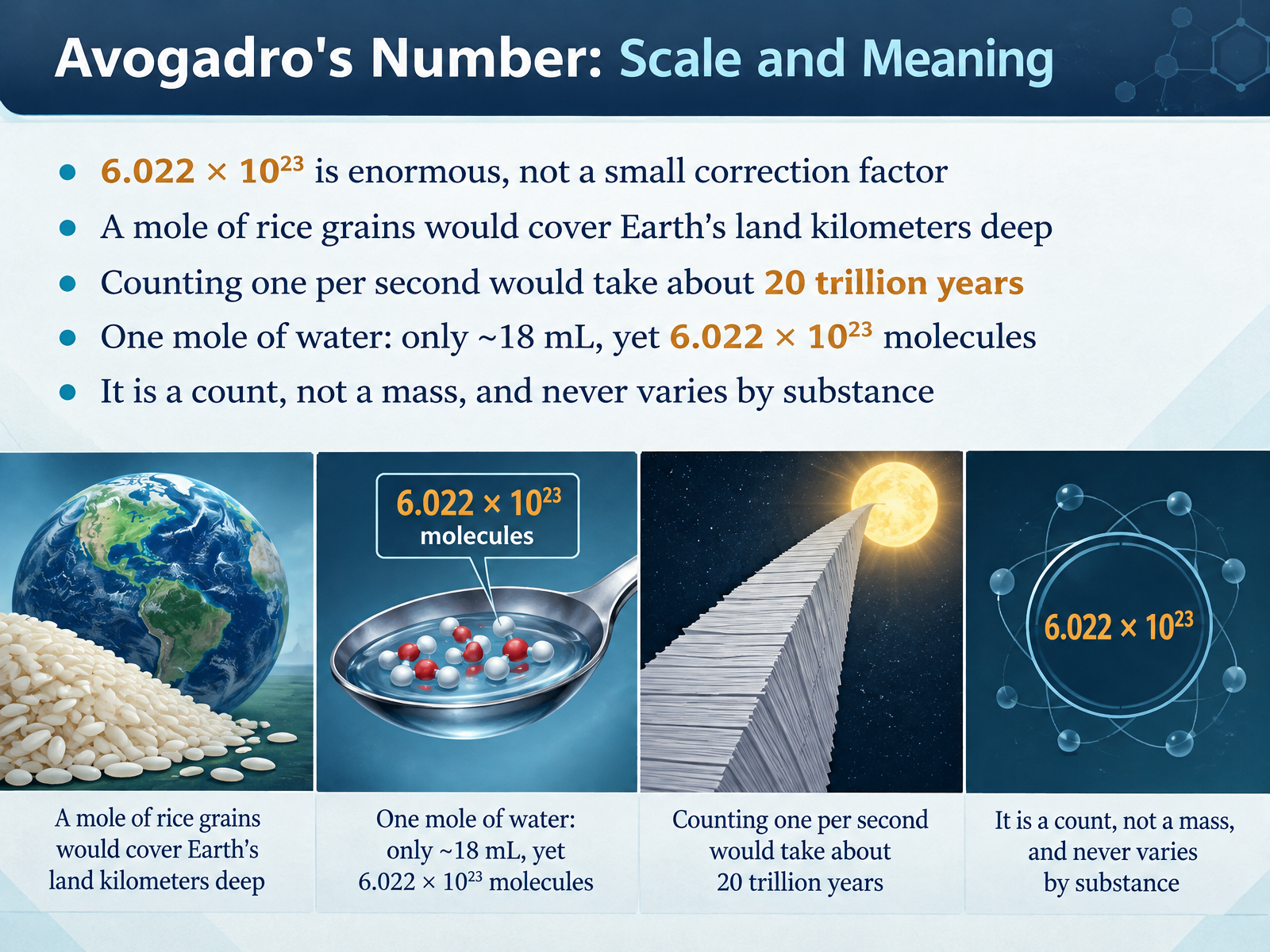
- 07Avogadro's Number: Scale and MeaningLet's put a real sense of scale on Avogadro's number. It is six point zero two two times ten to the twenty-third. That is enormous, not a small correction factor. Here is one way to picture it. A mole of rice grains would cover all of Earth's land kilometers deep. And if you counted one particle per second, it would take about twenty trillion years. Now for the beautiful part. One mole of water has a mass of about eighteen grams. That is roughly one tablespoon. Yet that small sip holds six point zero two two times ten to the twenty-third water molecules. Does that make sense? So the key idea is this. The mole is a count, not a mass, and it never varies by substance. One mole always means the same number of particles. Next, let's see how that count connects to mass in Molar Mass: The Mass of One Mole.
 learningcentre.vcc.capdesas.orgthenational.academy+21 min
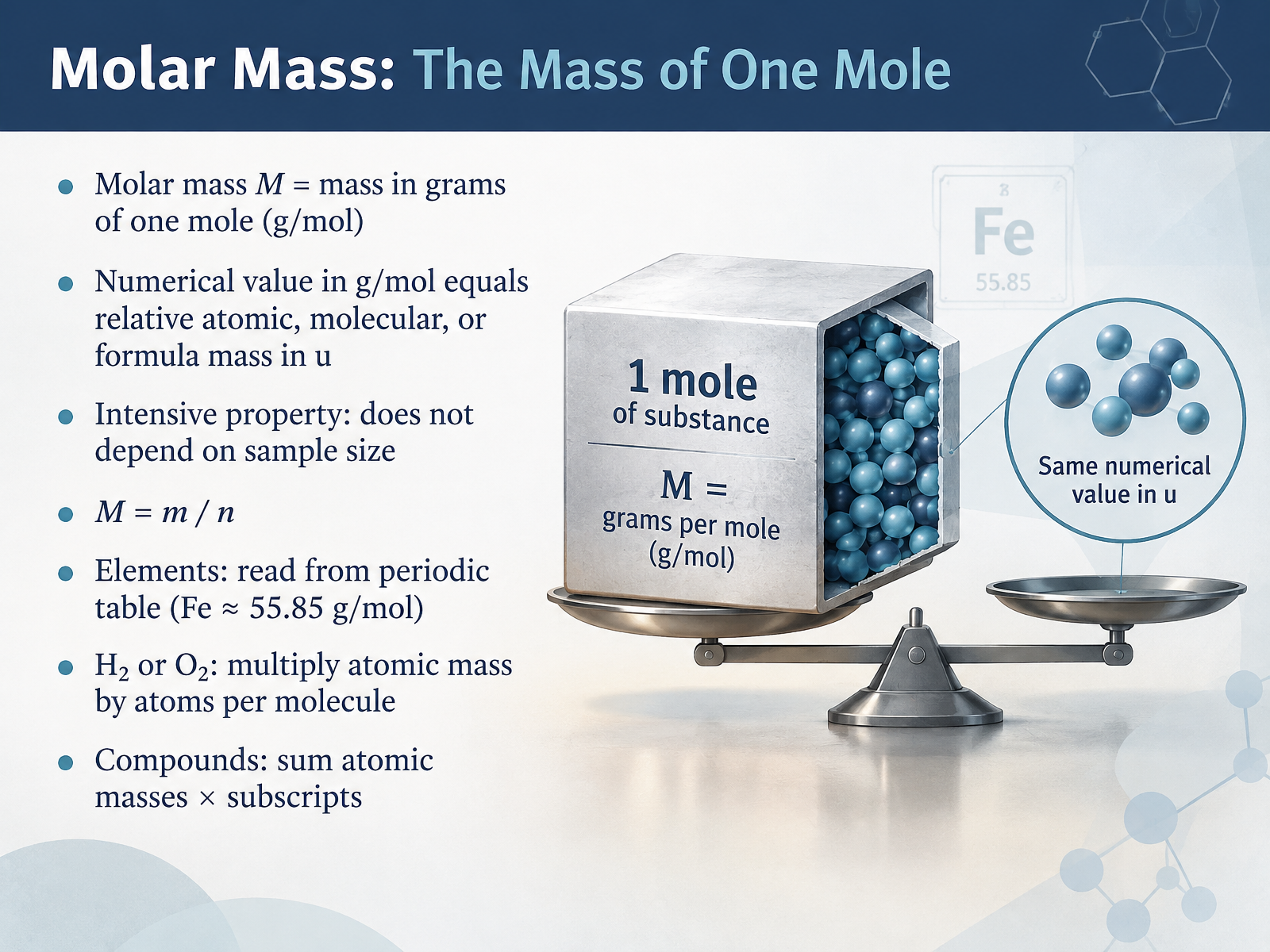
- 08Molar Mass: The Mass of One MoleNow let's talk about molar mass, which is the mass of one mole of a substance. Its unit is grams per mole. Here's the key idea: the number you see on the periodic table for atomic mass, in atomic mass units, becomes the same number in grams per mole. So iron has an atomic mass of about fifty-five point eight five unified atomic mass units, and its molar mass is fifty-five point eight five grams per mole. That means one mole of iron atoms has a mass of fifty-five point eight five grams. Molar mass is an intensive property, so it does not depend on how much sample you have. The relationship is M equals m divided by n, where M is molar mass, m is mass in grams, and n is moles. For elements, just read the value from the periodic table. For diatomic molecules like H two or O two, multiply the atomic mass by the number of atoms in the molecule. For compounds, add up the atomic masses of each element, multiplied by its subscript in the formula. This is how you connect the microscopic world of atoms to measurable lab quantities. Next, we'll work through some examples step by step.
 physicsclassroom.comchem.libretexts.orggetchemistryhelp.com+22 min
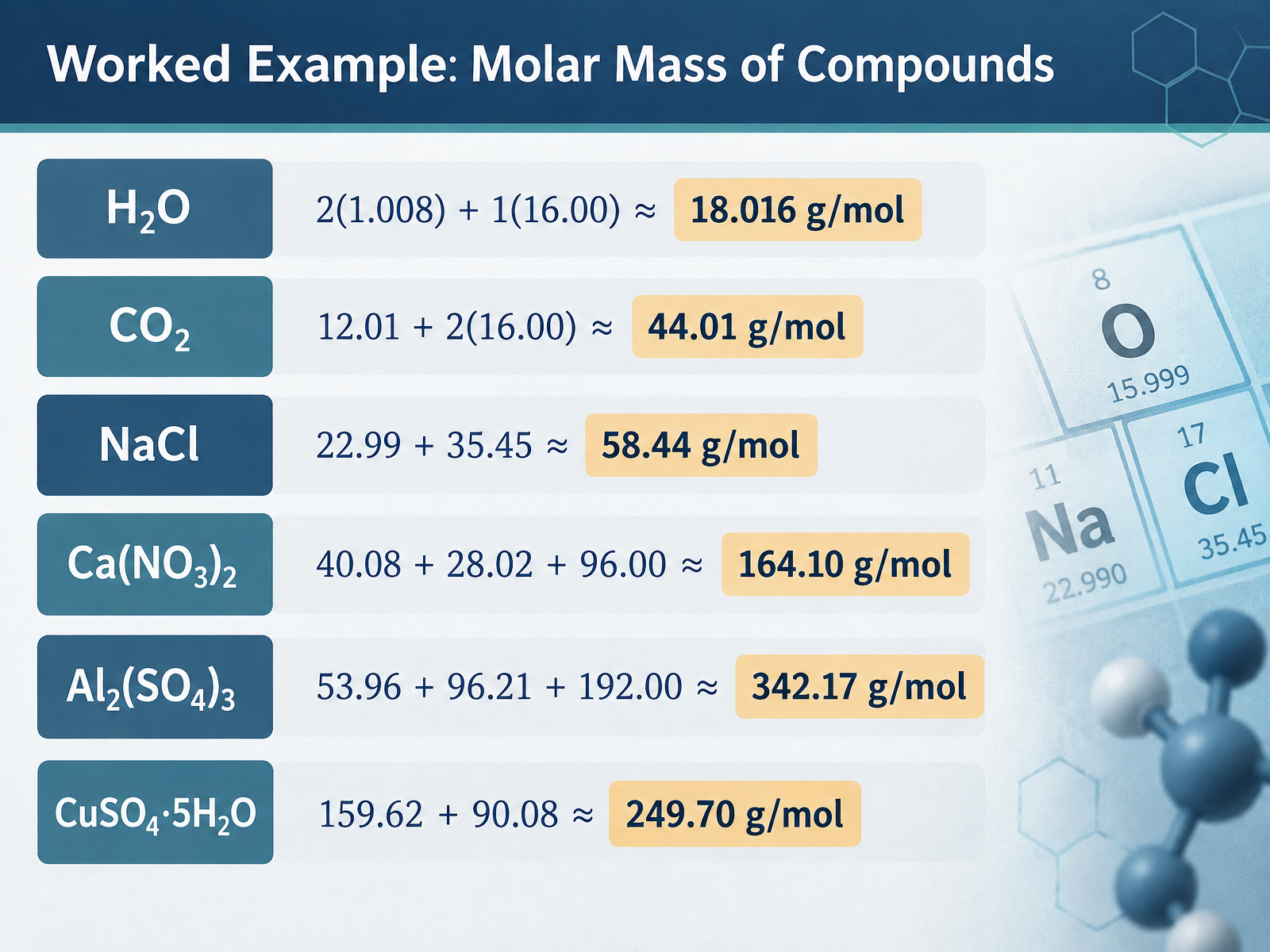
- 09Worked Example: Molar Mass of CompoundsNow let's put this into practice with a worked example: finding the molar mass of compounds. The rule is always the same. Count each atom, multiply by its atomic mass, then add everything up. Start with water, H two O. Two hydrogens at one point zero zero eight, plus one oxygen at sixteen point zero zero, gives approximately eighteen point zero two grams per mole. Does that make sense? Next, carbon dioxide, C O two. Twelve point zero one plus two times sixteen point zero zero equals approximately forty-four point zero one grams per mole. For sodium chloride, NaCl, it's simply twenty-two point nine nine plus thirty-five point four five, which equals fifty-eight point four four grams per mole. Now watch the parentheses carefully. In calcium nitrate, Ca N O three, all twice, the subscript two outside multiplies everything inside. So we get one calcium at forty point zero eight, two nitrogens at twenty-eight point zero two, and six oxygens at ninety-six point zero zero, totaling approximately one hundred sixty-four point one zero grams per mole. The same care applies to aluminum sulfate, Al two S O four, all three. Two aluminums give fifty-three point nine six, three sulfurs give ninety-six point two one, and twelve oxygens give one hundred ninety-two point zero zero, for a total of three hundred forty-two point one seven grams per mole. Finally, hydrates. Copper two sulfate pentahydrate, Cu S O four dot five H two O, means copper sulfate plus five water molecules. The copper sulfate part is one hundred fifty-nine point six two, and the five waters add ninety point zero eight, for a total of two hundred forty-nine point seven zero grams per mole. So the key takeaway is to count every atom, handle parentheses and dot multipliers correctly, and always attach the unit grams per mole. Next, we'll use these molar masses in core calculations, connecting mass, moles, and particles.
 physicsclassroom.comchem.libretexts.orggetchemistryhelp.com+22 min
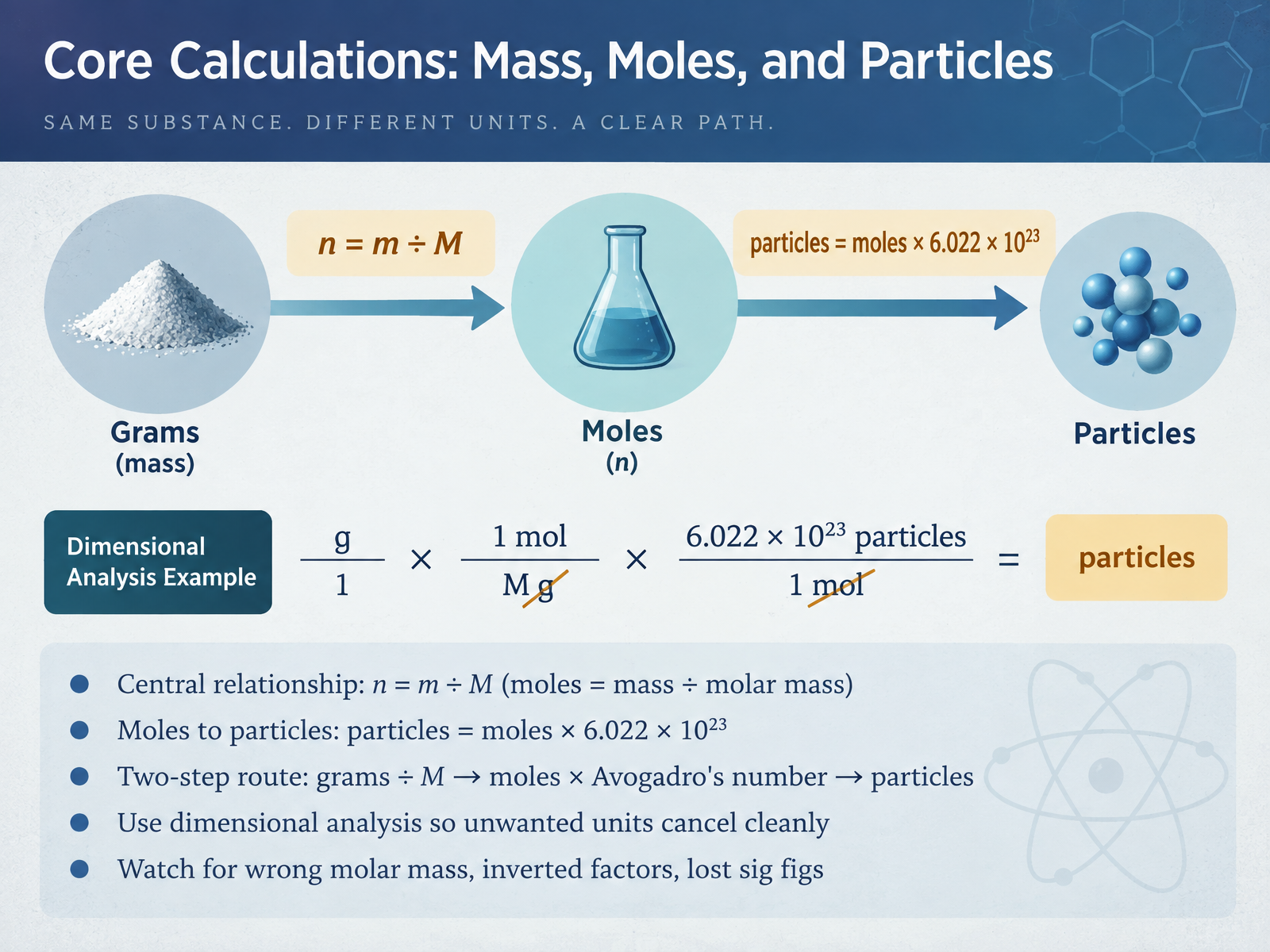
- 10Core Calculations: Mass, Moles, and ParticlesNow let's put these ideas together in the core calculations. The central relationship is n equals m divided by M. In words, moles equal mass in grams divided by molar mass. If you know the grams on your balance and the molar mass from the periodic table, you know the moles. To go from moles to particles, multiply by Avogadro's number, six point zero two two times ten to the twenty-third. For example, twenty grams of chlorine gas, with a molar mass of about seventy point nine grams per mole, gives roughly zero point two eight moles, then about one point seven times ten to the twenty-third molecules. Notice the two-step route. Grams divided by molar mass gives moles, then moles times Avogadro's number gives particles. Use dimensional analysis so unwanted units cancel cleanly. And watch for three common errors. Using the wrong molar mass, inverting a conversion factor, or dropping significant figures too early. Keep units attached, cancel carefully, and round only at the end. Next, we'll practice these conversions together in Guided Practice: Conversion Set.
 physicsclassroom.comchem.libretexts.orggetchemistryhelp.com+21 min
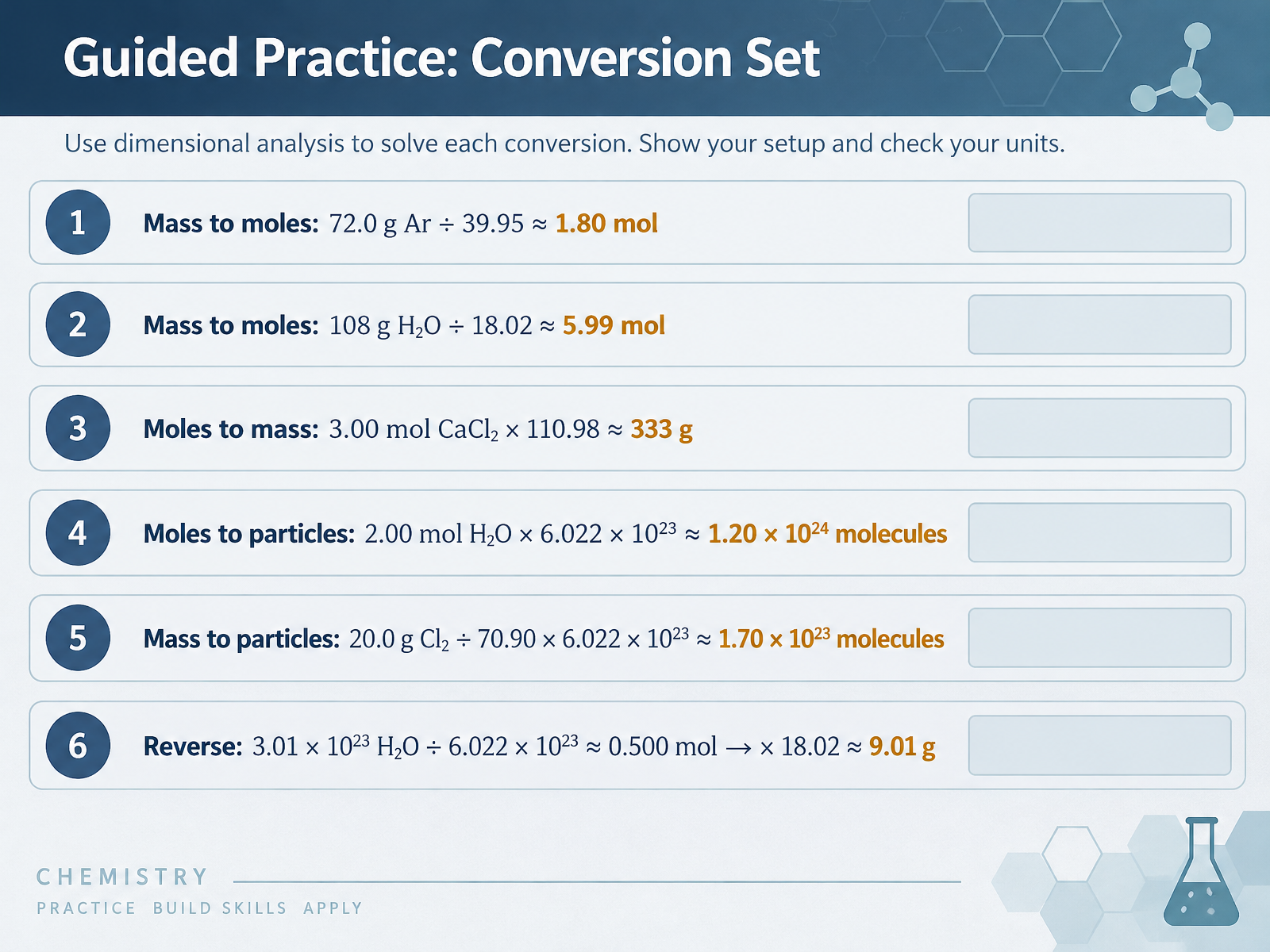
- 11Guided Practice: Conversion SetNow let's put those conversions to work with some guided practice. We'll walk through a set of examples, thinking aloud as we go. First, mass to moles. Take 72.0 grams of argon. The molar mass of argon is about 39.95 grams per mole. So we divide 72.0 by 39.95, and we get approximately 1.80 moles. Notice how the grams cancel, leaving moles. That's the unit check.
Next, 108 grams of water divided by 18.02 grams per mole gives approximately 5.99 moles.
Now, going the other way: moles to mass. We have 3.00 moles of calcium chloride. Its molar mass is 110.98 grams per mole. Multiply 3.00 by 110.98, and we get approximately 333 grams.
Then, moles to particles: 2.00 moles of water times Avogadro's number, 6.022 times 10 to the twenty-third. That gives approximately 1.20 times 10 to the twenty-fourth molecules.
For mass to particles, we do it in two steps. Start with 20.0 grams of chlorine gas. Divide by its molar mass, 70.90 grams per mole, to get moles. Then multiply by Avogadro's number. The result is approximately 1.70 times 10 to the twenty-third molecules.
Finally, a reverse problem: We have 3.01 times 10 to the twenty-third molecules of water. Divide by Avogadro's number to get 0.500 moles. Then multiply by the molar mass, 18.02 grams per mole, to get 9.01 grams.
Does that make sense? Each step is just canceling units. Practice these, and the flow becomes second nature. Next, we'll see a classroom demonstration with a one molar display.
 physicsclassroom.comchem.libretexts.orggetchemistryhelp.com+22 min
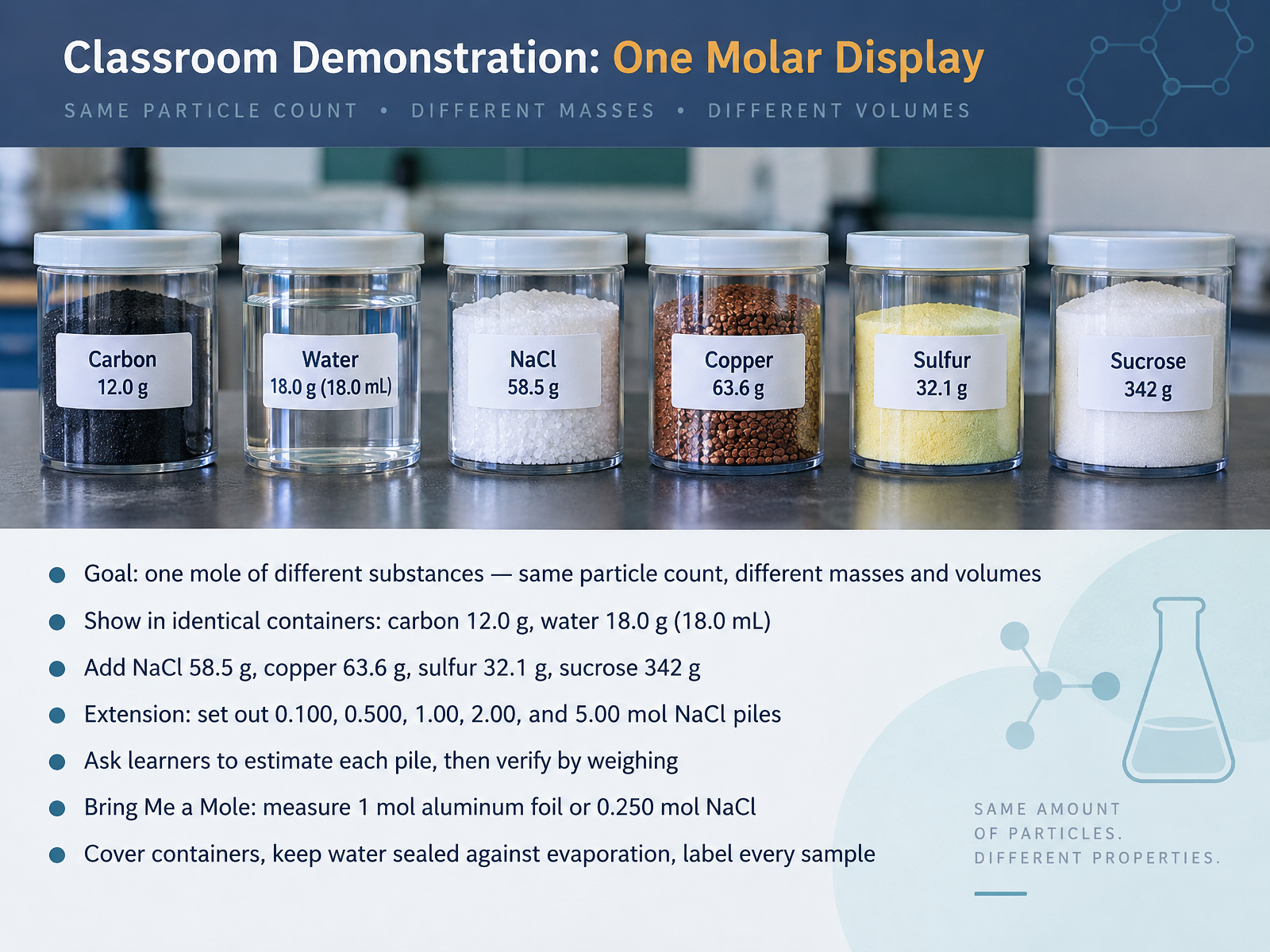
- 12Classroom Demonstration: One Molar DisplayNow let's bring the mole into the classroom with a demonstration called the One Molar Display. The goal is simple: show one mole of several different substances, each holding the same particle count, but with very different masses and volumes. Start with identical containers. Put twelve point zero grams of carbon in one, and eighteen point zero grams of water in another, which is eighteen point zero milliliters. Then add fifty-eight point five grams of sodium chloride, sixty-three point six grams of copper, thirty-two point one grams of sulfur, and three hundred forty-two grams of sucrose. The contrast is striking. Same number of particles, wildly different amounts. To extend this, set out sodium chloride piles at zero point one zero zero, zero point five zero zero, one point zero zero, two point zero zero, and five point zero zero moles. Ask learners to estimate each pile, then verify by weighing. For a hands-on challenge, try Bring Me a Mole: have them measure one mole of aluminum foil, or zero point two five zero moles of sodium chloride. A few practical tips. Cover the containers, keep the water sealed against evaporation, and label every sample clearly. That way, the display stays accurate and reusable. Up next, we will look at Common Misconceptions and Teaching Strategies.
 2 min
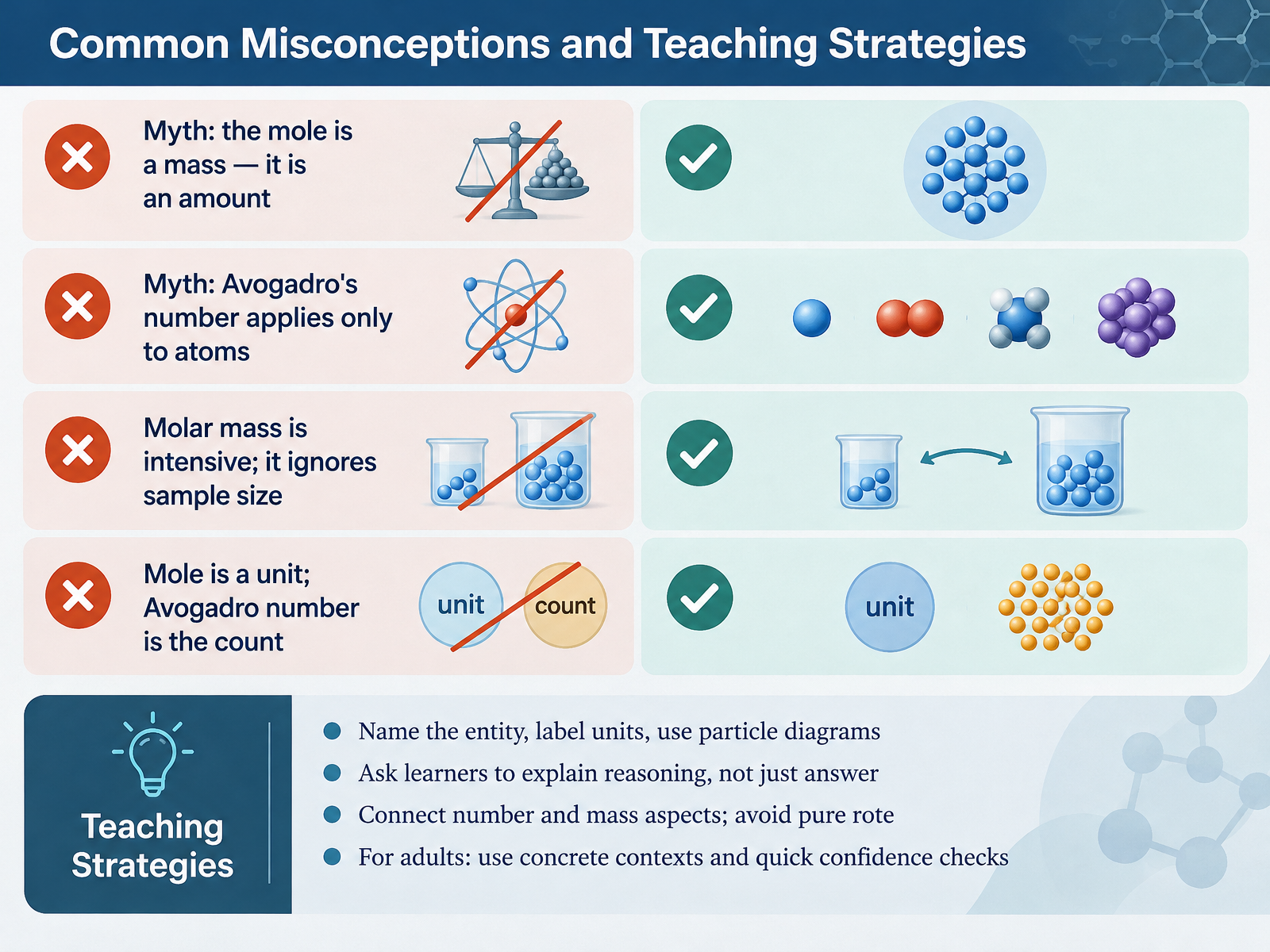
- 13Common Misconceptions and Teaching StrategiesLet's clear up the mistakes that trip people up. First myth: the mole is a mass. It isn't. It's an amount, a count, like a dozen. Second myth: Avogadro's number applies only to atoms. It counts any entity, molecules, ions, electrons. Molar mass is intensive, meaning it ignores sample size. And remember: the mole is the unit, while Avogadro's number is the count. As teachers, name the entity, label units clearly, and use particle diagrams. Ask learners to explain their reasoning, not just give an answer. Connect the number side and the mass side so it isn't pure rote. For adult learners, use concrete contexts and quick confidence checks. Next, we move to assessment, answer keys, and next steps.
 learningcentre.vcc.capdesas.orgthenational.academy+21 min
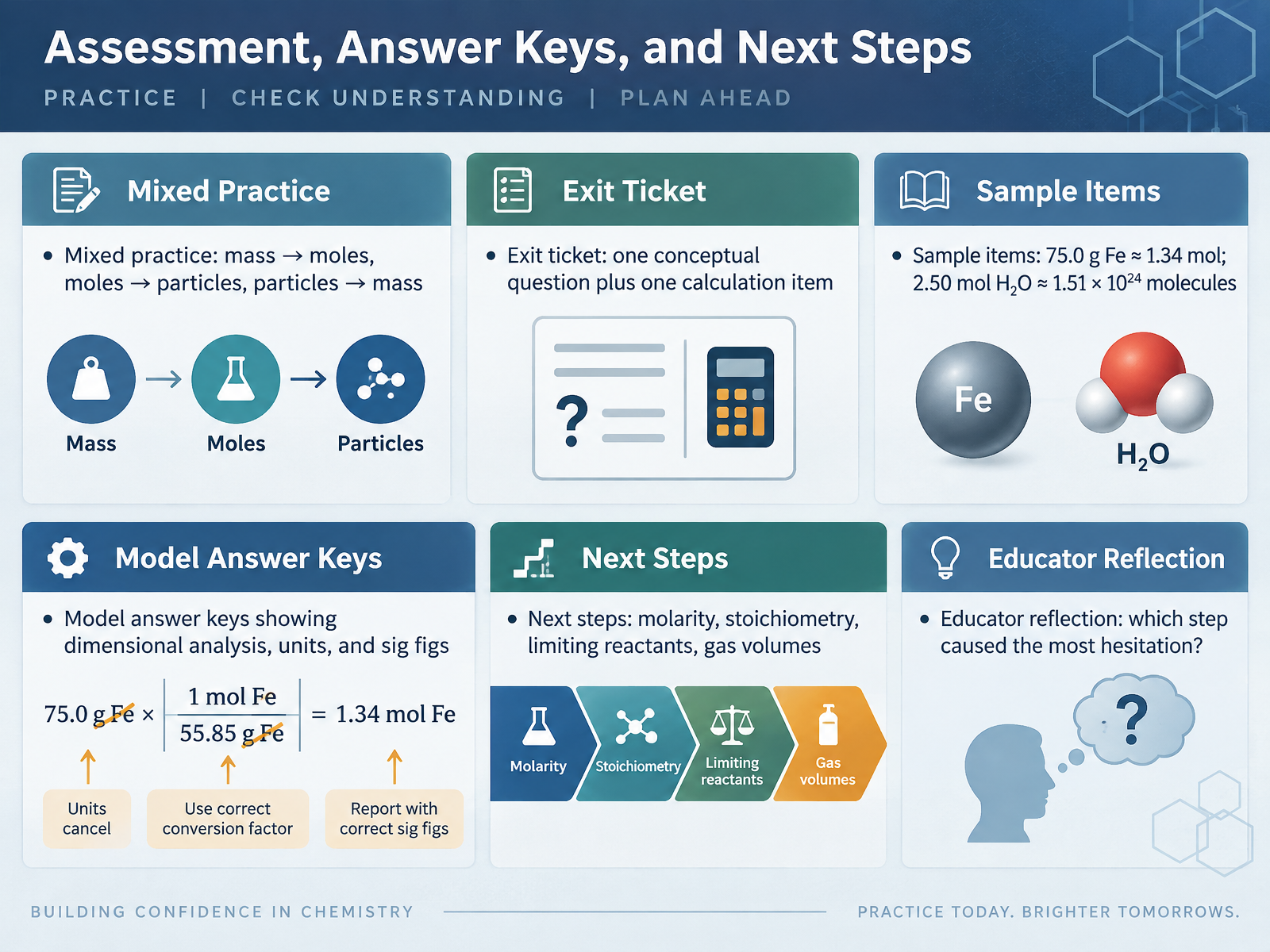
- 14Assessment, Answer Keys, and Next StepsLet's wrap up with assessment. For mixed practice, cycle through all three directions: mass to moles, moles to particles, and particles back to mass. Then close with a quick exit ticket: one conceptual question plus one calculation item. For example, seventy five point zero grams of iron converts to approximately one point three four moles. And two point five zero moles of water gives you approximately one point five one times ten to the twenty fourth molecules. Model your answer keys so students see dimensional analysis, units that cancel, and correct significant figures, not just the final number. Looking ahead, these skills feed directly into molarity, stoichiometry, limiting reactants, and gas volumes. And educators, take a moment to reflect: which step caused the most hesitation? That tells you exactly where to reteach. Thanks for joining me. You now have a solid foundation in counting atoms by weighing, so keep practicing, and I'll see you in the next topic.
 physicsclassroom.comchem.libretexts.orggetchemistryhelp.com+22 min
Take the deck with you
Download this course as a file — free, no sign-up needed.
- PDF handoutEvery slide page, ready to print or share.15 pages · 3.8 MBDownload
- Narrated PowerPointThe deck that presents itself — every slide carries the digital human's narration video.15 pages · 16.1 MBDownload
- PowerPoint slidesThe full deck as a .pptx — open it in PowerPoint, Keynote, or Google Slides.15 pages · 3.8 MBDownload
Free to use in your own training — please keep the PersonWise credit page at the end.
Have your own deck? Turn it into a course
Sources consulted
Web sources consulted while building this course.
- IUPAC - unified atomic mass unit (U06554) — goldbook.iupac.org
- IUPAC - atomic mass constant (A00497) — goldbook.iupac.org
- Dalton (unit) — en.wikipedia.org
- dalton — schemas.optimade.org
- 2.10: Atomic Mass Unit — chem.libretexts.org
- Why Use Moles? — learningcentre.vcc.ca
- Share Suggestion — pdesas.org
- The mole GCSE | KS4 | Y10 Combined science Higher Edexcel | Lesson Resources | Oak National Academy — thenational.academy
- Counting the Uncountable: The Chemist's Secret Tool - The Mole | OER Commons — oercommons.org
- How to calculate moles | Infographics | RSC Education — edu.rsc.org
- SI base unit: mole (mol) — bipm.org
- SI Units – Amount of Substance — nist.gov
- The International System of Units (SI), 2019 Edition — nvlpubs.nist.gov
- Mise en pratique - mole - Appendix 2 - SI Brochure — bipm.org
- Resolution 1 (2018) - BIPM — bipm.org
- How to Calculate Molar Mass with Examples — physicsclassroom.com
- 6.5: Molar Mass - Chemistry LibreTexts — chem.libretexts.org
- Chemistry Lesson: Molar Mass - Get Chemistry Help — getchemistryhelp.com
- 5.4: Counting Molecules by the Gram - Chemistry LibreTexts — chem.libretexts.org
- Molar Mass Calculation: Step-by-Step Worked Examples for Compounds, Hydrates, and Unknown Formulas | ChemistryIQ — chemistryaitutor.com