Begin
14 pages · ~28 min
Chemical Equilibrium & Le Chatelier's Principle
This training explains chemical equilibrium and Le Chatelier's Principle, helping learners predict how concentration, temperature, and pressure changes shift equilibrium in chemical systems.
A digital instructor presents all 14 pages. Hold “Ask” at any point and ask out loud — the answer comes from this course. No sign-up needed.
What you’ll learn
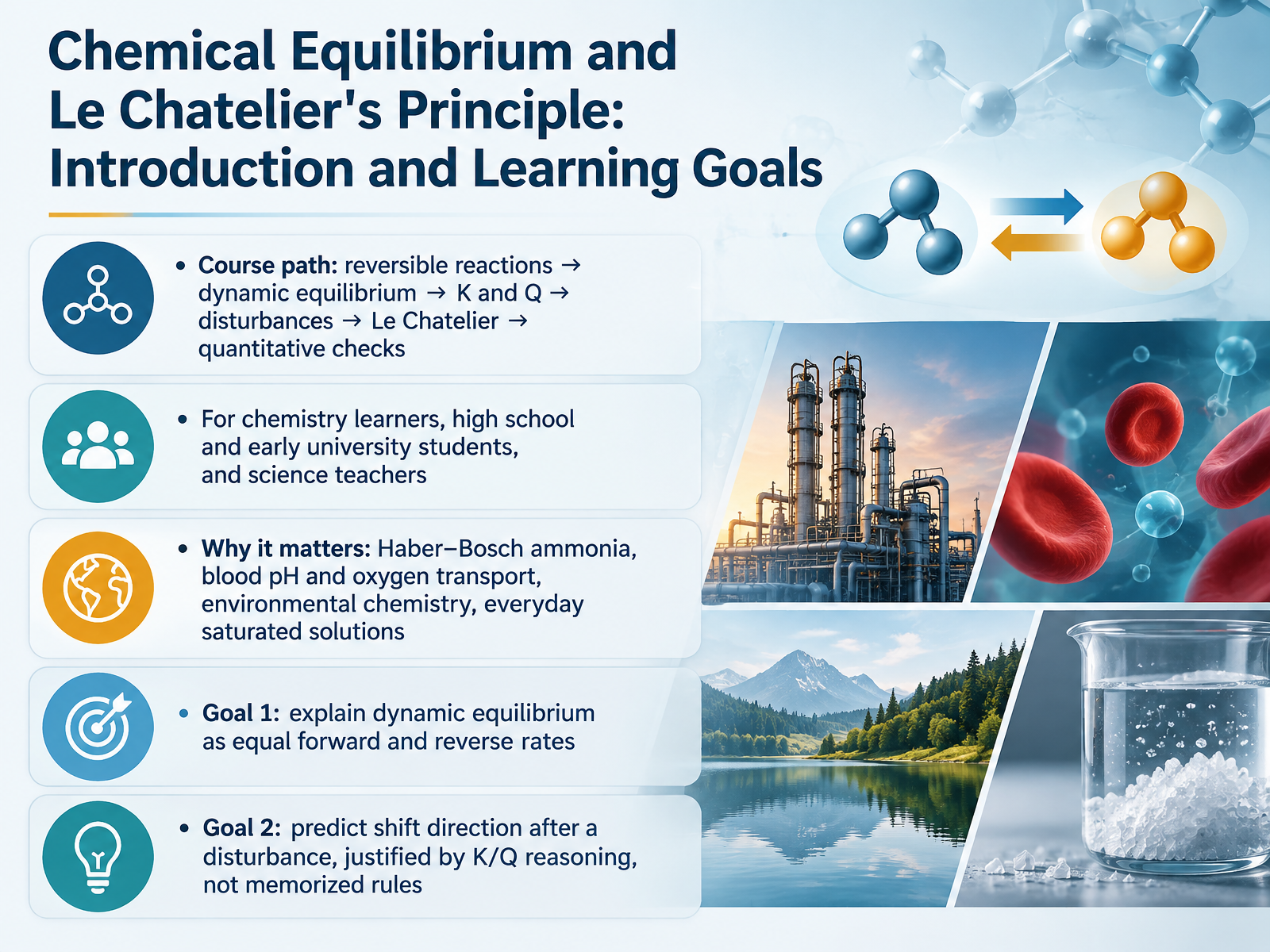
- 01Chemical Equilibrium and Le Chatelier's Principle: Introduction and Learning GoalsWelcome. Today we begin chemical equilibrium and Le Chatelier's principle. We will move step by step, from reversible reactions, to dynamic equilibrium, to the equilibrium constant K and the reaction quotient Q, then to disturbances and Le Chatelier, and finally to quantitative checks. This course is for chemistry learners, high school and early university students, and science teachers. Why does it matter? The Haber-Bosch process for ammonia, blood pH and oxygen transport, environmental chemistry, and everyday saturated solutions all depend on equilibrium. Here are our two main goals. First, explain dynamic equilibrium as equal forward and reverse rates, not a stopped reaction. Second, predict the direction of a shift after a disturbance, and justify it with K and Q reasoning rather than memorized rules. Keep this takeaway in mind: equilibrium is active and balanced, and good predictions come from clear reasoning. Next, we look at reversible reactions and the meaning of dynamic equilibrium.journals.le.ac.ukdoi.orgiopscience.iop.org+21 min
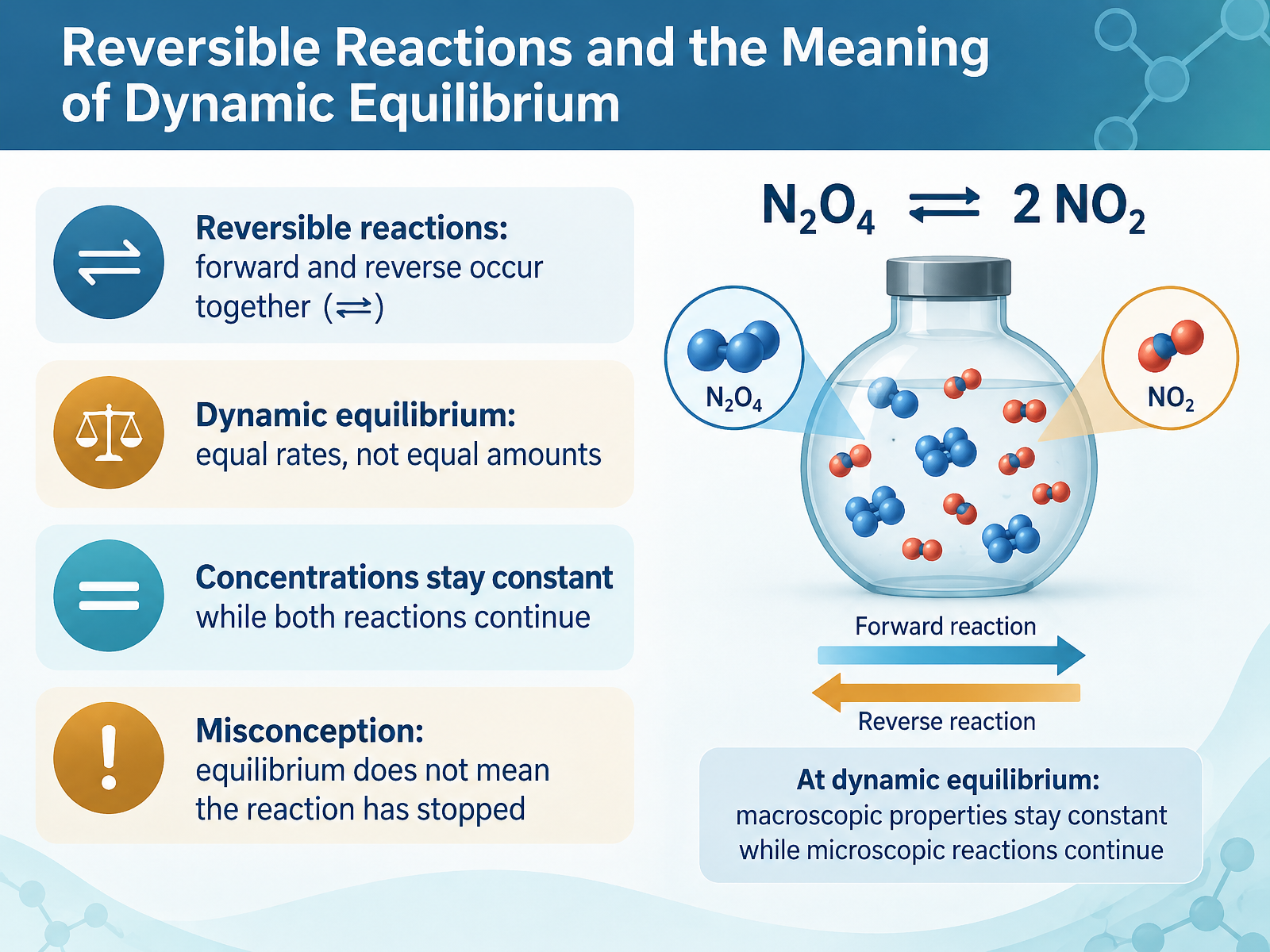
- 02Reversible Reactions and the Meaning of Dynamic EquilibriumLet's look at what makes a reaction reversible. In a reversible reaction, the forward reaction and the reverse reaction happen at the same time, and we show that with a double arrow symbol. Now, dynamic equilibrium is the state where the rates of those two reactions become equal. Notice the careful wording: equal rates, not equal amounts. At equilibrium, the concentrations of reactants and products stay constant, even though both reactions keep going. This is the key misconception to clear up. Equilibrium does not mean the reaction has stopped. It means the system is active, with changes in one direction balanced by changes in the other. Think of water flowing into and out of a bathtub at the same rate: the water level stays steady, but the flow never stops. Takeaway: reversible reactions run both ways, and dynamic equilibrium means equal forward and reverse rates, with constant concentrations while both reactions continue. Next, we will see how to describe equilibrium mathematically with the equilibrium constant K.
 1 min
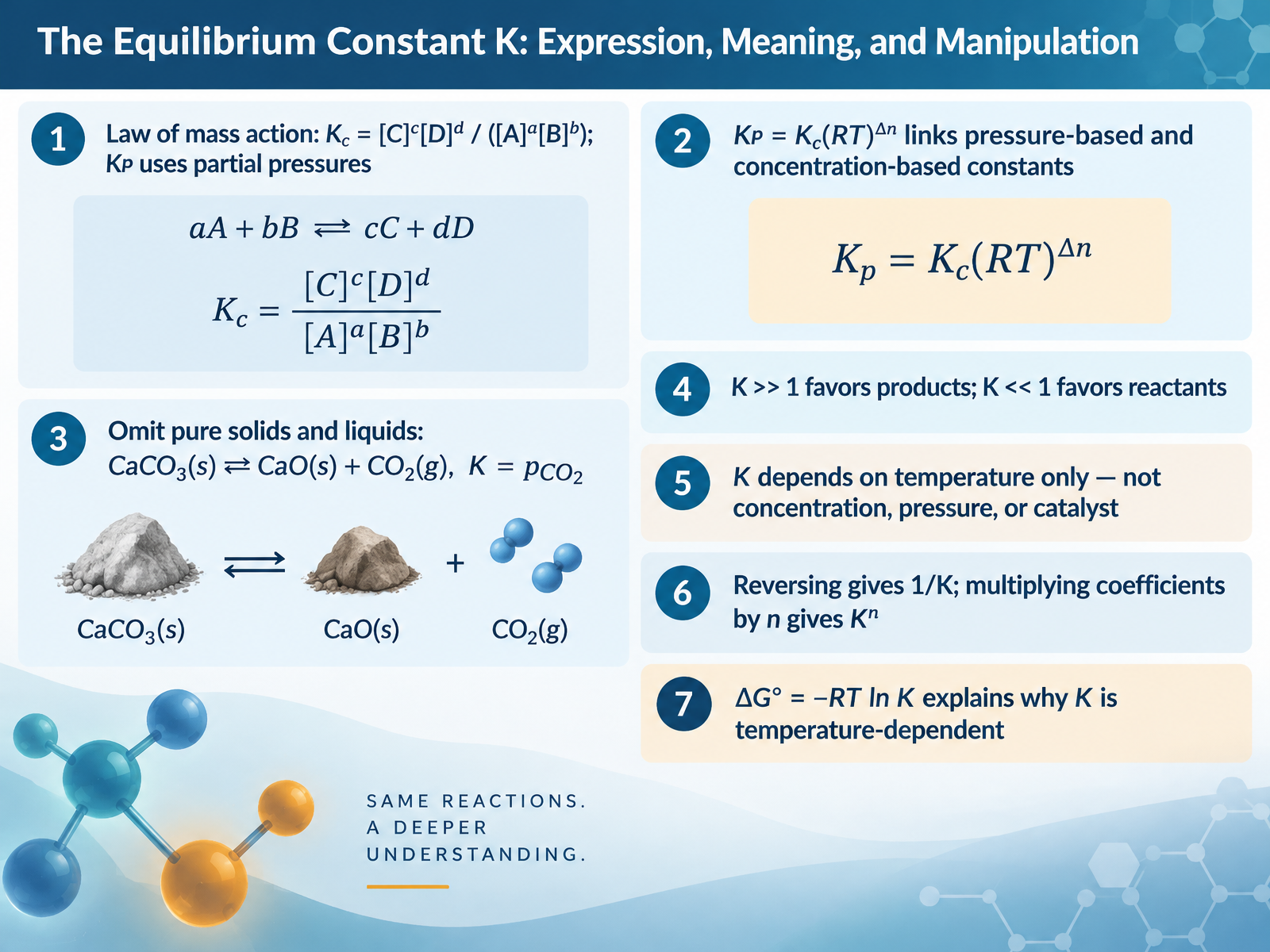
- 03The Equilibrium Constant K: Expression, Meaning, and ManipulationNow let's look at the equilibrium constant, K. Start with the law of mass action. For a general reaction, K c equals the product concentrations, each raised to its coefficient, divided by the reactant concentrations, each raised to its coefficient. When you use partial pressures instead, you write K p, and K p equals K c times R T, raised to the power delta n. Here, delta n is the change in moles of gas. A key rule: leave out pure solids and liquids. For example, in the decomposition of calcium carbonate, the constant is simply the partial pressure of carbon dioxide. What does K tell you? A large K, much greater than one, favors products. A small K, much less than one, favors reactants. And remember, K depends only on temperature, not on concentration, pressure, or a catalyst. Two useful manipulations: reversing a reaction gives one over K, and multiplying the coefficients by n gives K to the power n. The temperature dependence comes from the relationship delta G standard equals negative R T natural log K. Quick takeaway: write K correctly, omit pure solids and liquids, and use its size to judge which side is favored. Next, we move to the reaction quotient Q and the three-case logic for predicting shift.
 2 min
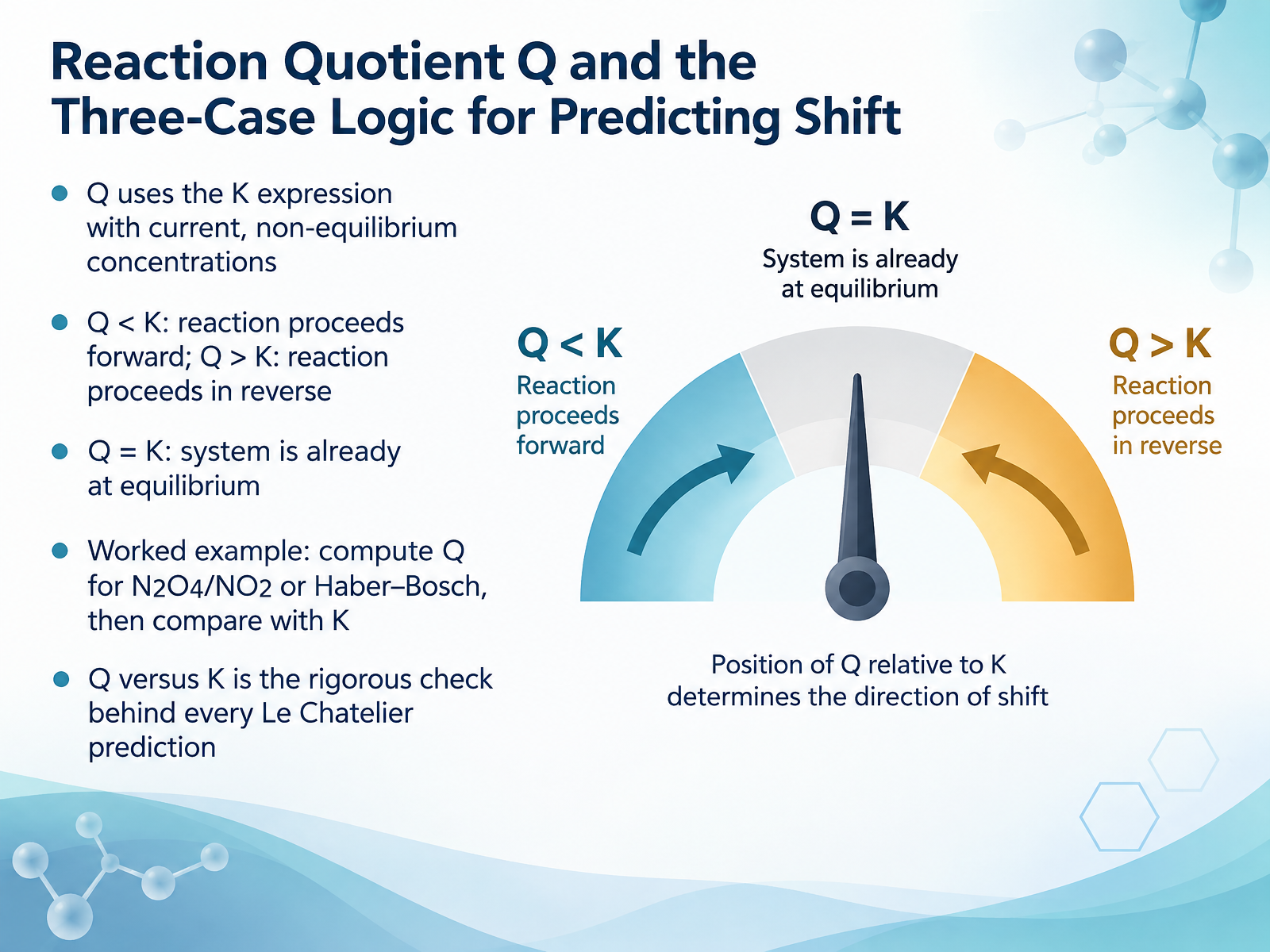
- 04Reaction Quotient Q and the Three-Case Logic for Predicting ShiftNow let's turn to the reaction quotient, Q. Q uses the same equilibrium expression as K, but with the concentrations you measure right now, before the system has settled. Comparing Q with K gives you three clear cases. If Q is less than K, there are too few products, so the reaction proceeds forward. If Q is greater than K, there are too many products, so it proceeds in reverse. And if Q equals K, the system is already at equilibrium. Let's compute Q for a simple case. Suppose you add nitrogen dioxide and dinitrogen tetroxide to a container. You calculate Q by squaring the nitrogen dioxide concentration and dividing by the dinitrogen tetroxide concentration. Then compare that number with K. This rigorous check is the real logic behind every Le Chatelier prediction. Takeaway: Q versus K tells you the direction of change. Next, we'll use ICE tables for quantitative calculations.
 1 min
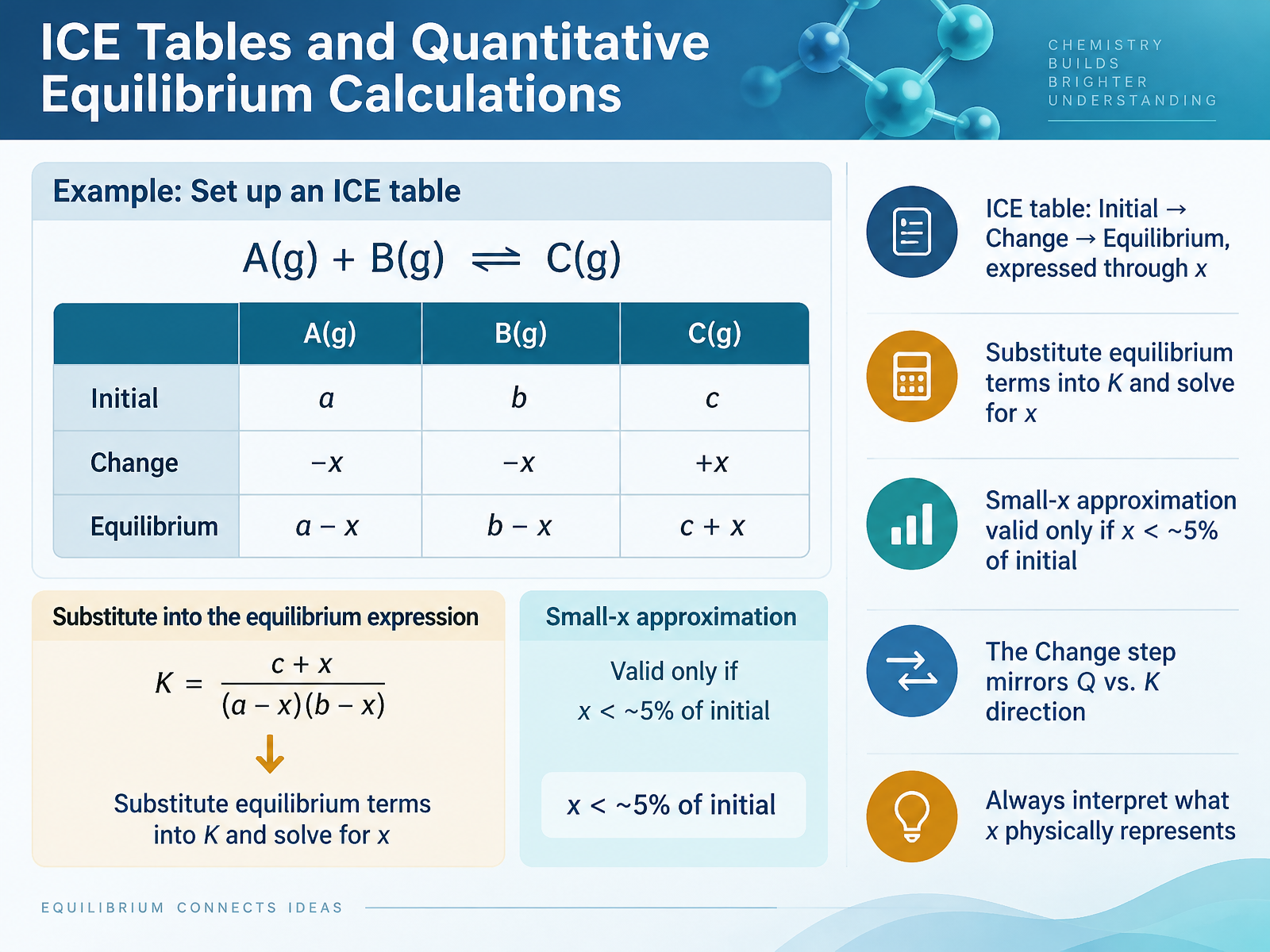
- 05ICE Tables and Quantitative Equilibrium CalculationsNow let's put equilibrium math into practice with ICE tables. ICE stands for Initial, Change, and Equilibrium. You list each substance's starting concentration, write the change in terms of x, then add the rows to get equilibrium terms. Next, substitute those equilibrium expressions into K and solve for x. Often you can simplify with the small x approximation, but it is only valid when x is less than about five percent of the initial concentration. Check that before you drop x. Also, the Change step must mirror the direction of reaction, the same logic as comparing Q with K. Finally, always interpret what x physically represents. It is a concentration change, not just a number. So if x comes out larger than the initial value, stop and recheck. Takeaway: build the table, justify every approximation, and translate x back into real concentrations. Next, we turn to Le Chatelier's Principle: Statement, Logic, and Honest Caveats.
 1 min
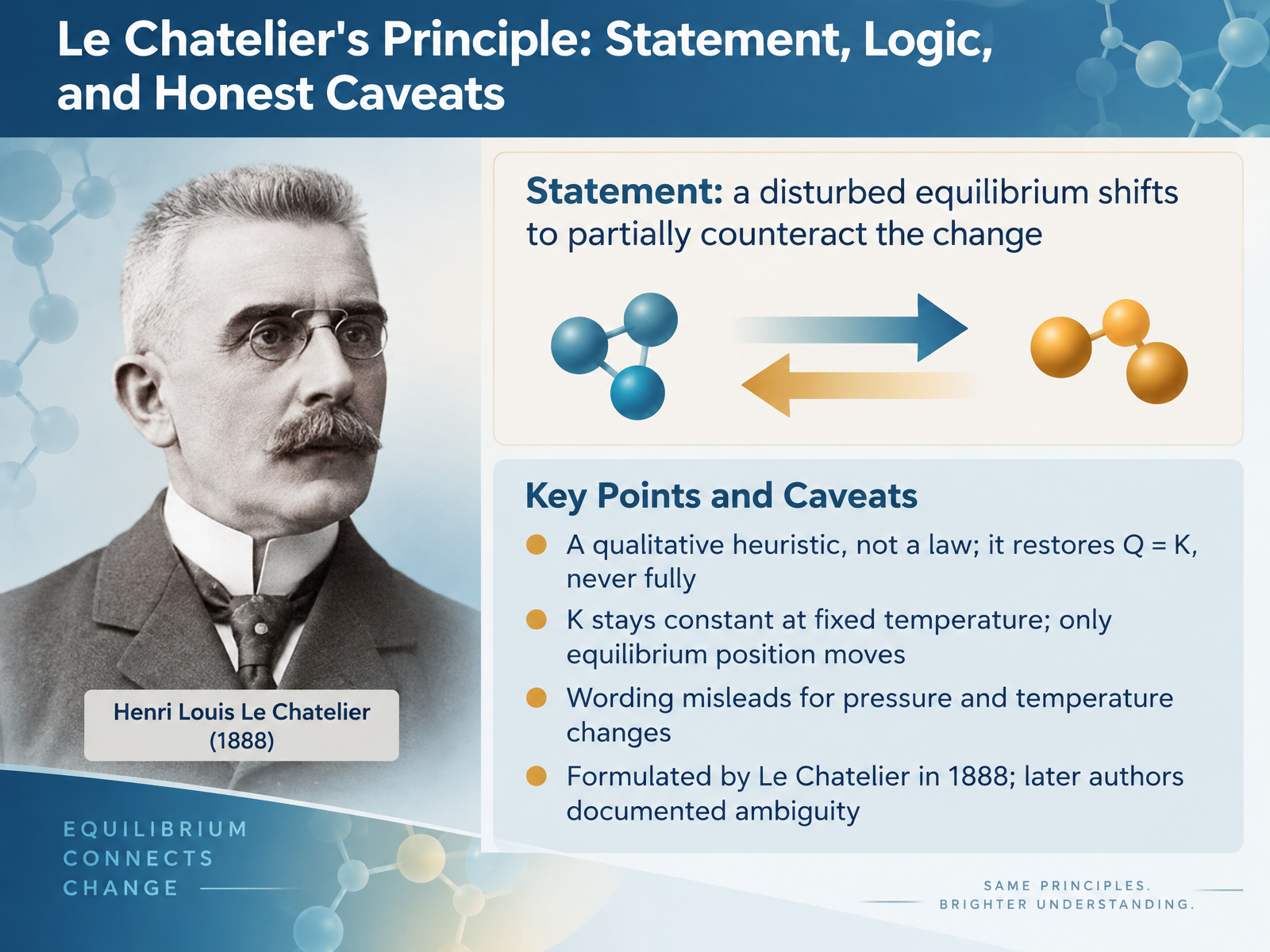
- 06Le Chatelier's Principle: Statement, Logic, and Honest CaveatsLet's look closely at Le Chatelier's principle, its logic, and its honest caveats. The classic statement says this. If an equilibrium is disturbed, the system shifts to partially counteract the change. Treat this as a qualitative heuristic, not a law. A heuristic is a practical rule of thumb. When you disturb a system, the reaction quotient Q no longer equals K. The shift restores Q equals K, but it never fully undoes the change. Here is a key distinction. At a fixed temperature, K stays constant. Only the equilibrium position moves, not the constant itself. Be careful with wording. The phrase counteract the change misleads for pressure and temperature changes. For example, raising the temperature favors the endothermic direction, not the exothermic one you might expect from opposing added heat. Finally, Le Chatelier formulated this in 1888, and later authors documented its ambiguity. Takeaway: use the principle for quick insight, then verify with Q and K. Next, we turn to concentration effects, explained through Q versus K.
 edu.rsc.orgensciencias.uab.catpubs.acs.org+22 min
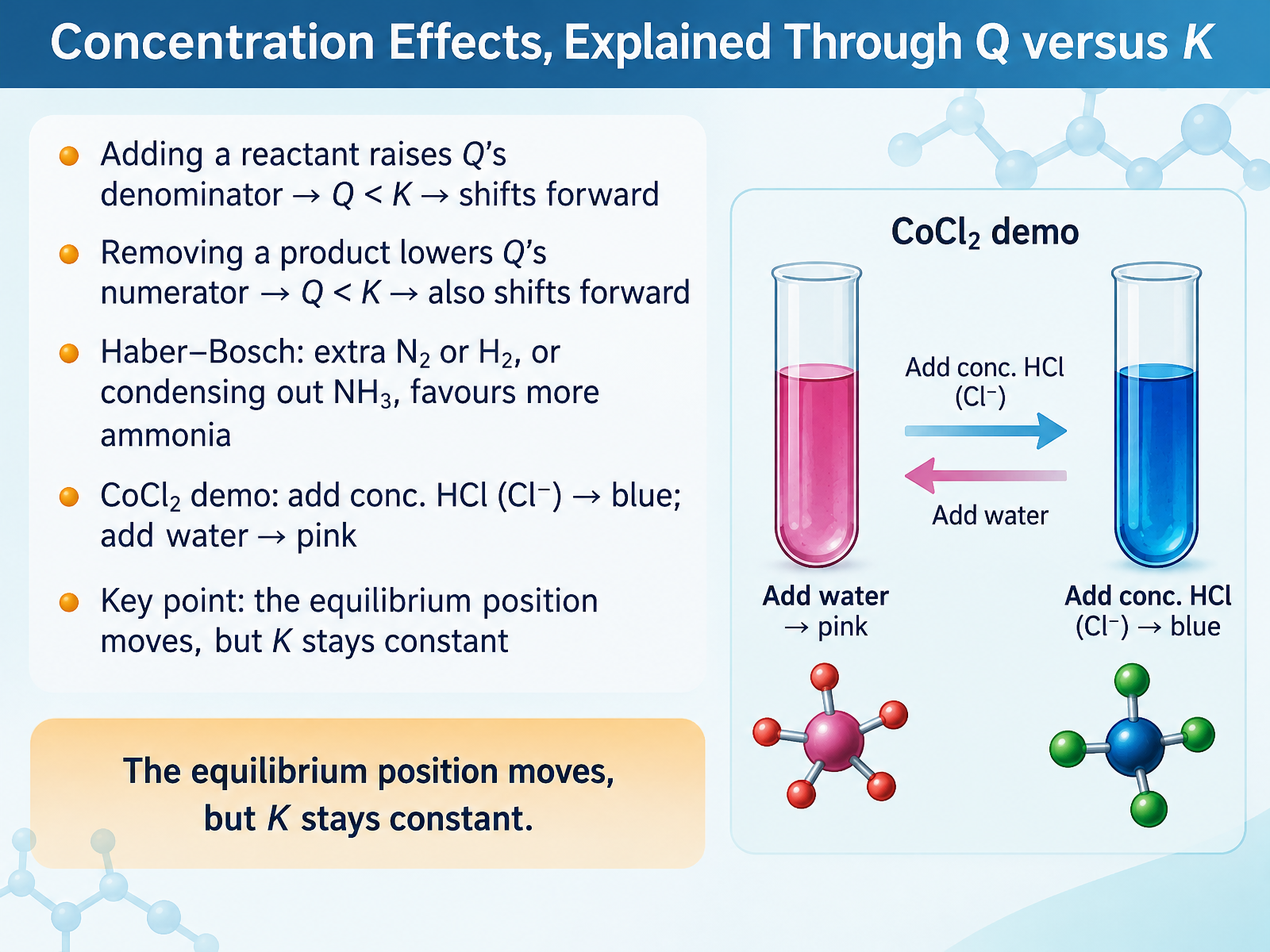
- 07Concentration Effects, Explained Through Q versus KNow let's see what concentration changes actually do, using the reaction quotient Q compared with K. Q has the same form as K, but uses the current concentrations. If you add a reactant, the denominator of Q gets larger. So Q becomes less than K, and the reaction shifts forward to make more products. If you remove a product, the numerator of Q gets smaller. Again, Q is less than K, and the reaction shifts forward. This is the same logic in both cases. In the Haber–Bosch process, adding extra nitrogen or hydrogen, or condensing ammonia out as it forms, pushes the equilibrium toward more ammonia. In the cobalt chloride demonstration, adding concentrated hydrochloric acid increases chloride ions and turns the solution blue. Adding water dilutes the chloride and turns it pink. Here is the key point. The equilibrium position moves, but the equilibrium constant K stays the same at a given temperature. Next, we will look at pressure, volume, and inert gas effects.
 1 min
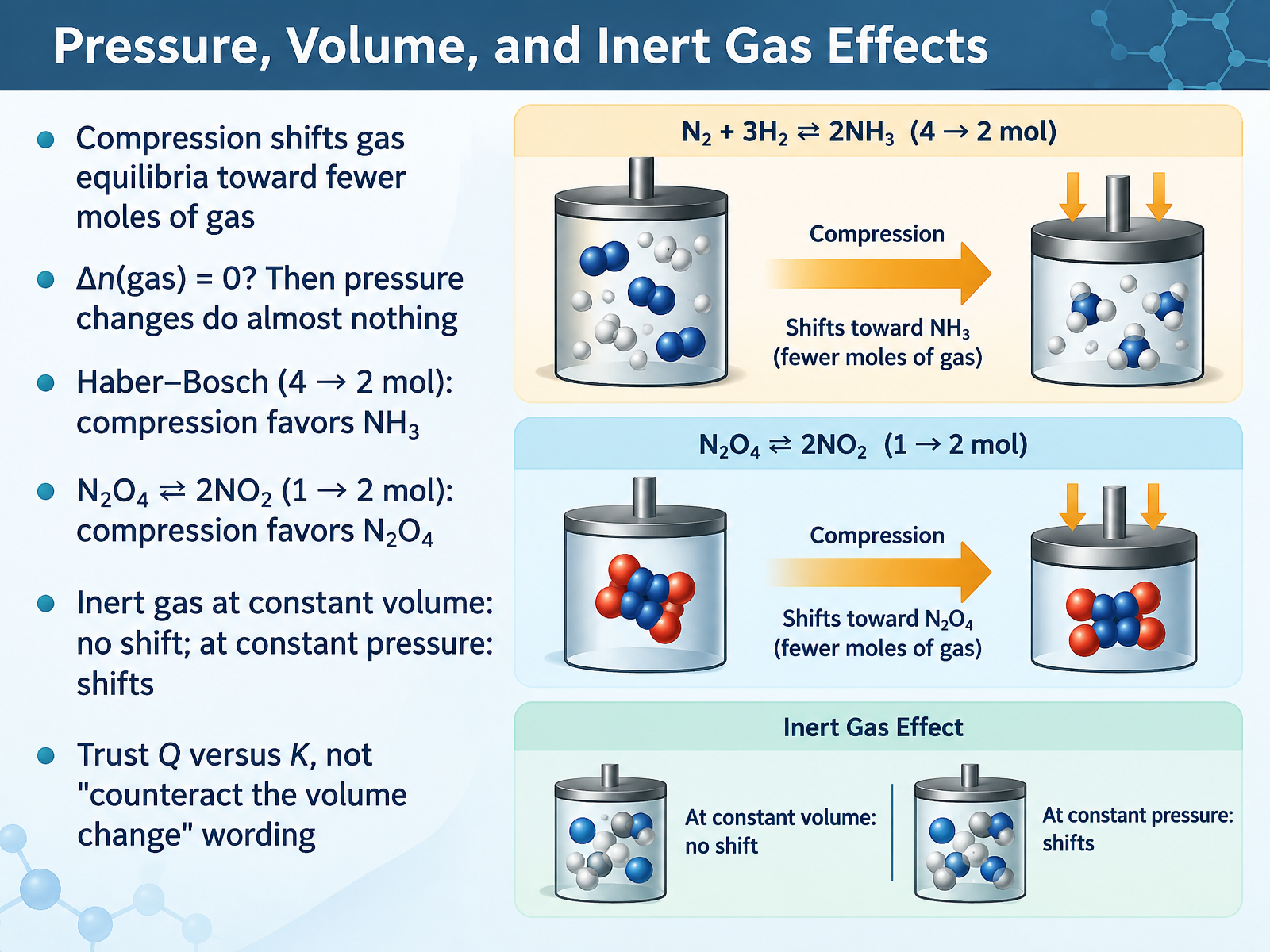
- 08Pressure, Volume, and Inert Gas EffectsNow let's look at how pressure and volume changes affect gas equilibria. When you compress a gas mixture, the system shifts toward the side with fewer moles of gas. That is the observable rule. If the number of gas moles is the same on both sides, denoted delta n of gas equals zero, then pressure changes do almost nothing. Two classic examples make this concrete. In the Haber-Bosch process, four moles of gas become two, so compression favors ammonia production. But in the equilibrium between dinitrogen tetroxide and two molecules of nitrogen dioxide, one mole becomes two, so compression favors dinitrogen tetroxide. Now for an inert gas. Added at constant volume, it causes no shift, because partial pressures of the reacting gases do not change. Added at constant pressure, the volume expands, partial pressures drop, and the equilibrium shifts. A key takeaway for practice: trust the reaction quotient compared with the equilibrium constant. Do not rely on the phrase counteract the volume change. That wording can lead you to the wrong answer. Coming up next, we look at temperature effects and the distinct role of catalysts.
 edu.rsc.orgensciencias.uab.catpubs.acs.org+22 min
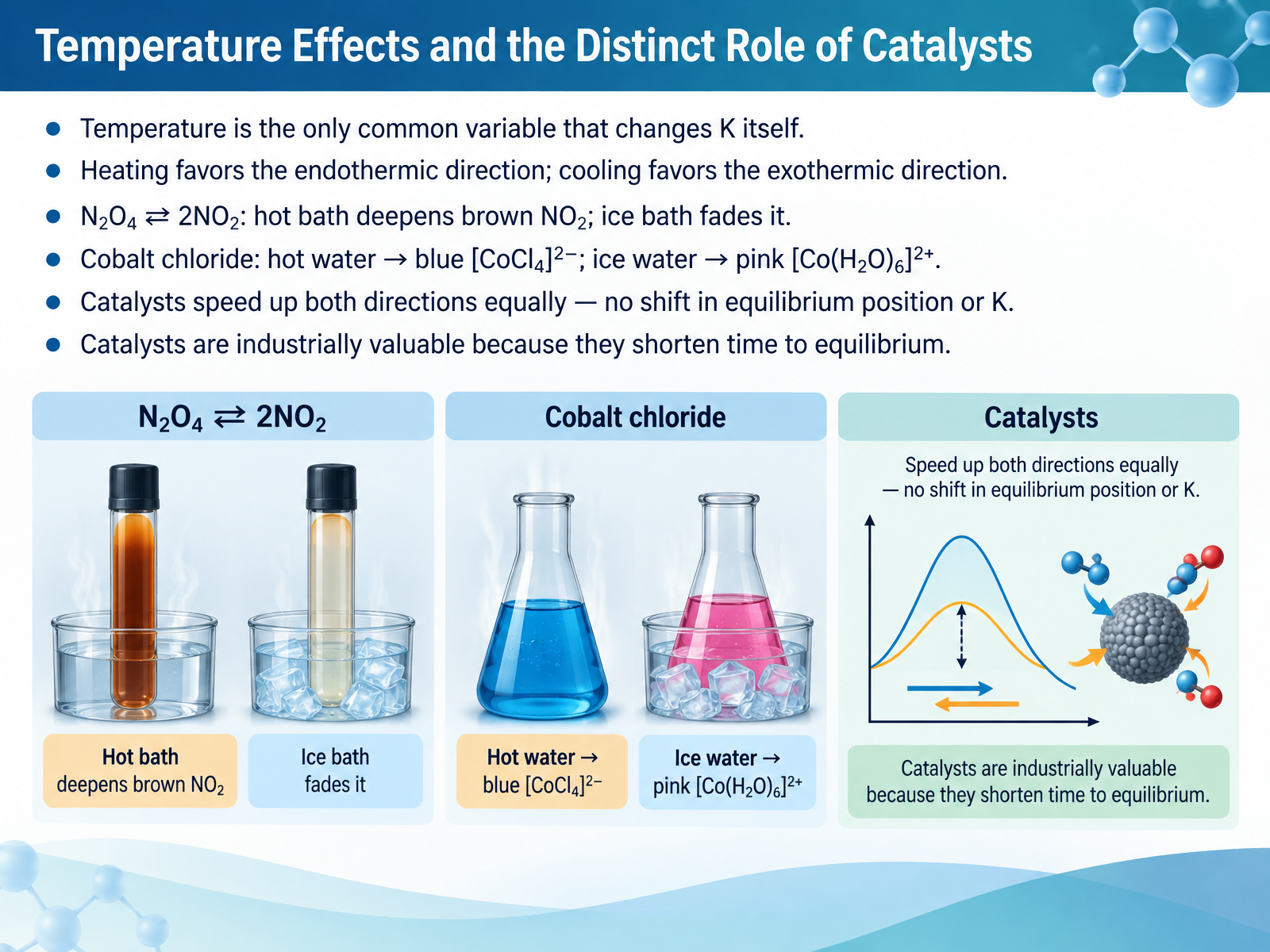
- 09Temperature Effects and the Distinct Role of CatalystsNow let's look at temperature, and at what a catalyst really does. Temperature is the only common variable that changes the value of K itself. Heating favors the endothermic direction. Cooling favors the exothermic direction. You can see this with the equilibrium between dinitrogen tetroxide and nitrogen dioxide. In a hot bath, the brown color of nitrogen dioxide deepens. In an ice bath, it fades. Cobalt chloride shows the same idea in solution. Hot water turns it blue, toward the tetrahedral cobalt chloride complex. Ice water turns it pink, toward the hydrated cobalt ion. Catalysts are different. A catalyst speeds up both directions equally. It does not shift the equilibrium position, and it does not change K. Its industrial value is time. It shortens the time needed to reach equilibrium. So remember this takeaway. Temperature changes K. A catalyst only changes how fast equilibrium arrives. Next, we'll apply these ideas to a real industrial process, in our case study of Haber Bosch ammonia synthesis.
 intro.chem.okstate.eduteachchemistry.orgedu.rsc.org+22 min
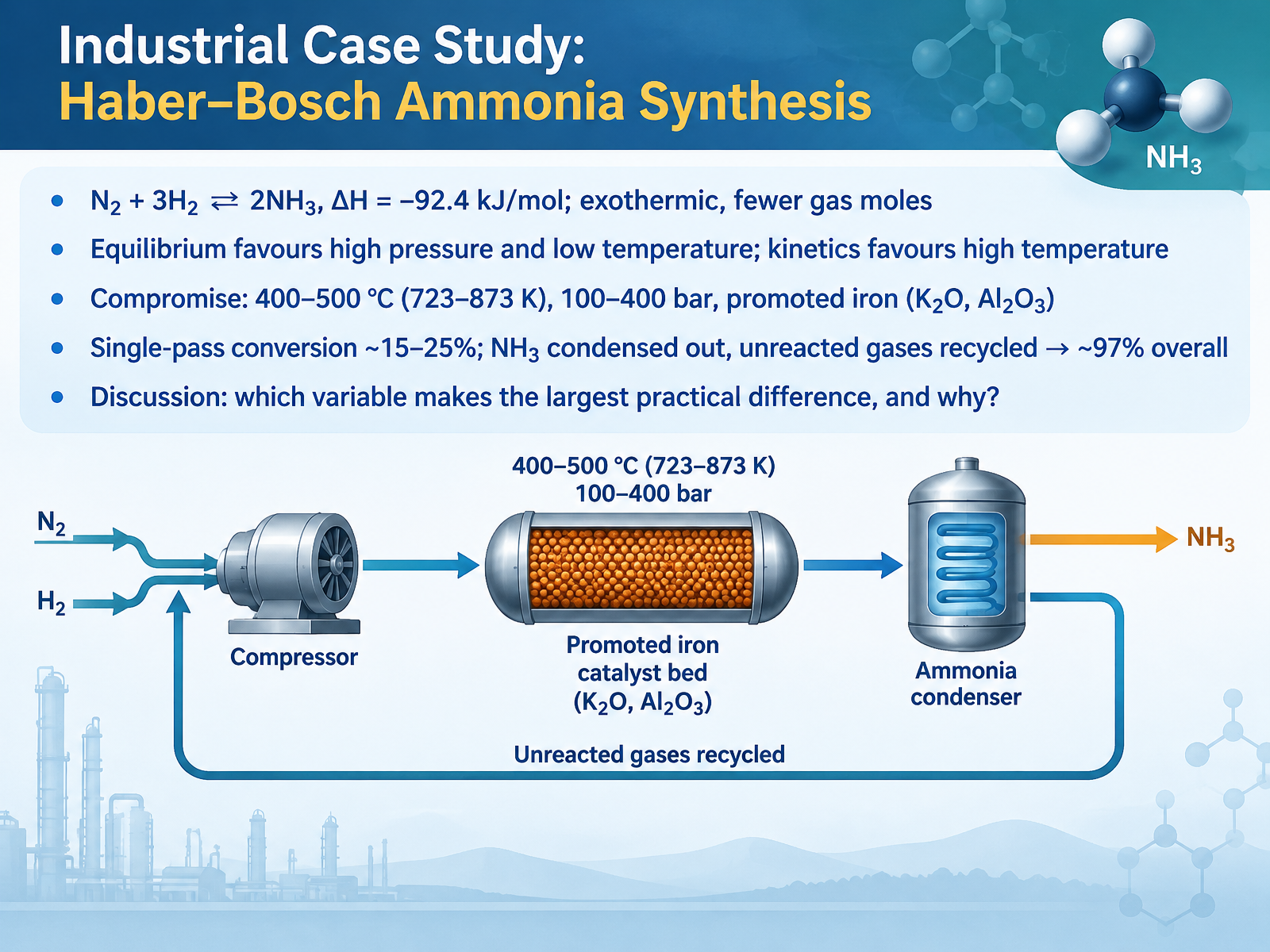
- 10Industrial Case Study: Haber–Bosch Ammonia SynthesisNow let's apply everything to an industrial case study: the Haber-Bosch process for ammonia synthesis. The reaction is nitrogen plus three hydrogen molecules in equilibrium with two ammonia molecules, with an enthalpy change of negative ninety-two point four kilojoules per mole. It is exothermic, and it produces fewer gas molecules. So equilibrium favors high pressure and low temperature. But kinetics favors high temperature, because at low temperature the reaction is far too slow. The compromise is four hundred to five hundred degrees Celsius, one hundred to four hundred bar, and a promoted iron catalyst. Single-pass conversion is only about fifteen to twenty-five percent. Ammonia is condensed out, and unreacted gases are recycled, giving about ninety-seven percent overall conversion. Here is a question to discuss. Which variable makes the largest practical difference, and why? Keep this in mind as we move to biological and environmental equilibrium cases.
 fertilizer.orgonlinelibrary.wiley.comchem.libretexts.org+21 min
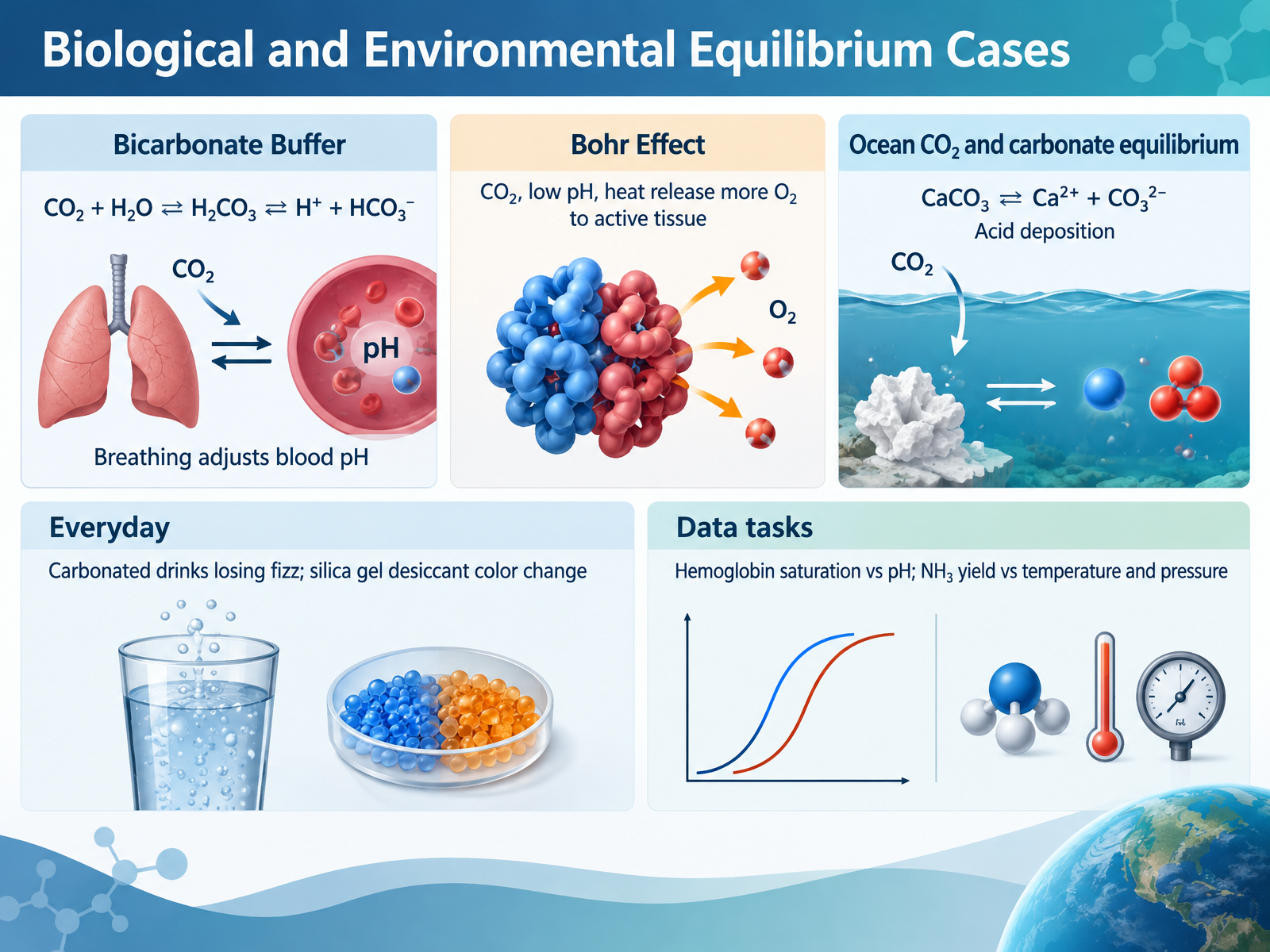
- 11Biological and Environmental Equilibrium CasesNow let's see equilibrium at work in real systems, starting with the body. Your blood contains a bicarbonate buffer. Carbon dioxide reacts with water to form carbonic acid, which then releases hydrogen ions and bicarbonate ions. This is a reversible equilibrium. When you breathe faster, you remove carbon dioxide, and the equilibrium shifts to lower the hydrogen ion concentration. That raises blood pH. Breathing slower does the opposite. The Bohr effect is related. In active tissue, carbon dioxide rises, pH falls, and heat is released. Each of these stresses shifts the hemoglobin equilibrium so that more oxygen is released where it is needed most. In the ocean, carbon dioxide dissolves and joins the carbonate equilibrium involving calcium carbonate. Acid deposition adds hydrogen ions, pushing that equilibrium toward dissolved calcium and carbonate. That is one concern for coral and shellfish. Everyday cases help too. A carbonated drink loses fizz as carbon dioxide escapes to the air. Self-indicating silica gel changes color because a cobalt chloride equilibrium responds to water and temperature. For data tasks, you will analyze hemoglobin saturation versus pH, and ammonia yield versus temperature and pressure. Remember, each shift changes the amounts of substances, not the equilibrium constant itself. Next, we look at common misconceptions and diagnostic teaching.
 intro.chem.okstate.eduteachchemistry.orgedu.rsc.org+22 min
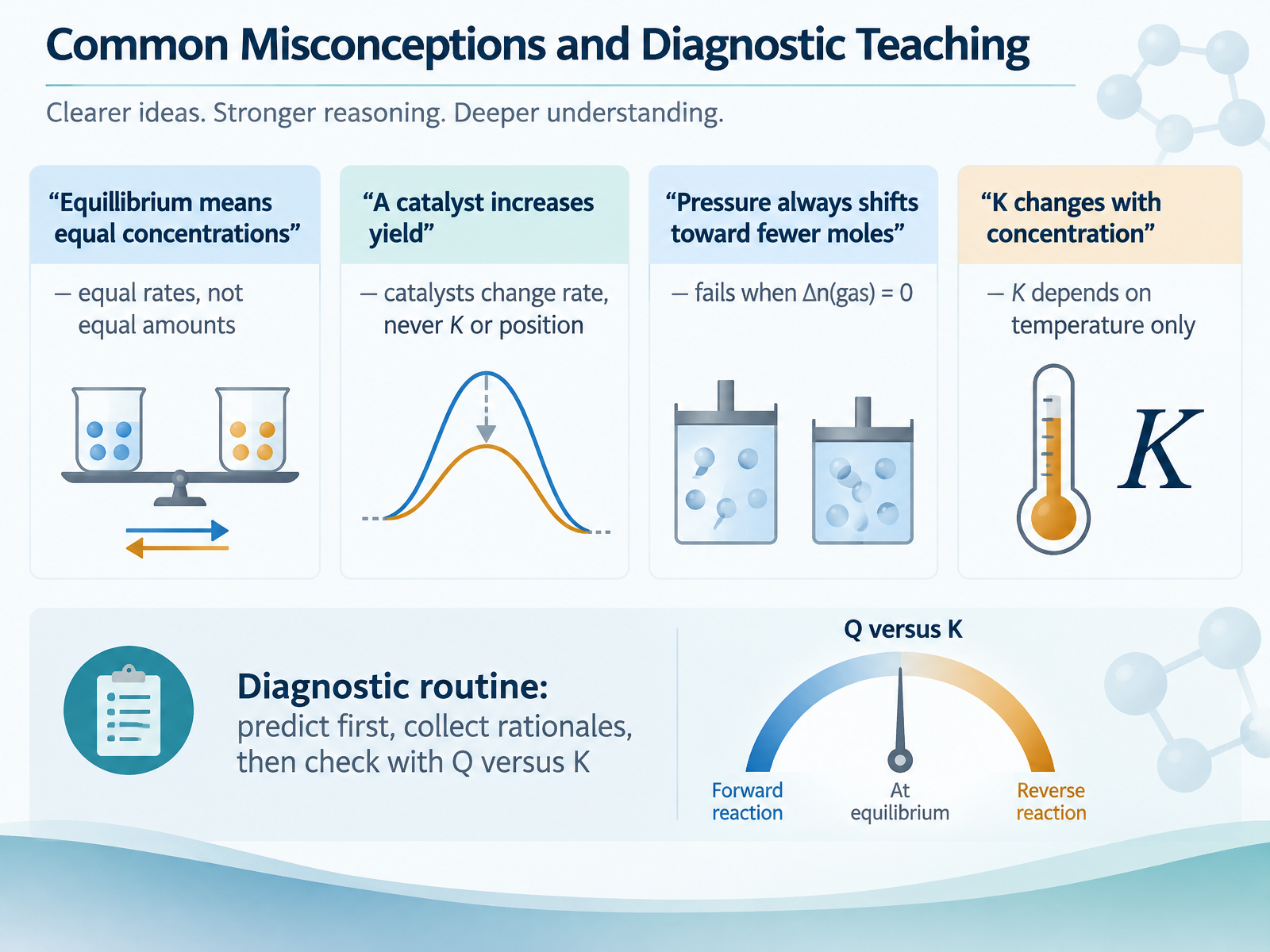
- 12Common Misconceptions and Diagnostic TeachingLet's clear up a few common misconceptions before they cost you marks. First, equilibrium does not mean equal concentrations. It means equal forward and reverse rates. Amounts can still differ. Second, a catalyst increases rate, not yield. It never changes the equilibrium constant or the position. Third, pressure does not always shift toward fewer moles. If the number of gas moles is equal on both sides, pressure has no effect. Fourth, the equilibrium constant depends on temperature only. Changing concentration may shift position, but it does not change K. So use a diagnostic routine: ask learners to predict first, collect their reasoning, then check with Q versus K. That reveals the misconception behind the answer. Next, we will look at classroom demonstrations, simulations, and assessment design.
 1 min
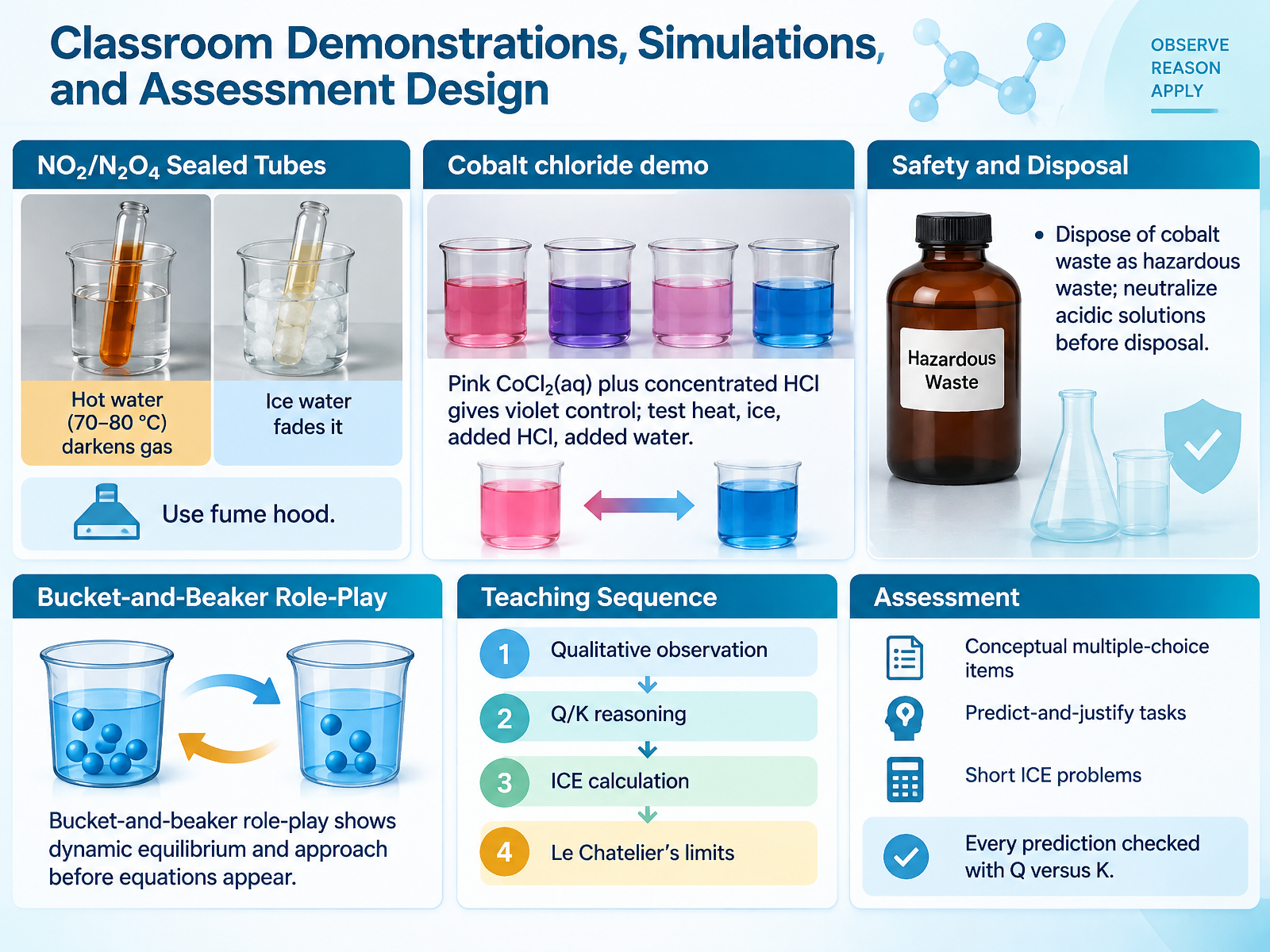
- 13Classroom Demonstrations, Simulations, and Assessment DesignNow let's turn these ideas into classroom practice. For the nitrogen dioxide and dinitrogen tetroxide tubes, place one sealed tube in hot water at seventy to eighty degrees Celsius, and it darkens as more brown nitrogen dioxide forms. Place another in ice water, and it fades as colorless dinitrogen tetroxide is favored. Always use a fume hood. For the cobalt chloride demo, start with pink cobalt chloride solution plus concentrated hydrochloric acid to get a violet control. Then test heat, ice, added acid, and added water. Dispose of cobalt waste as hazardous waste, and neutralize acidic solutions before disposal. A bucket and beaker role-play can show dynamic equilibrium before any equations appear. Teach in sequence: qualitative observation, then Q versus K reasoning, then ICE calculations, then the limits of Le Chatelier's principle. For assessment, use conceptual multiple-choice items, predict-and-justify tasks, and short ICE problems, always checking each prediction with Q versus K. Takeaway: demonstrations build intuition, but Q versus K keeps predictions honest. Next, we'll gather the key takeaways and next steps.
 intro.chem.okstate.eduteachchemistry.orgedu.rsc.org+22 min
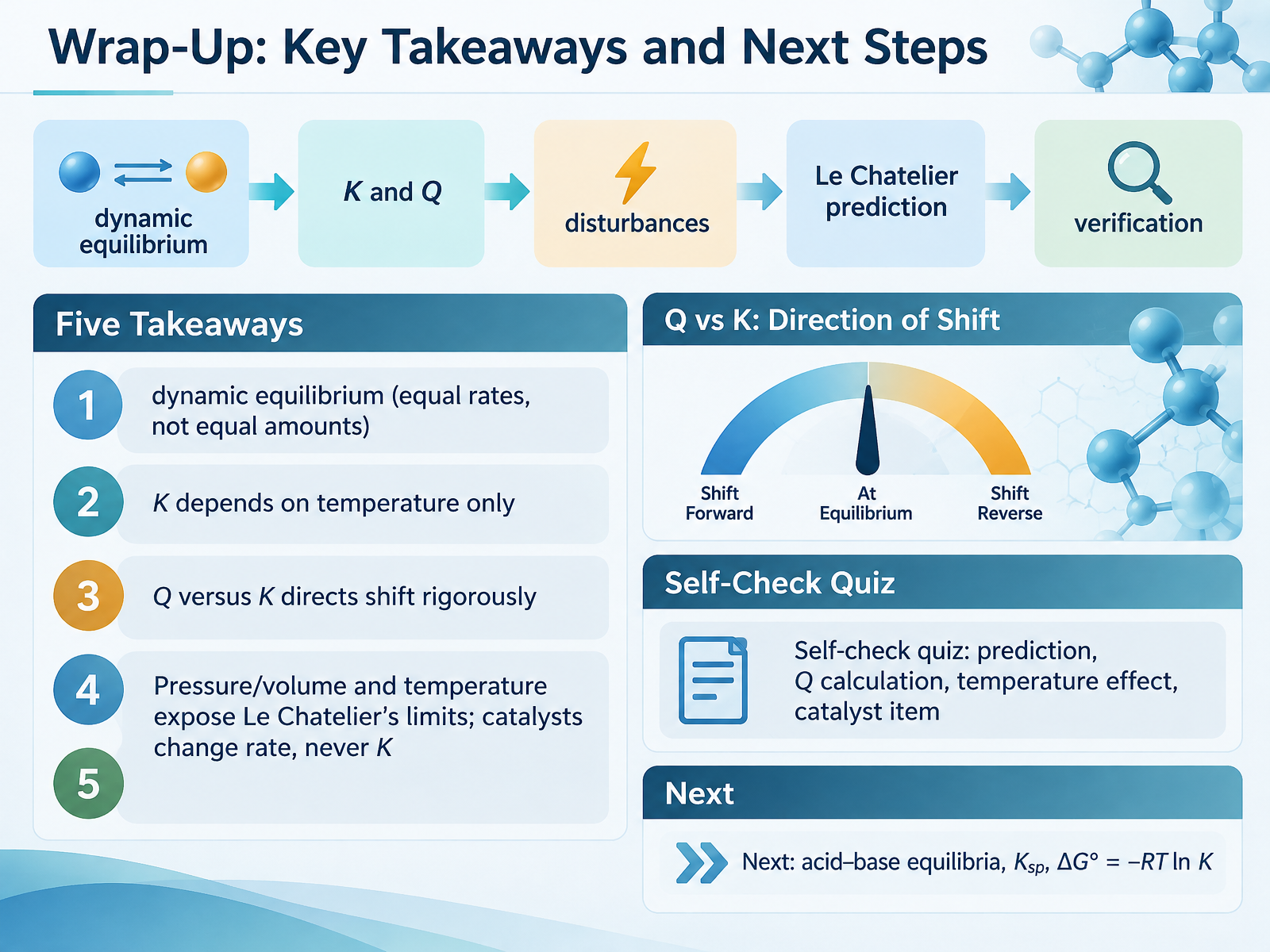
- 14Wrap-Up: Key Takeaways and Next StepsLet's bring everything together. The core chain is this: dynamic equilibrium, then the equilibrium constant K and the reaction quotient Q, then disturbances, then a Le Chatelier prediction, then experimental verification. Here are your five takeaways. First, dynamic equilibrium means equal rates, not equal amounts. Second, K depends only on temperature. Third, comparing Q with K gives you a rigorous direction of shift. Fourth, pressure, volume, and temperature changes expose the limits of Le Chatelier, so trust Q and K first. And fifth, a catalyst changes rate, never K. Before you move on, try the self-check quiz: one prediction item, one Q calculation, one temperature effect, and one catalyst item. Next, you'll meet acid–base equilibria, solubility product K s p, and the link between free energy and K, delta G standard equals negative R T natural log K. Keep working through the examples, and you'll be ready for what comes next. Thank you for learning with me, and I wish you success in your practice.
 journals.le.ac.ukdoi.orgiopscience.iop.org+22 min
Take the deck with you
Download this course as a file — free, no sign-up needed.
- PDF handoutEvery slide page, ready to print or share.15 pages · 3.8 MBDownload
- Narrated PowerPointThe deck that presents itself — every slide carries the digital human's narration video.15 pages · 14.9 MBDownload
- PowerPoint slidesThe full deck as a .pptx — open it in PowerPoint, Keynote, or Google Slides.15 pages · 3.7 MBDownload
Free to use in your own training — please keep the PersonWise credit page at the end.
Have your own deck? Turn it into a course
Sources consulted
Web sources consulted while building this course.
- Students’ Misconceptions in Chemical Equilibria and Suggestions for Improved Instruction | New Directions in the Teaching of Natural Sciences — journals.le.ac.uk
- Misconceptions of chemical equilibrium — doi.org
- Misconceptions and troublesome knowledge on chemical equilibrium - IOPscience — iopscience.iop.org
- Dynamic Equilibrium Across Systems: A Narrative Literature Review of Students’ Difficulties and Conceptual Challenges — ccl.northwestern.edu
- Students’ ideas about chemical equilibria | Beyond appearances | Resource | RSC Education — edu.rsc.org
- Le Châtelier’s principle | 5 ideas in chemistry that must die | RSC Education — edu.rsc.org
- La necesidad de un cambio metodológico en la enseñanza del equilibrio químico: limitaciones del principio de Le Chatelier | Enseñanza de las Ciencias. Revista de investigación y experiencias didácticas — ensciencias.uab.cat
- Reflections Catalyzed by an Assault on a Favorite Principle | Journal of Chemical Education — pubs.acs.org
- CHANGES IN CONCENTRATION AND IN PARTIAL PRESSURE IN CHEMICAL EQUILIBRIA: STUDENTS’ AND TEACHERS’ MISUNDERSTANDINGS | Chemistry Education Research and Practice | The Royal Society of Chemistry — pubs.rsc.org
- El principio de Le Chatelier a través de la historia y su formulación didáctica en la enseñanza del equilibrio químico — doi.org
- Demonstrations — intro.chem.okstate.edu
- Classroom Resources | Le Châtelier’s Principle | AACT — teachchemistry.org
- The equilibrium between two coloured cobalt species | Demonstration | RSC Education — edu.rsc.org
- Chemical Equilibrium – Temple Chemistry Demonstrated — sites.temple.edu
- Jack's Demos 19-22 — www1.columbia.edu
- The Ammonia Production Technology — fertilizer.org
- Development and Recent Progress on Ammonia Synthesis Catalysts for Haber–Bosch Process — onlinelibrary.wiley.com
- The Haber Process — chem.libretexts.org
- Heterogeneous catalysis — is.muni.cz
- Facilitating green ammonia manufacture under milder conditions: what do heterogeneous catalyst formulations have to offer? — pmc.ncbi.nlm.nih.gov