Customer Journey Mapping Basics
Begin
16 pages · ~32 min
Customer Journey Mapping Basics
This training introduces customer journey mapping, helping learners visualize and improve customer experiences to drive engagement and loyalty.
What you’ll learn
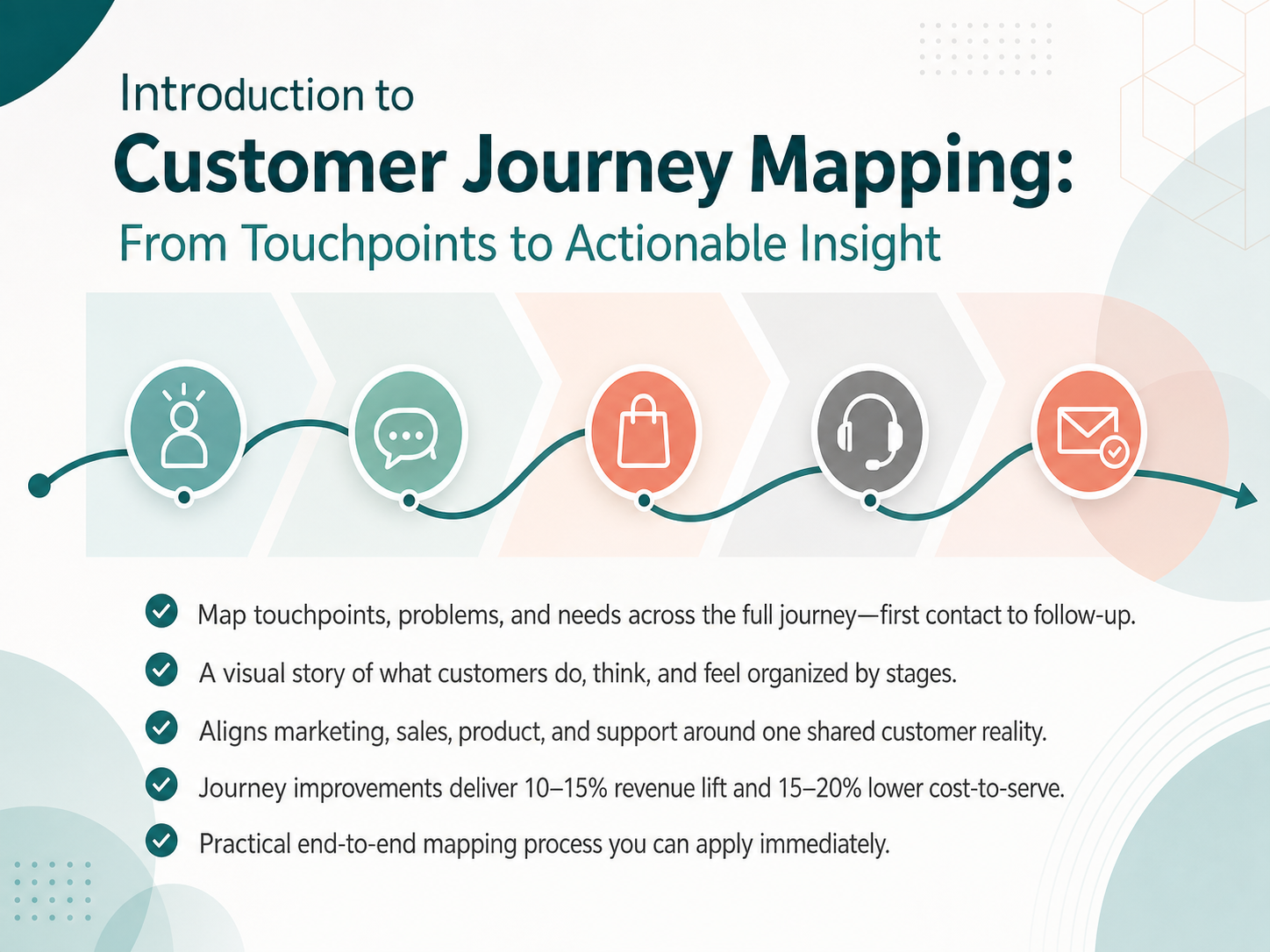
- 01Introduction to Customer Journey Mapping: From Touchpoints to Actionable InsightWelcome. Today we are going to map the full customer journey together. Our goal is simple. We will identify every touchpoint, problem, and need from the very first contact all the way through follow-up. Think of this as building a visual story. It captures what your customers do, what they think, and what they feel, organized by clear stages. The real power here is alignment. When you share this one map, your marketing, sales, product, and support teams all see the same customer reality. And the business impact is significant. Companies often see a ten to fifteen percent lift in revenue and a fifteen to twenty percent lower cost to serve. You will leave with a practical, end-to-end mapping process that you can start using immediately. Let us begin by defining exactly what a journey map is, and what it is not.2 min
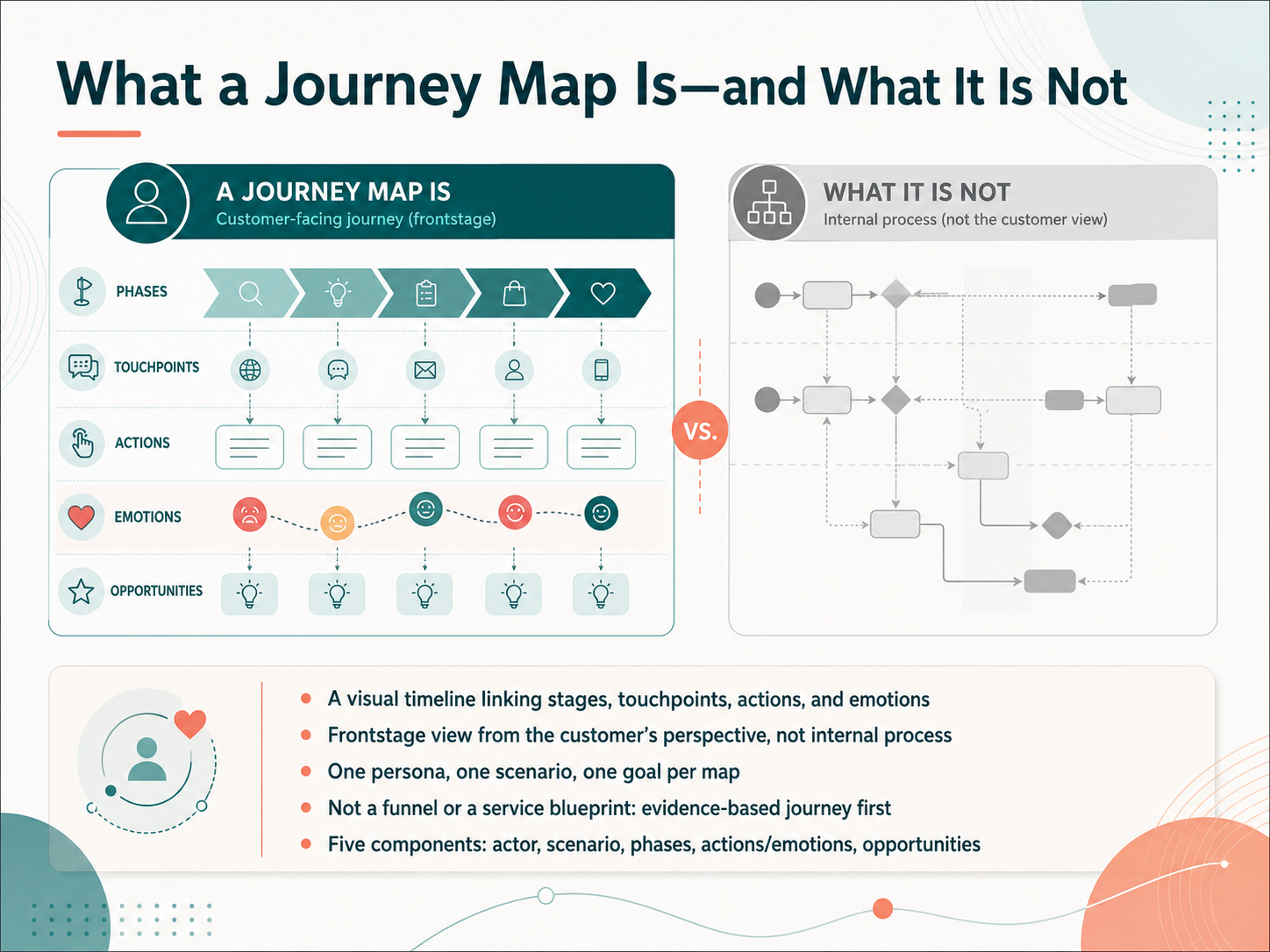
- 02What a Journey Map Is—and What It Is NotNow let's define what a journey map actually is, and just as important, what it is not. Think of a journey map as a visual timeline. It links stages, touchpoints, actions, and emotions together on one page. Crucially, it shows the frontstage view from your customer's perspective, not your internal process. Each map focuses tightly on one persona, one scenario, and one goal. That focus keeps the map clear and actionable. This is not a sales funnel, and it's not a service blueprint. Those come later. Right now, we build an evidence-based journey first. Every map you create here will have five components: the actor, the scenario, the phases, the actions and emotions, and the opportunities you uncover. Now that you know what the tool is, we can explore why starting with real evidence beats relying on assumptions every time.
 2 min
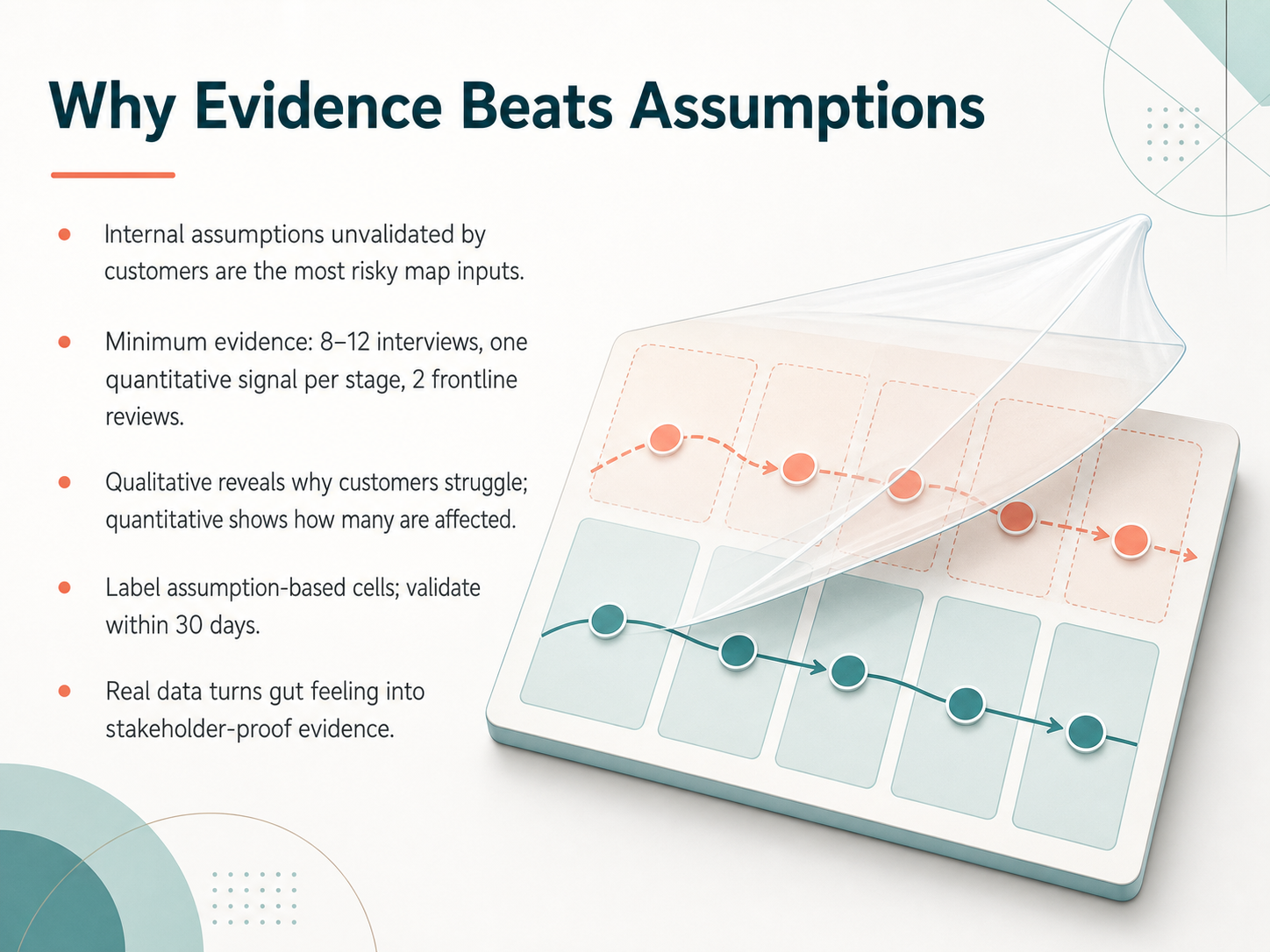
2 min - 03Why Evidence Beats AssumptionsNow, let's talk about why evidence beats assumptions every time. When we build a journey map, the most dangerous inputs are the ones we make up inside our own organization without ever checking with real customers. To fix this, you need a minimum evidence baseline. Aim for eight to twelve customer interviews, at least one quantitative signal per stage, and two reviews with frontline teams. Qualitative data from interviews shows you why customers struggle. Quantitative data shows you how many are affected. As you build your map, label every assumption-based cell clearly. Then commit to validating those cells within thirty days. This turns guesswork into stakeholder-proof evidence, giving your recommendations real weight. Next, we will translate this evidence into a working structure called The Core Framework: Stages, Touchpoints, Problems, and Information Needs.
 2 min
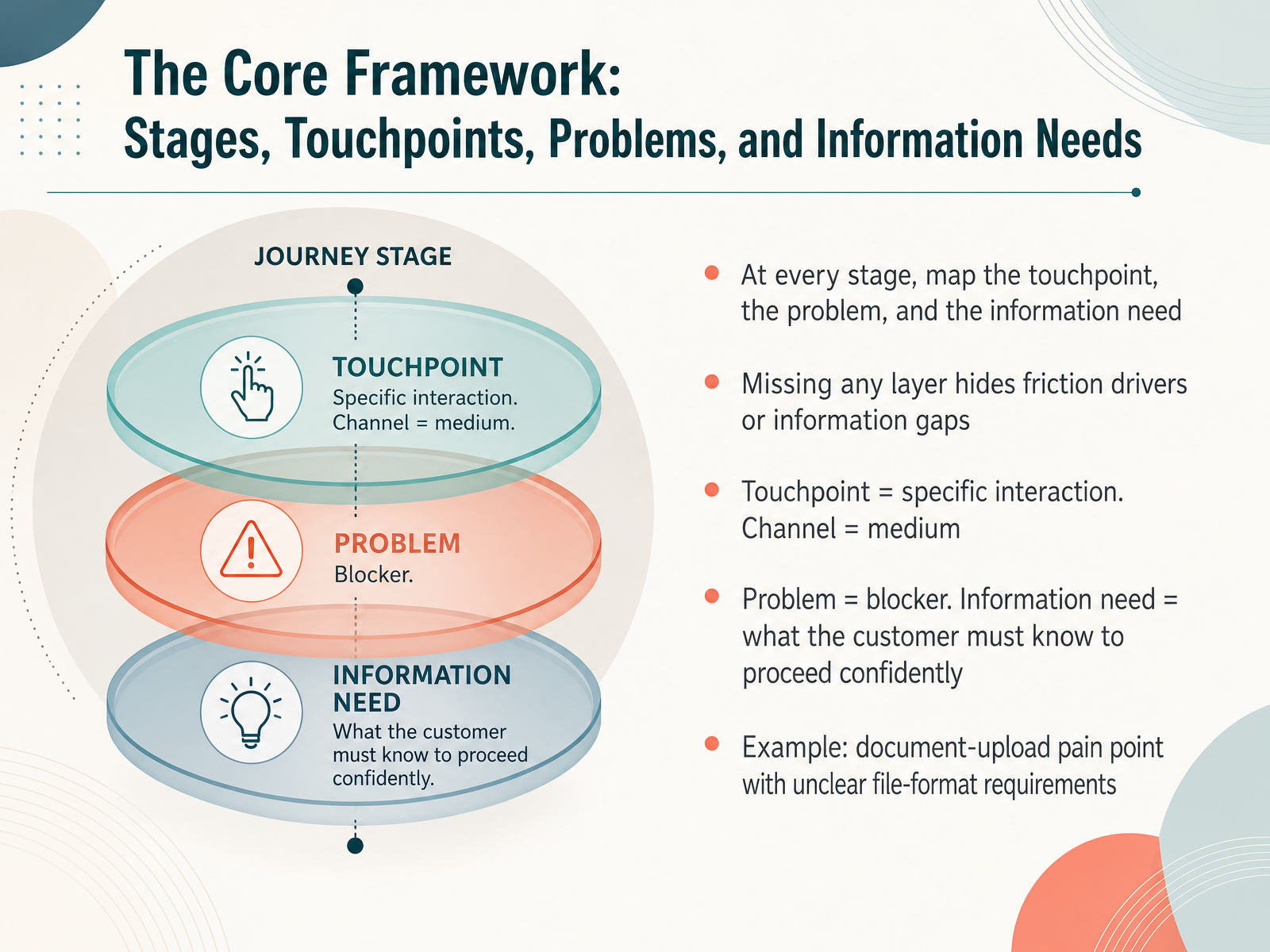
2 min - 04The Core Framework: Stages, Touchpoints, Problems, and Information NeedsNow we get into the core framework. At every single stage of the journey, you will map four connected layers: the touchpoint, the channel, the problem, and the information need. If you skip a layer, you hide the real friction points. A touchpoint is the specific interaction, like clicking upload. The channel is the medium, like a mobile app. A problem is the blocker that stops progress. An information need is what your customer must know to move forward with confidence. Let me give you a clear example. Imagine a customer is uploading a document, but the required file format is not displayed. The touchpoint is the upload action. The problem is uncertainty. The information need is a clear, visible list of accepted formats. Without that, the customer gets stuck. Use this four-layer check for every stage, and you will uncover the gaps that truly matter. Next, let’s walk through the journey stages, from first contact all the way to advocacy.
 2 min
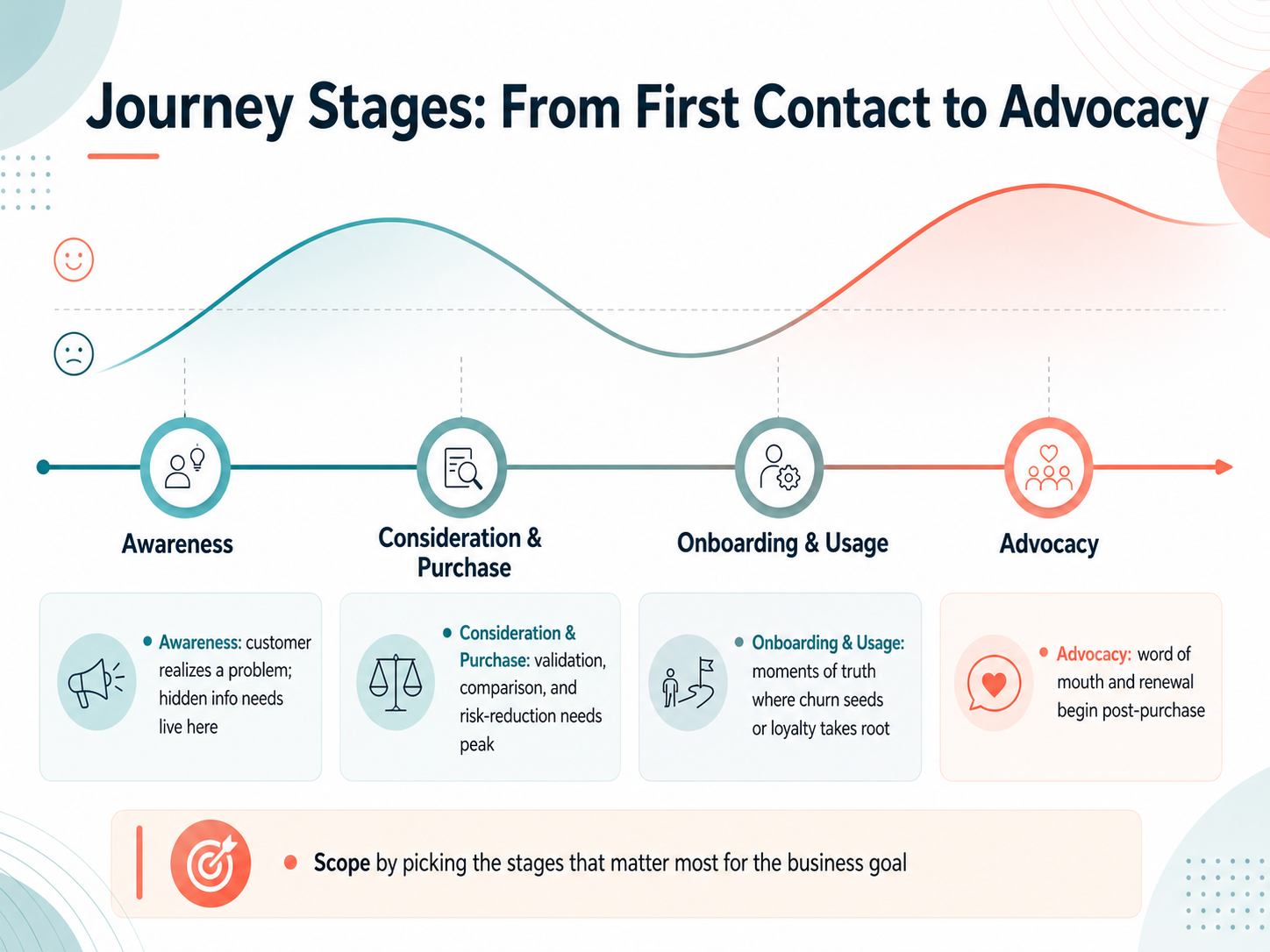
2 min - 05Journey Stages: From First Contact to AdvocacyNow, let's walk through the five core journey stages, from first contact all the way to advocacy. You won't always need every stage for every project, but it's important to know what happens in each one.
Start with Awareness. This is when your customer first realizes they have a problem. Hidden here are all the unspoken questions they haven't even typed into a search engine yet.
Next come Consideration and Purchase. This is where validation, comparison, and the need to reduce risk peak. Your customer is asking, "Is this the right choice, and what happens if I'm wrong?"
Then we hit Onboarding and Usage. These are critical moments of truth. This is where the seeds of churn are planted, or where loyalty begins to take root.
Finally, we reach Advocacy. This doesn't happen by accident. Word-of-mouth and renewal are behaviors that begin right after the purchase, based on everything that came before.
Your task is to scope your map by picking only the stages that matter most for your specific business goal.
Next, we'll move into pinpointing every touchpoint, including the hidden ones you might normally miss.
 2 min
2 min - 06Identifying Every Touchpoint—Including the Ones You MissNow, let's tackle one of the most revealing steps in mapping: identifying every single touchpoint. We break them into three layers. First, direct touchpoints you control, like your website or a sales call. Next, indirect touchpoints you influence but don’t own, like review sites or peer chats. And finally, invisible touchpoints that happen behind the scenes—think of a stalled security check that delays a login. To surface these, pull data from customer interviews, support tickets, session recordings, and workshops with your frontline teams. But here’s the critical part: don’t just write down ‘email’ or ‘website.’ Inventory every specific interaction inside that channel. For example, separate a promotional email from a shipping confirmation. They create very different experiences. As you do this, tag any touchpoint without a clear owner. These ownerless moments are where the experience quietly breaks down. Watch for common blind spots too. The pause between browsing and buying, communications sent after a cancellation, review threads, and social comments are all part of the real journey. Capturing this full picture sets the stage for our next focus: uncovering the real customer problems and pain points behind these interactions.
 2 min
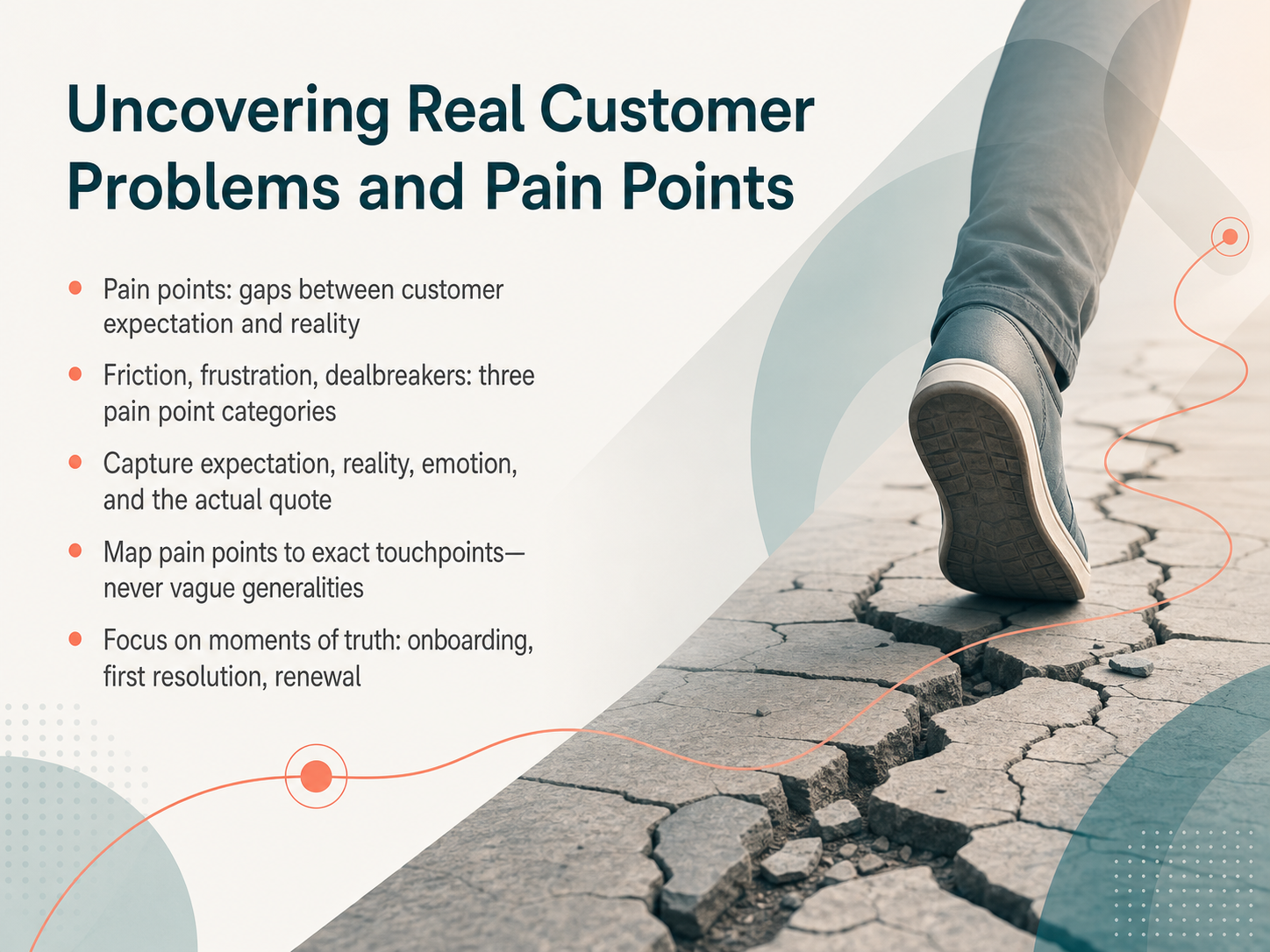
2 min - 07Uncovering Real Customer Problems and Pain PointsNow let's turn our attention to uncovering the real customer problems and the pain points that cause them. Think of a pain point as the gap between what a customer expects and what they actually experience. We categorize these into three groups: friction, frustration, and dealbreakers. Friction is a small extra step that annoys. Frustration is a recurring issue that erodes trust. A dealbreaker is a failure that pushes the customer to leave. To capture these accurately, you need to record four things: the customer's expectation, the reality they faced, the emotion they felt, and if possible, an actual quote from them. Then, map each pain point to the exact touchpoint where it happened. Never use vague generalities like 'poor service.' Pin it to a step, like 'password reset on the mobile app.' Finally, pay special attention to moments of truth. These are make-or-break interactions such as onboarding, the first support resolution, and the renewal conversation. Fixing pain points at these moments delivers the highest impact. Next, we'll map information needs at every stage.
 2 min
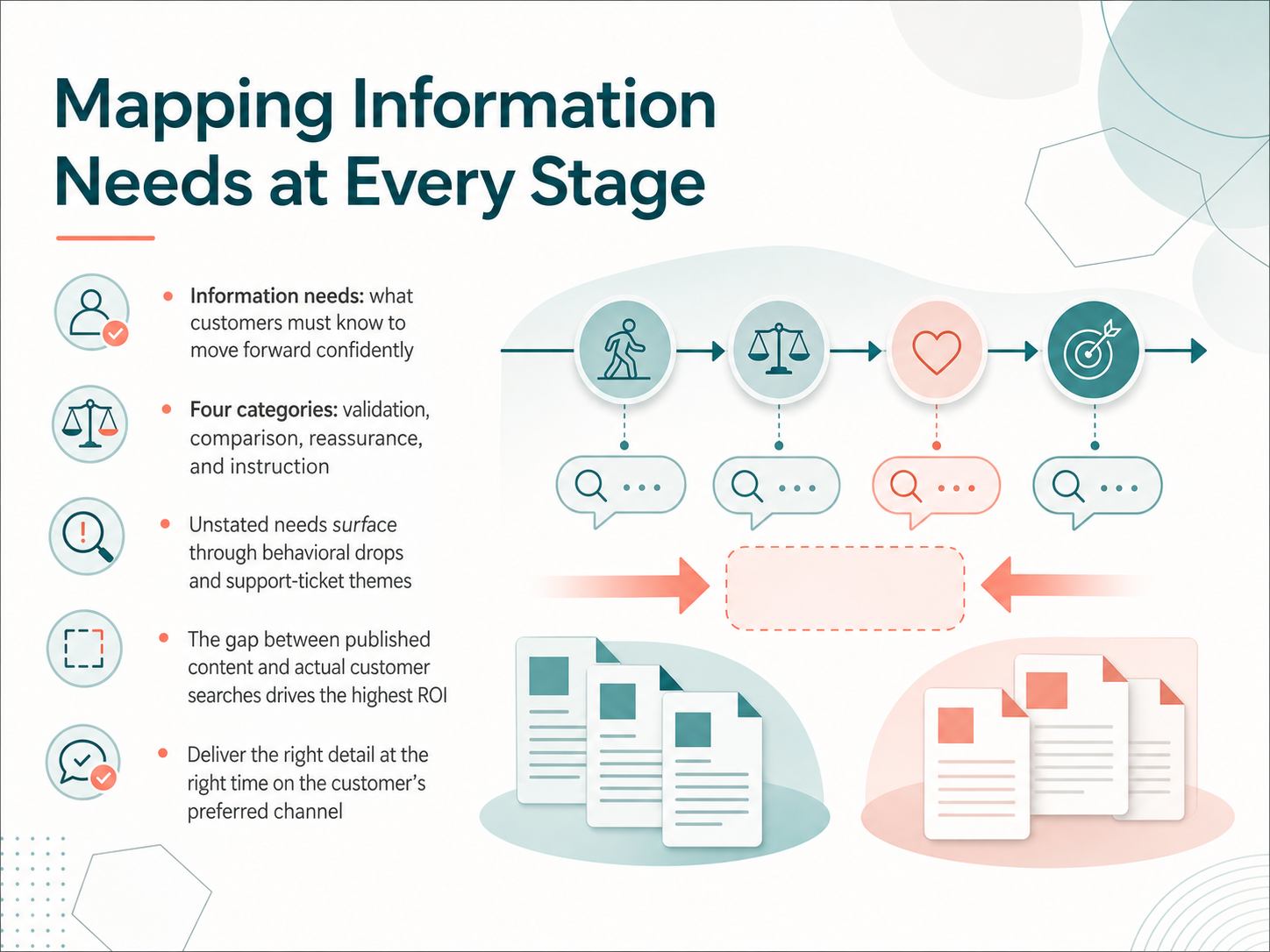
2 min - 08Mapping Information Needs at Every StageNow let's map what your customers need to know at every stage. Information needs are simply what someone must understand to take the next step with confidence. We sort these into four practical categories. Validation tells them they're on the right track. Comparison helps them weigh options. Reassurance reduces risk and anxiety. And instruction shows them exactly how to do something. Not all needs are stated openly. You'll spot unstated needs in behavior drops, like abandoning a cart, or recurring themes in support tickets. Pay special attention to the gap between the content you publish and what customers actually search for. Closing that gap often drives the highest return on investment. Your goal is to deliver the right detail at the right time on the customer's preferred channel. Next, we'll put this into practice by focusing the scope on one persona and one journey.
 2 min
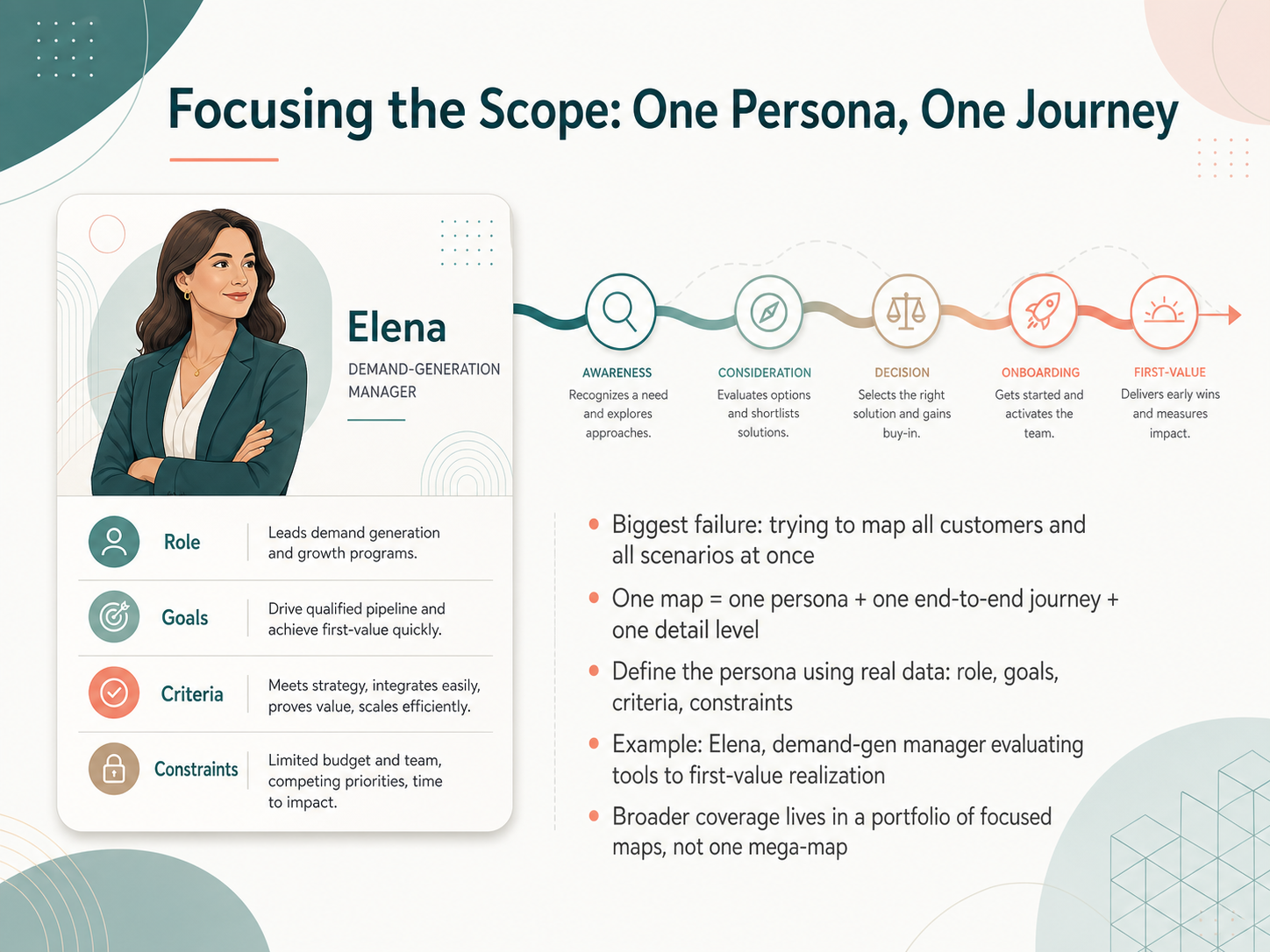
2 min - 09Focusing the Scope: One Persona, One JourneyNow, let's talk about focus. The single biggest mistake teams make is trying to map every customer and every scenario at once. When you do that, you end up with a confusing tangle, not a useful map. So let's narrow our scope. One map equals one persona plus one end-to-end journey at one level of detail. Start by defining your persona using real data, not assumptions. Pin down their role, key goals, decision criteria, and constraints. For example, consider Elena, a demand-generation manager. Her journey isn't just about evaluating software tools. It spans from first awareness all the way to achieving first-value realization. Now, you might be wondering, doesn't this single-focus approach leave gaps? It doesn't, because broader coverage lives in a portfolio of focused maps, not inside one impossible mega-map. With that clarity in mind, next we will walk through the actual build process. Let's move to building the map step by step in a workshop format.
 2 min
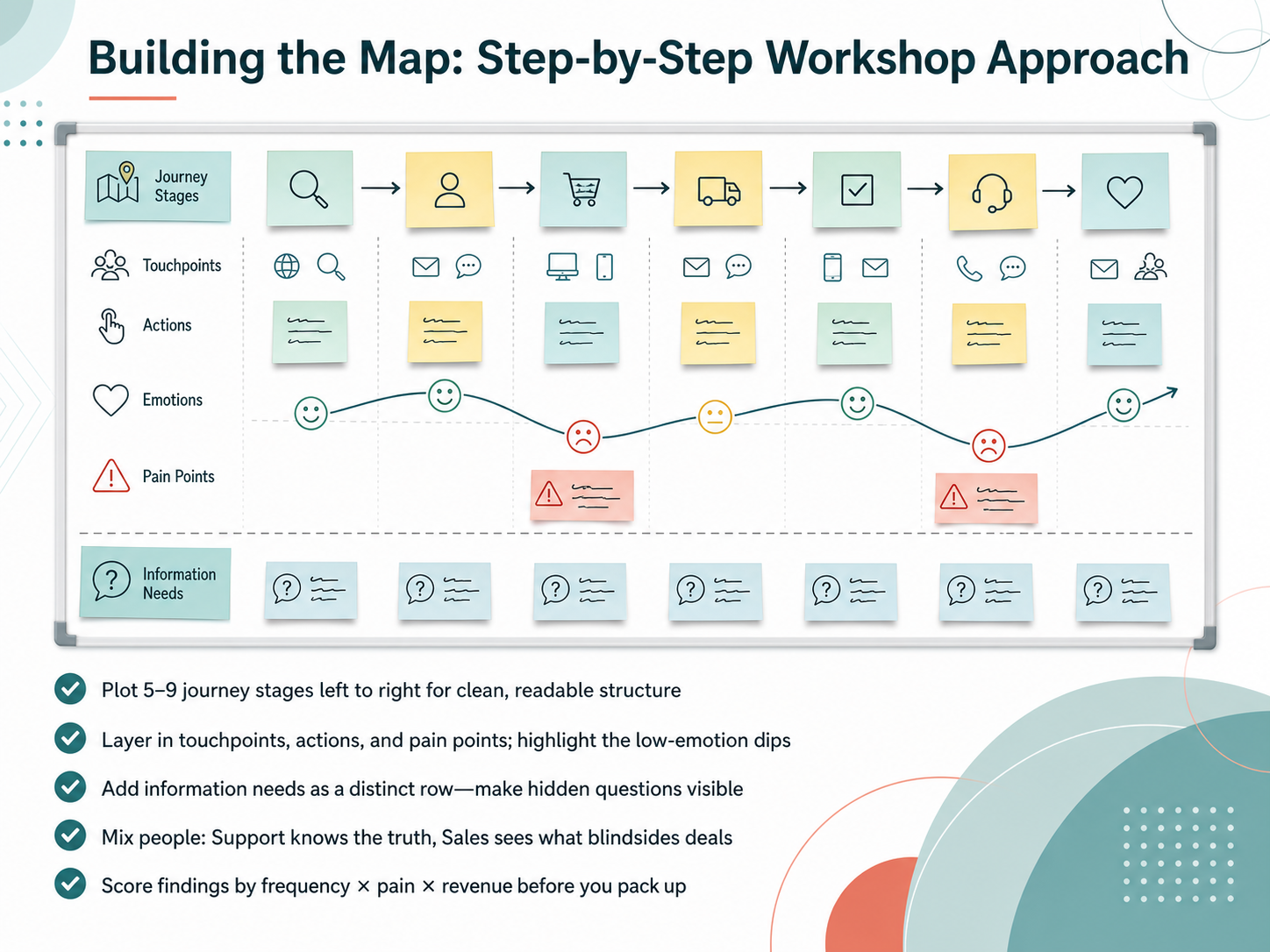
2 min - 10Building the Map: Step-by-Step Workshop ApproachNow let's build the map itself. Start by plotting five to nine journey stages from left to right. Keep it clean, keep it readable. Next, layer in the touchpoints, actions, and pain points for each stage. Pay special attention to the low-emotion dips. Those quiet moments often hide the biggest risks of churn. Then add a distinct row for information needs. Treat this like a detective's log. What hidden questions is your customer asking but not voicing out loud? After that, mix your people. Bring Support into the room. They know the unvarnished truth. Bring Sales in as well. They see the deal-breakers and blind spots firsthand. Finally, before you pack up, score your findings. Multiply frequency by pain level by revenue impact. This simple formula turns a wall of sticky notes into a prioritized action list.
 2 min
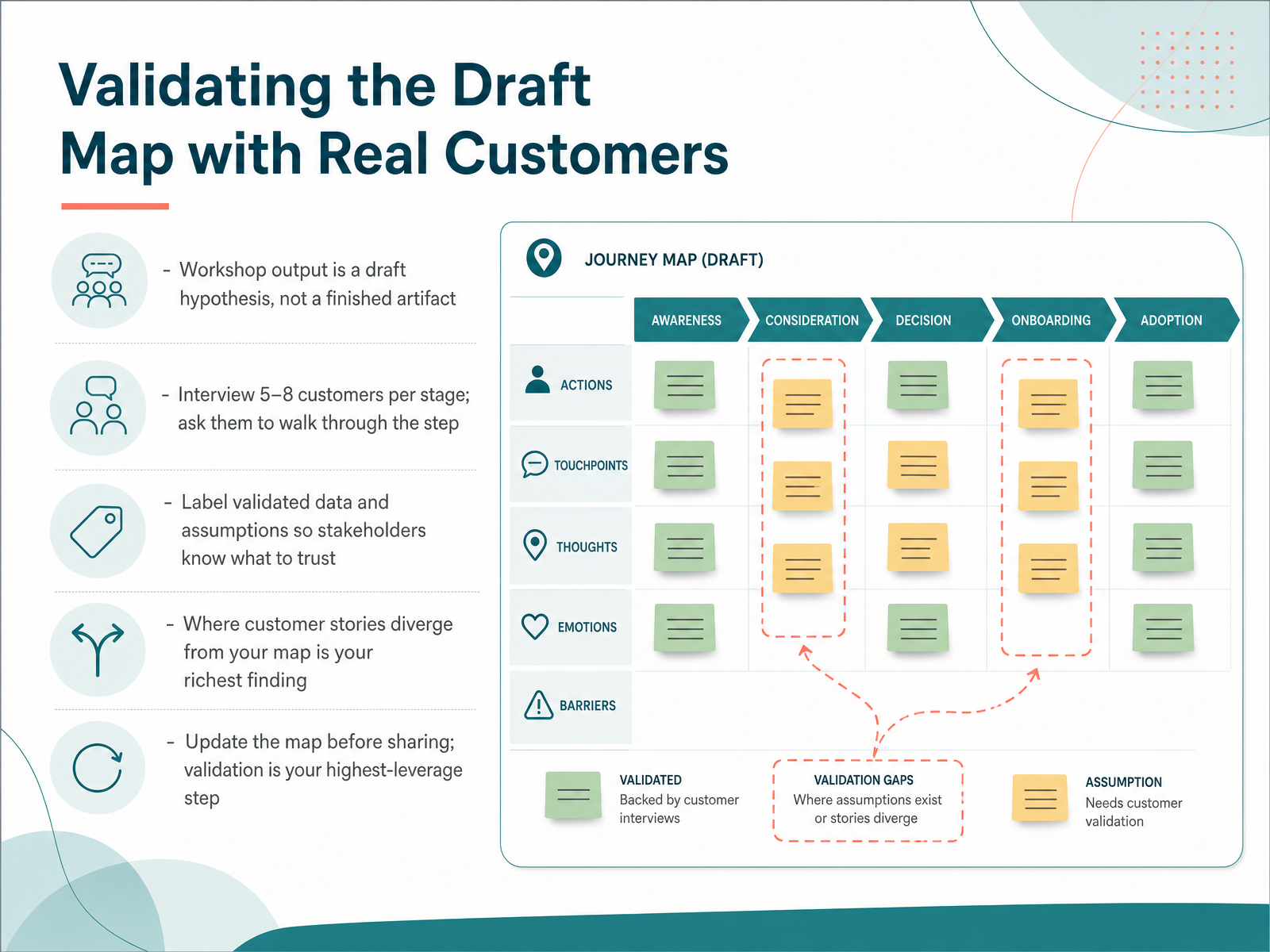
2 min - 11Validating the Draft Map with Real CustomersYour workshop map is a strong starting point, but right now it is still a draft hypothesis. To turn it into a reliable tool, you need to validate it with real customers. Interview five to eight customers per journey stage and ask them to simply walk you through that step in their own words. As you listen, mark every data point as either validated or assumed. This labeling lets your stakeholders know exactly what to trust. Pay special attention to the moments where a customer's story diverges from your map. Those gaps are your richest findings because they reveal what you did not know. Update the map before you share it broadly. Validation is your highest-leverage step in the entire journey mapping process. Now let's move from the validated map into action with prioritization and ownership.
 1 min
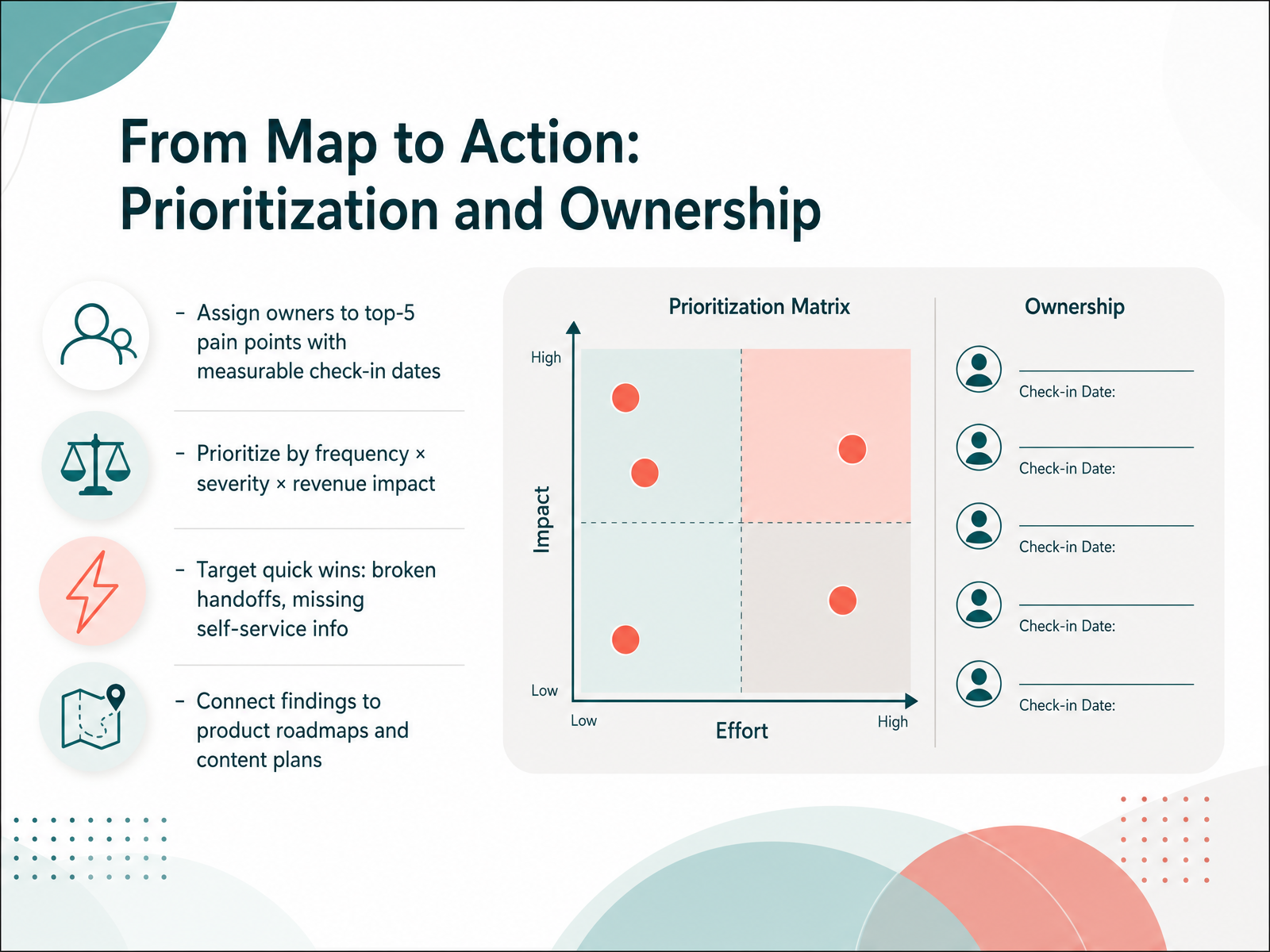
1 min - 12From Map to Action: Prioritization and OwnershipNow, let's turn your map into real action. You've identified the friction points, so it's time to assign ownership and prioritize. Start by picking your top five pain points. For each one, name a specific person who will own the fix and set a measurable check-in date. That turns a vague complaint into an accountable task. To decide which issues matter most, use a simple formula: multiply frequency by severity by revenue impact. This highlights the problems that cost you the most. Then, target quick wins first. Look for broken handoffs between teams or missing self-service information on your website. These are often easy to fix and deliver immediate relief for your customers. Finally, connect your findings directly to your product roadmap and your content plans. If a major pain point is confusing setup instructions, that's not just a support ticket; it's a content gap to fill. Let's look at how to package all of this work into practical tools and formats that fit your context.
 2 min
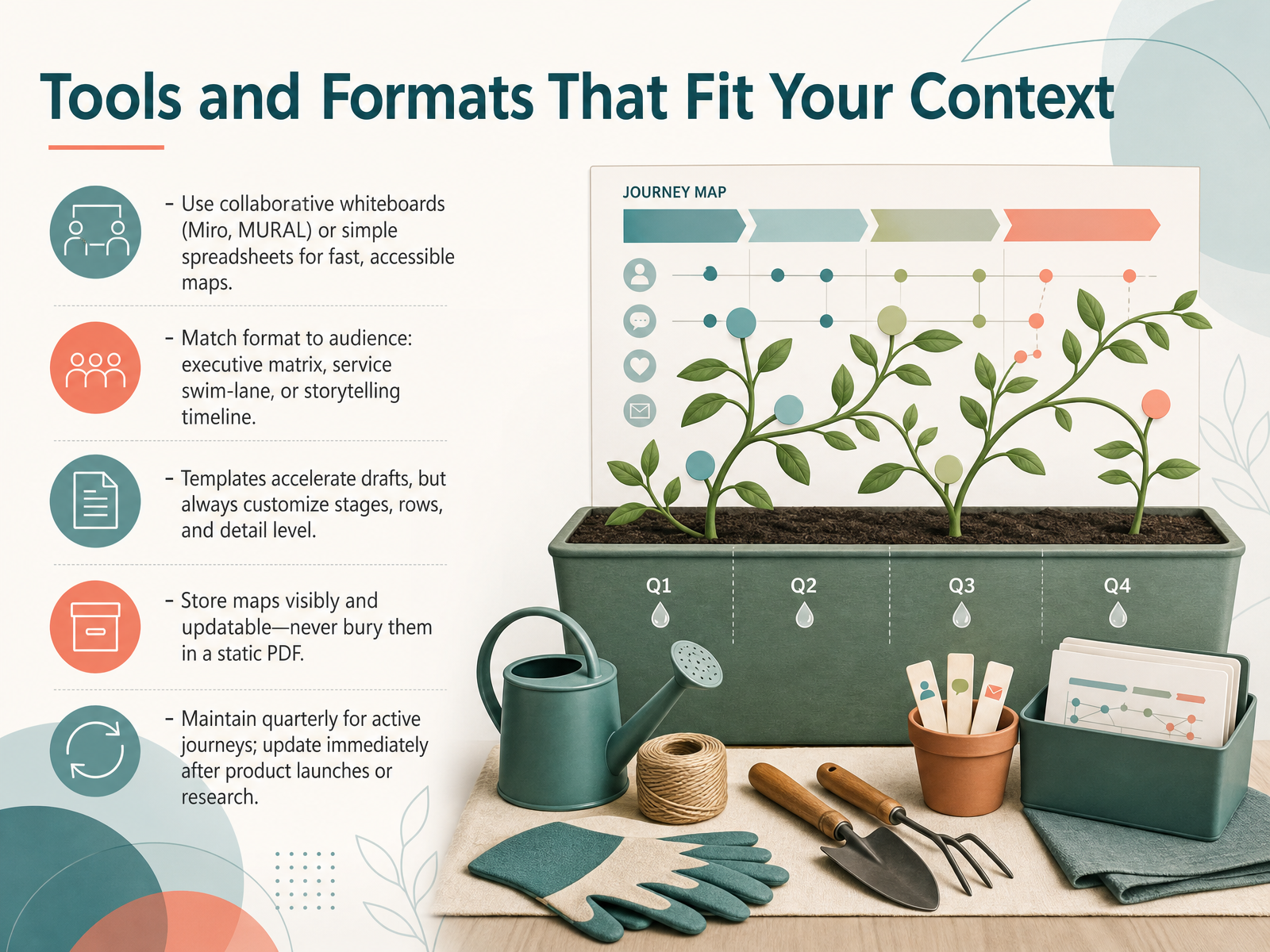
2 min - 13Tools and Formats That Fit Your ContextLet's talk about the practical tools and formats that keep your maps useful, not just pretty. First, pick a tool that makes collaboration easy. Collaborative whiteboards like Miro or MURAL work great. Even a simple shared spreadsheet can get you started fast. The key is accessibility. Next, match your format to your audience. An executive team may need a clean matrix showing high-level pain points and opportunities. An operations team often prefers a swim-lane diagram to see hand-offs between departments. For a company all-hands, a storytelling timeline that shows the customer's emotional highs and lows works best. Templates will accelerate your first draft, but don't just fill in the boxes. Always customize the stages, rows, and level of detail to fit your specific context. Once the map is built, keep it visible. Store it in a shared, updateable system, and never bury it in a static PDF. Make it a living document. For active journeys, schedule a light review every quarter. And always update the map immediately after any product launch or major research finding. Up next, we'll focus on avoiding the most common pitfalls that cause these maps to fail.
 2 min
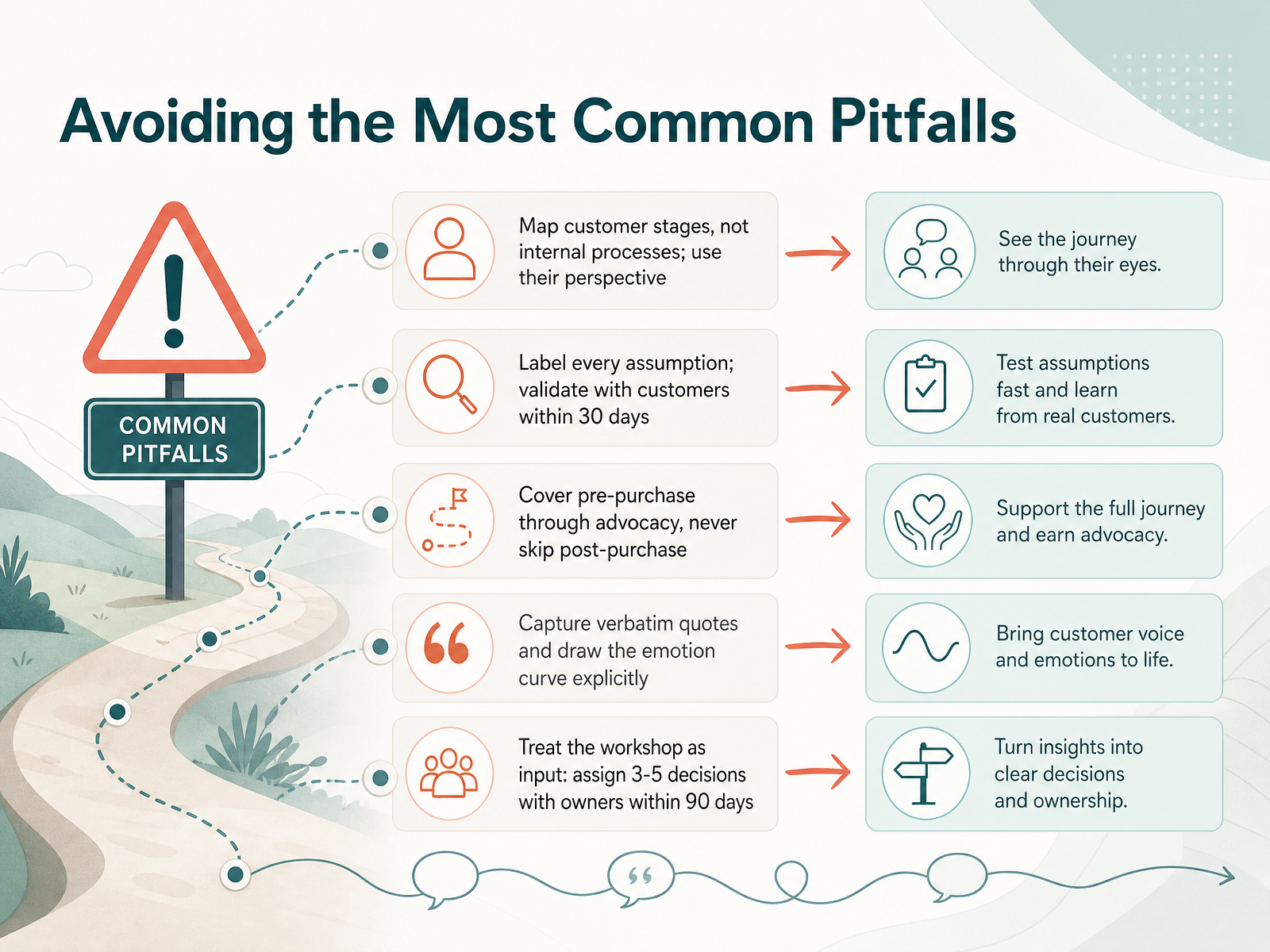
2 min - 14Avoiding the Most Common PitfallsNow let’s look at the most common pitfalls, so you can avoid them. First, map customer stages, not your internal processes. Always use the customer’s perspective, their words, their experience. Second, label every assumption you make and commit to validating those assumptions with real customers within thirty days. This keeps your map grounded in reality. Third, cover the full journey from pre-purchase all the way through advocacy. Never skip post-purchase, because that’s where loyalty is won or lost. Fourth, capture verbatim customer quotes and draw the emotion curve explicitly. That curve shows you exactly where to act. Finally, treat the workshop as input, not the final output. Before you finish, assign three to five concrete decisions with clear owners, and set a ninety-day deadline for action. Next, let’s explore how to embed journey thinking into your daily operations.
 1 min
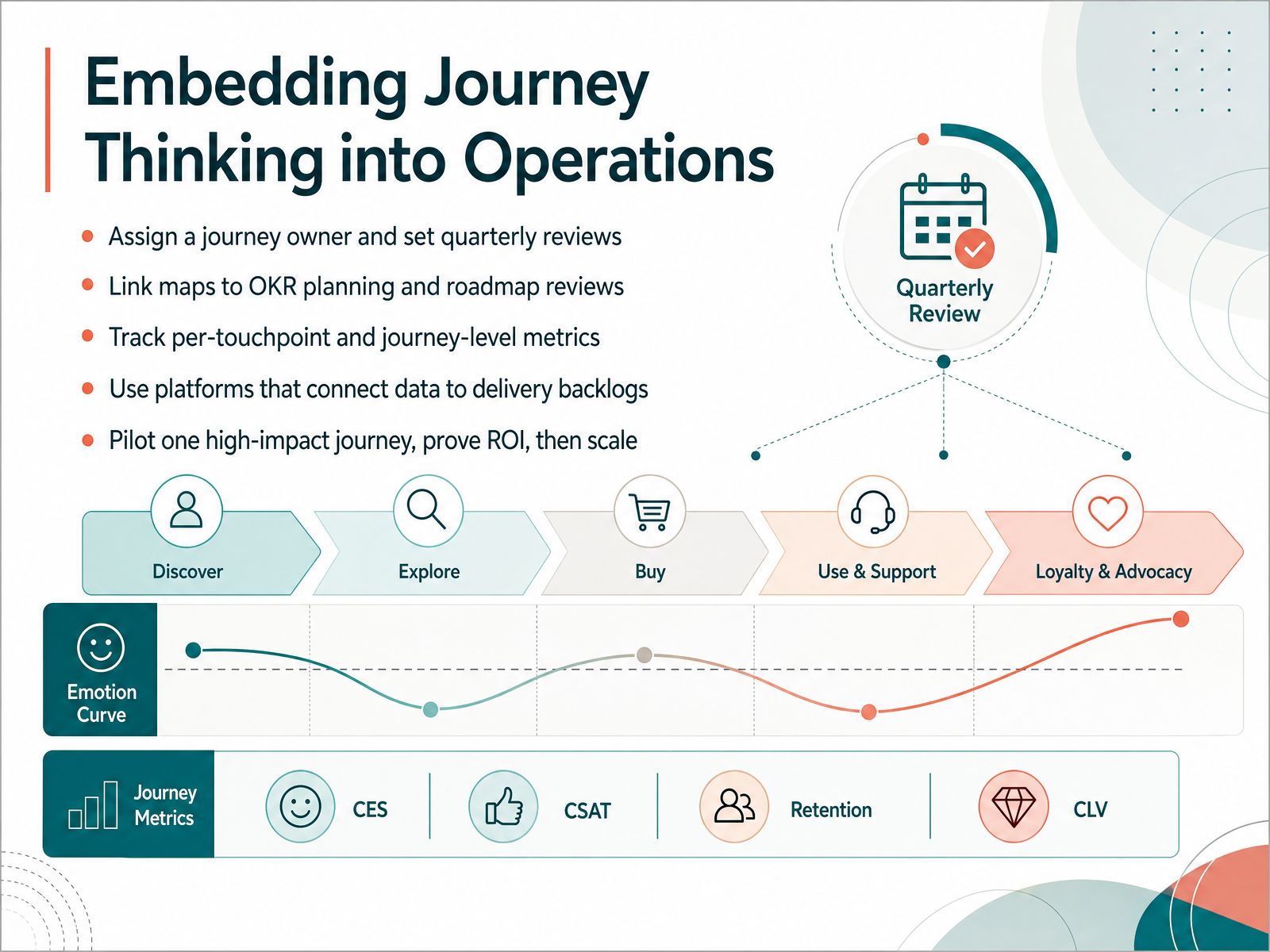
1 min - 15Embedding Journey Thinking into OperationsNow let's talk about how to make journey thinking stick inside your operations. Start by assigning a journey owner. This person champions the experience end-to-end and runs a short quarterly review to spot what's working and what's broken. Next, link your journey maps directly to your OKR planning and roadmap reviews. When a quarterly objective is set, ask which journey steps it actually impacts. Track two layers of metrics. Monitor per-touchpoint signals like call resolution time, and also track journey-level metrics such as time-to-onboarding. Use platforms that connect real customer data straight to your delivery backlog, so insights turn into development tickets, not forgotten reports. Then pilot one high-impact journey first. Prove clear ROI with that single end-to-end flow before you scale the practice. Soon you'll see journey work shift from a one-off workshop activity into a repeatable operating rhythm. Coming up next, we'll plan your first mapping action and the concrete next steps to keep momentum alive.
 2 min
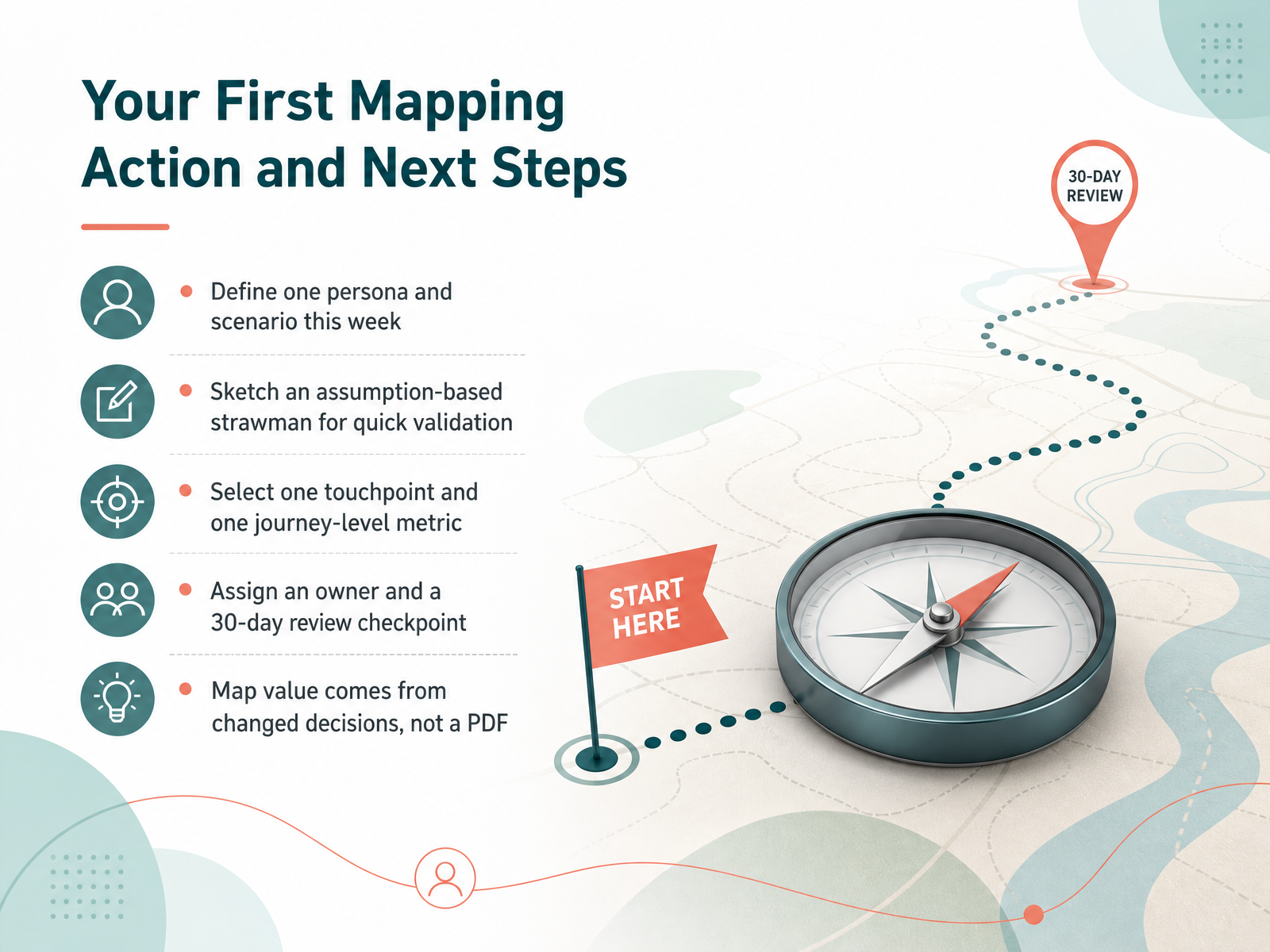
2 min - 16Your First Mapping Action and Next StepsAlright, let's turn this into action. For your first mapping exercise this week, pick one persona and one specific scenario. Just one. Don't try to map everything at once. Next, sketch a quick strawman journey based on your assumptions. It doesn't need to be perfect. This rough draft is meant for fast validation, not for presentation. Then, select one single touchpoint and one journey-level metric to measure. Focus on something simple, like time to resolution or customer effort score. After that, assign an owner who will be responsible for this map. Set a thirty-day review checkpoint on the calendar right now. The goal here is momentum, not a one-time document. Remember, the real value of journey mapping comes from changed decisions, not from a polished PDF that sits in a folder. You have a clear, simple path forward. Thank you for your focus today. Go take that first small step.
 2 min
2 min
Take the deck with you
Download this course as a file — free, no sign-up needed.
- PDF handoutEvery slide page, ready to print or share.17 pages · 3.7 MBDownload
- Narrated PowerPointThe deck that presents itself — every slide carries the digital human's narration video.17 pages · 19.5 MBDownload
- PowerPoint slidesThe full deck as a .pptx — open it in PowerPoint, Keynote, or Google Slides.17 pages · 3.6 MBDownload
Free to use in your own training — please keep the PersonWise credit page at the end.
Have your own deck? Turn it into a course