Begin
14 pages · ~28 min
Oxidation and Reduction: Electron Flow
This training explains oxidation and reduction by tracing electron transfer, helping learners identify redox reactions and assign oxidation states. Ideal for chemistry students and professionals seeking a clear foundation in redox chemistry.
A digital instructor presents all 14 pages. Hold “Ask” at any point and ask out loud — the answer comes from this course. No sign-up needed.
What you’ll learn
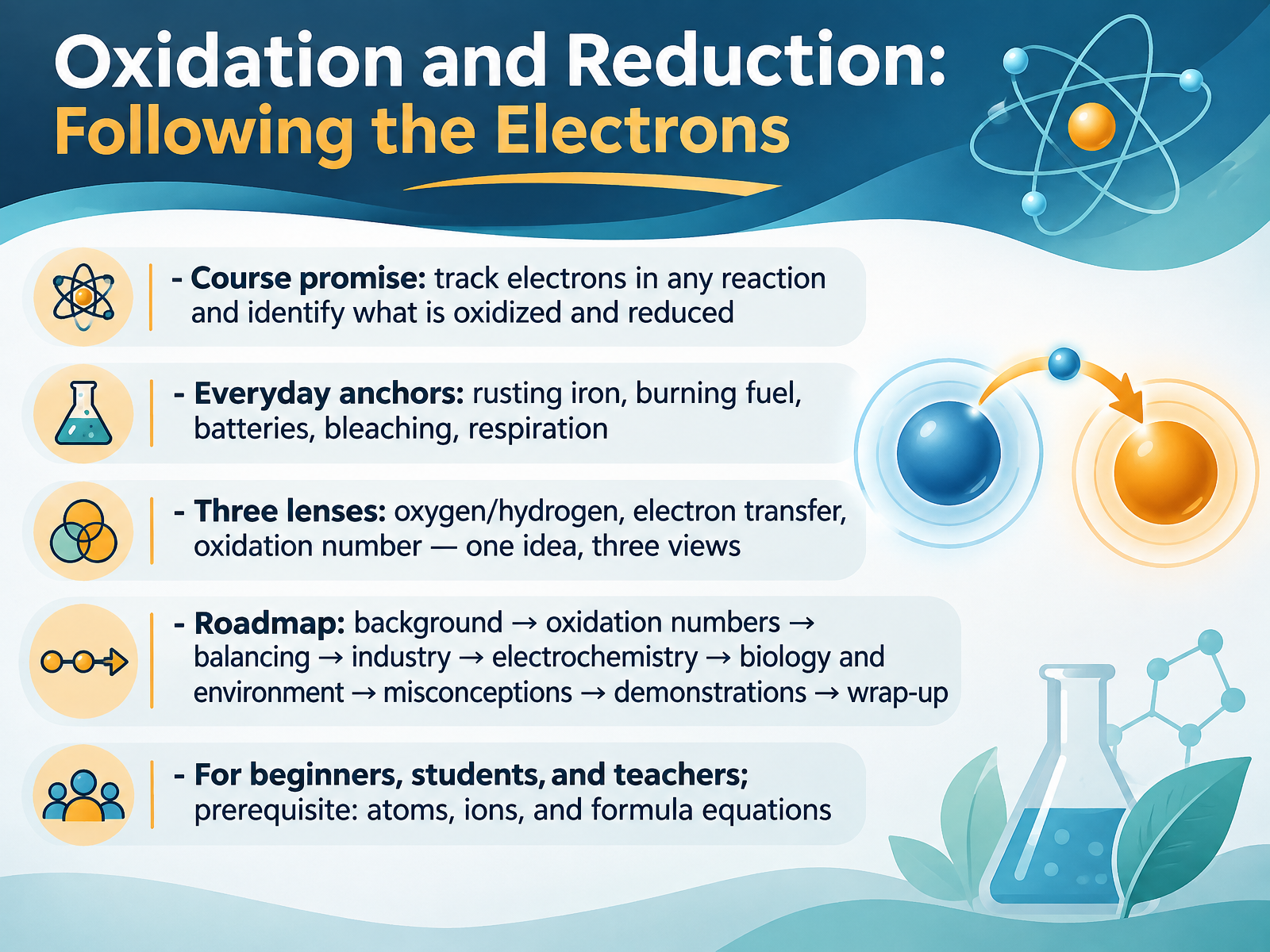
- 01Oxidation and Reduction: Following the ElectronsWelcome. In this course, you'll learn to follow the electrons in any chemical reaction and say clearly what is oxidized and what is reduced. You already know these processes from daily life. Rusting iron, burning fuel, batteries, bleaching, and even respiration all involve electron transfer. Here is the key idea. Oxidation and reduction are one concept seen through three lenses: oxygen and hydrogen, electron transfer, and oxidation number. First, we start with background. Next, we cover oxidation numbers, balancing equations, industry, electrochemistry, biology and the environment. Then we address common misconceptions, demonstrations, and a wrap-up. This course is for beginners, students, and teachers. You should know atoms, ions, and formula equations. When you finish, you'll track electron bookkeeping with confidence. Next, we look at why electrons move, with atoms, ions, and the OIL RIG rule.2 min
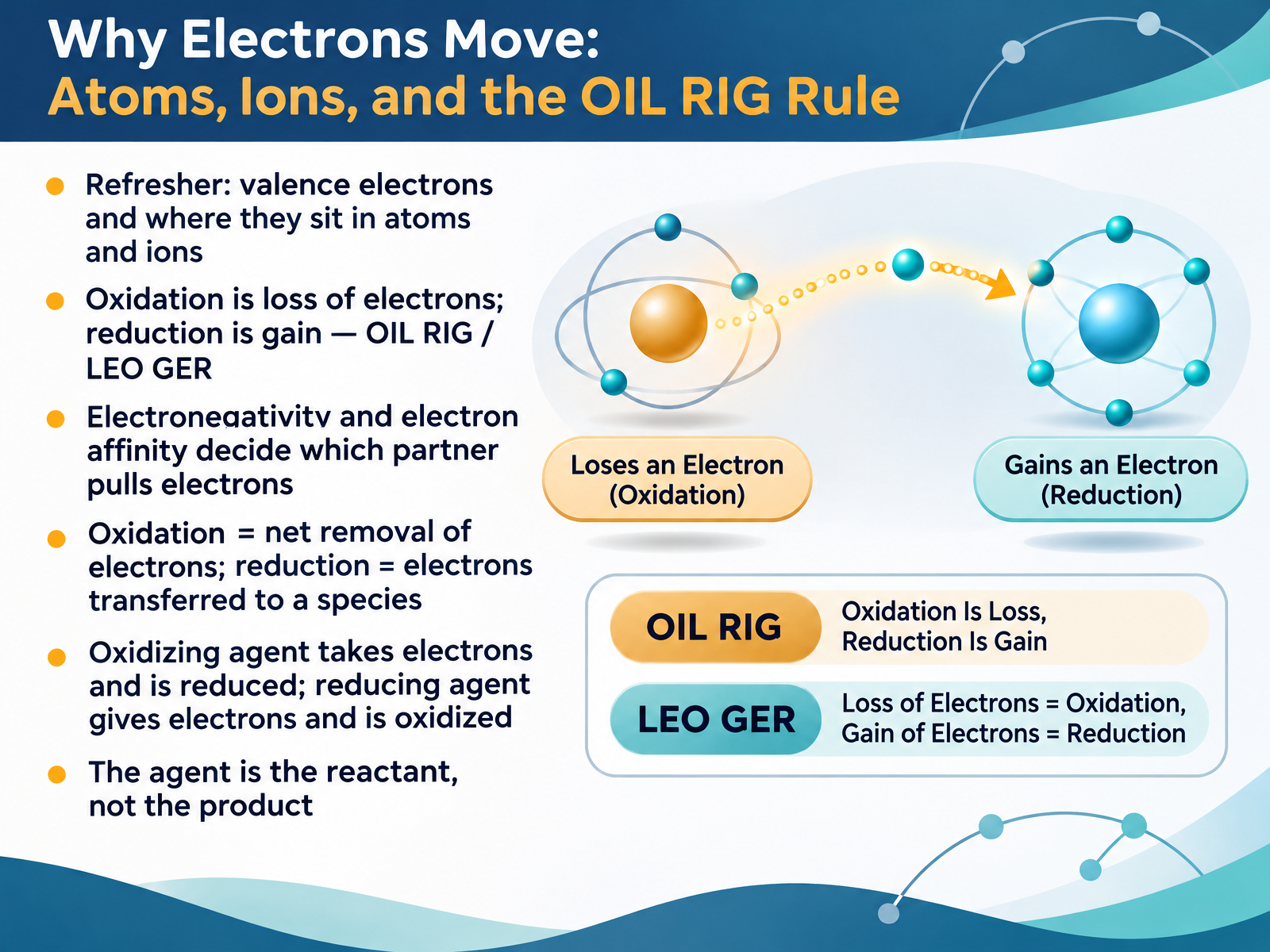
- 02Why Electrons Move: Atoms, Ions, and the OIL RIG RuleLet's build on that by looking at why electrons move in the first place. First, a quick refresher. Valence electrons are the outermost electrons, and they are the ones most likely to be transferred or shared. Next, the core rule. Oxidation is loss of electrons. Reduction is gain of electrons. Remember it with OIL RIG, or LEO GER, where LEO says GER. Notice that reduction sounds like losing, but it actually means gaining electrons. What decides which partner pulls electrons? Electronegativity and electron affinity. The species that pulls electrons more strongly takes them and is reduced, so it is the oxidizing agent. The species that gives electrons up is oxidized, so it is the reducing agent. Keep one thing straight. The agent is the reactant, not the product. In the next part, we will use oxidation numbers to track these electron changes reliably.
 chem12u.weebly.compubs.rsc.orgdoi.org+22 min
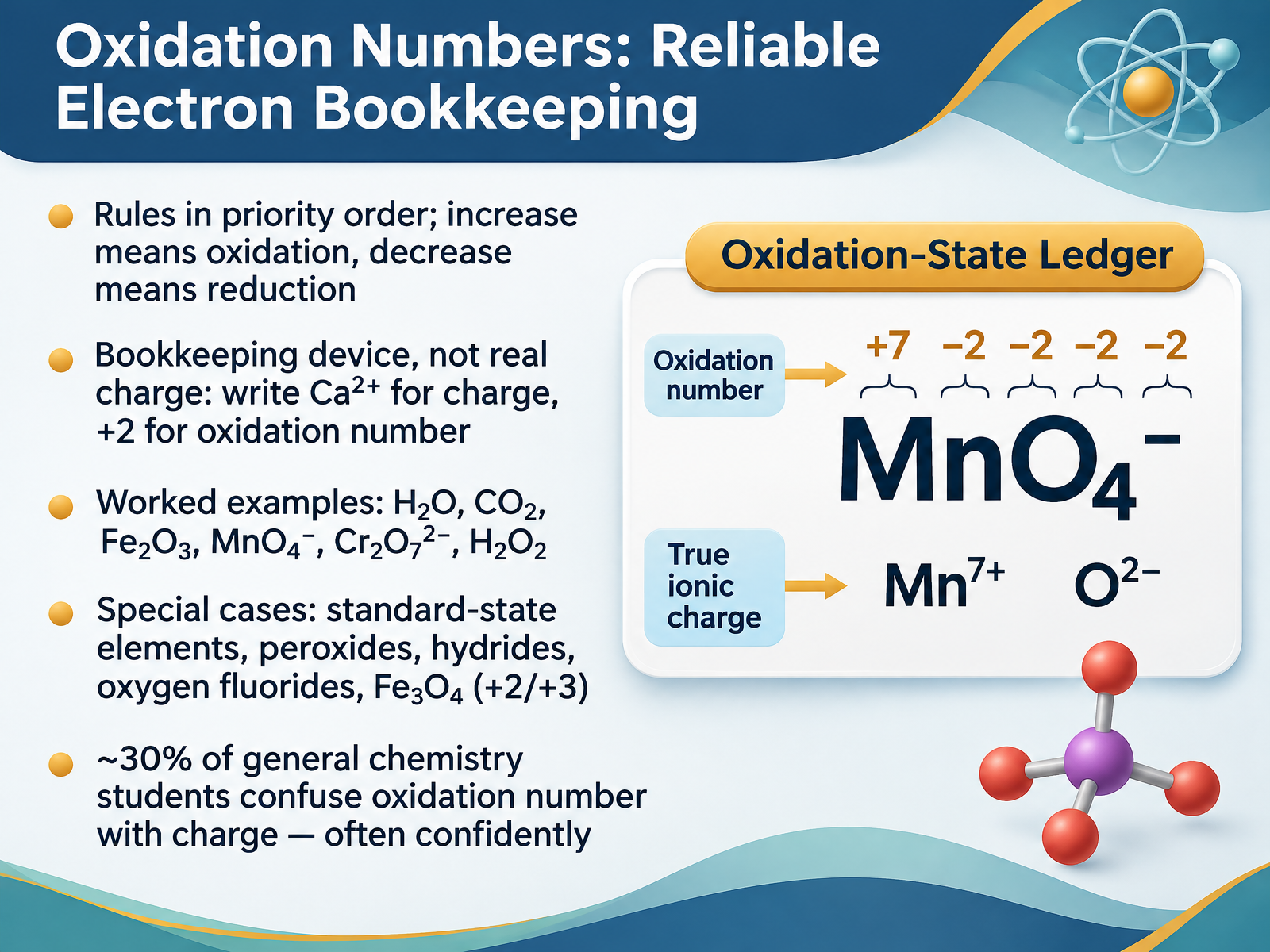
- 03Oxidation Numbers: Reliable Electron BookkeepingNow let's turn to oxidation numbers, a reliable bookkeeping device for tracking electrons. An oxidation number is a number we assign to each atom using rules in priority order. Notice that if an atom's oxidation number increases, it is oxidized, and if it decreases, it is reduced. Here is the key idea. Oxidation numbers are bookkeeping, not real charge. Write Ca two plus for charge, but plus two for an oxidation number. Let's practice with a few examples. In H two O, oxygen is minus two. In CO two, oxygen is again minus two. In Fe two O three, iron is plus three. For MnO four minus, manganese is plus seven. For Cr two O seven two minus, chromium is plus six. And in hydrogen peroxide, H two O two, oxygen is minus one. Watch for special cases. Standard state elements have an oxidation number of zero. Peroxides contain oxygen at minus one. Hydrides contain hydrogen at minus one. And in Fe three O four, iron has both plus two and plus three. One important warning. About thirty percent of general chemistry students confuse oxidation number with charge, often confidently. Keep them separate in your notes. Next, we'll see how to separate and balance half-reactions.
 pubs.rsc.orgfiles.eric.ed.govdoi.org+22 min
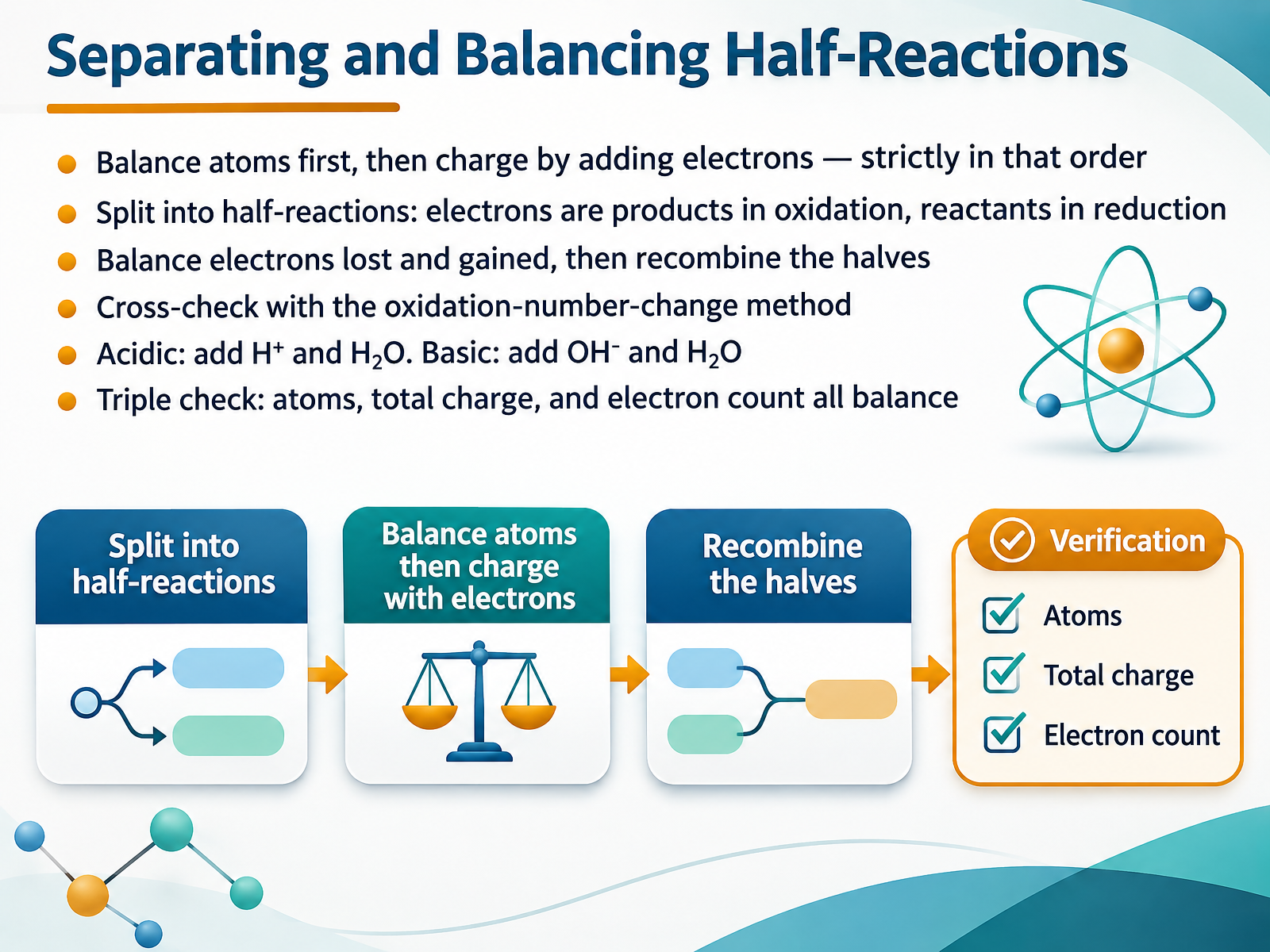
- 04Separating and Balancing Half-ReactionsNow let's put those electrons on paper. First, balance atoms. Then balance charge by adding electrons, strictly in that order. Next, split the reaction into two half-reactions. In oxidation, electrons are products, written on the right. In reduction, electrons are reactants, printed on the left. Balance the electrons lost against the electrons gained, then recombine the halves into one equation. Notice that you can cross-check your work with the oxidation-number-change method. In acidic solution, add hydrogen ions and water. In basic solution, add hydroxide ions and water. Finally, triple check: atoms, total charge, and electron count must all balance.
 chem12u.weebly.compubs.rsc.orgdoi.org+21 min
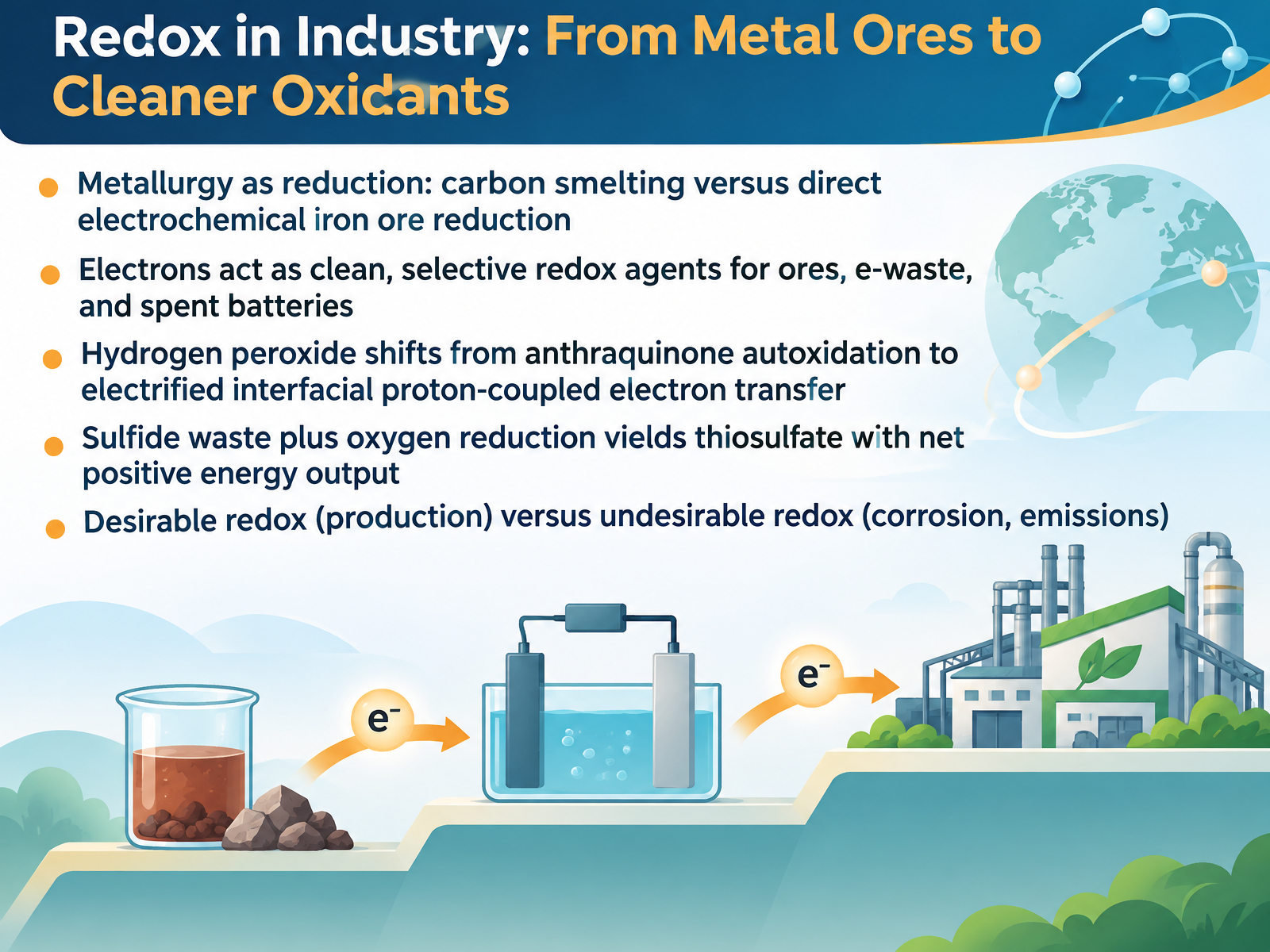
- 05Redox in Industry: From Metal Ores to Cleaner OxidantsNow let's follow the electrons into industry. First, metallurgy. Traditional smelting uses carbon to strip oxygen from metal ores, and carbon becomes carbon dioxide. Direct electrochemical reduction instead uses electrons, producing iron without that carbon dioxide. Next, notice that electrons are clean, selective redox agents. They let us recover metals from ores, electronic waste, and spent batteries under mild conditions. Consider hydrogen peroxide. Its traditional route is anthraquinone autoxidation. A newer approach uses electrified interfacial proton-coupled electron transfer, where electrons and protons move together at the interface. Then there is sulfide waste, which is a liability. Coupling sulfide oxidation with oxygen reduction yields thiosulfate, with net positive energy output. Finally, keep the distinction clear. Desirable redox makes products. Undesirable redox gives corrosion and emissions. That brings us to the next slide: Corrosion, Combustion, Bleaching, and Respiration in Daily Life.
 nature.comdoi.orglink.springer.com+21 min
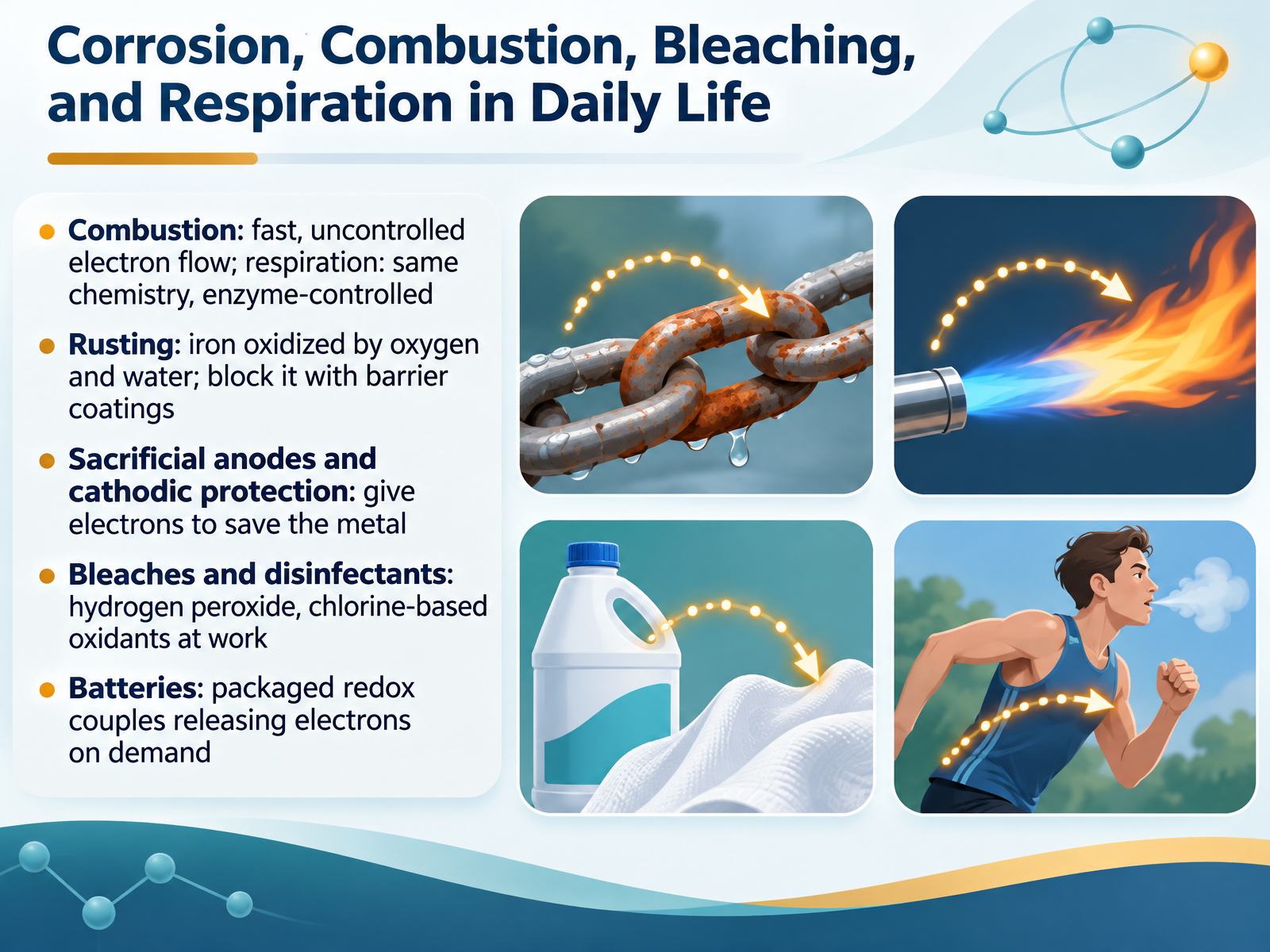
- 06Corrosion, Combustion, Bleaching, and Respiration in Daily LifeNow let us see redox chemistry at work in daily life. First, combustion. Fuel burns and electrons flow fast to oxygen, uncontrolled, releasing heat and light. Respiration uses the same chemistry, but enzymes control the electron flow, releasing energy in small steps. Next, rusting. Iron is oxidized by oxygen and water. Block that contact with barrier coatings such as paint or grease. Or use a sacrificial anode, a more reactive metal that gives up its electrons to save the metal you care about. This is called cathodic protection. Then there are bleaches and disinfectants. Hydrogen peroxide and chlorine-based oxidants work by pulling electrons from pigments and microbes. Notice that all these examples are electron bookkeeping. Finally, batteries are packaged redox couples that release electrons on demand. Next, we look at electrochemistry, where we use those electrons to do useful work.
 nature.comdoi.orglink.springer.com+22 min
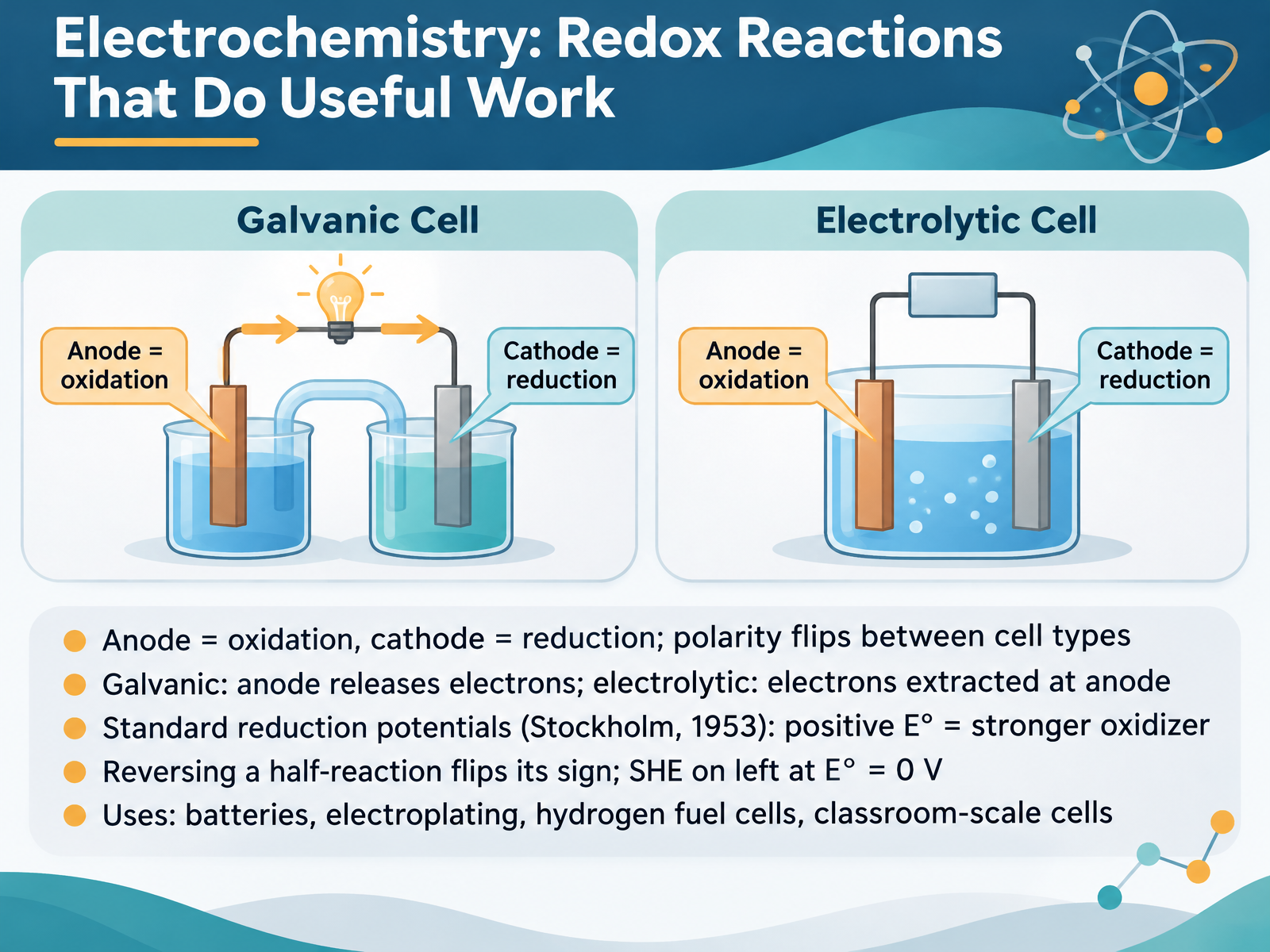
- 07Electrochemistry: Redox Reactions That Do Useful WorkNow let's see redox reactions doing useful work in an electrochemical cell. First, the labels. The anode is where oxidation happens. The cathode is where reduction happens. Notice that the polarity of these electrodes flips between cell types. In a galvanic cell, the anode releases electrons. In an electrolytic cell, electrons are extracted at the anode. Next, standard reduction potentials, fixed by the Stockholm convention of 1953. All half-reactions are written as reductions, and a positive standard potential means a stronger oxidizing agent. If you reverse a half-reaction, you flip the sign of its potential. And by definition, the standard hydrogen electrode sits on the left at zero volts. These ideas give you batteries, electroplating, hydrogen fuel cells, and classroom-scale cells. Next, we'll bring electrochemistry into practice with demonstrations and microscale cells.
 cpoli.github.iochem.academymedia.iupac.org+22 min
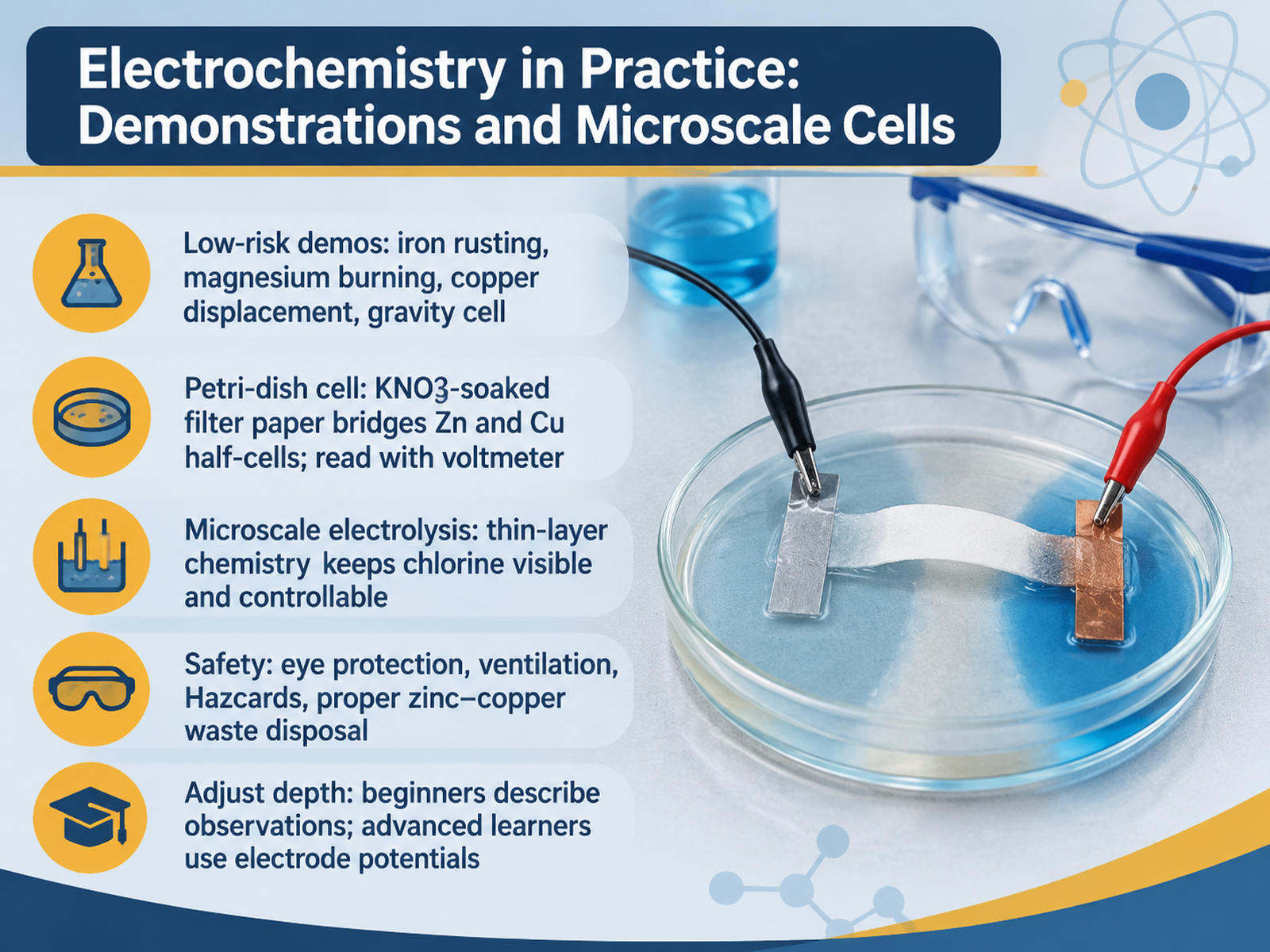
- 08Electrochemistry in Practice: Demonstrations and Microscale CellsNow let's put electron transfer to work. First, low-risk demonstrations: an iron nail rusting, magnesium ribbon burning, copper displacing silver from solution, and a gravity cell. Each shows oxidation and reduction through a visible change. Next, the petri-dish cell. A filter paper soaked in potassium nitrate bridges two half-cells, one zinc, one copper. Read the voltage with a voltmeter and watch the needle settle. Then microscale electrolysis. Thin-layer chemistry keeps chlorine visible and controllable, so students see bubbles at the positive electrode and copper forming at the negative. Safety matters throughout: eye protection, good ventilation, checking Hazcards, and disposing of zinc and copper waste properly. Adjust the depth: beginners describe observations, while advanced learners use electrode potentials. Next, we tackle common misconceptions and diagnostic questions.
 edu.rsc.org1 min
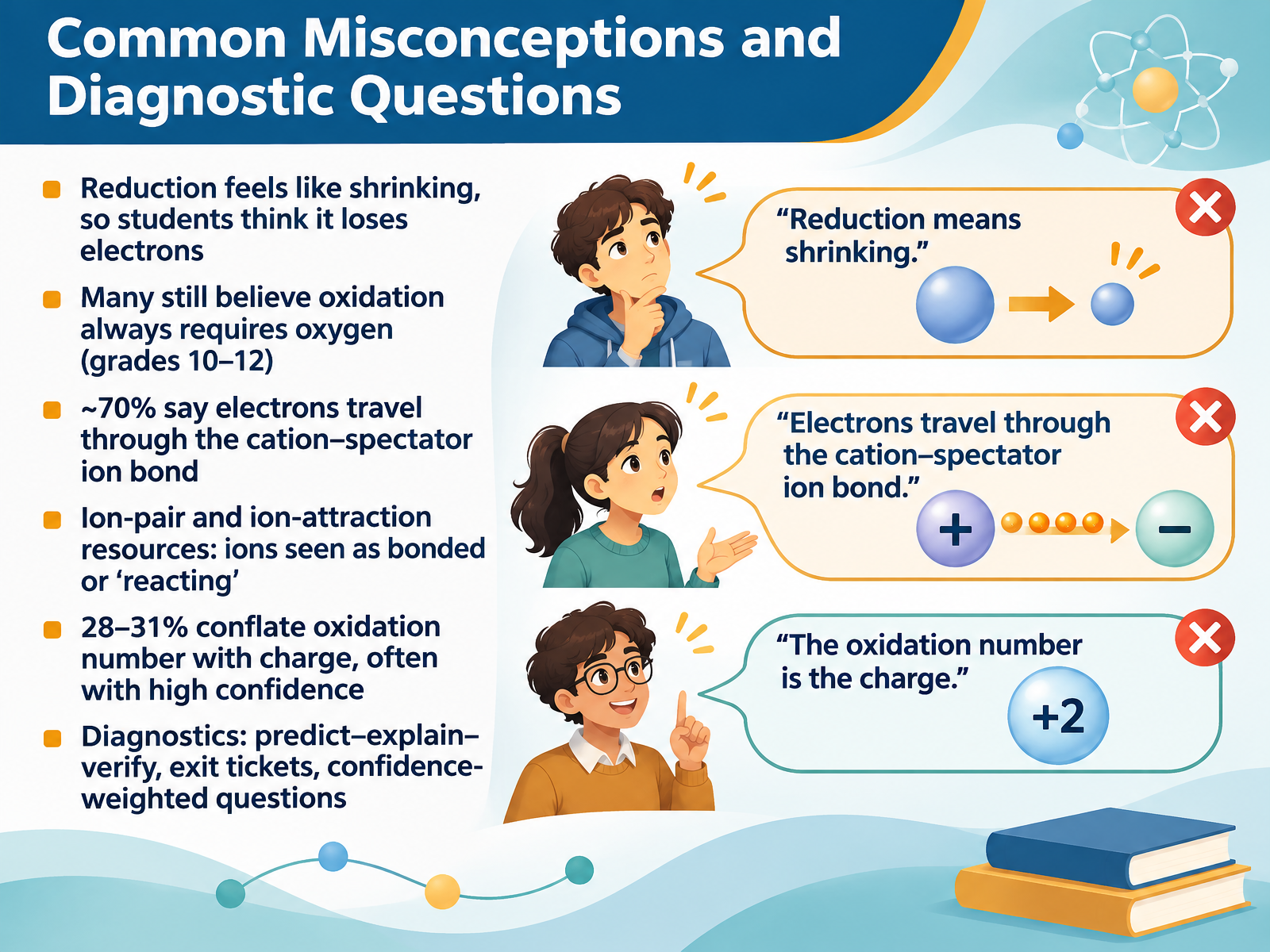
- 09Common Misconceptions and Diagnostic QuestionsLet's confront the misconceptions that trip students up again and again. First, the word reduction. It feels like shrinking, so many students decide it means losing electrons. Say it plainly: reduction is gain of electrons. Track the electrons and the word stops misleading you. Next, oxidation. Many students in grades ten through twelve still believe oxygen is always required. It is not. Oxidation is loss of electrons, with or without oxygen. Then there is the spectator ion. About seventy percent of students say electrons travel through the cation to spectator ion bond. Notice that ions in solution are separate and mobile, and electron transfer happens between the reacting species, not through that bond. Watch for the ion pair and ion attraction resources, where ions are treated as bonded or simply reacting by opposite charge. Also watch the numbers. Roughly twenty-eight to thirty-one percent of students conflate oxidation number with charge, often with high confidence, so ask them to compare sulfur and sulfate directly. Good diagnostics are predict, explain, verify, exit tickets, and confidence-weighted questions that reveal overconfidence. Next, we take these ideas into biology, with redox in the body, respiration and antioxidants.
 pubs.rsc.orgfiles.eric.ed.govdoi.org+22 min
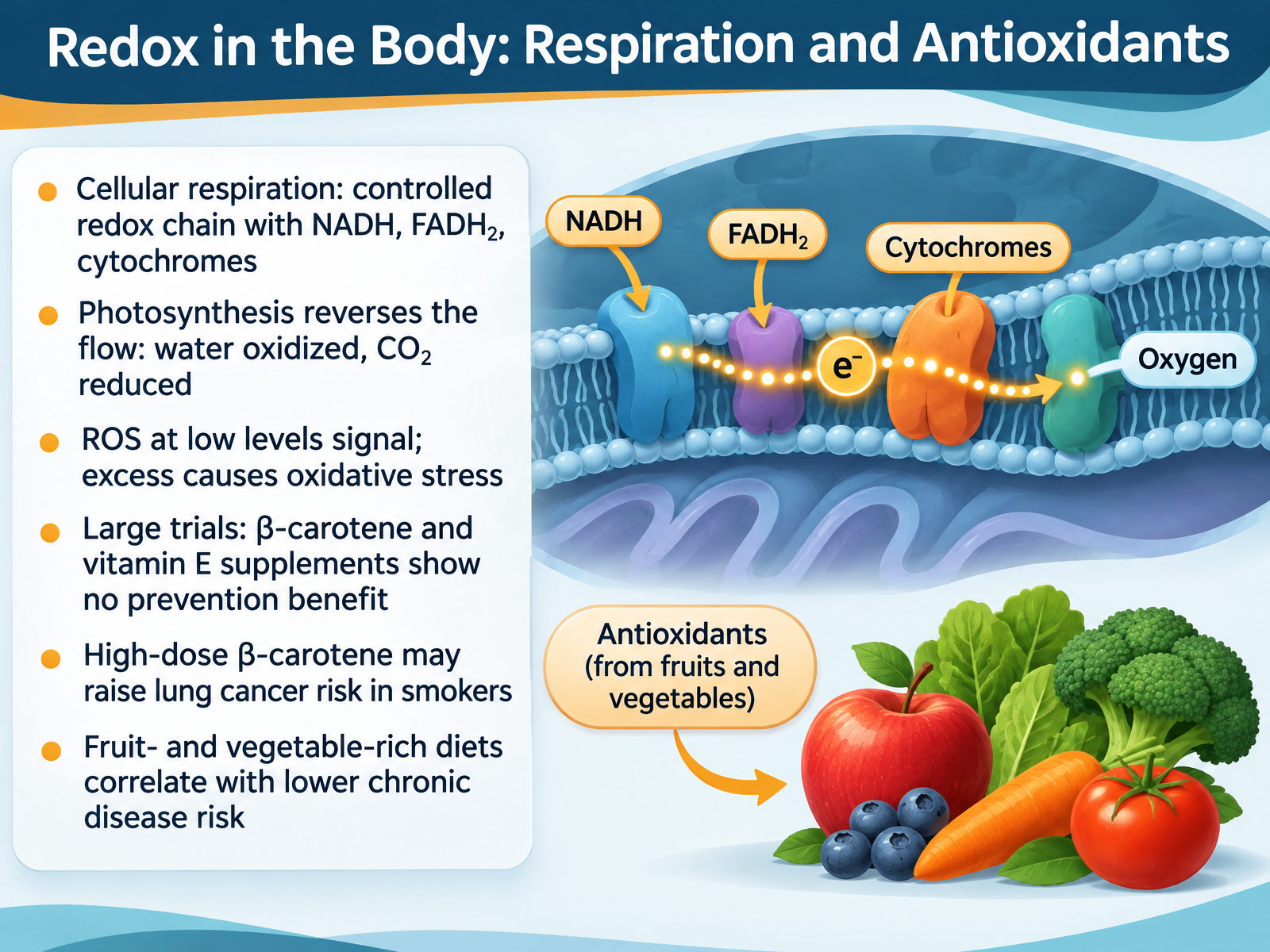
- 10Redox in the Body: Respiration and AntioxidantsNow let's see redox at work inside living things. In cellular respiration, electrons travel a controlled chain from NADH and FADH two, through cytochromes, to oxygen. Notice that this is a staged release of energy, not a sudden burn. Photosynthesis runs the reverse flow: water is oxidized, releasing electrons, and carbon dioxide is reduced to sugar. Next, reactive oxygen species. At low levels, these molecules act as signals. In excess, they cause oxidative stress, damaging proteins, DNA, and lipids. This is where antioxidants come in. But here is the common confusion: large trials found that beta-carotene and vitamin E supplements showed no prevention benefit, and high-dose beta-carotene may actually raise lung cancer risk in smokers. By contrast, fruit- and vegetable-rich diets correlate with lower chronic disease risk. So remember: whole foods, not high-dose pills. Next, we move from the body to the environment, with redox in nitrogen, sulfur, and remediation.
 2 min
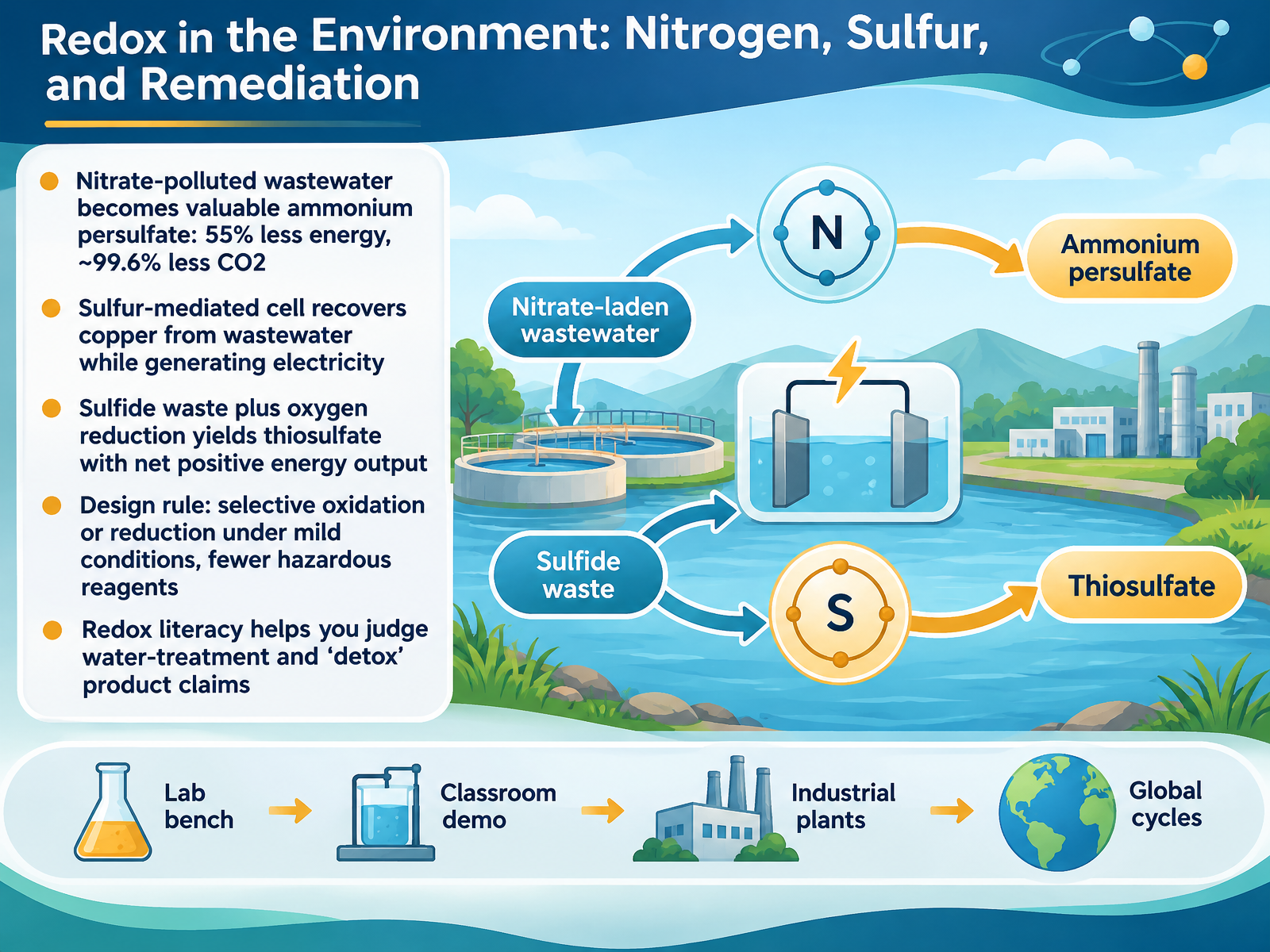
- 11Redox in the Environment: Nitrogen, Sulfur, and RemediationNow let's see redox at work in the environment. First, nitrate-polluted wastewater can be turned into valuable ammonium persulfate. That process uses fifty-five percent less energy and about ninety-nine point six percent less carbon dioxide than conventional routes. Next, a sulfur-mediated cell recovers copper from wastewater while generating electricity, thanks to the reversible conversion of sulfur to copper sulfide. Then, sulfide waste plus oxygen reduction yields thiosulfate with net positive energy output. Notice the design rule behind all three: selective oxidation or reduction under mild conditions, with fewer hazardous reagents. That is why redox literacy matters. It helps you judge water-treatment and detox product claims, asking simply: what is oxidized, what is reduced, and is the electron bookkeeping honest? Next, we look at teaching redox, sequencing for beginners and advanced learners.
 nature.comdoi.orglink.springer.com+22 min
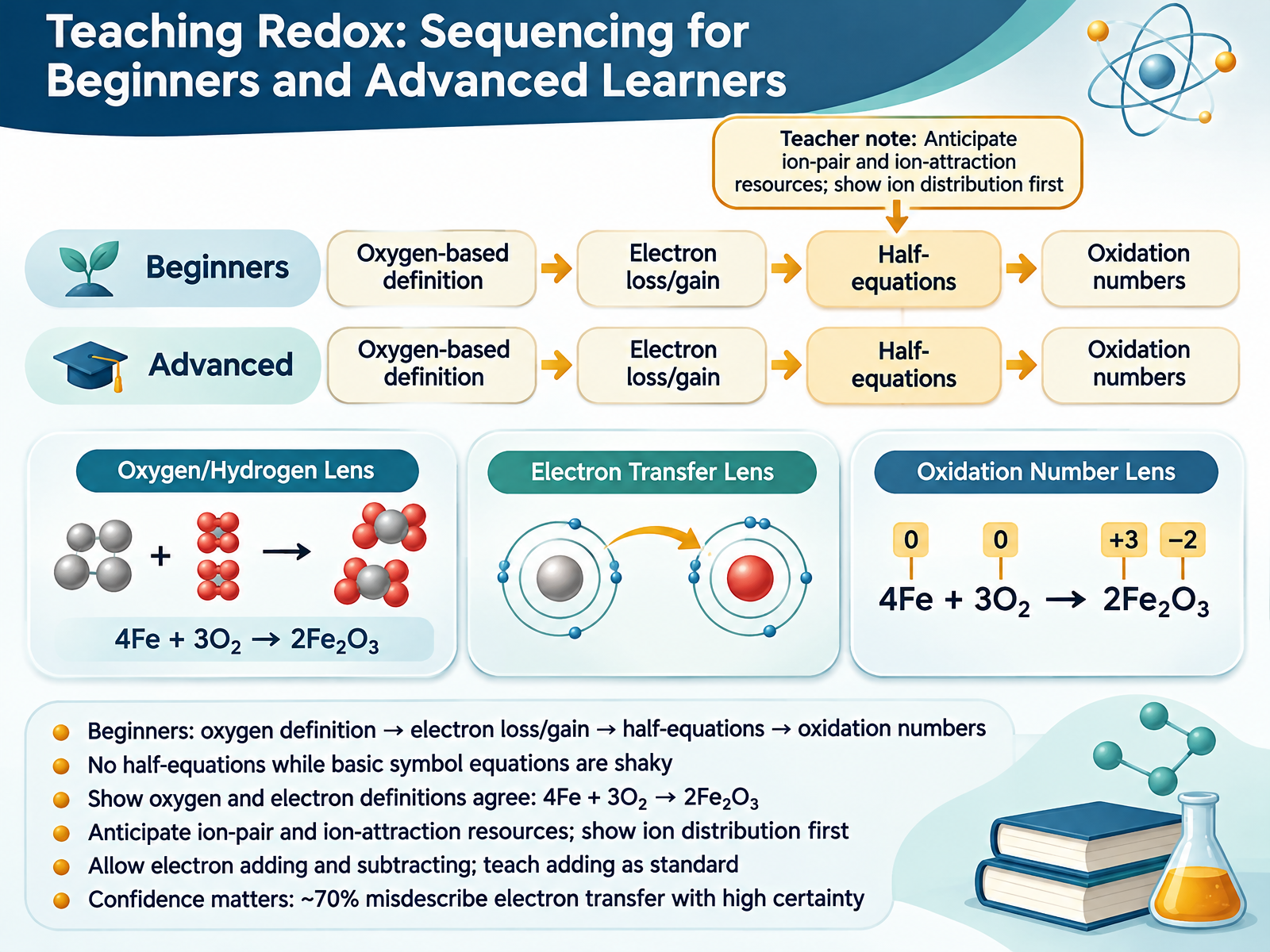
- 12Teaching Redox: Sequencing for Beginners and Advanced LearnersNow let's talk about sequencing, because the order you teach redox matters as much as the content. For beginners, move step by step: first the oxygen definition, next electron loss and gain, then half-equations, and only after that, oxidation numbers. Here is the key caution. Do not introduce half-equations while basic symbol equations are still shaky. Students need to balance atoms and charges first. Notice that the oxygen and electron definitions agree. Take four iron plus three oxygen molecules gives two iron oxide. Written with electrons, iron loses three electrons and each oxygen atom gains two. Show students that proof, so the new definition does not feel like a contradiction. Also anticipate two common ideas students bring: ions staying paired, and opposite charges attracting. Show the ion distribution in solution before any electron transfer. When balancing half-equations, allow students to add or subtract electrons, but teach adding as the standard convention. And remember confidence matters. Research shows about seventy percent of students misdescribe electron transfer while feeling highly certain. Our next step is your integrated problem set, where you will follow the electrons yourself.
 pubs.rsc.orgfiles.eric.ed.govdoi.org+22 min
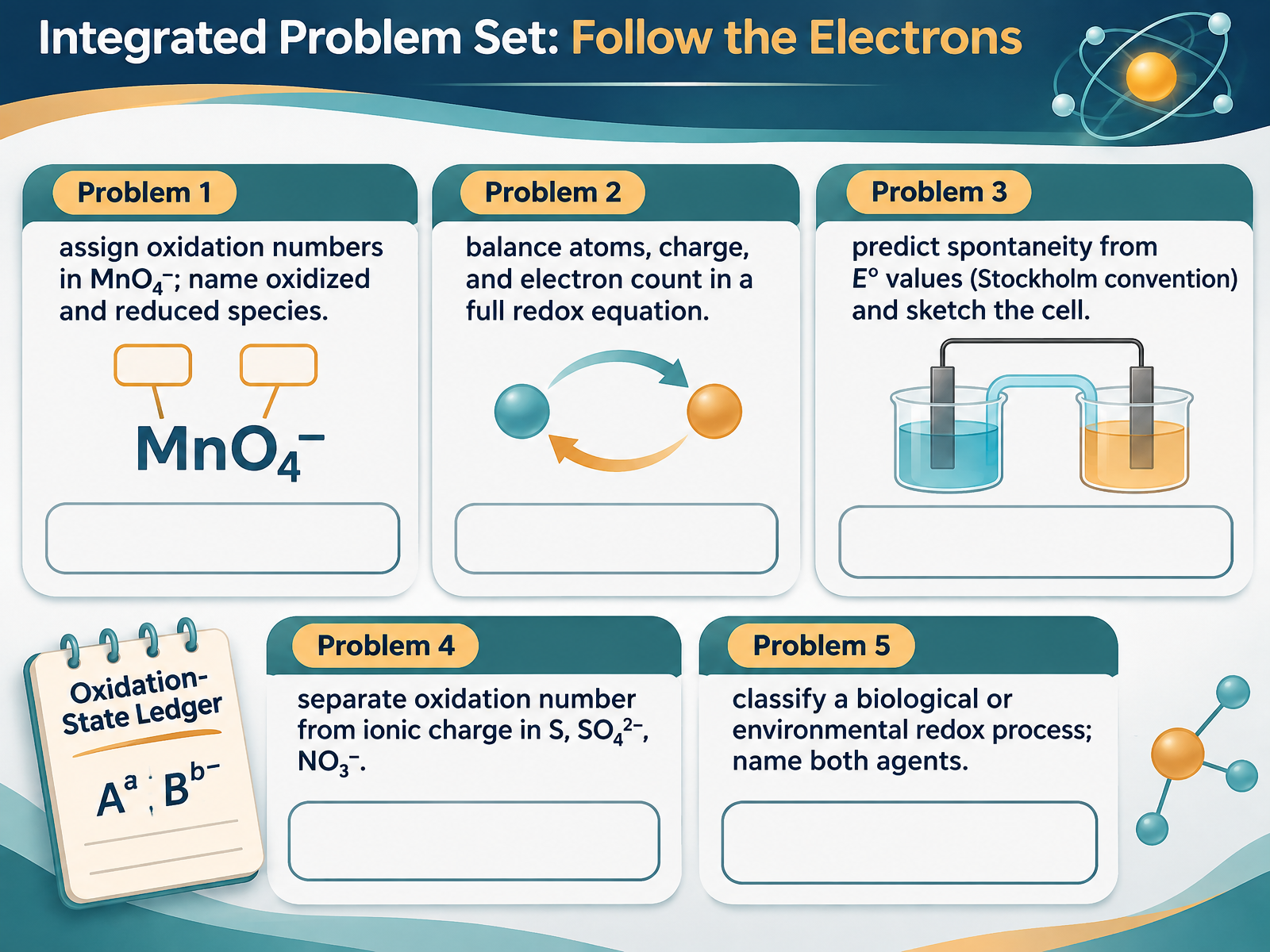
- 13Integrated Problem Set: Follow the ElectronsLet's put everything together with an integrated problem set. Your goal on every problem is simple: follow the electrons. First, assign oxidation numbers in permanganate, MnO4 minus. Oxygen is minus two, and the ion's overall charge is minus one, so manganese comes out at plus seven. Manganese is reduced; oxygen is oxidized. Next, balance a full redox equation by fixing atoms first, then charge, then electron count. Notice that electrons lost must equal electrons gained. Third, predict spontaneity from standard reduction potentials using the Stockholm convention, where all tabulated values are reduction potentials. Subtract the anode value from the cathode value; a positive result means the reaction is spontaneous. Then sketch the cell, with oxidation at the anode and reduction at the cathode. Fourth, keep oxidation number separate from ionic charge in sulfur, sulfate, and nitrate; the number tracks electrons, while the charge is real. Fifth, classify a biological or environmental redox process and name both agents. Remember, the oxidizing agent is itself reduced. Let's carry these habits forward into the wrap-up.
 cpoli.github.iochem.academymedia.iupac.org+22 min
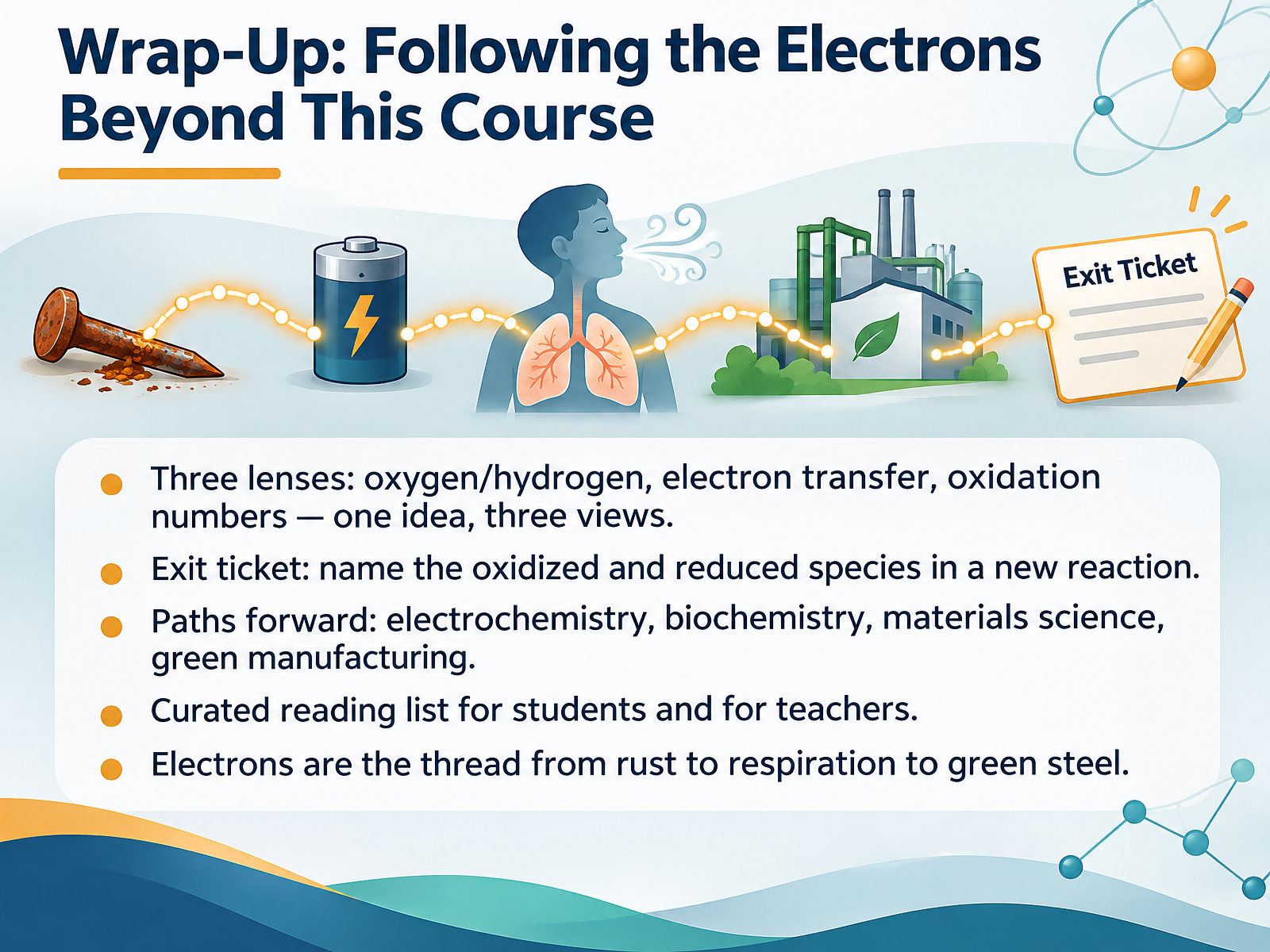
- 14Wrap-Up: Following the Electrons Beyond This CourseLet's bring it all together. You have followed the electrons through three lenses: oxygen and hydrogen, electron transfer, and oxidation numbers. They are one idea seen three ways, so use whichever lens makes the bookkeeping clearest. Next, your exit ticket: take a new reaction and name the oxidized species and the reduced species, then justify both answers. Notice that the reasoning matters more than the label. From here, your paths forward include electrochemistry, biochemistry, materials science, and green manufacturing, where electrons are already replacing carbon-based reagents in processes like greener steel and chemical production. A curated reading list is on the slide, one set for students and one for teachers. The big takeaway: electrons are the thread running from rust to respiration to green steel. Thank you for your attention and your questions. Keep following those electrons, stay curious, and trust the bookkeeping you have practiced.
 nature.comdoi.orglink.springer.com+22 min
Take the deck with you
Download this course as a file — free, no sign-up needed.
- PDF handoutEvery slide page, ready to print or share.15 pages · 4.3 MBDownload
- Narrated PowerPointThe deck that presents itself — every slide carries the digital human's narration video.15 pages · 14.0 MBDownload
- PowerPoint slidesThe full deck as a .pptx — open it in PowerPoint, Keynote, or Google Slides.15 pages · 4.2 MBDownload
Free to use in your own training — please keep the PersonWise credit page at the end.
Have your own deck? Turn it into a course
Sources consulted
Web sources consulted while building this course.
- Common Misconceptions - Grade 12 Chemistry (SCH4U) — chem12u.weebly.com
- Why learning redox is difficult even with animations – students’ adherence to cognitive resources | Chemistry Education Research and Practice | The Royal Society of Chemistry — pubs.rsc.org
- Conceptual difficulties experienced by senior high school students of electrochemistry: Electric circuits and oxidation‐reduction equations — doi.org
- 4 ways to teach redox in terms of electrons | Ideas | RSC Education — edu.rsc.org
- Teaching and learning difficulties in electrochemistry. — wiredspace.wits.ac.za
- Measuring meta-ignorance through the lens of confidence: examining students' redox misconceptions about oxidation numbers, charge, and electron transfer | Chemistry Education Research and Practice | The Royal Society of Chemistry — pubs.rsc.org
- LIMITATIONS OF TEACHING AND LEARNING REDOX: A SYSTEMATIC REVIEW — files.eric.ed.gov
- Student misinterpretations and misconceptions based on their explanations of two computer animations of varying complexity depicting the same oxidation–reduction reaction — doi.org
- The Development of the Redox Concept Inventory as a Measure of Students’ Symbolic and Particulate Redox Understandings and Confidence — doi.org
- Electrifying industrial hydrogen peroxide production via soft interfacial molecular mediation | Nature Chemistry — nature.com
- Advances in green electrochemical pathways for sustainable mineral and metal processing — doi.org
- Direct Electrochemical Reduction Processes as Potential Alternatives for Green Iron Production | Journal of Sustainable Metallurgy | Springer Nature Link — link.springer.com
- Ex Ante Life Cycle Assessment of Industrial-Scale Electrochemical Reduction of CO2 to Formic Acid | ACS Sustainable Chemistry & Engineering | ACS Publications — pubs.acs.org
- Sulfur-mediated electrochemical copper recovery from wastewater with net electricity generation | Nature Sustainability — nature.com
- The 1953 Stockholm convention: electrode potentials are reduction potentials — chemistrykit — cpoli.github.io
- Standard Reduction Potentials – Chem.Academy — chem.academy
- 1.3.10 Electrochemistry — media.iupac.org
- IUPAC - redox potential (RT06783) — goldbook.iupac.org
- 17.12: Standard Electrode Potentials — chem.libretexts.org
- Microscale redox reactions - teacher notes — edu.rsc.org