Begin
14 pages · ~28 min
Customer Education Fundamentals
Foundational course teaching key principles of customer education, designed for professionals building or enhancing customer training programs. Learners will master strategies for creating effective learning experiences that drive product adoption and customer success.
A digital instructor presents all 14 pages. Hold “Ask” at any point and ask out loud — the answer comes from this course. No sign-up needed.
What you’ll learn
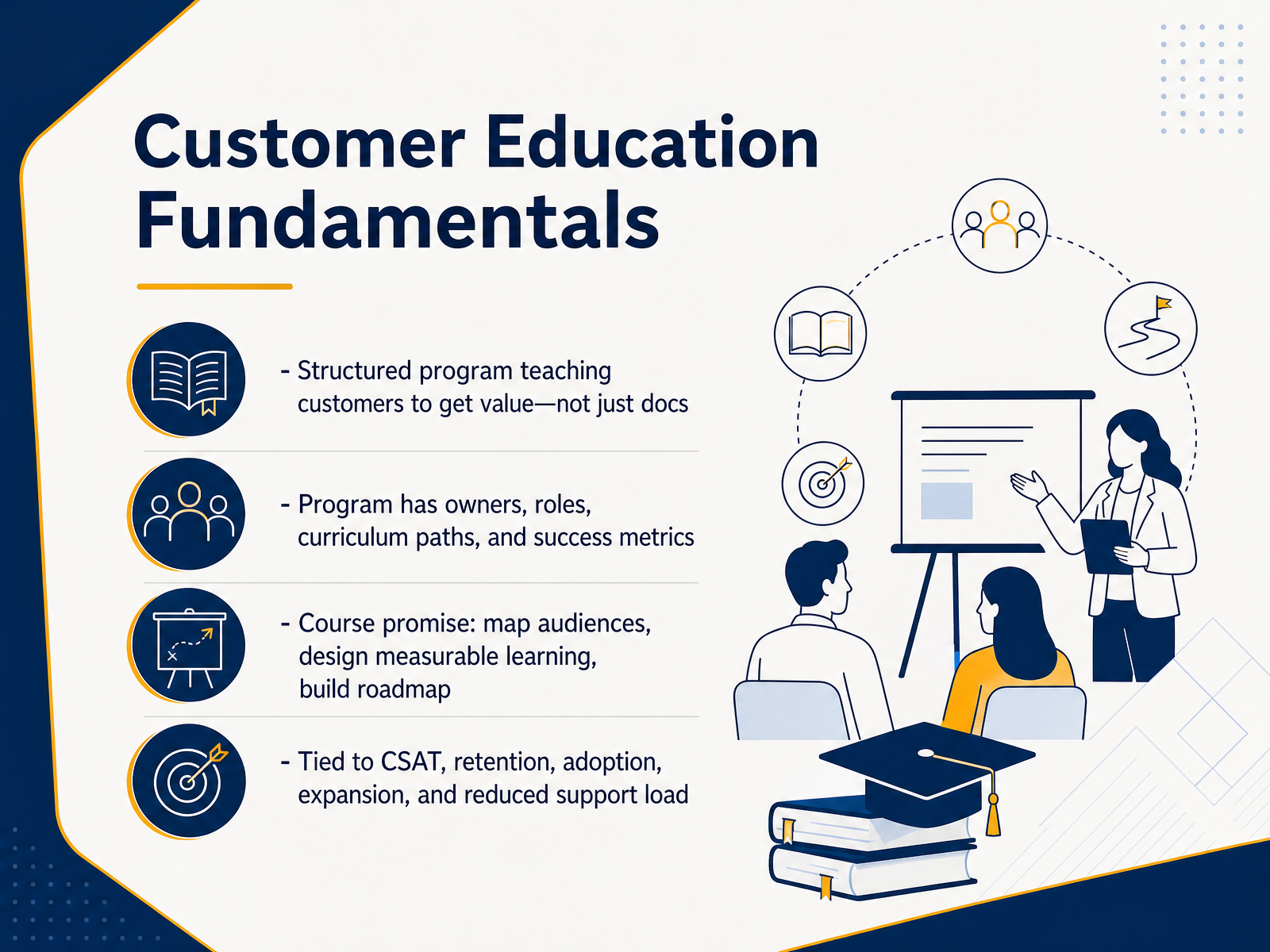
- 01Customer Education FundamentalsWelcome. This is Customer Education Fundamentals. If you work in customer success, training, or content, you already know the problem. Customers struggle to get value, and your team repeats the same answers every single day. This course is about fixing that root problem, not just publishing more help docs. A real customer education program is structured. It has owners, defined roles, and curriculum paths. And it is measured against the numbers your leadership already tracks, like CSAT, retention, adoption, expansion, and support load. Here is the promise of our time together. We will map your audiences, design learning that measurably changes behavior, and build a roadmap that scales training without scaling headcount. Over the next few slides, we will turn your existing onboarding and enablement workflow into a self-serve asset. Let us start by looking at why customer education needs to function as a formal program, and not just a folder of resources.trainn.coabsorblms.comabsorblms.com+21 min
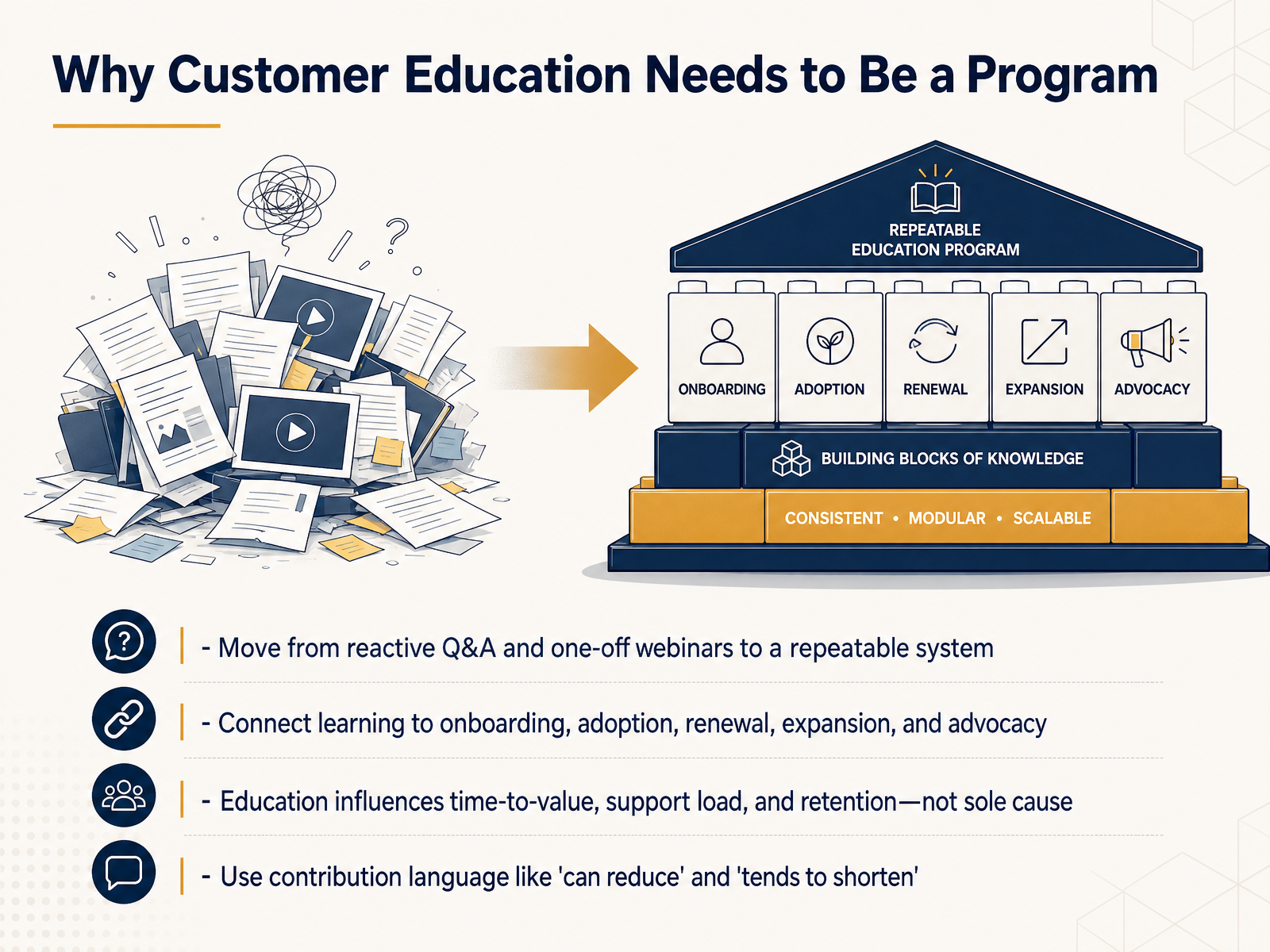
- 02Why Customer Education Needs to Be a ProgramLet's look at why customer education needs to be a program, not a pile of content. Right now, many teams are stuck in reactive mode, answering the same questions over and over and running one-off webinars that do not scale. A program changes that. It builds a repeatable system that maps learning directly to the moments that matter: onboarding, adoption, renewal, expansion, and advocacy. The key is to connect education to outcomes your leadership already tracks, like time to value, support load, and retention. But here is the important part. Education rarely causes those outcomes by itself. If you claim it does, you will lose credibility fast. Instead, use contribution language. Say education can reduce time to first value, tends to shorten onboarding, or is associated with higher renewal rates. That honest framing builds trust and keeps the conversation focused on the levers you can actually influence. Next, let's build the business case.
 trainn.coabsorblms.comabsorblms.com+21 min
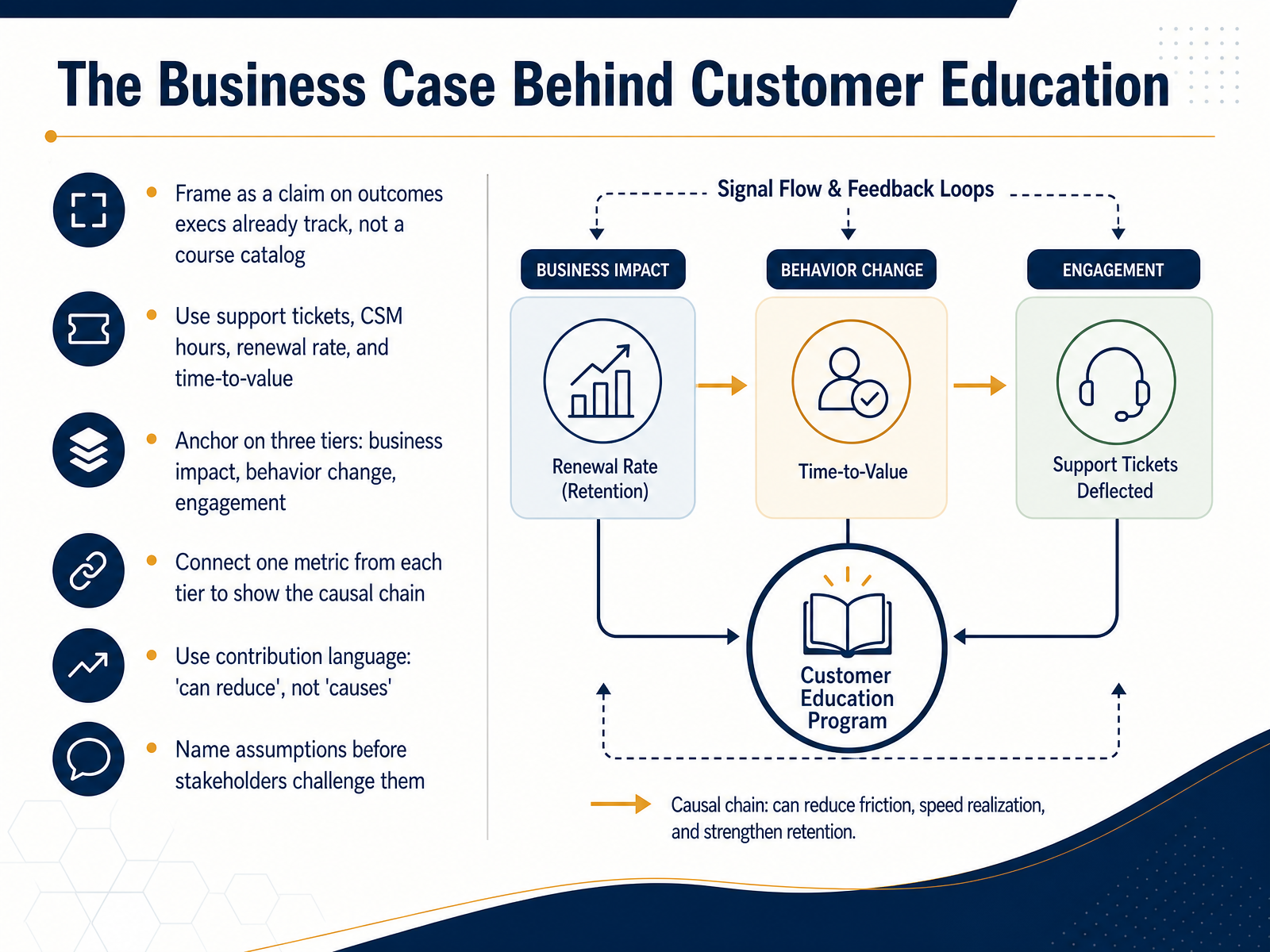
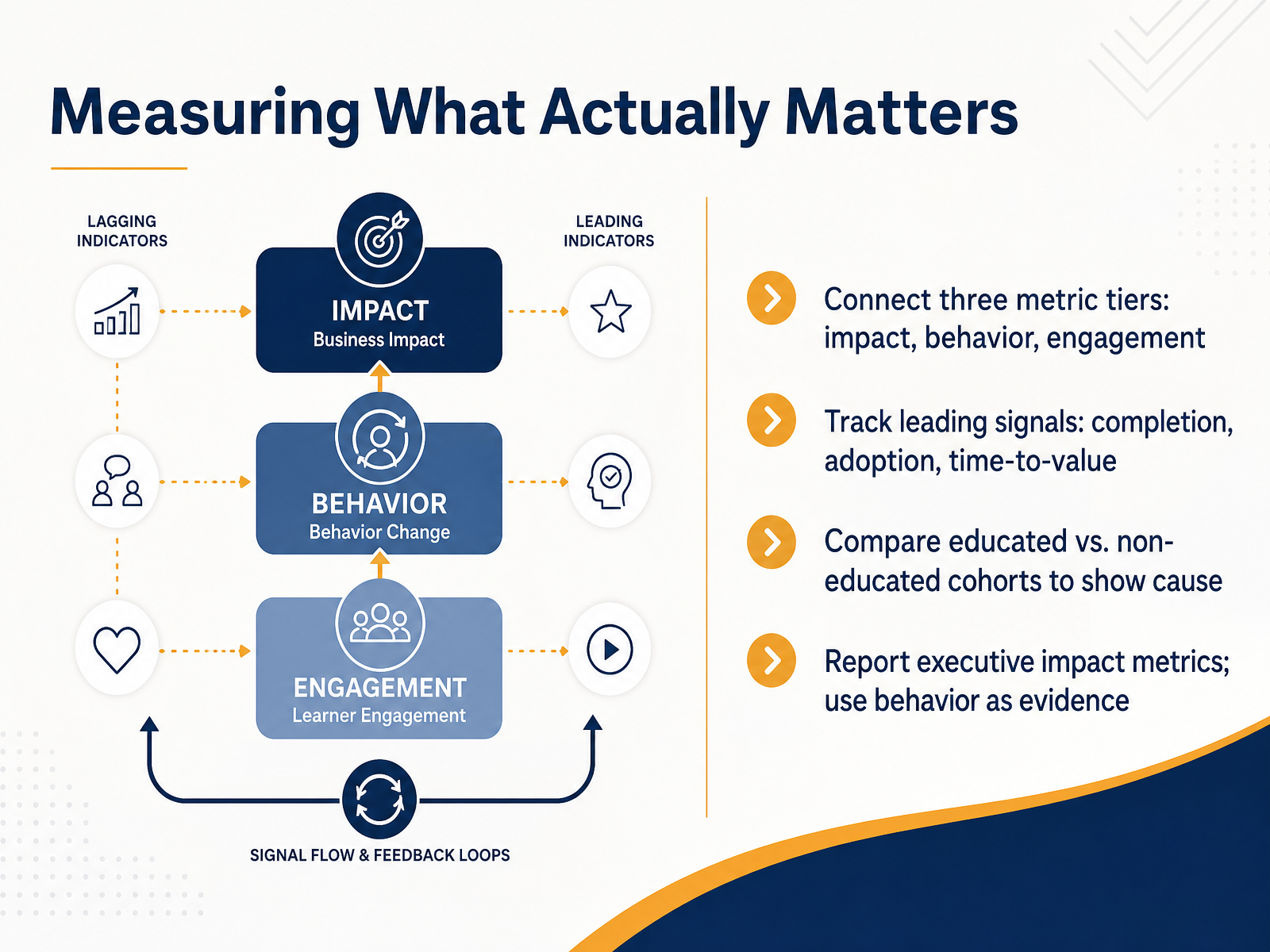
 - 03The Business Case Behind Customer EducationSo that brings us to the business case. When we talk to leadership, the fastest way to lose the room is by presenting a course catalog. Instead, we need to frame this as a claim on the outcomes they already track. Think support tickets, CSM hours, renewal rate, and time-to-value. We organize this around three tiers. First, business impact. That is retention and CSAT. Second, behavior change. That is feature adoption and ticket deflection. Third, engagement. That is completion rates and time-to-value. The key is to connect one metric from each tier. Show the causal chain. For example, customers who finish onboarding open thirty percent fewer tickets, which frees up support hours. But here is the critical rule. Use contribution language. Say a program 'can reduce' churn, not that it 'causes' it. And always name your assumptions. If you are projecting a five percent retention lift, say where that number came from before a stakeholder asks. This is how we protect our credibility and secure the budget. Next, we will look at core concepts and maturity stages.
 trainn.coabsorblms.comabsorblms.com+21 min
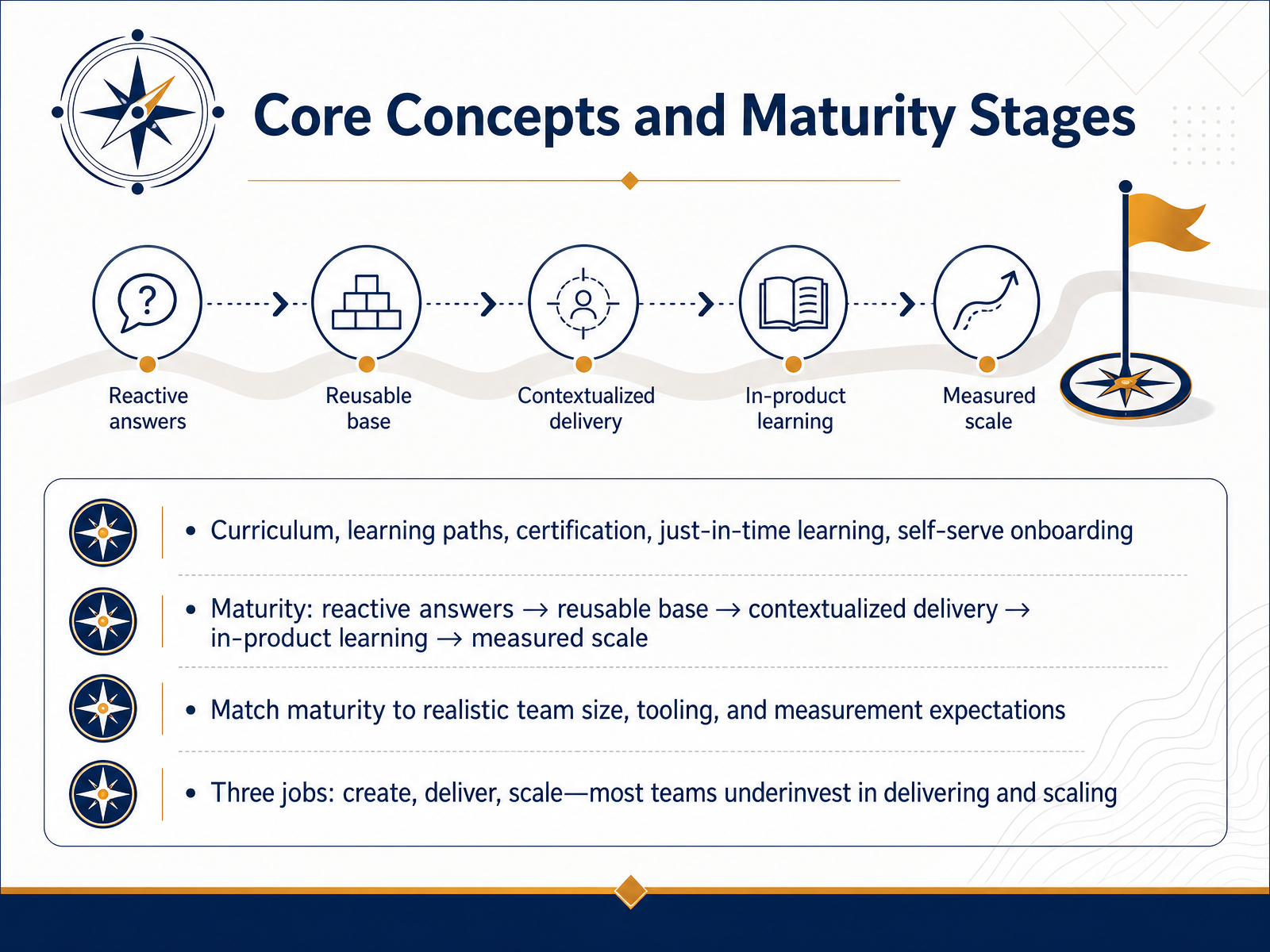
 - 04Core Concepts and Maturity StagesLet's look at the core concepts that hold all of this together, and the maturity stages your program actually moves through. You've heard the terms before: curriculum, learning paths, certification, just-in-time learning, self-serve onboarding. Think of these not as separate projects, but as layers that stack on top of each other as you mature. The progression is predictable. You start reacting to tickets with one-off answers. Then you build a reusable content base. Next, you organize it so people can find it, then you tailor it to specific audiences and embed it inside the product workflow. The top stage is self-serve learning at scale, where you can finally measure impact on time-to-value and retention. The trap is trying to skip stages. Match your maturity to your actual team size, your current tooling, and what you can realistically measure right now. At every level, there are really only three jobs: create content, deliver it, and scale the system. Most teams underinvest in delivering and scaling because they feel more productive when they're making new content. But delivery friction is what stalls most programs, not a shortage of videos. So as you go through the next few slides, keep asking: which of those three jobs is my current bottleneck? Next, we'll talk about who actually needs customer education, because that answer changes what you build.
 trainn.cothoughtindustries.comtemjournal.com+22 min
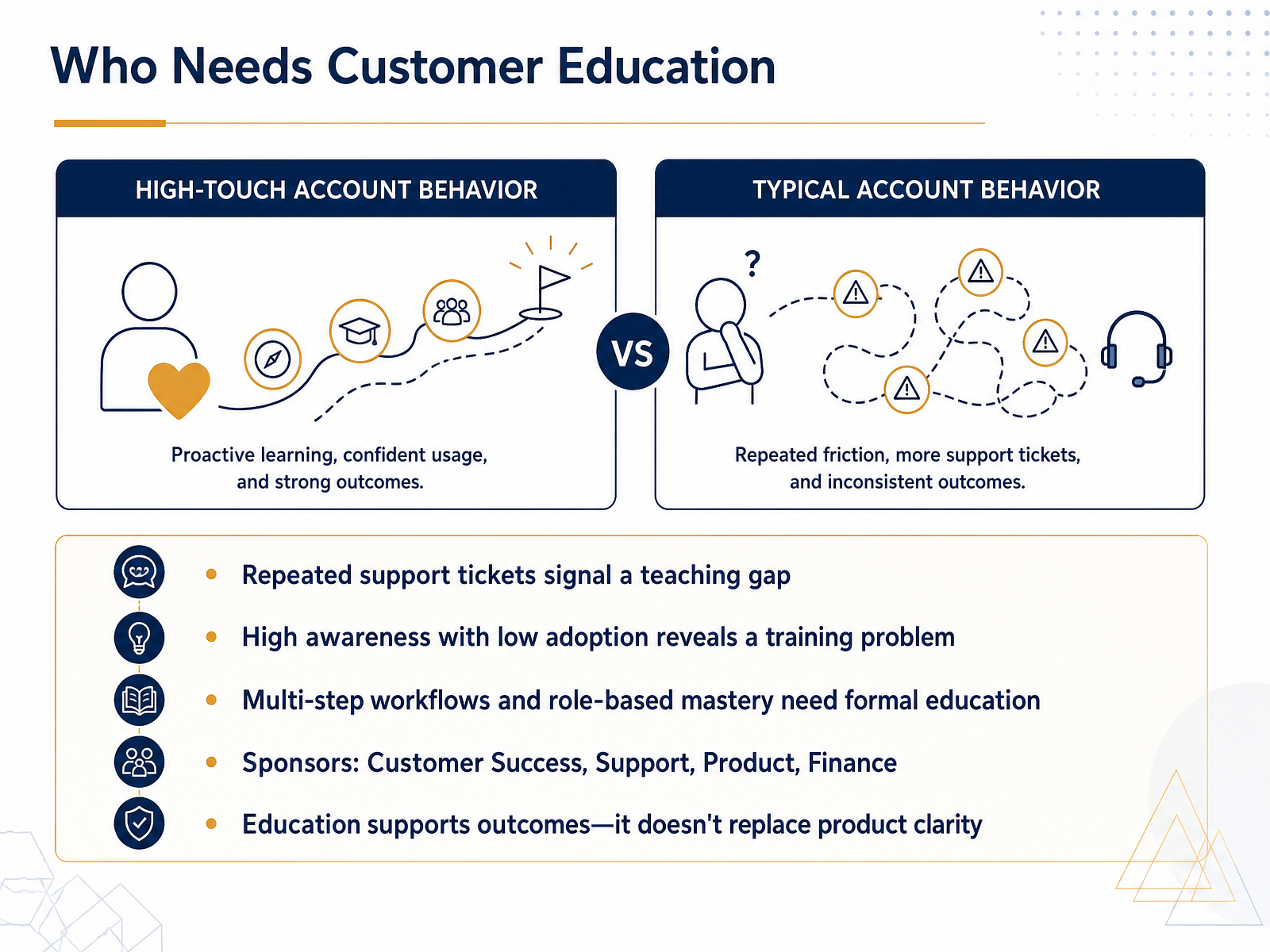
 - 05Who Needs Customer EducationLet’s talk about who actually needs customer education, because it is not always the person you assume. Start with repeated support tickets. When the same question keeps coming back, that is a signal the product itself is probably clear, but the teaching is missing. Next, look at high awareness paired with low adoption. If users know a feature exists but never activate it, the gap is training, not discovery. Then consider multi-step workflows or role-based mastery. These need structured paths, not a help article. The people who sponsor this work usually come from Customer Success, Support, Product, or Finance, because education supports the outcomes each of those teams already owns. It reduces time-to-value, deflects tickets, and protects renewals. One thing to remember: education supports outcomes. It does not replace product clarity. If the product is confusing, fix that first. That distinction will matter as we move into how to segment audiences by role and context.
 trainn.coabsorblms.comabsorblms.com+21 min
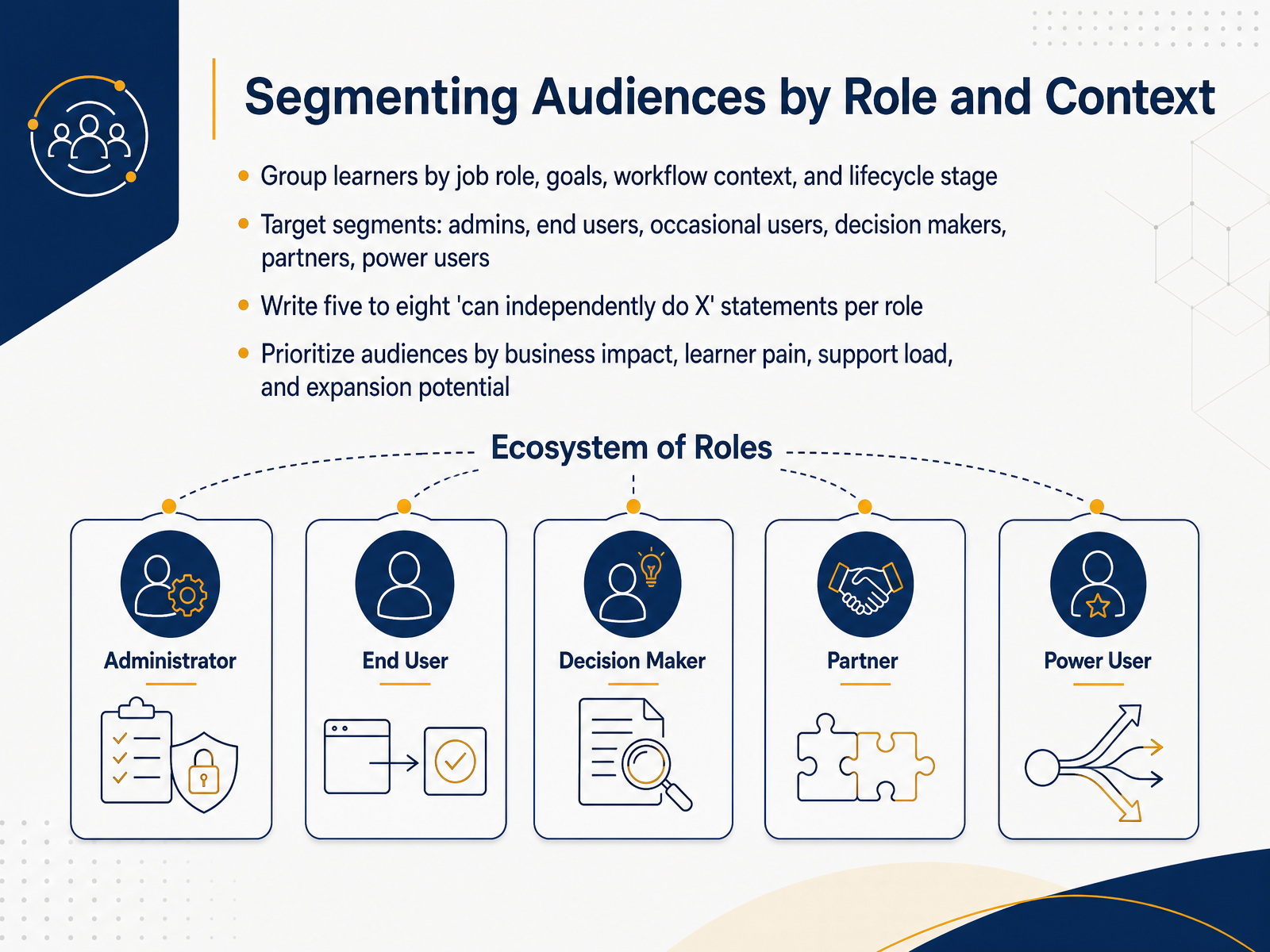
 - 06Segmenting Audiences by Role and ContextNow let's talk about who you're actually teaching, because not every customer needs the same path. Group your learners by their job role, their goals, the context they work in, and where they are in their lifecycle. Think admins, end users, occasional users, decision makers, partners, and power users. Each of these groups has a different job to do, so each one needs different content. For every role, write five to eight statements that start with can independently do. Not understands the reporting module, but can build a filtered report and schedule it to a colleague every Monday. Those statements become your curriculum and your definition of success. Then prioritize. Which audiences drive the most business impact? Which ones feel the most pain? Which generate the most support tickets? And which ones have real expansion potential? That's where you start, not with the easiest content to make. Next, we'll move from who you're teaching to how you know it worked, by defining measurable learning outcomes.
 trainn.cokompassify.comlearnworlds.com+21 min
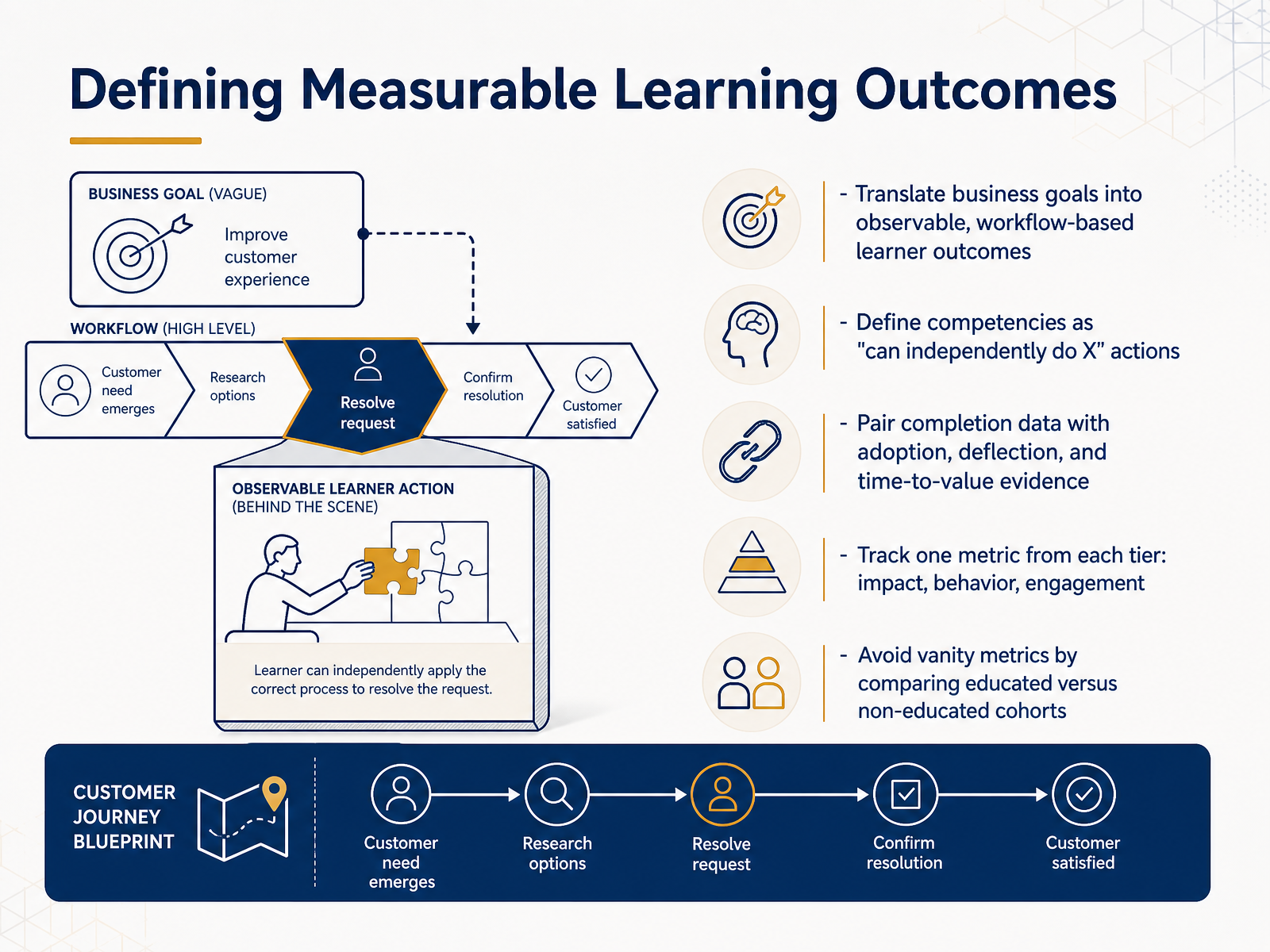
 - 07Defining Measurable Learning OutcomesLet's move from why we measure to how we define what to measure. Start by turning business goals into observable, workflow-based outcomes. Instead of saying a learner understands reporting, say they can independently build a filtered report and schedule it. That clarity drives your curriculum and your proof. Next, avoid the vanity trap. Completion rates alone don't fund programs. Pair engagement data with adoption, deflection, and time-to-value evidence. Track one metric from each tier: business impact, behavior change, and engagement. The strongest proof comes from comparing educated versus non-educated cohorts. That comparison shows cause, not just correlation. It turns a narrative into a number leadership can trust. With outcomes defined, we can choose the right formats to teach them.
 trainn.coabsorblms.comabsorblms.com+21 min
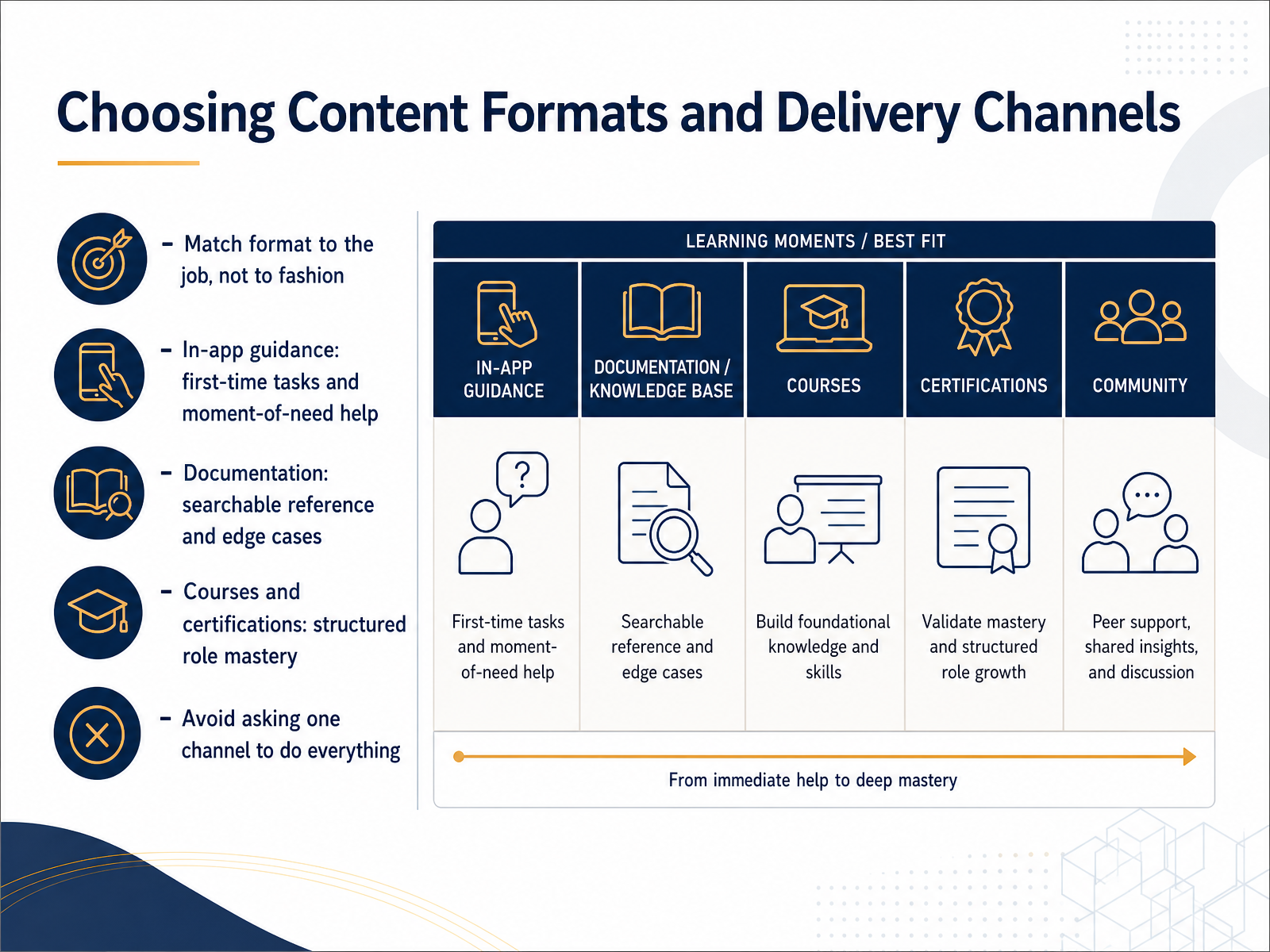
 - 08Choosing Content Formats and Delivery ChannelsLet's get practical about where your education actually lives. The golden rule is to match the format to the job, not to what's trendy. In-app guidance is your best tool for first-time tasks. It meets users at the exact moment they need help, without forcing them to stop working and go study a manual. Think of it as your moment-of-need safety net. Documentation is the searchable reference layer. It's where you handle edge cases, troubleshooting, and the deep details nobody should have to memorize. Courses and certifications serve a different purpose entirely. They're for structured role mastery, like training an admin to configure your system or getting a power user certified on advanced workflows. The most expensive mistake is asking one channel to carry the entire load. When you force a written guide to teach a multi-step setup task, you get traffic but low completion. So, keep these lanes distinct. That balance between immediate help and deep structure is exactly what we'll explore next with in-app learning and just-in-time support.
 trainn.cokompassify.comlearnworlds.com+21 min
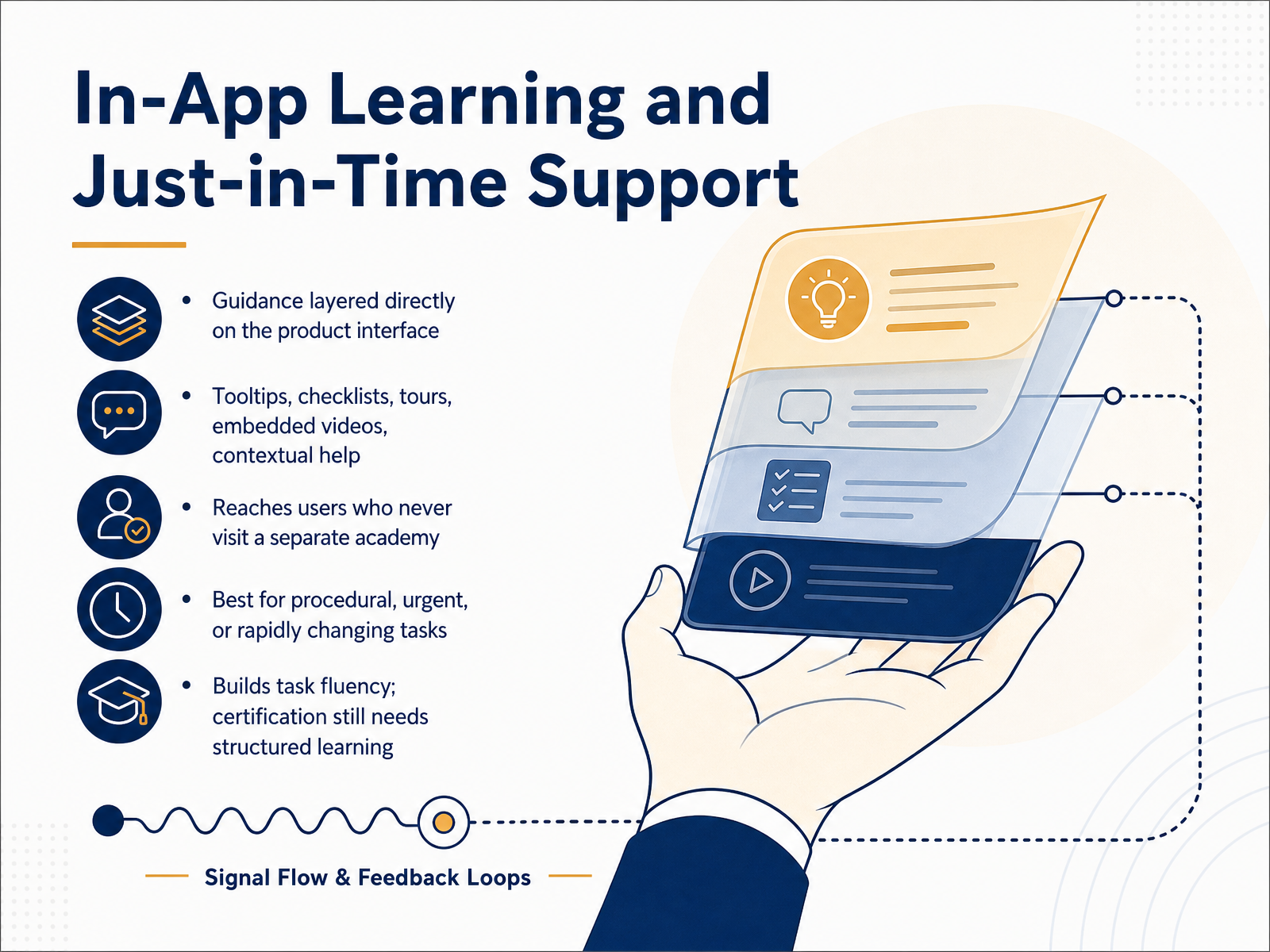
 - 09In-App Learning and Just-in-Time SupportNow let’s talk about reaching users where they already are: inside the product. In-app learning layers guidance directly on the interface. Think tooltips, checklists, product tours, embedded videos, and contextual help links. This matters for one big reason. Most of your users will never open a separate academy or knowledge base. They have a job to do, and they don’t want to leave the screen. In-app support meets them at the exact moment of need, and that removes the friction of searching or switching tabs. This format works best for procedural or urgent tasks. A multi-step setup, a new feature, a workflow that changed last week. You can show the step right where the user is stuck. It builds task fluency quickly, and it scales without adding manual support time. But keep one boundary clear. In-app guidance is not a replacement for structured learning. A tooltip can show a user how to run a report. It cannot teach them when and why to use that report in a larger strategy. For that depth, you still need courses and certification. Think of in-app learning as the safety net, and structured learning as the foundation. Next, we’ll shift from real-time support to something more durable: building a scalable curriculum.
 trainn.cokompassify.comlearnworlds.com+21 min
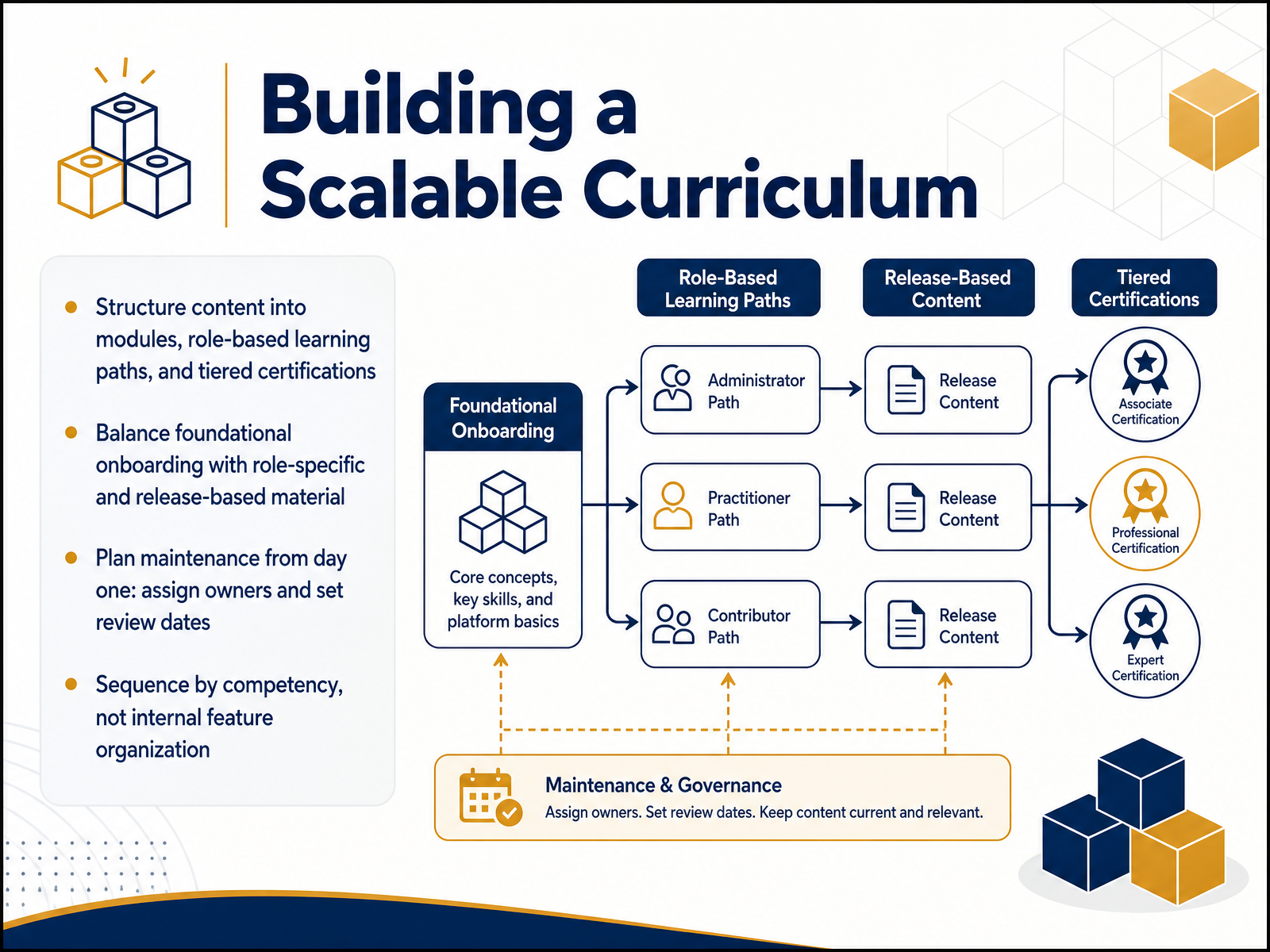
 - 10Building a Scalable CurriculumSo, once you have a clear picture of your content, the next question is how to structure it so it can actually scale. And the key here is to avoid building a flat, unsorted pile of content. Think in terms of modules. Break things down into small, focused lessons that can be combined and reused. These modules then plug into role-based learning paths. Your admins don't need the same training as your end users or your executives, so don't make them wade through everything else. This is also where you can introduce tiered certifications, which give your power users and partners a clear path to validate their skills and become champions for your product. You also need to balance that foundational onboarding material with more advanced, role-specific content, and even material tied to new product releases. A common mistake is organizing everything by internal feature names. Instead, sequence your curriculum by competency. Ask what should a customer be able to do after this lesson. Finally, plan for maintenance from day one. Every piece of content needs a clear owner and a scheduled review date, otherwise, your curriculum will become stale and start creating support tickets instead of deflecting them. With that structure in place, you can move on to measuring what actually matters.
 trainn.cothoughtindustries.comtemjournal.com+22 min
 - 11Measuring What Actually MattersSo let’s talk about measuring what actually matters. The mistake I see most teams make is reporting course completions as the final answer. Completion is a signal, not an outcome. What leadership actually funds is the business impact: retention, customer satisfaction, and expansion revenue. So start there. Pick one impact metric that maps to the result your team is accountable for. Then work backward to the behavior that drives it, like feature adoption or ticket deflection. And finally, track engagement as a leading signal of that behavior. The key is the comparison. Look at customers who completed training versus those who did not. If the educated group renews at a higher rate or opens fewer tickets, you have cause, not just activity. Report the impact numbers to executives, and use the behavior and engagement data as the evidence that education drove the change. Once you have that line drawn, you are ready to run a pilot that proves value.
 trainn.coabsorblms.comabsorblms.com+21 min
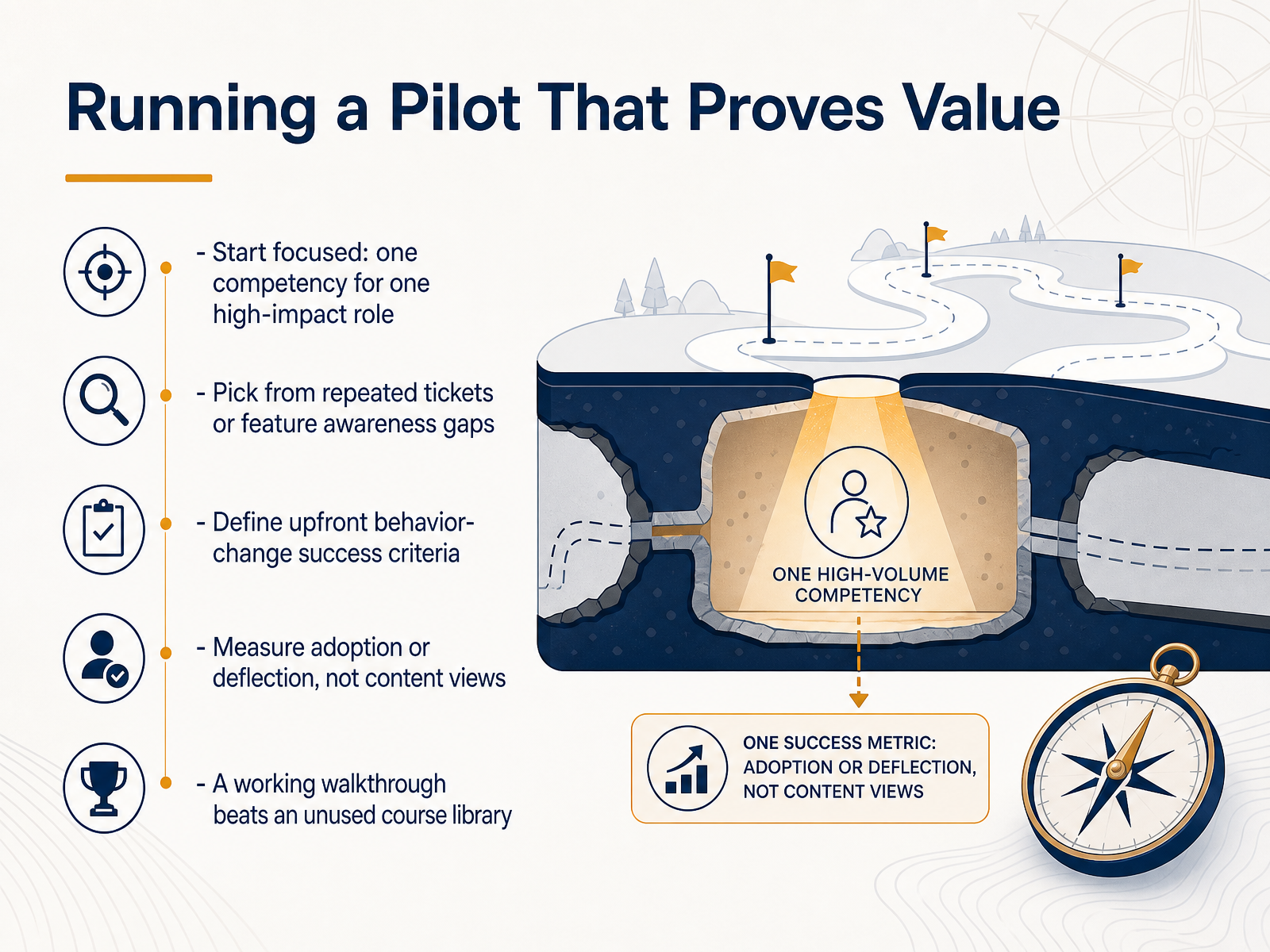
 - 12Running a Pilot That Proves ValueNow let's talk about how to run a pilot that actually proves value. The goal here is not to build more content. The goal is to get one clear win you can point to. So start focused. Pick one competency for one high-impact role. Where do you find that? Look at your repeated support tickets or the features people know about but never use. That gap is your curriculum. Define upfront what behavior change looks like. If the training works, what will customers do differently? Maybe they will configure a dashboard on their own, or stop submitting a specific type of ticket. Then measure that. Measure adoption or ticket deflection, not how many people watched a video. Views tell you people showed up. They do not tell you the work got easier. A short, working walkthrough that reduces support load is worth far more than a library of courses nobody opens. Keep the pilot tight, keep the criteria clear. Next, we will move from this first pilot to building ongoing operations that scale.
 trainn.coabsorblms.comabsorblms.com+21 min
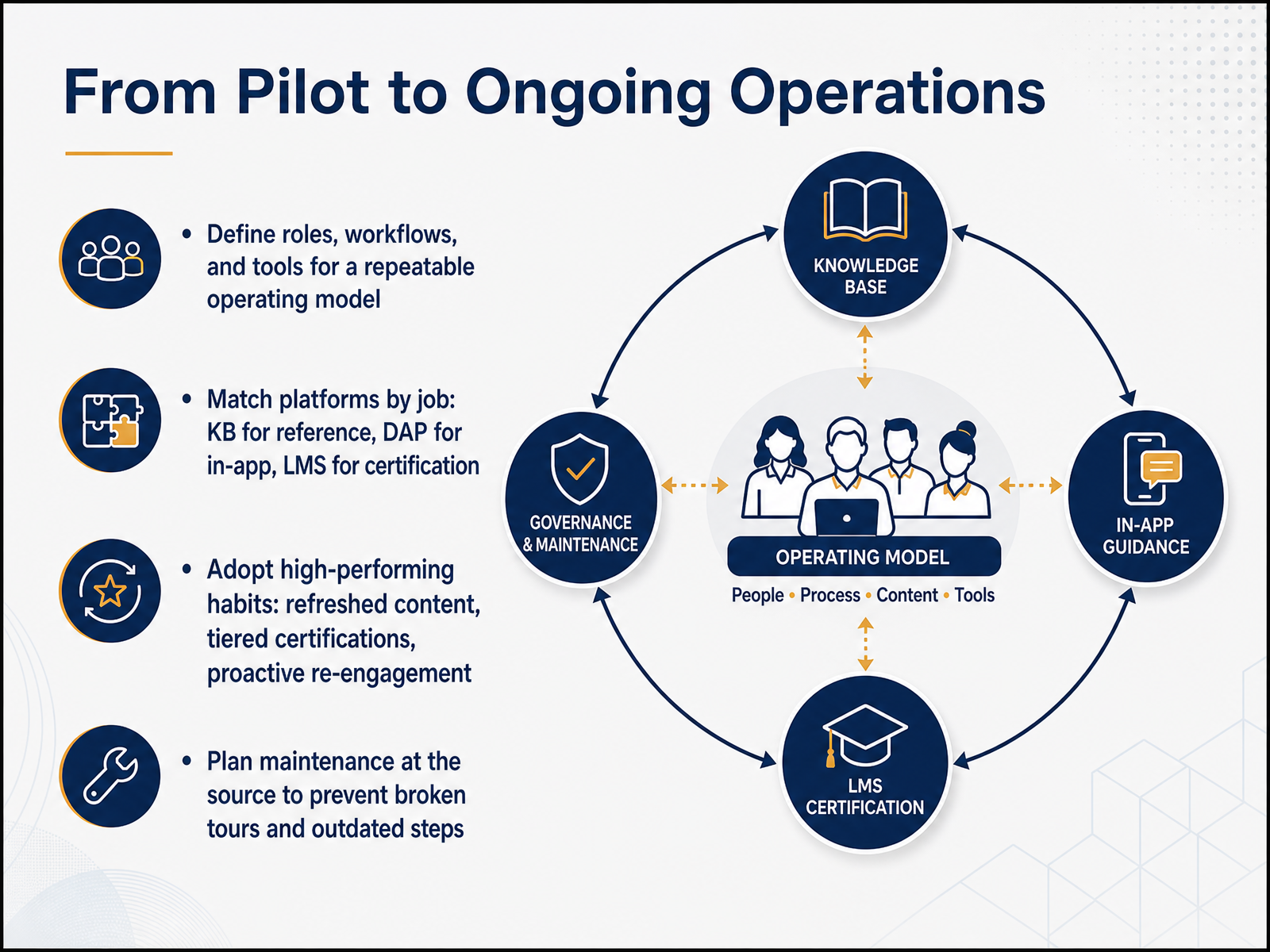
 - 13From Pilot to Ongoing OperationsNow let's talk about turning your pilot into a model that runs itself. The goal here is simple: stop doing one-off work and start running a system. First, define the operating model. Who owns the content, who reviews it, and what happens when the product changes? Without clear roles, everything silently becomes your job. Second, match your tools to the right job. Use the knowledge base for reference, in-app guidance for the moment of need, and an LMS for structured certification. One platform should not do everything. Also, adopt the habits of high-performing programs. Keep content refreshed, offer tiered certifications so learners have a reason to return, and build a proactive plan to re-engage inactive users. These are the habits that separate teams with strong renewal rates from everyone else. Finally, plan maintenance at the source. When a workflow changes, update the guide once where it lives, not in five separate places. Broken tours and outdated steps quietly destroy trust. Let's move to our final slide and talk about your action plan for the first ninety days.
 trainn.coabsorblms.comabsorblms.com+22 min
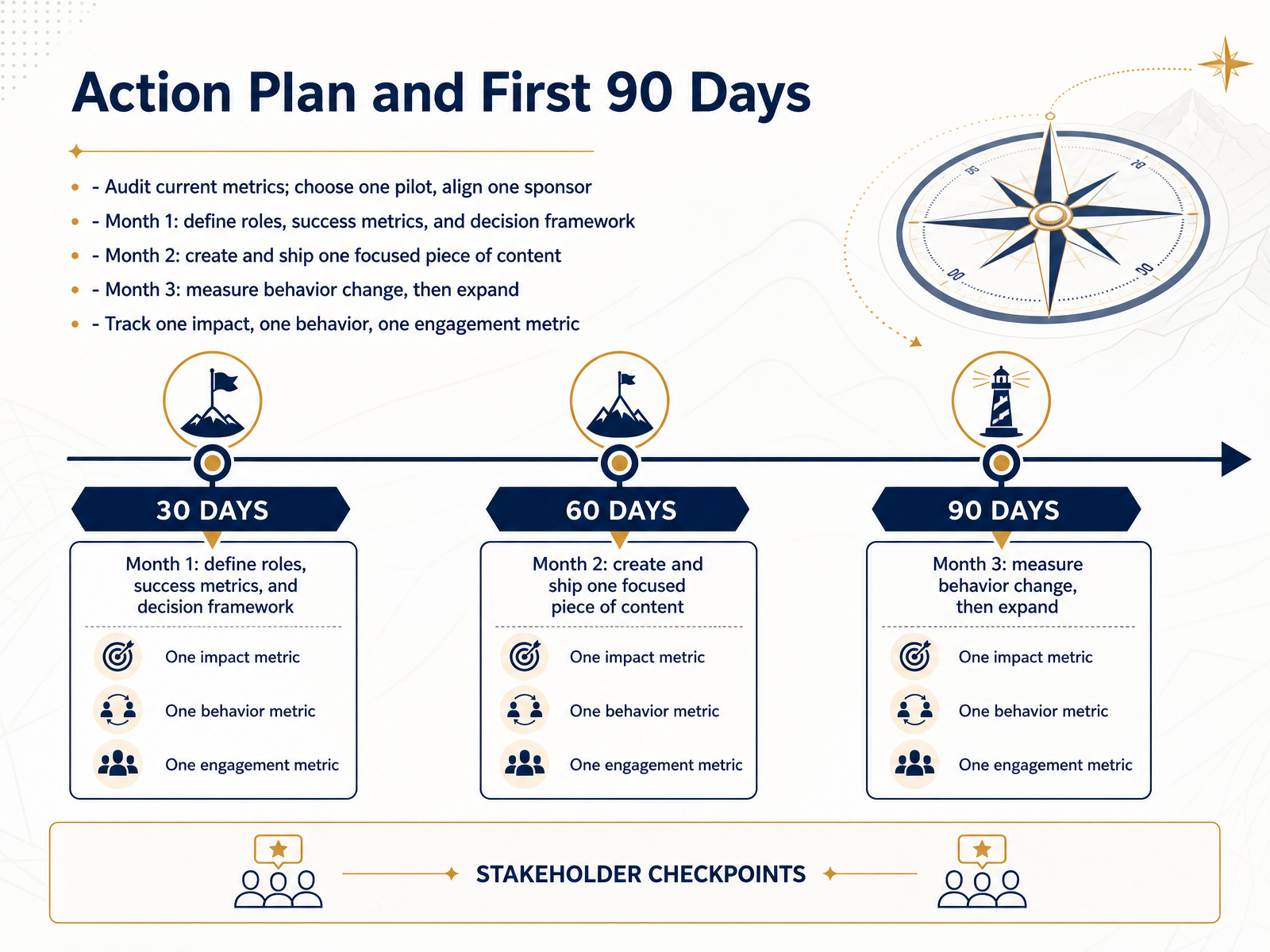
 - 14Action Plan and First 90 DaysLet's turn this into a plan you can actually run. Start by auditing what you already have. Pick one pilot audience, and find one sponsor who owns a number you can move. Month one, define the roles, name the success metric, and agree on how you'll decide what gets built. Month two, focus on shipping a single piece of content. Keep it narrow. A short guide or a three-step walkthrough that solves one repeated problem beats a library nobody opens. Month three, measure whether behavior actually changed. Did adoption go up, or did tickets go down? Then expand from what worked. As you go, track just three metrics. One business impact number, like retention or CSAT. One behavior change, like feature adoption. And one engagement number, like completion. That's the whole system. Keep the first ninety days small, show the proof, and let the results earn the next investment. Thanks for working through this with me. Go run your audit this week.
 trainn.coabsorblms.comabsorblms.com+22 min
Take the deck with you
Download this course as a file — free, no sign-up needed.
- PDF handoutEvery slide page, ready to print or share.15 pages · 3.6 MBDownload
- Narrated PowerPointThe deck that presents itself — every slide carries the digital human's narration video.15 pages · 15.0 MBDownload
- PowerPoint slidesThe full deck as a .pptx — open it in PowerPoint, Keynote, or Google Slides.15 pages · 3.5 MBDownload
Free to use in your own training — please keep the PersonWise credit page at the end.
Have your own deck? Turn it into a course
Sources consulted
Web sources consulted while building this course.
- Customer Education Metrics: 14 to Track (2026) | Trainn — trainn.co
- New Absorb Software and Lighthouse Research & Advisory Study Reveals How the Highest-Performing Customer Education Programs Turn Learning into Measurable Growth | Absorb LMS Software — absorblms.com
- The state of customer education in 2026 | Absorb LMS Software — absorblms.com
- Customer Education Metrics to Measure - Intellum — intellum.com
- How to build a customer education business case leaders trust | Absorb LMS Software — absorblms.com
- Customer Education Maturity Model: 6 Stages (2026) | Trainn — trainn.co
- The Maturity Model For Customer Education and Learning — thoughtindustries.com
- Developing Customer-Based Education Strategic Guidelines for Promoting a Software Product — temjournal.com
- A tension-based maturity model for customer education in knowledge-intensive business service firms — doi.org
- The Customer Education Maturity Scale — learnupon.com
- Customer Education Best Practices: 12 Proven (2026) | Trainn — trainn.co
- Customer Education: How to Build a Program That Drives Adoption (2026) — kompassify.com
- How to improve customer education (complete 2026 guide) — learnworlds.com
- In-app training for SaaS: Best practices and examples | Supademo Blog — supademo.com
- What Is Customer Education? Benefits, Types + How to Drive Adoption — trainn.co