Begin
14 pages · ~28 min
Changing Historical Interpretations
This training explores how historical interpretations evolve over time, helping learners understand the forces that shape historiography and why accounts of the past change.
A digital instructor presents all 14 pages. Hold “Ask” at any point and ask out loud — the answer comes from this course. No sign-up needed.
What you’ll learn
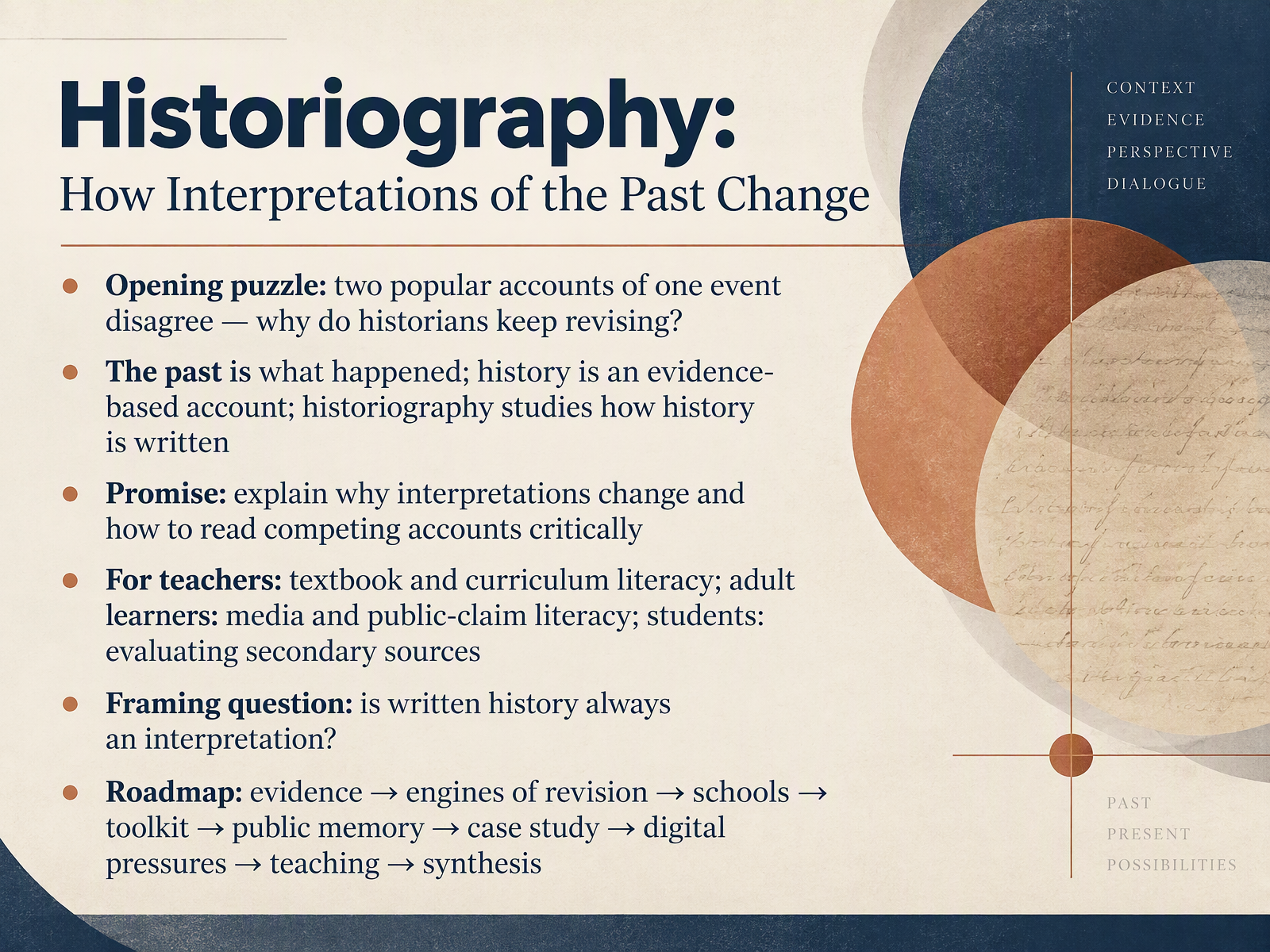
- 01Historiography: How Interpretations of the Past ChangeWelcome. I'm glad you're here. Our topic is historiography, the study of how history gets written. Here's the puzzle we'll start with. Two popular accounts of the same event disagree. Not on small details, but on what the event means. Why do historians keep revising their accounts? First, three terms, defined once. The past is what happened. History is an evidence-based account of it. Historiography studies how that account gets made and remade. So here is our promise. By the end, you'll see why interpretations change and how to read competing accounts critically. Teachers, this supports textbook and curriculum literacy. Adult learners, it strengthens your reading of media and public claims. Students, it gives you a way to evaluate secondary sources. A framing question to hold as we go. Is written history always an interpretation? Take a moment with that. Our roadmap runs from evidence, to the engines of revision, to schools of thought, to a practical toolkit, to public memory, a case study, digital pressures, teaching, and a synthesis. Next, we turn to the Past Versus History: Evidence, Sources, and Narrative.nmu.eduhistory.berkeley.eduen.wikipedia.org+22 min
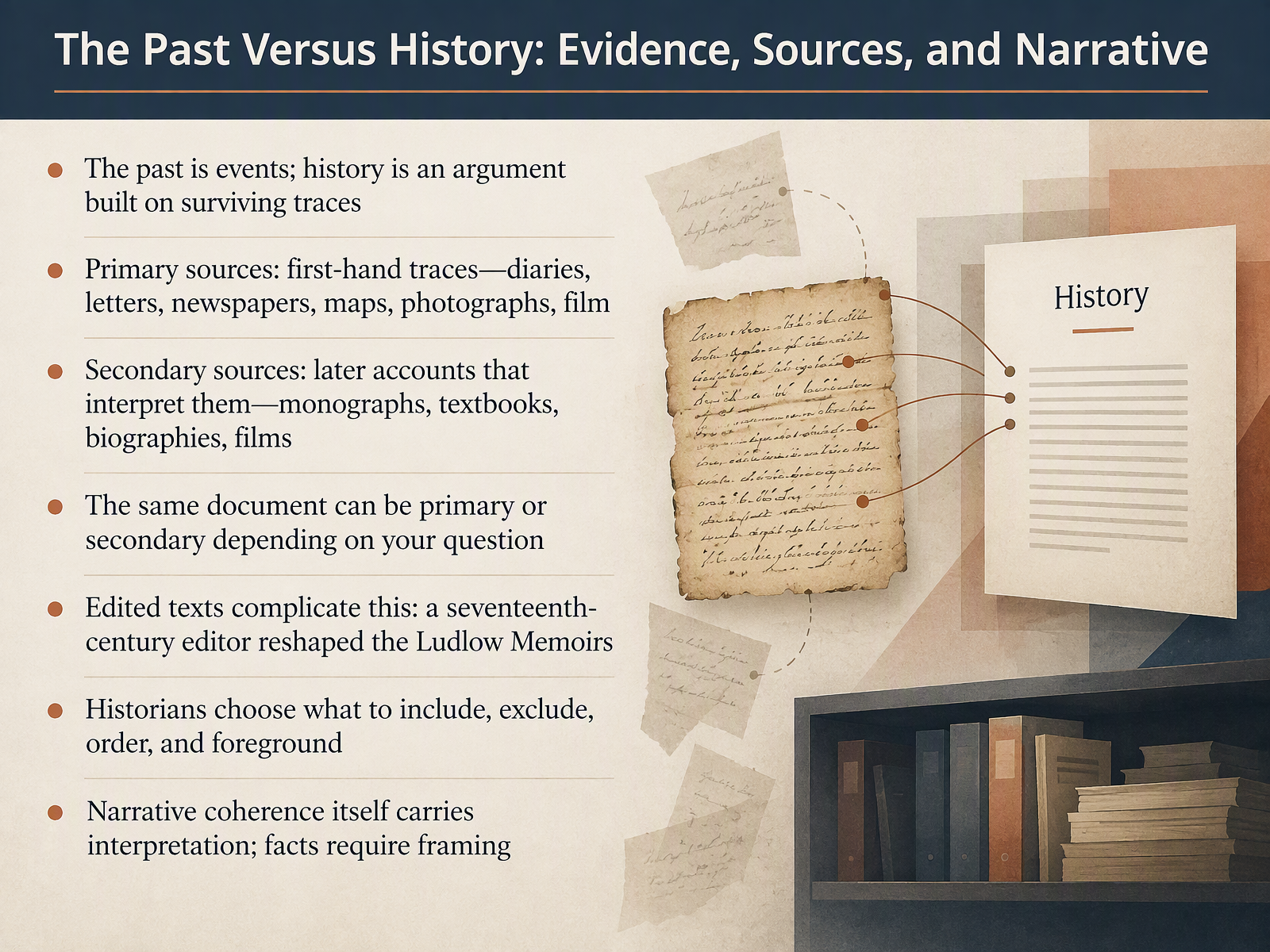
- 02The Past Versus History: Evidence, Sources, and NarrativeLet's begin with a distinction that shapes everything else. The past is what happened. History is an argument built from the traces that survive. We call those traces primary sources: diaries, letters, newspapers, maps, photographs, film. Secondary sources come later and interpret them, such as monographs, textbooks, biographies, and films. Here is a subtle point. The same document can be primary or secondary, depending on your question. Editing complicates this further. A late seventeenth-century editor reshaped the Ludlow Memoirs, giving them a markedly secular tone. Only a later manuscript version revealed the change. And historians choose what to include, exclude, order, and foreground. So narrative coherence itself carries interpretation. Facts require framing. What evidence would change this account? Take a moment to think. What follows from this is the next topic: seven engines of revision, and why interpretations change.
 read.uolpress.co.uktandfonline.comhistory.berkeley.edu+22 min
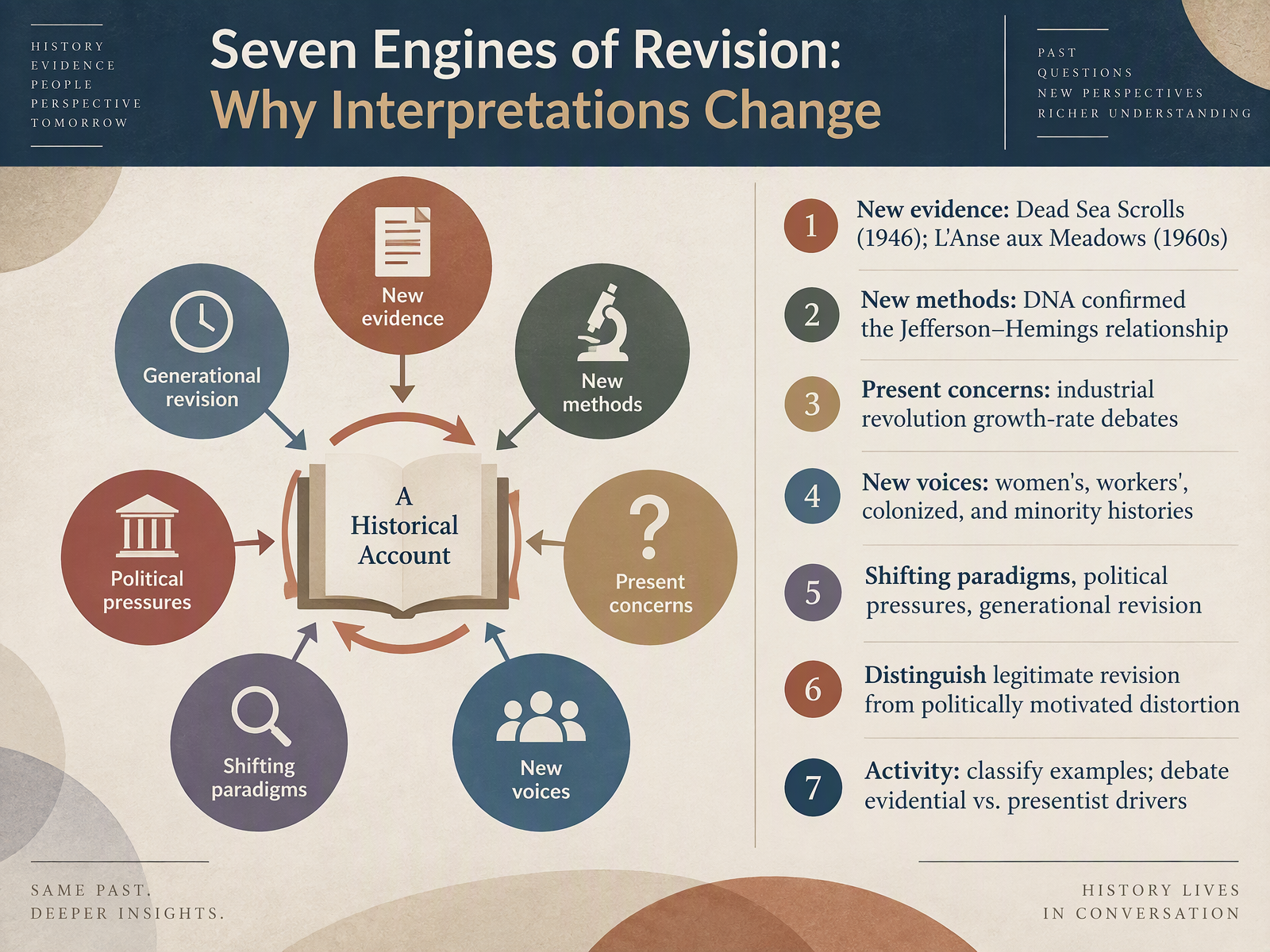
- 03Seven Engines of Revision: Why Interpretations ChangeSo why do interpretations change? Historians often point to several engines of revision. First, new evidence. The Dead Sea Scrolls, found in nineteen forty-six, sharply changed our picture of early Judaism. The Norse site at L'Anse aux Meadows, identified in the nineteen sixties, supported a European presence in the Americas before Columbus. Second, new methods. Genetic testing confirmed the Jefferson and Hemings relationship, using material long available. Third, present concerns. Debates over growth rates in the industrial revolution shifted as economists asked new questions of old data. Fourth, new voices. Women's, workers', colonized, and minority histories brought neglected people into view. Behind all of these sit shifting paradigms, political pressures, and generational change. Now here is a problem scholars debate: when is revision legitimate, and when is it politically motivated distortion? Consider the evidence, then ask what evidence would change this account. For your activity, classify examples and debate whether evidential or presentist drivers mattered more. Schools and Paradigms: How Frameworks Shape What We See.
 open.eduneh.govplus.ac.at+22 min
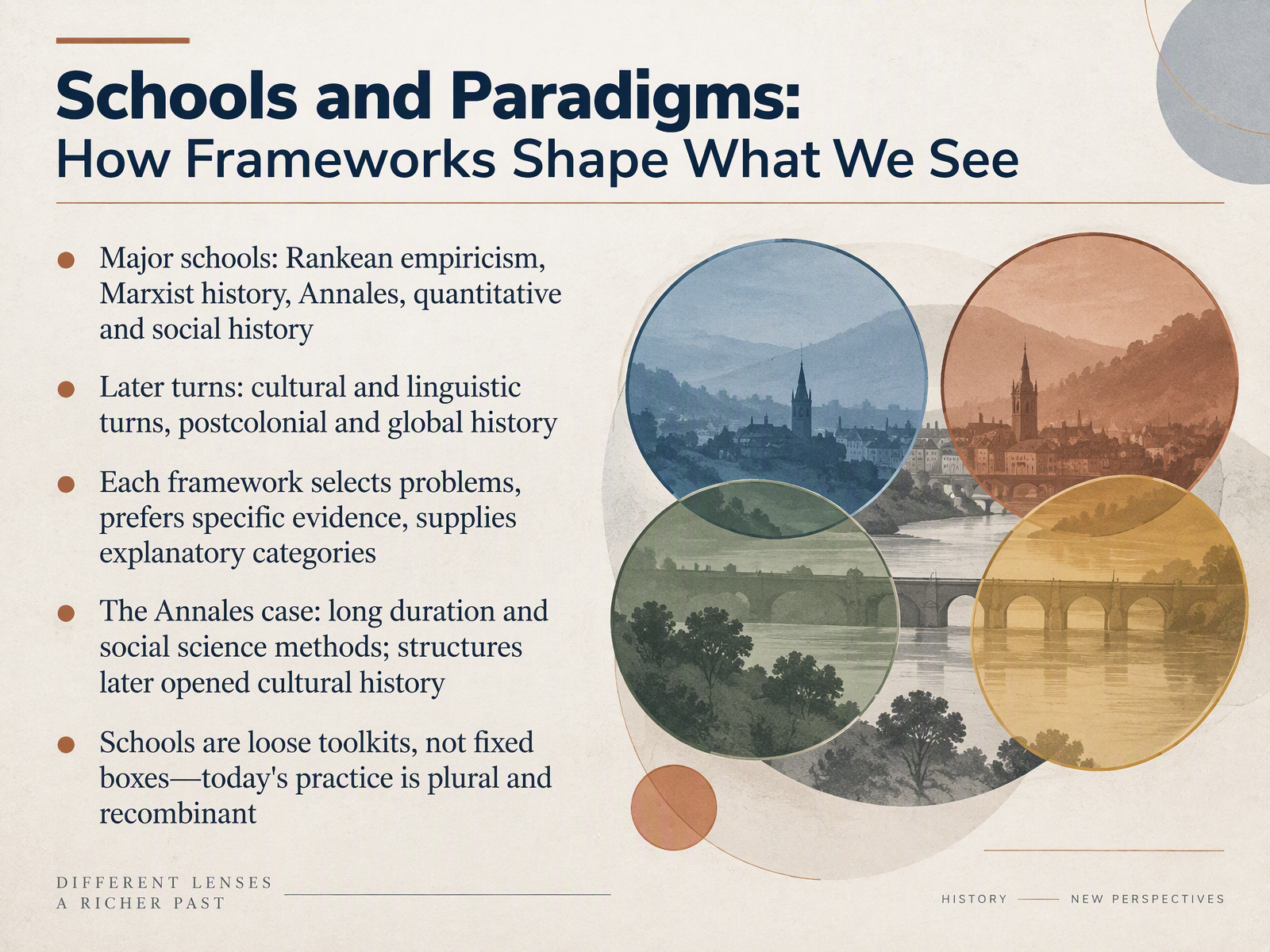
- 04Schools and Paradigms: How Frameworks Shape What We SeeSo let's turn to how schools of thought shape what historians actually see. First, the major frameworks. Rankean empiricism centers on archival documents and careful verification. Marxist history foregrounds class and economic relations. The Annales school emphasizes long duration and social science methods, and quantitative and social history lean on numbers and structures. By contrast, later turns, cultural, linguistic, postcolonial, and global, shift attention to meaning, language, empire, and connections across regions. Here is the key point. Each framework selects its own problems, prefers certain kinds of evidence, and supplies its own explanatory categories. Take the Annales case. Its stress on long duration and structures later opened the door to cultural history. The evidence suggests schools work best as loose toolkits, not fixed boxes. Today's practice is plural and recombinant. So ask yourself, what evidence would change this account? Take a moment to think. What follows from this is that frameworks are tools we choose, and we can combine them. Next, we will look at how to read a historian's argument using a five-question toolkit.
 doi.orgdegruyterbrill.commanchesteruniversitypress.co.uk+22 min
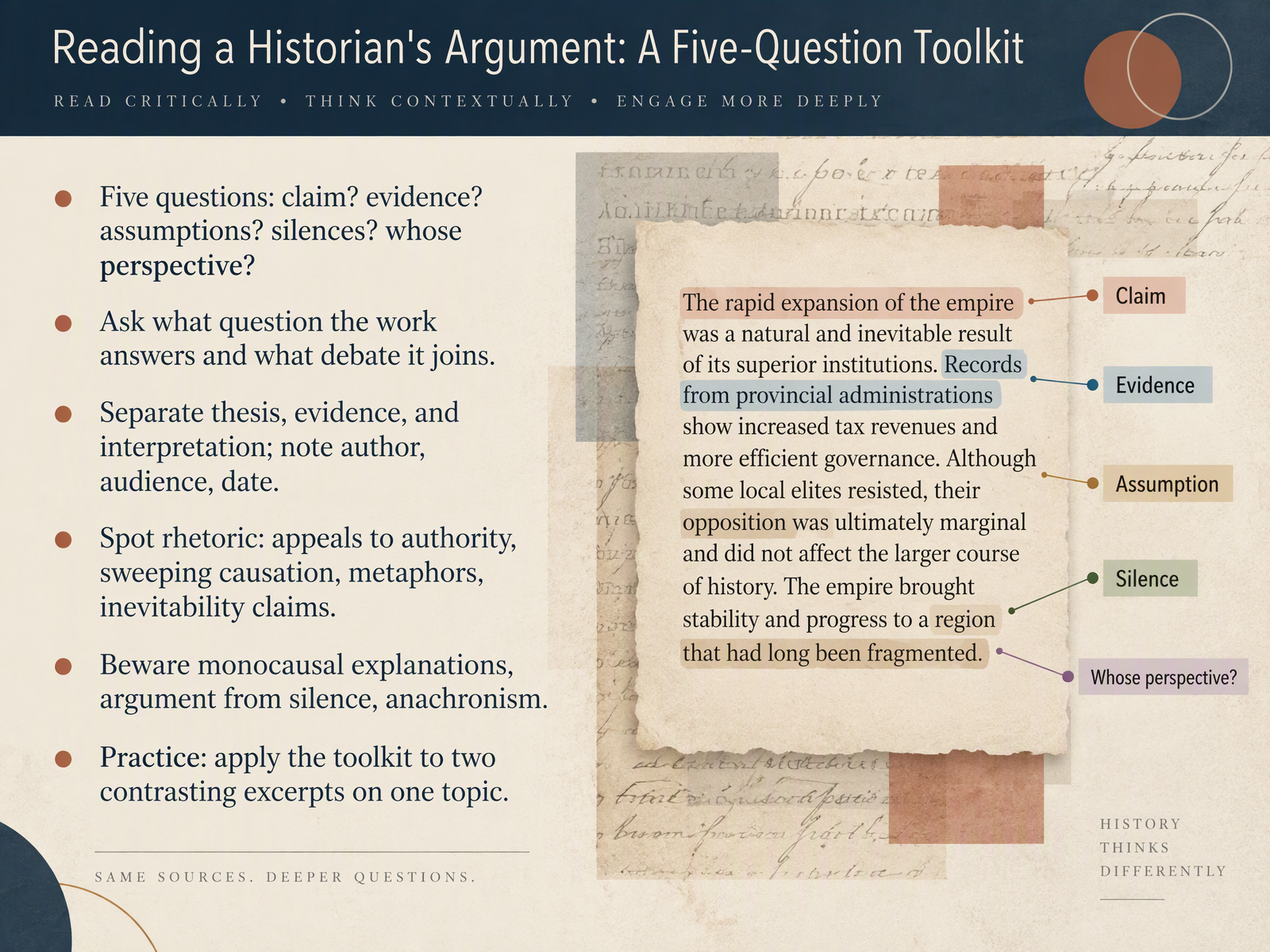
- 05Reading a Historian's Argument: A Five-Question ToolkitLet's turn now to a practical toolkit for reading a historian's argument. You can hold any work of history up to five questions. What is the claim? What evidence supports it? What assumptions does it rest on? What does it leave out? And whose perspective does it center? First, ask what question the work answers, and what debate it joins. Then separate thesis from evidence, and note the author, audience, and date. Next, watch for rhetoric: appeals to authority, sweeping causation, vivid metaphors, and claims of inevitability. Be wary of monocausal explanations, arguments from silence, and anachronism, judging the past by present standards. Here is a question to sit with. What evidence would change this account? Pause and think. Finally, practice the toolkit on two contrasting excerpts about one topic. What follows from this is a closer look at how these arguments shape textbooks, curricula, and public memory.
 nmu.eduhistory.berkeley.eduen.wikipedia.org+22 min
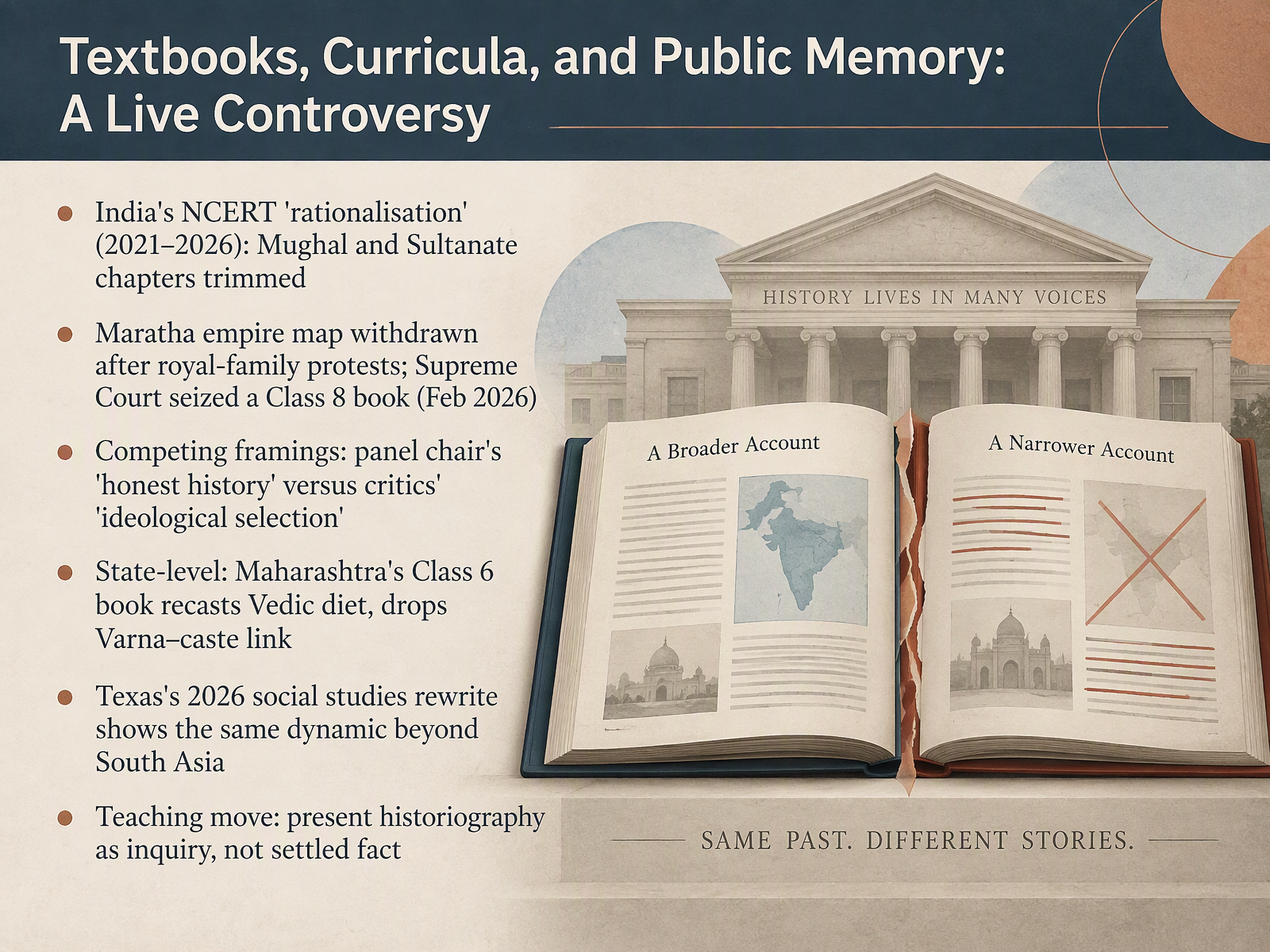
- 06Textbooks, Curricula, and Public Memory: A Live ControversyNow let's turn to a live controversy, because textbook debates are not abstract. In India, the NCERT rationalisation from 2021 to 2026 trimmed Mughal and Sultanate chapters. A Maratha empire map was withdrawn after royal family protests. In February 2026, the Supreme Court seized a Class 8 book. Competing framings emerged. The panel chair called it honest history. Critics called it ideological selection. At the state level, Maharashtra's Class 6 book recasts the Vedic diet and drops the Varna to caste link. And Texas's 2026 social studies rewrite shows the same dynamic beyond South Asia. So here is the teaching move. Present historiography as inquiry, not settled fact. Ask your students, what evidence would change this account? Give them a moment to think. By contrast, a textbook that gives only one answer teaches them to stop asking. What follows from this is that curriculum is public memory in the making. Next, we will look at a single case study to see how one event can produce three different accounts.
 indianexpress.comeducation.economictimes.indiatimes.com2 min
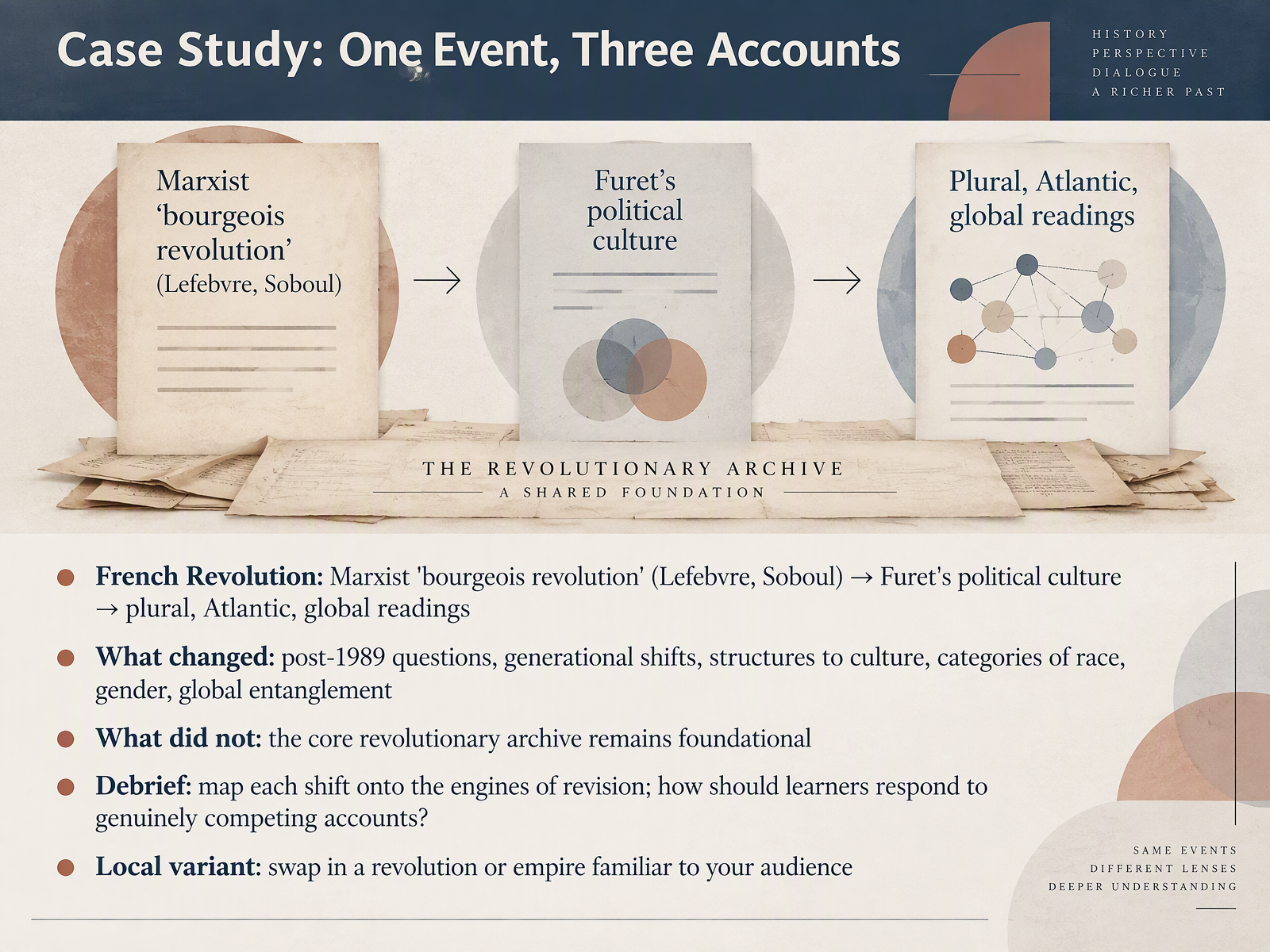
- 07Case Study: One Event, Three AccountsHere is a concrete case. Take the French Revolution. First, Lefebvre and Soboul read it as a bourgeois revolution, driven by class conflict. By contrast, Furet shifted attention to political culture and language. More recent work reads the Revolution in plural, Atlantic, and global terms. What changed? Questions after 1989, new generations of scholars, and a turn from structures toward culture, race, gender, and global entanglement. What did not change? The core revolutionary archive remains foundational. So consider this question, and pause to think: what evidence would change your own account of the Revolution? In a local session, you could swap in a revolution or empire your learners know well. What follows from this? Map each shift onto the engines of revision. When accounts genuinely compete, respond by weighing evidence, not by choosing sides. Next, we turn to public memory and commemoration, when the past is built in stone.
 open.eduneh.govplus.ac.at+22 min
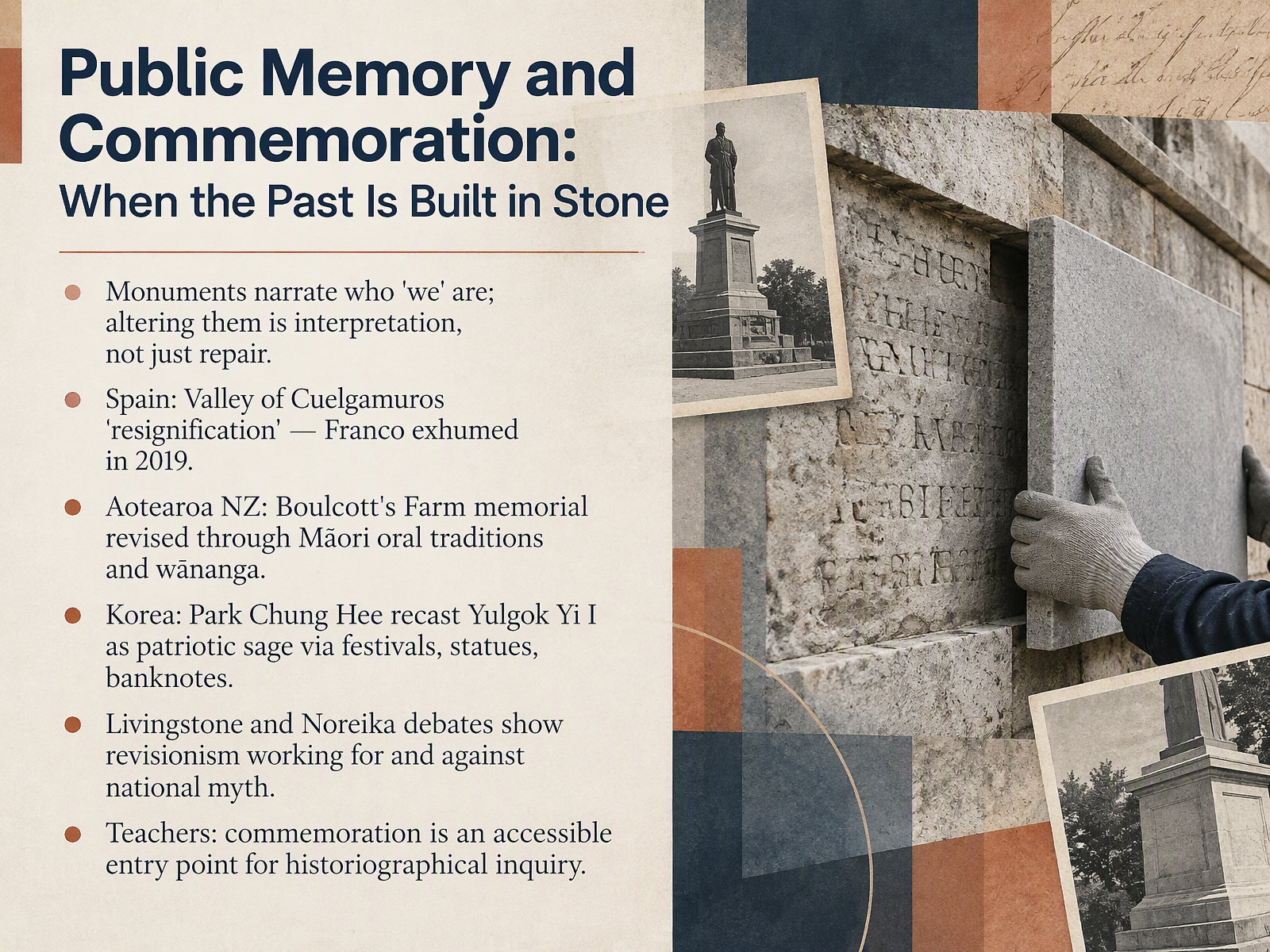
- 08Public Memory and Commemoration: When the Past Is Built in StoneNow let's look at public memory, where the past is literally built in stone. Monuments narrate who we are, so altering them is interpretation, not just repair. In Spain, the Valley of Cuelgamuros has undergone what scholars call resignification, including Franco's exhumation in twenty nineteen. In Aotearoa New Zealand, the Boulcott's Farm memorial was revised through Māori oral traditions and wānanga. In Korea, Park Chung Hee recast Yulgok Yi I as a patriotic sage through festivals, statues, and banknotes. The Livingstone and Noreika debates show revisionism working for and against national myth. Here is a question to sit with: what evidence would change this account? For teachers, commemoration is an accessible entry point for historiographical inquiry. What follows from this is a closer look at today's changing conditions.
 2 min
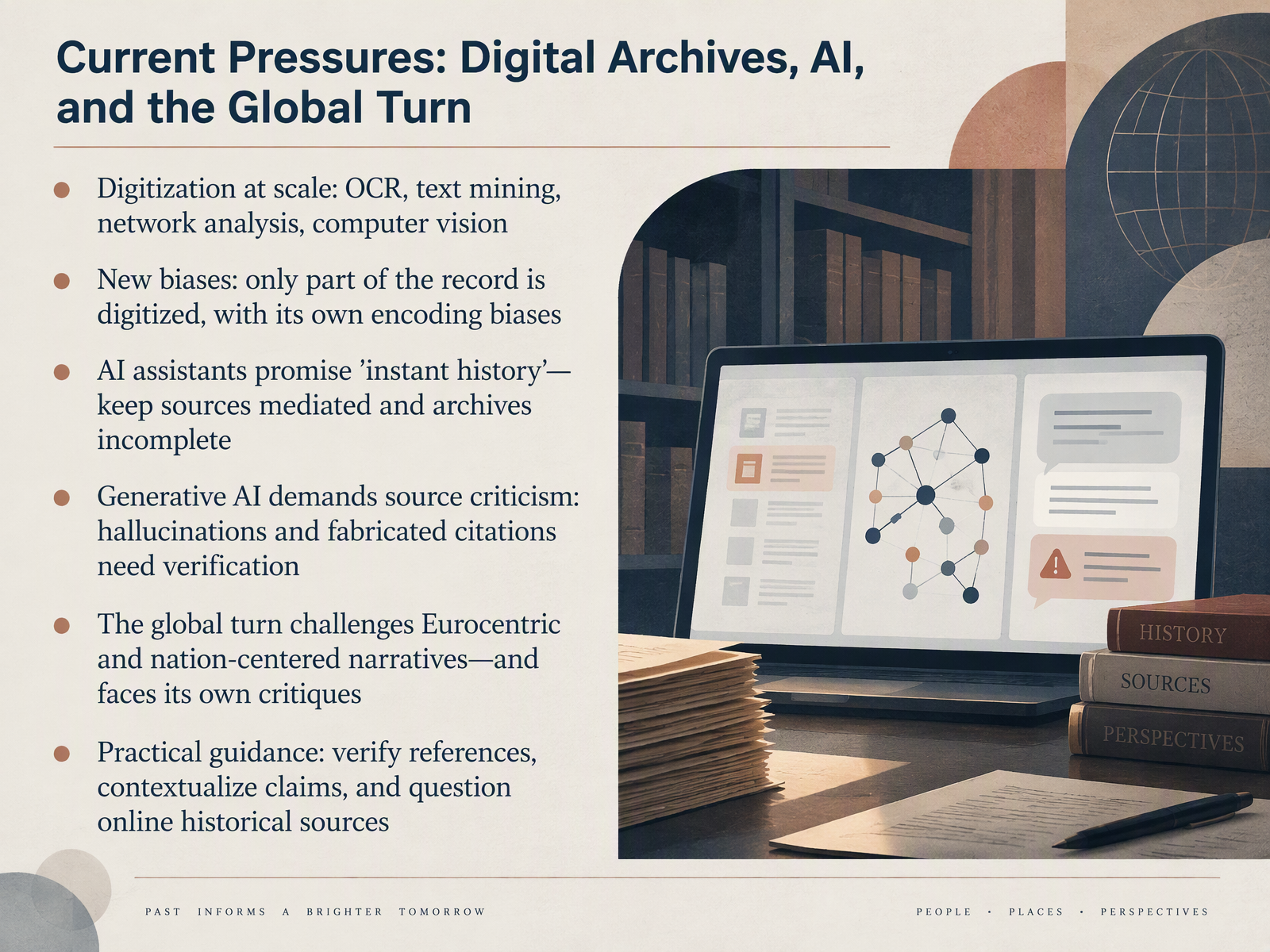
- 09Current Pressures: Digital Archives, AI, and the Global TurnLet's turn to the pressures shaping historical work right now.
First, digitization at scale. Optical character recognition, text mining, network analysis, and computer vision let historians search collections no single person could read in a lifetime. But the record is only partly digitized, and the selection carries its own biases.
Next, AI assistants promise instant history. Treat that promise carefully. Sources remain mediated, and archives remain incomplete. Generative AI also demands source criticism, because it can hallucinate and fabricate citations. Every reference needs verification.
By contrast, the global turn challenges Eurocentric and nation-centered narratives. It also faces its own critiques.
So here is one focused question. What evidence would change this account? Take a moment to think.
What follows from this is practical guidance. Verify references, contextualize claims, and question online historical sources.
This leads us to the next topic: Projecting Present Concerns: The Question of Objectivity.
 2 min
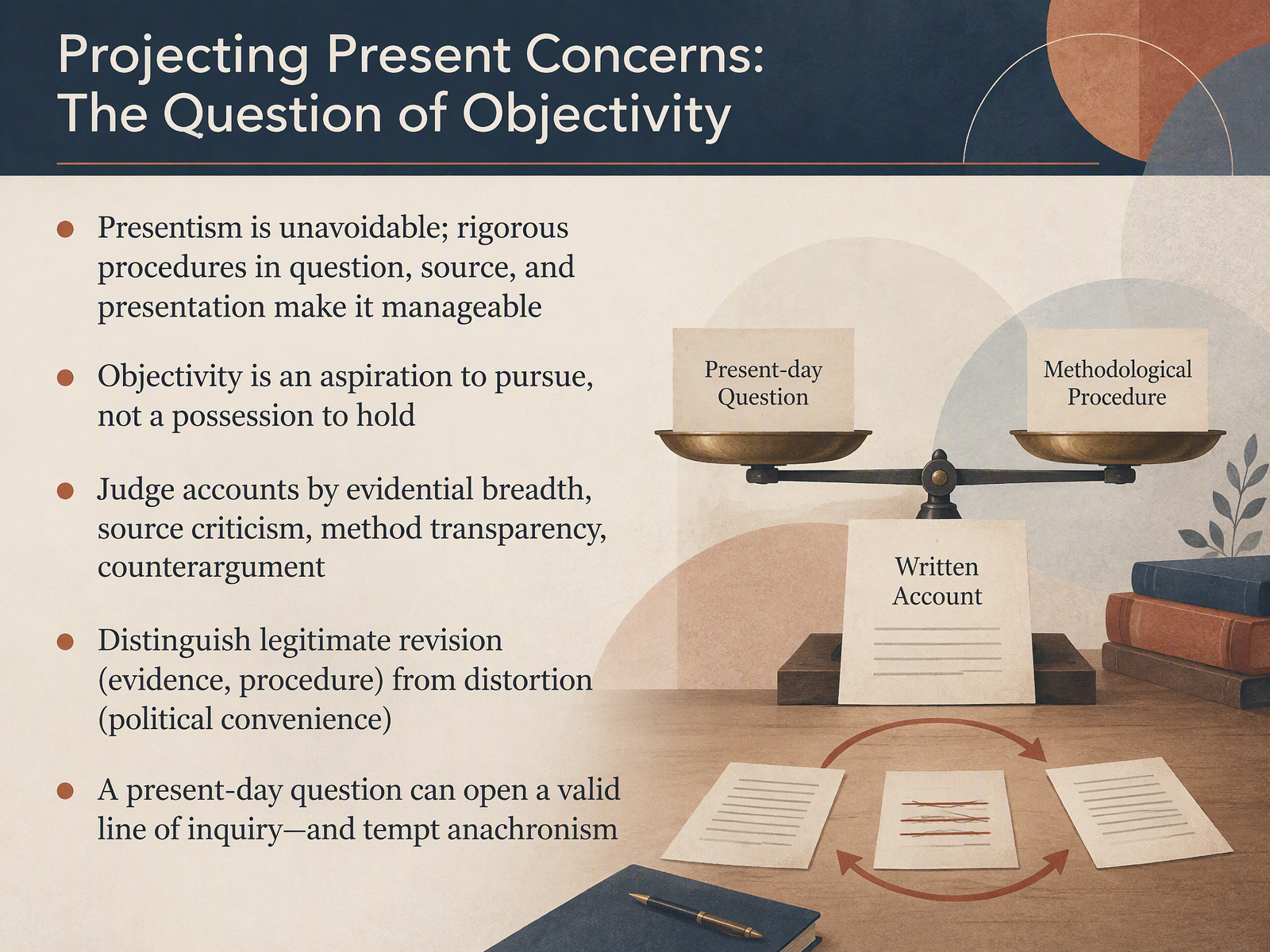
- 10Projecting Present Concerns: The Question of ObjectivityLet's turn to objectivity. Historians often argue that presentism, reading the past through today's concerns, is unavoidable. Rigorous procedures in framing questions, selecting sources, and presenting findings make it manageable. Objectivity, then, is an aspiration to pursue, not a possession to hold. So how do we judge an account? Look at evidential breadth, source criticism, method transparency, and how it handles counterarguments. We can also distinguish legitimate revision, driven by evidence and procedure, from distortion, driven by political convenience. And here is the tension: a present-day question can open a valid line of inquiry, and tempt anachronism. What evidence would change this account? That question tests both the historian and us. Next, we turn to teaching strategies for classrooms and adult learners.
 open.eduneh.govplus.ac.at+22 min
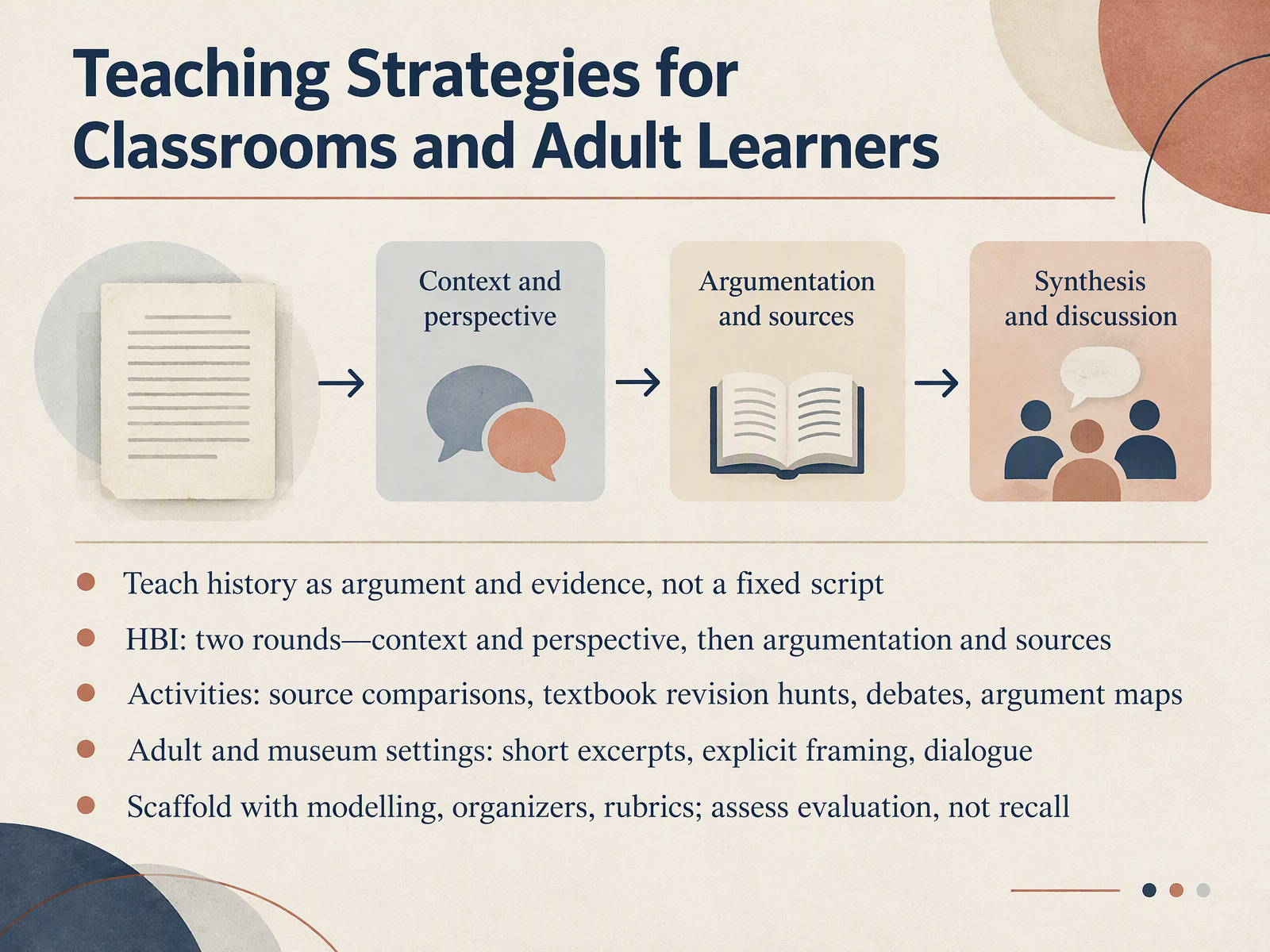
- 11Teaching Strategies for Classrooms and Adult LearnersBuilding on that, how do we actually teach this in a classroom or with adult learners? First, teach history as argument and evidence, not a fixed script. Historiography-Based Inquiry works in two rounds. Round one covers context and perspective. Round two covers argumentation and the use of sources. Then students synthesize. Useful activities include comparing sources, hunting for revisions in old textbooks, holding debates, and building argument maps. In adult and museum settings, the evidence suggests short excerpts, explicit framing, and real dialogue work best. What evidence would change this account for your learners? Scaffold with modelling, graphic organizers, and rubrics. Assess evaluation, not recall. Next, we turn to watching the watchdogs, textbook revisions in the classroom.
 nmu.eduhistory.berkeley.eduen.wikipedia.org+22 min
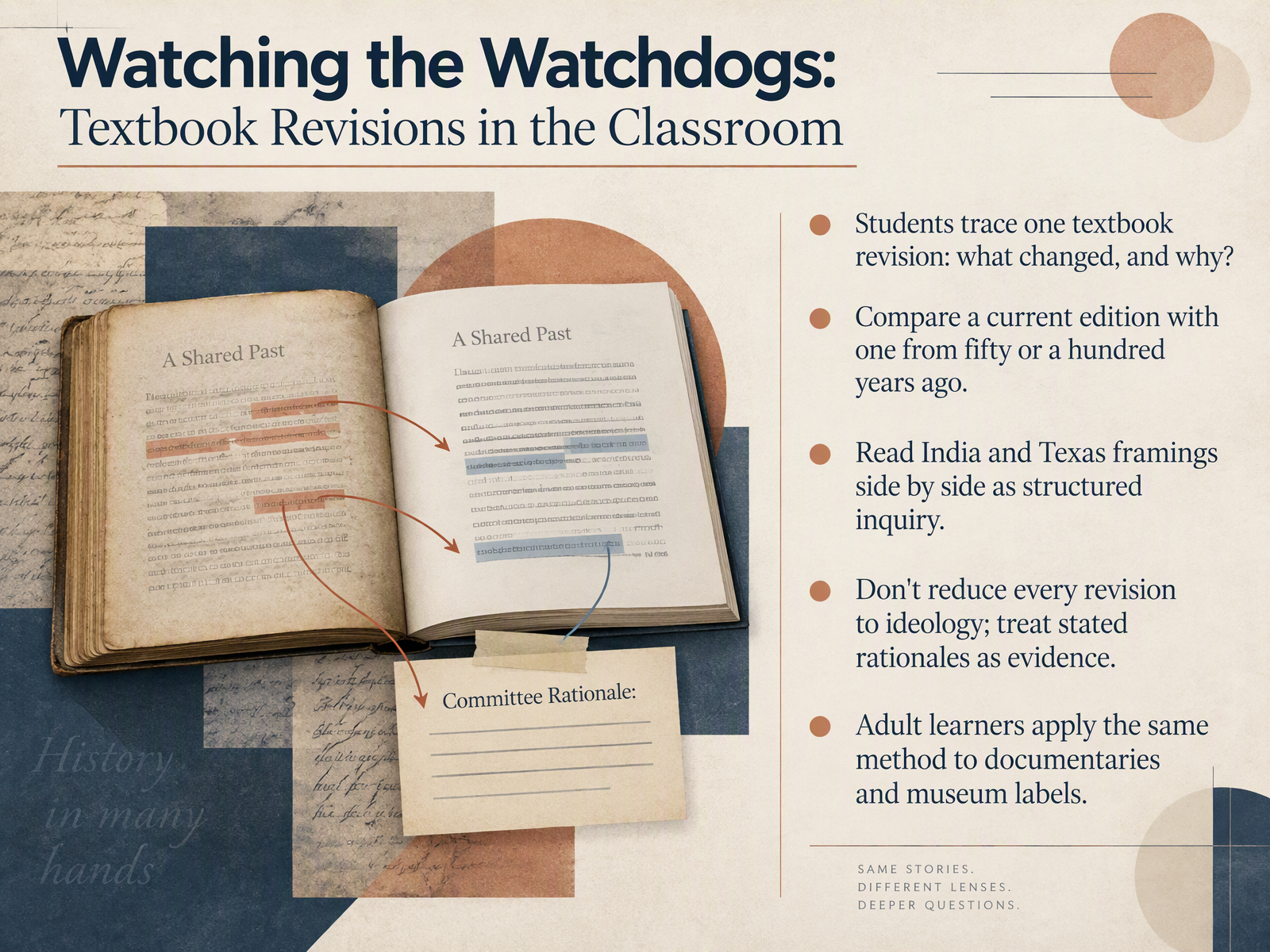
- 12Watching the Watchdogs: Textbook Revisions in the ClassroomNow let us put this method to work on the watchdogs themselves, our textbooks. Ask your students to trace one revision: what changed, and what rationale was given? Comparing a current edition with one from fifty or a hundred years ago makes the change visible. An NCERT textbook is a strong case, because scholars publicly disagree about why a map was withdrawn, or why certain chapters were trimmed. You can also read India and Texas framings side by side as structured inquiry. But do not reduce every revision to ideology. Treat the stated rationales as evidence to examine, not as verdicts. Adult learners can apply the same method to documentaries and museum labels. What evidence would change this account?
 indianexpress.comeducation.economictimes.indiatimes.com1 min
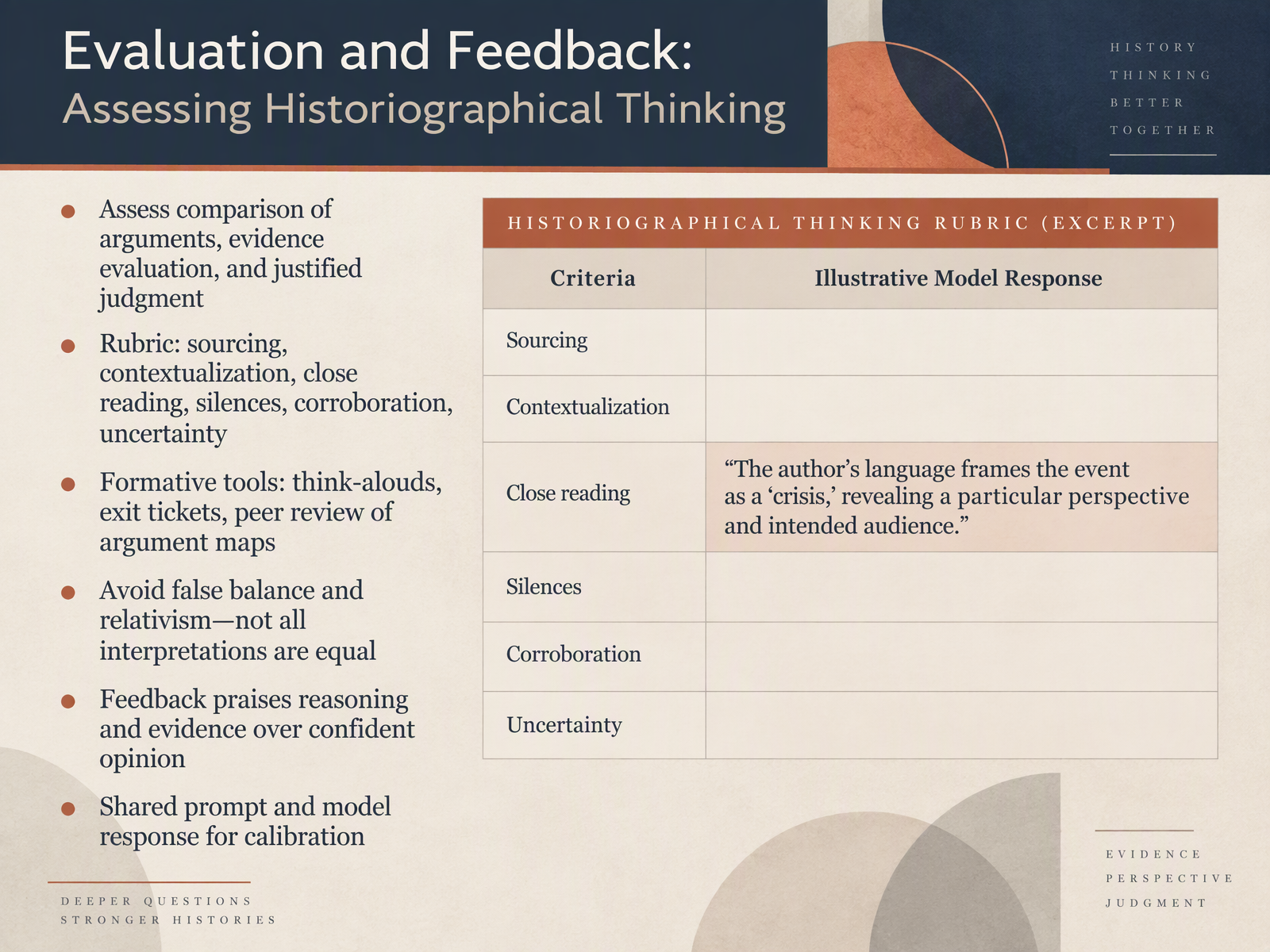
- 13Evaluation and Feedback: Assessing Historiographical ThinkingLet's turn, now, to evaluation and feedback. When you assess historiographical thinking, look for three things. Can students compare arguments fairly? Can they evaluate the evidence behind each claim? And can they reach a judgment they can justify? A useful rubric names the moves directly: sourcing, contextualization, close reading, reading the silences, corroboration, and tolerance for uncertainty. Notice that these criteria reward reasoning, not confidence. Feedback should say what a student did with evidence. So praise a strong comparison, not a loud opinion. For formative work, ask students to think aloud as they read. Short exit tickets and peer review of argument maps also make reasoning visible. Here is a caution. Avoid false balance. Not all interpretations are equal, because evidence and argument differ in quality. Equally, avoid relativism. The evidence suggests some claims are simply better supported. One focused question to keep in mind: What would count as strong evidence for this interpretation? Let students sit with that. Finally, share one prompt and one model response across the class. Calibration keeps your judgments consistent, and it shows students what good reasoning looks like. Next, we'll consider synthesis and next steps, and how you become a critical reader of history.
 open.eduneh.govplus.ac.at+22 min
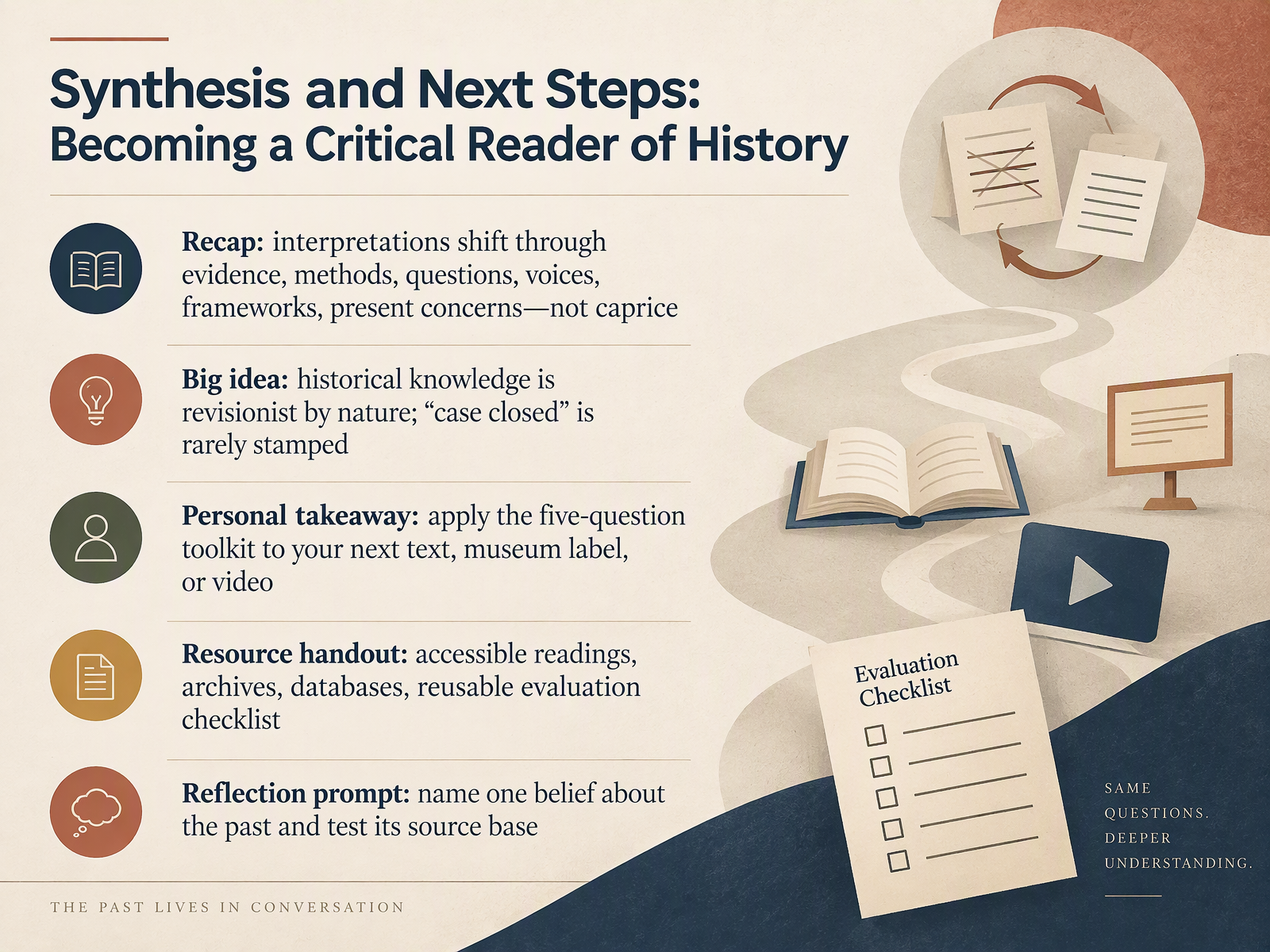
- 14Synthesis and Next Steps: Becoming a Critical Reader of HistoryLet's bring this together. Interpretations shift through evidence, methods, questions, voices, frameworks, and present concerns. Historians often argue that change is not caprice. It is the discipline working. The big idea is this. Historical knowledge is revisionist by nature. The evidence suggests that case closed is rarely stamped on any subject. So here is your personal takeaway. Take the five-question toolkit to your next text, museum label, or video. Ask who made it, what evidence it uses, what it leaves out, which questions shaped it, and what present concerns it reflects. Your resource handout gives you accessible readings, archives, databases, and a reusable evaluation checklist. And here is your reflection prompt. Name one belief you hold about the past, then test its source base. What evidence would change this account? Take a moment to think. Thank you for your attention throughout this course. Keep asking those questions. That is how you become a critical reader of history.
 nmu.eduhistory.berkeley.eduen.wikipedia.org+22 min
Take the deck with you
Download this course as a file — free, no sign-up needed.
- PDF handoutEvery slide page, ready to print or share.15 pages · 4.9 MBDownload
- Narrated PowerPointThe deck that presents itself — every slide carries the digital human's narration video.15 pages · 14.7 MBDownload
- PowerPoint slidesThe full deck as a .pptx — open it in PowerPoint, Keynote, or Google Slides.15 pages · 4.9 MBDownload
Free to use in your own training — please keep the PersonWise credit page at the end.
Have your own deck? Turn it into a course
Sources consulted
Web sources consulted while building this course.
- Historiography | NMU Writing Center — nmu.edu
- Reading Historiography (i.e., Secondary Sources): Some Suggested Guidelines — history.berkeley.edu
- Historiography — en.wikipedia.org
- Research Help for History Students: Historiography — libguides.hartford.edu
- Historiography - Themes - Making History — archives.history.ac.uk
- 5. Probing sources and methodologies | Becoming a Historian | University of London Press — read.uolpress.co.uk
- Narrative and experience: interdisciplinary methodologies between history and narratology — tandfonline.com
- HISTORY ESSAY GUIDE — uottawa.ca
- The Ever-Changing Shape and Texture of the Past — plus.ac.at
- Why Do Historians Disagree? | OpenLearn - Open University — open.edu
- All History is Revisionist History | National Endowment for the Humanities — neh.gov
- 3. Historical Analysis and Interpretation | Public History Initiative — phi.history.ucla.edu
- The Ever-Changing Past — yalebooks.yale.edu
- Changing Trends in Historical Writing: A Critical Analysis of Modern Historiographical Approaches — doi.org
- The houses of history — degruyterbrill.com
- Manchester University Press - The houses of history — manchesteruniversitypress.co.uk
- A Global History of Modern Historiography - 2nd Edition - Georg Iggers — routledge.com
- Annales school — en.wikipedia.org
- Royal descendants, citizens move Bombay High Court against NCERT's ‘removal’ of Maratha empire map — indianexpress.com
- 5 Years of NCERT Textbook Revisions: A Timeline from Mughal Chapters to Supreme Court Scrutiny, ETEducation — education.economictimes.indiatimes.com