Instructional Design Learning Theories
Begin
14 pages · ~28 min
Instructional Design Learning Theories
This training introduces educators and trainers to key instructional design learning theories, enabling them to apply these frameworks to create more effective learning experiences.
What you’ll learn
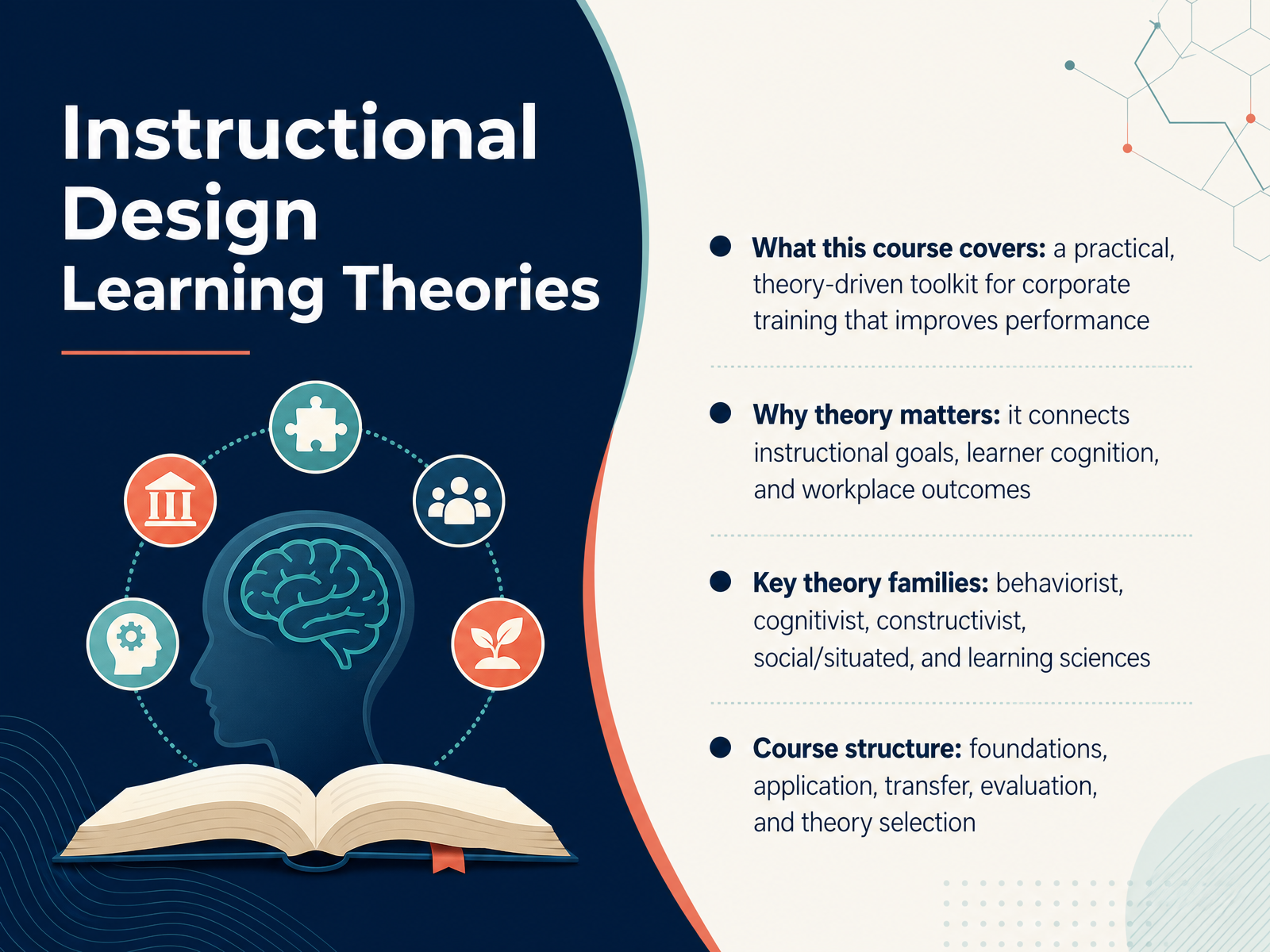
- 01Instructional Design Learning TheoriesWelcome. We're here to talk about the engine behind every effective training program: learning theories. As instructional designers and educators, we know that relying on intuition or the latest trend often leaves learners disengaged and skills untouched. That's why this course builds a practical toolkit connecting instructional goals, learner cognition, and real workplace outcomes. We'll dissect the major theory families — behaviorist, cognitivist, constructivist, and social or situated models — and bring them down to concrete design decisions. Each has trade-offs. Behaviorism drives measurable compliance and drill; cognitivism structures information to fit how the brain processes and stores it; and constructivism builds deep understanding through problem-solving and collaboration. We'll map these to our course structure: foundations, application, transfer, evaluation, and selecting the right theory for the task. When we finish, you won't just know definitions. You'll know which lever to pull for your next project and why the science of learning matters more than ever as our workplaces evolve. Let's dig in.sciopen.comlink.springer.comdigi-journalphils.com+22 min
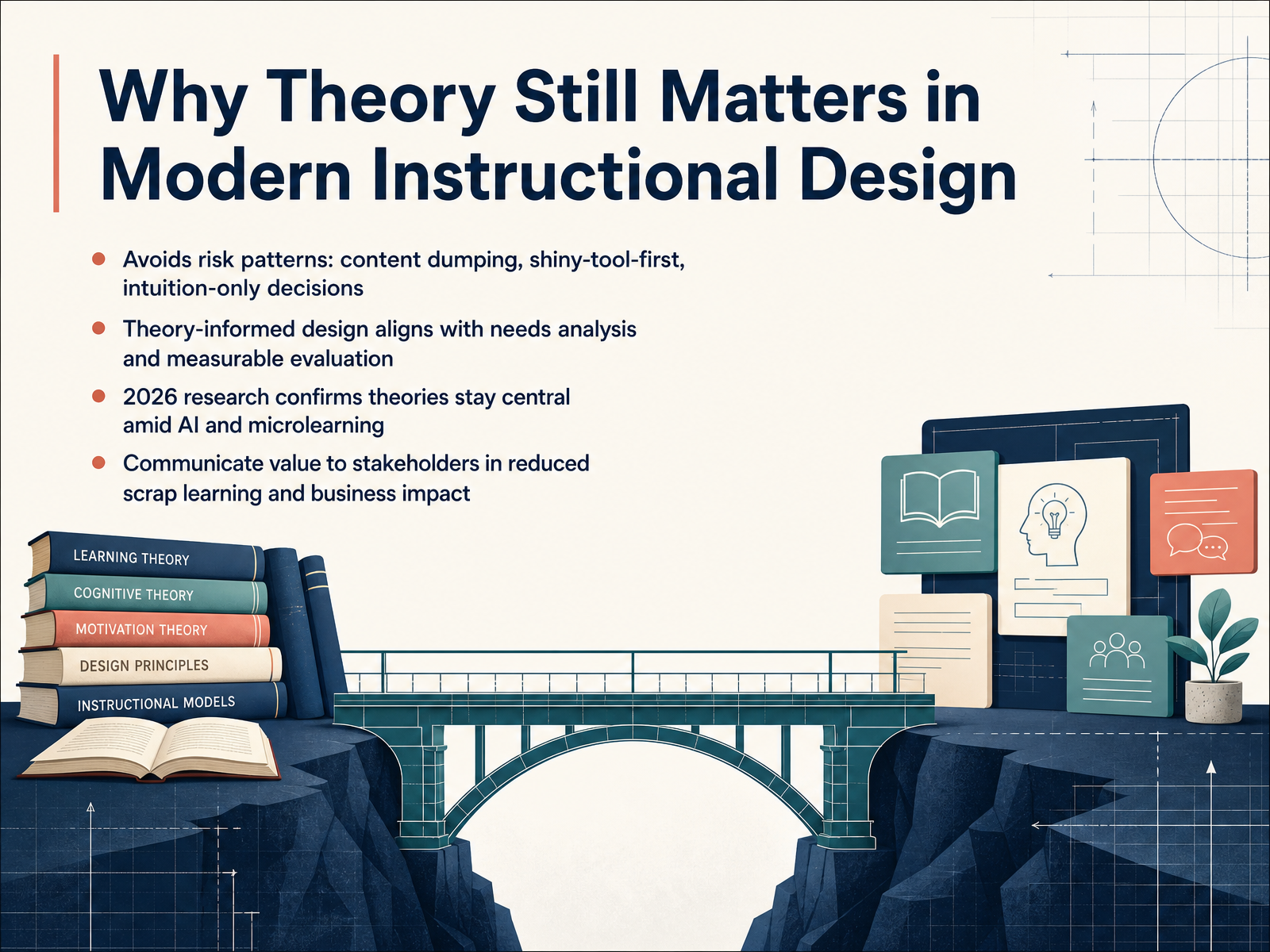
- 02Why Theory Still Matters in Modern Instructional DesignLet’s be honest about why we’re here. Theory isn’t an academic luxury; it’s the guardrail that keeps our projects from derailing. Without it, we fall into familiar traps: dumping content into a slide deck, picking a shiny new tool first, or making decisions purely on intuition. We’ve all seen those projects fail. Theory-informed design prevents that. It forces alignment with a real needs analysis and gives us measurable evaluation criteria from the start. And this isn’t a throwback argument. Research published through 2026 shows that learning theories remain central, even as AI and microlearning dominate our toolkits. The frameworks are adapting and integrating, but they are not fading away. For us, this is a strategic advantage. When we ground our work in theory, we stop talking about likes and completion rates, and start talking business impact and reduced scrap learning. That is a language stakeholders respect. For your next project, resist the urge to jump to solutions. Start with the learning problem, and use theory as your diagnostic lens. In our next segment, we'll build on this by revisiting the foundational pillars of behaviorism, cognitivism, and constructivism.
 sciopen.comlink.springer.comdigi-journalphils.com+22 min
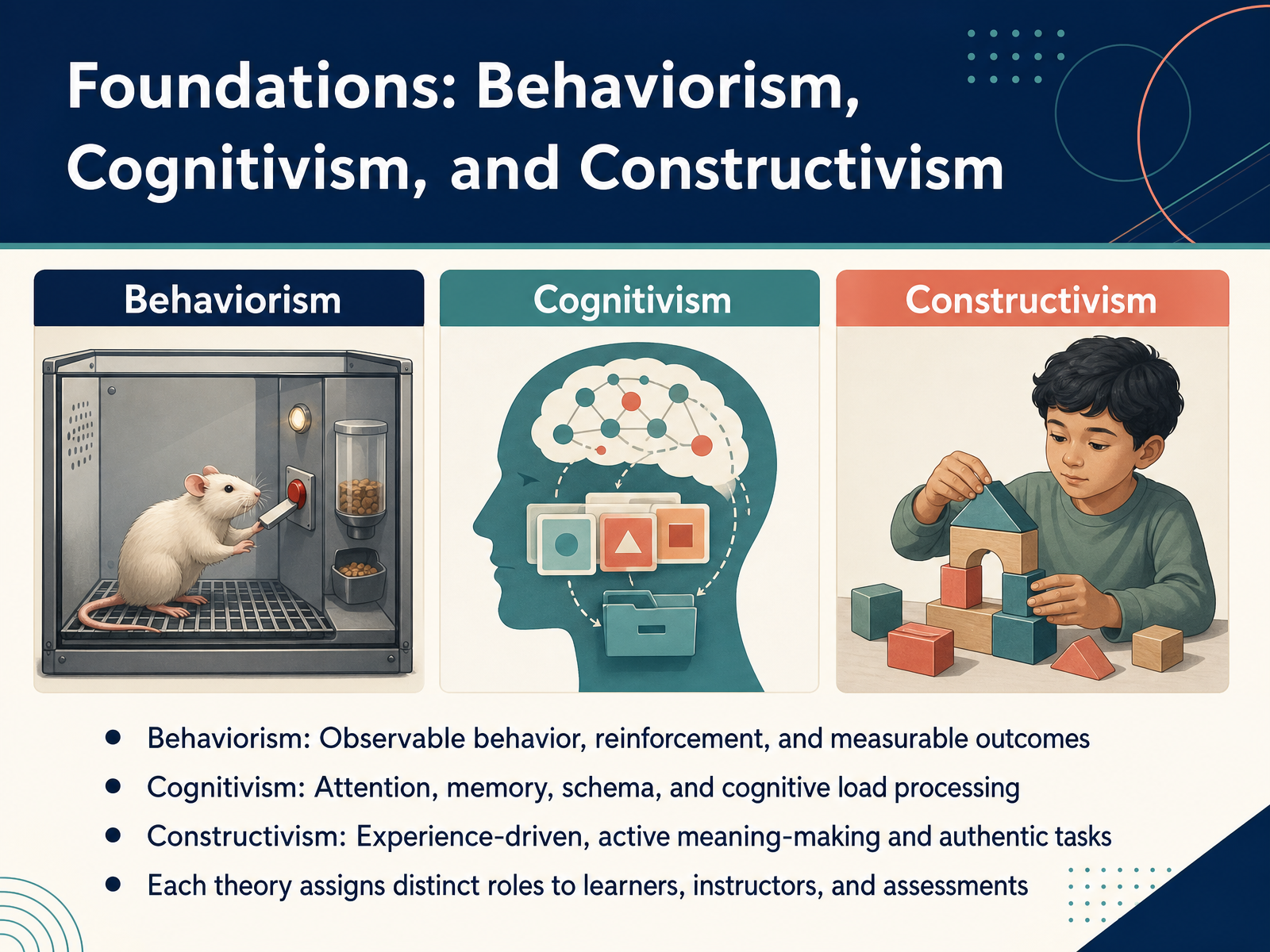
 - 03Foundations: Behaviorism, Cognitivism, and ConstructivismSo let's look at our foundational toolkit. These three theories aren't competing philosophies; they're complementary lenses, each offering a different answer to the same question: what does it mean to learn? Behaviorism focuses on the observable. It defines learning as a measurable change in behavior, shaped by reinforcement and practice. Think of mastering a compliance checklist or learning the exact sequence for taking vitals. The instructor sets the cues, the learner responds, and assessment is straightforward: did they perform the correct action? Cognitivism shifts the focus inward to the black box behaviorists ignored. Here, the learner is an active information processor. We care about attention, working memory limits, and how new knowledge connects to existing mental models, or schemas. This is where strategies like chunking content, using analogies, and worked examples come from to manage cognitive load. Constructivism takes yet another stance, arguing that knowledge isn't transferred but built. Learners create their own meaning through experience, collaboration, and tackling authentic, messy problems, like an ambiguous sales negotiation. The instructor serves as a guide. And here the assessment isn't a test; it's a portfolio, a simulation, or a reflective case analysis. The practical takeaway? These assign distinct roles to you, the learner, and your assessments. Your job is to match the theory to the demand of the task. Which brings us to deciding when each is your best tool.
 onlinelibrary.wiley.comeric.ed.govteachers.institute+22 min
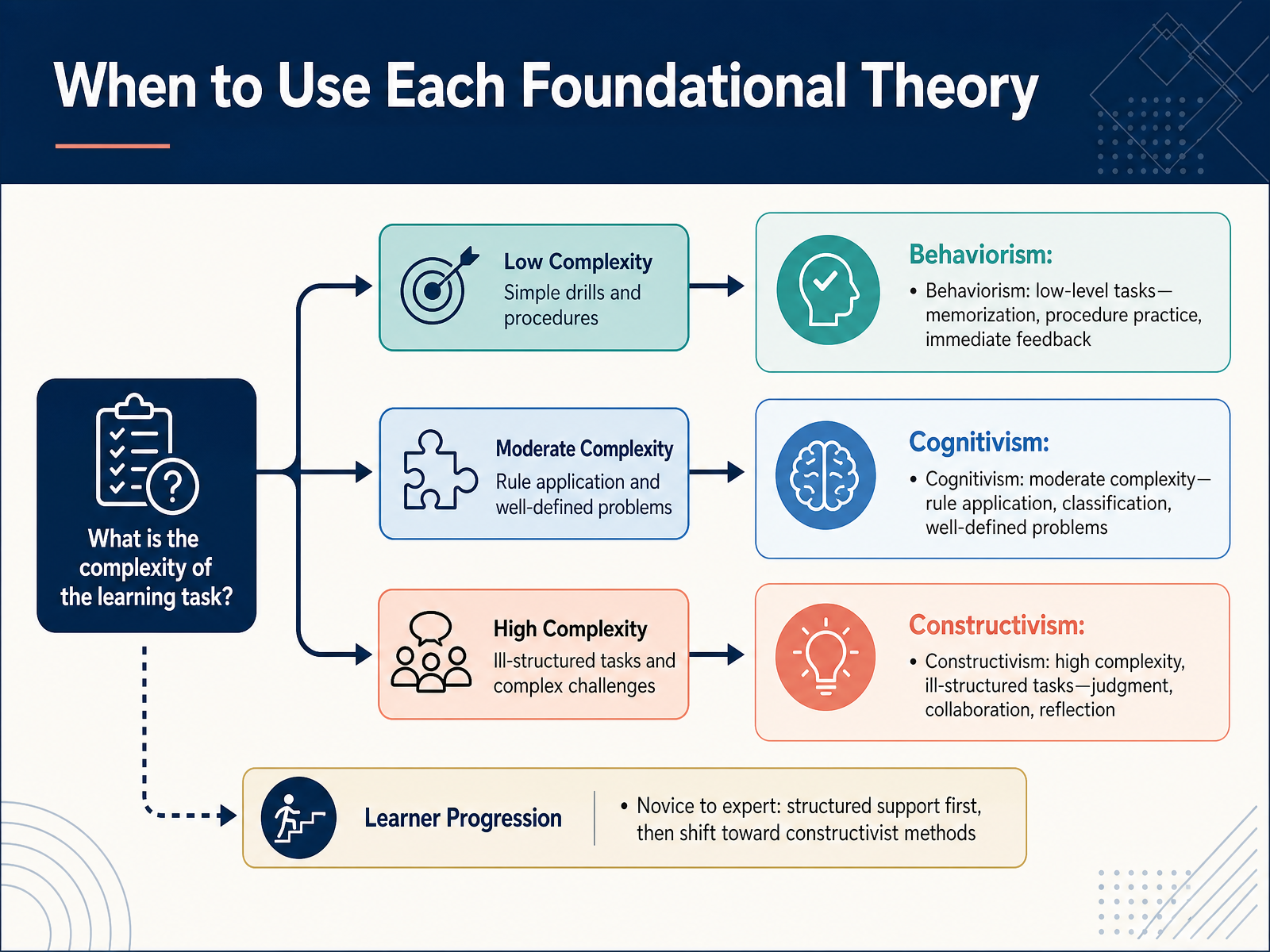
 - 04When to Use Each Foundational TheorySo how do we choose? Start with the task complexity and the learner's proficiency. For low-level tasks, think memorization, procedure practice, or immediate feedback, behaviorism is your tool. It gives you clear, measurable objectives and reliable reinforcement. Cognitivism steps in when tasks reach moderate complexity, like applying rules, classifying information, or solving well-defined problems. Here, you're supporting mental processing with organizers and worked examples. But when you face high complexity and ill-structured tasks that demand judgment, collaboration, and reflection, that's constructivism's territory. Let learners grapple with authentic scenarios and build their own understanding. The real art is sequencing. Think of the journey from novice to expert. Beginners need structured support. So you scaffold with behaviorist and cognitive methods to build foundational knowledge first. Then, as competence grows, you shift toward constructivist methods, allowing learners to integrate knowledge and tackle ambiguity. The best designs aren't loyal to one theory; they move fluidly along this continuum. Next, let's look at how social learning and situated approaches add another layer to this picture.
 onlinelibrary.wiley.comeric.ed.govteachers.institute+22 min
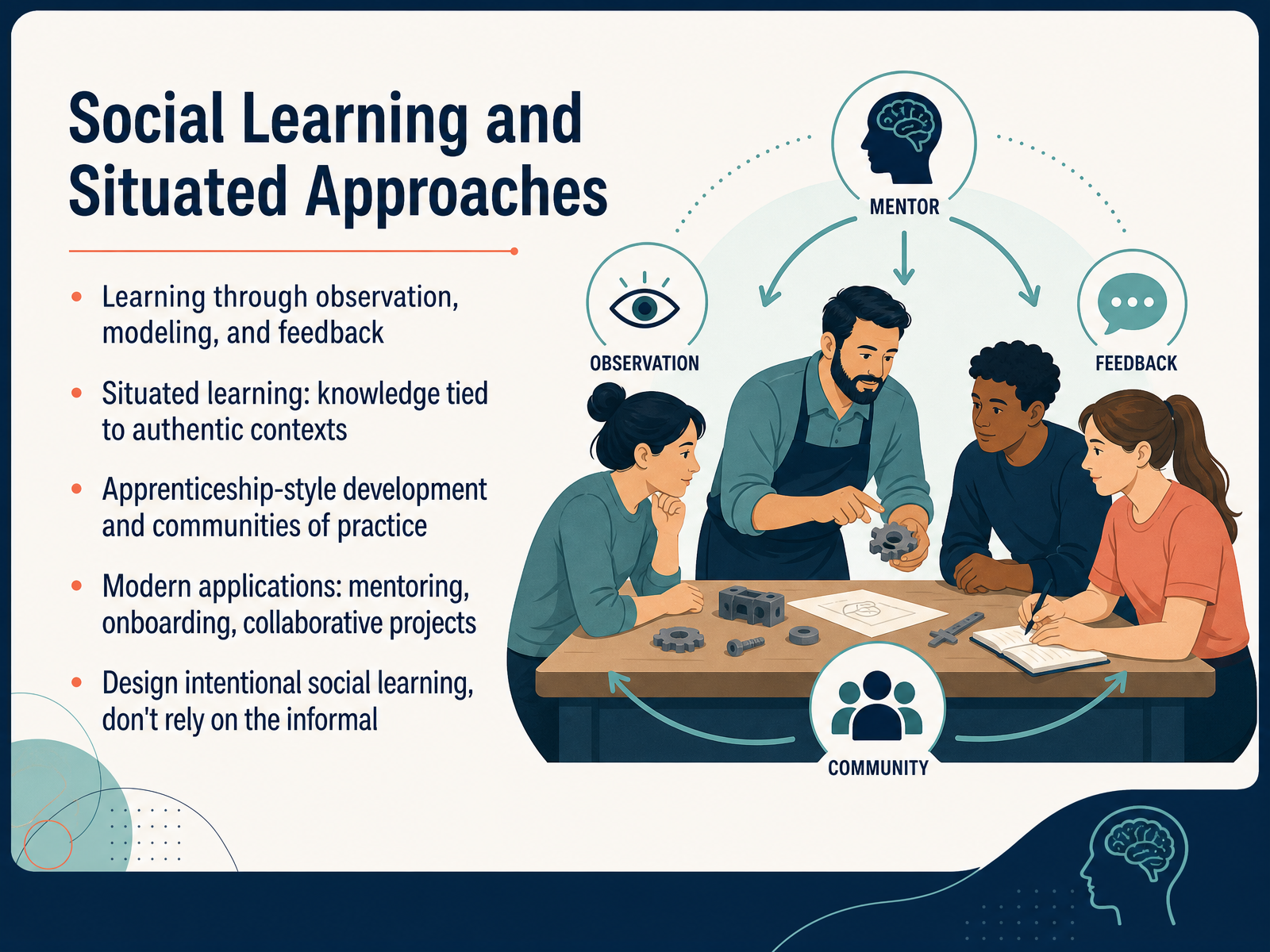
 - 05Social Learning and Situated ApproachesLet us look at the social and situated side of learning. The core idea here is that much of our professional knowledge is not acquired in isolation. It develops through observation, through modeling, through feedback from colleagues, and through participating in authentic work. This is what we mean by situated learning. Knowledge is not abstract; it is tied to the real contexts where it is produced and used.
Consider the apprenticeship model. A newcomer does not just read a manual. They observe an expert, take on peripheral tasks, receive coaching, and gradually become a full participant in the community of practice. This is the engine behind effective mentoring, structured onboarding, and well-designed collaborative projects.
Now, the trade-offs are worth naming. This kind of learning takes time and facilitation. It can feel less structured than a standard eLearning module, and the outcomes are harder to measure. It is also uneven. Some people get great mentors, others do not. That is why the designer’s job here is to make social learning structured and equitable. Do not rely on the informal water-cooler moments to carry your skills strategy. Your role is to intentionally build the scaffolds, the coaching checkpoints, and the shared reflection time that make informal learning reliable.
Think about these as design tools, not just ambient culture. Next, we will shift gears and ground these theories in the cognitive machinery behind learning.
 emerald.comtandfonline.comflr-journal.org+22 min
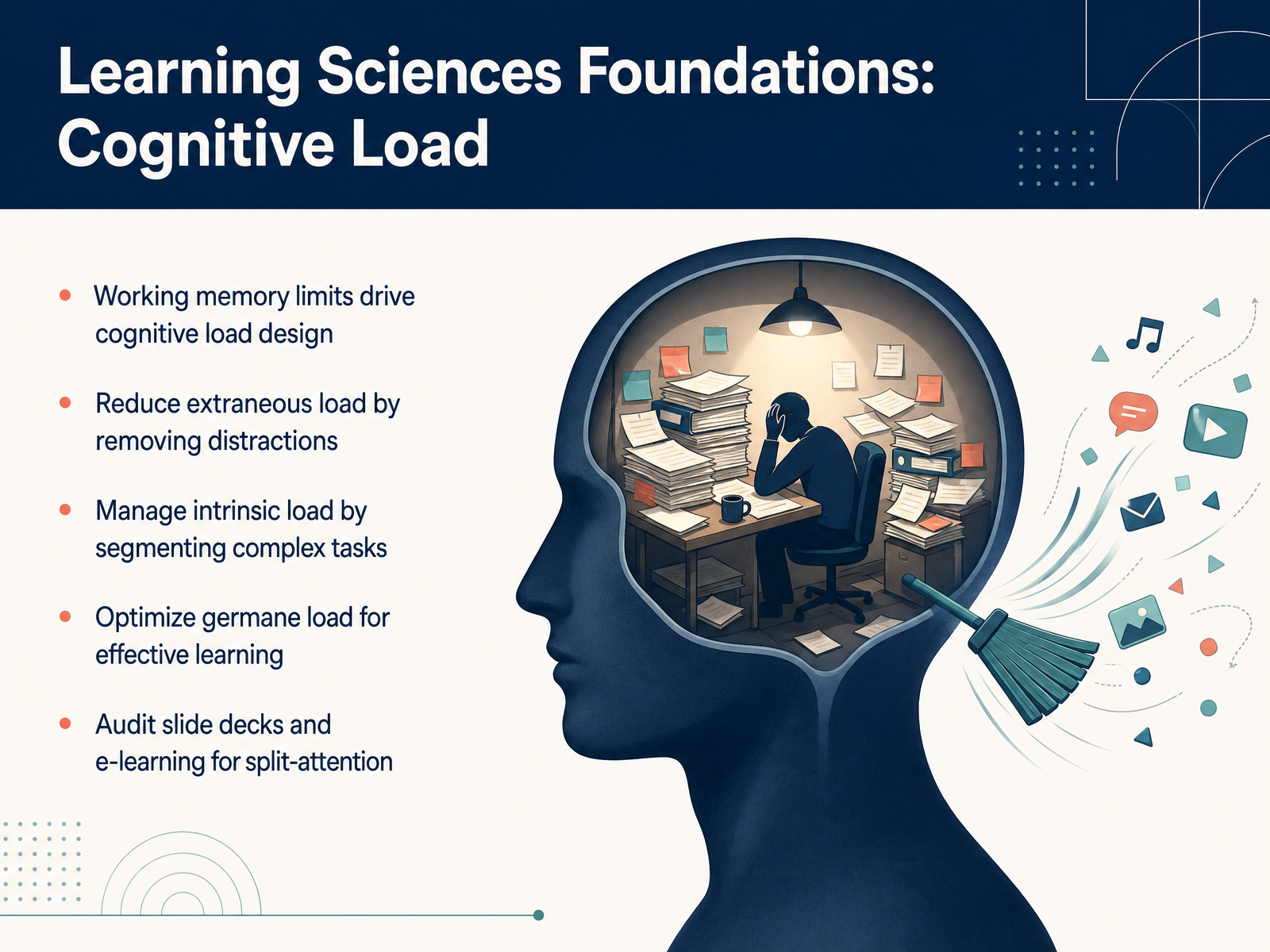
 - 06Learning Sciences Foundations: Cognitive LoadLet's shift our focus now to the science of cognitive load. This is really the engineer's view of memory, and it's foundational to almost every design choice we make. The core idea is that our working memory has strict, finite limits. When we exceed them, learning stops, even if the content is perfect. So, our job is rarely to add more, but to curate and structure what's already there. We achieve this by managing three types of load. First, we strip away extraneous load. That's the distraction overhead, like irrelevant images or redundant on-screen text. Think of it as removing noise. Second, we manage intrinsic load, which is the inherent complexity of the task itself. We shouldn't dumb it down, but we should chunk it. Break that complex process into digestible steps. Finally, and this is critical, we optimize germane load. This is the good load, the mental effort spent on actually building schemas. By removing the barriers, we free up capacity for the deep processing that leads to real understanding. So, a very practical action item: audit your next slide deck or e-learning module for split-attention effects. If the text is at the bottom of the screen and the diagram it explains is at the top, you've lost the learner. Our goal is always cognitive efficiency, not just information delivery. Next, we'll explore how Mayer's multimedia principles translate these ideas into concrete, actionable design rules.
 sciopen.comlink.springer.comdigi-journalphils.com+21 min
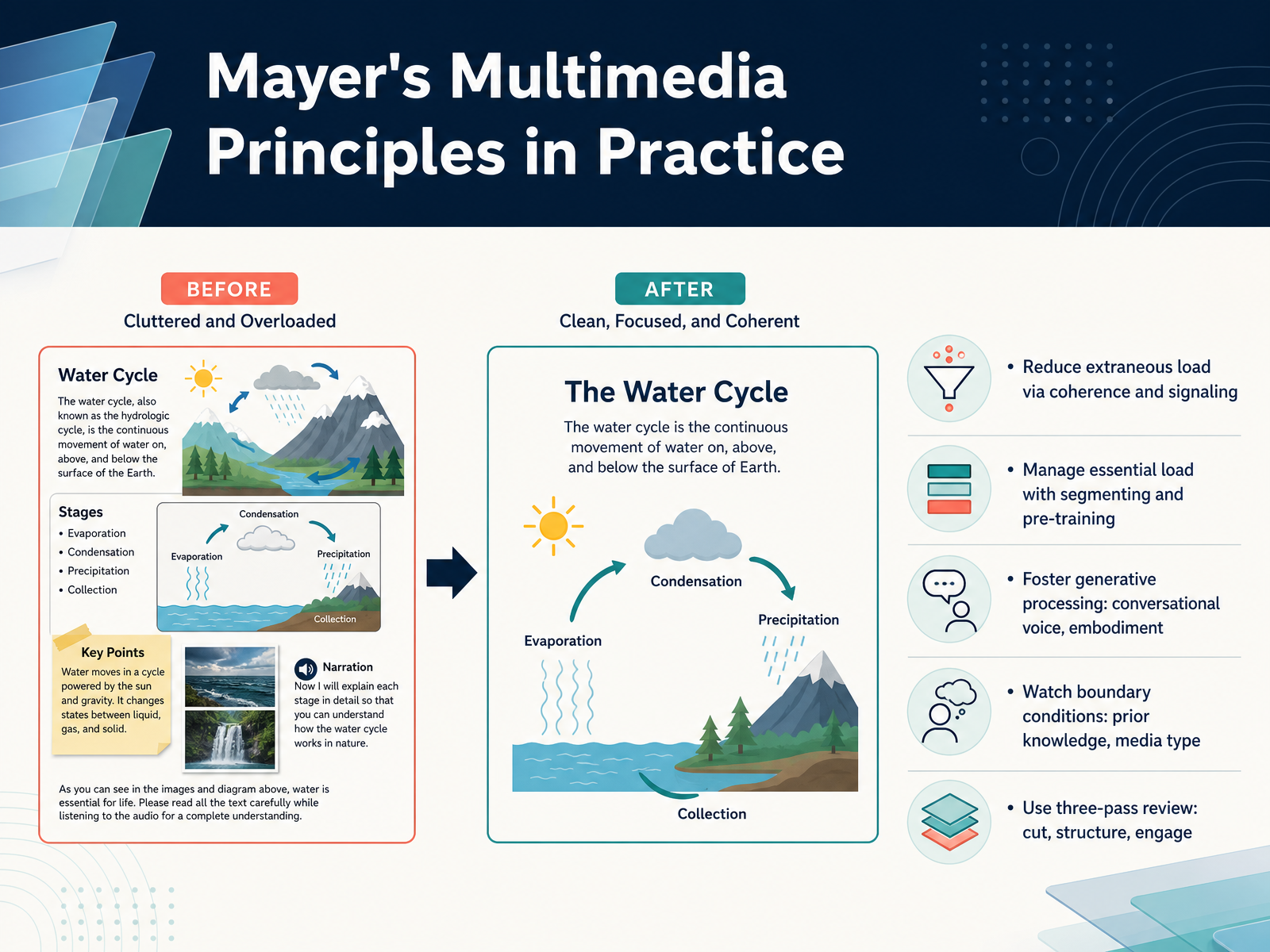
 - 07Mayer's Multimedia Principles in PracticeNow let's put the Cognitive Theory of Multimedia Learning to work in our everyday projects. Mayer's research gives us a practical toolkit, organized around three goals. First, we reduce extraneous load. This means applying the coherence principle: cut anything that doesn't serve the learning objective. That background music, those decorative images, they have to go. Pair this with signaling: use arrows or highlights to cue learners to the essential information. Second, we manage essential load. When content is complex, use segmenting to break it into learner-paced chunks, and offer pre-training to front-load key terms and concepts before the main task. Third, we foster generative processing. Write scripts in a conversational style, and use a warm, human narrator. For on-screen characters, incorporate natural gestures to create social presence. And be mindful of boundary conditions—these principles have the strongest effects for novices, and evidence varies across media types. Here's your actionable takeaway: before you publish, run a three-pass review. First, cut the extraneous material. Next, structure the essentials with signaling and segmentation. Finally, engage the learner with a conversational voice and generative activity. This discipline will sharpen every storyboard you produce. Up next, we'll see how andragogy shapes motivation for adult learners.
 illumina-interactive.comcambridge.orgonlinelibrary.wiley.com+22 min
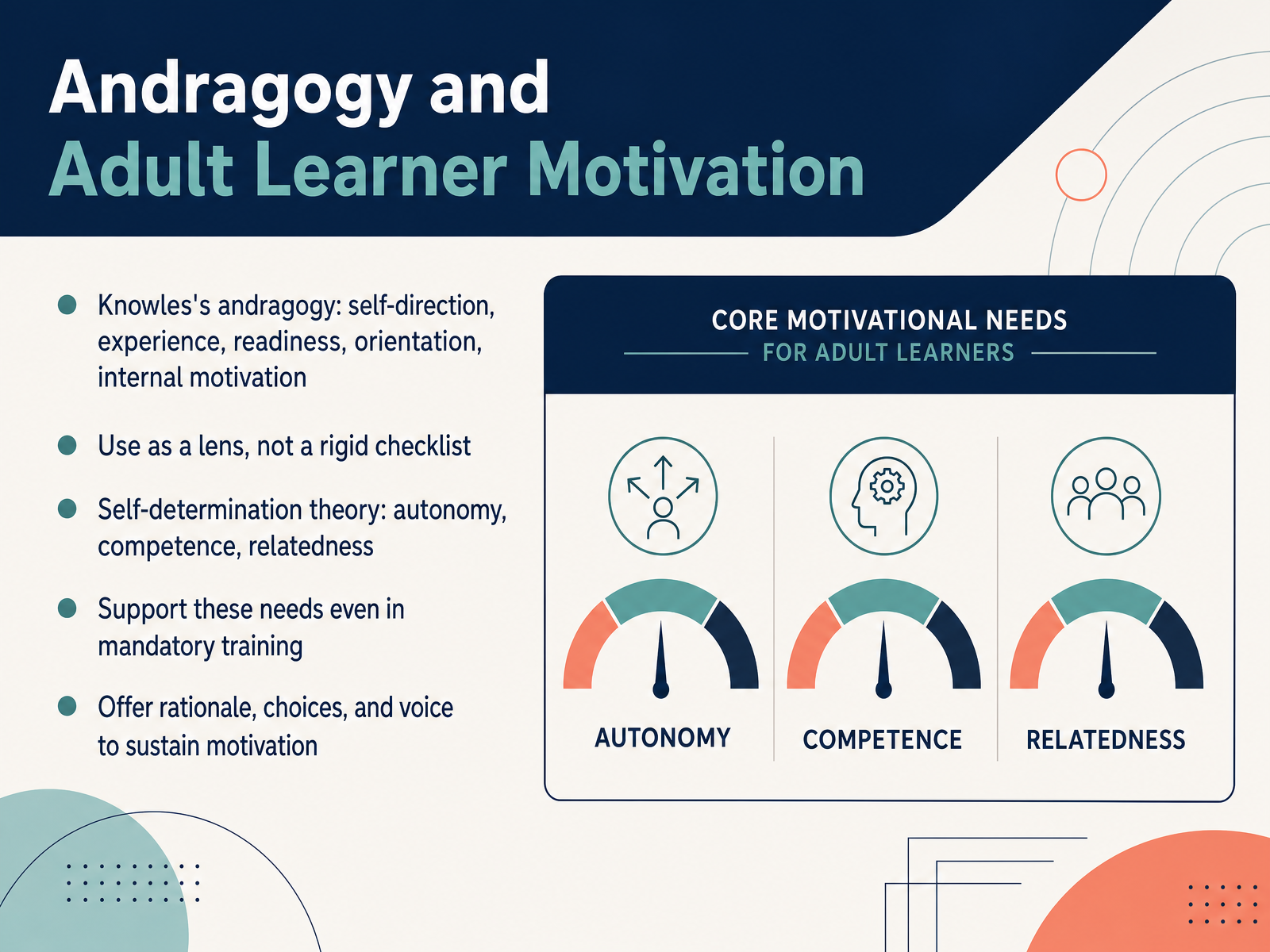
 - 08Andragogy and Adult Learner MotivationNow, let’s talk about what actually drives adult learners: andragogy and motivation. Knowles gave us a helpful set of lenses — self-direction, experience, readiness, orientation to learning, and internal motivation. But treat these as diagnostic lenses, not a rigid checklist. An adult brings expertise and urgency; your job is to connect the new material to what they already face back on the job. That is where self-determination theory sharpens the picture. Learners need autonomy — the feeling that they choose to engage, not that they are being processed. They need competence — evidence that they are mastering something real. And they need relatedness — a sense that they are learning with people who value them. Now, you might be thinking: that is great for elective courses, but what about mandatory compliance training? That is the hard case, and the theory still applies. You cannot remove the mandate, but you can support the person inside it. Give them a transparent rationale for why the content matters. Offer procedural choices: how they pace it, what format they use. And give them a voice in the process, even in small ways. These moves do not change the requirement; they change the experience of being required to learn. Next, let’s talk about designing required training without killing motivation.
 sciopen.comlink.springer.comdigi-journalphils.com+22 min
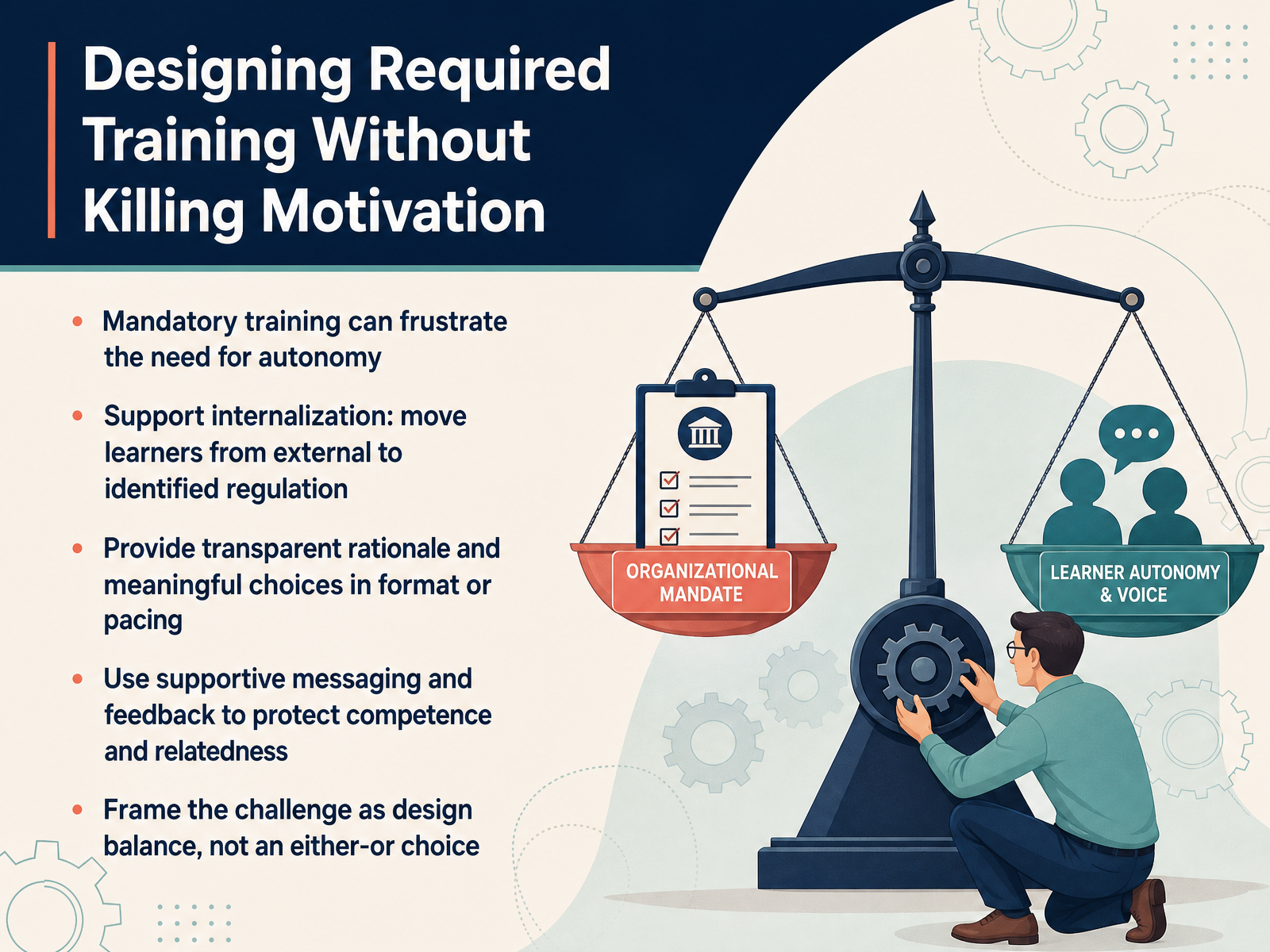
 - 09Designing Required Training Without Killing MotivationLet’s turn to a tension every one of us knows from practice: required training. The word mandate often reads as the opposite of autonomy, which makes learners bristle before they click. But self-determination theory gives us a way to honor the requirement without strangling motivation. The key is supporting internalization. We move learners from external regulation, doing it because compliance says so, toward identified regulation, doing it because they genuinely see why it matters. So how do we design that move? First, give a transparent rationale. Explain why this skill protects the team or the client, not just why the audit demands it. Second, offer meaningful choices in format or pacing. Let a learner choose the simulation over the video, or spread modules across a week. Third, keep language supportive and give feedback that builds competence, not surveillance. Notice we are not choosing between rigor and respect; it is a balance. For your next compliance project, ask yourself: what is one choice I can offer, and what is one reason I can make vivid? That is where motivation survives the mandate. Next, we will see how all of these theories apply to common corporate formats.
 sciopen.comlink.springer.comdigi-journalphils.com+22 min
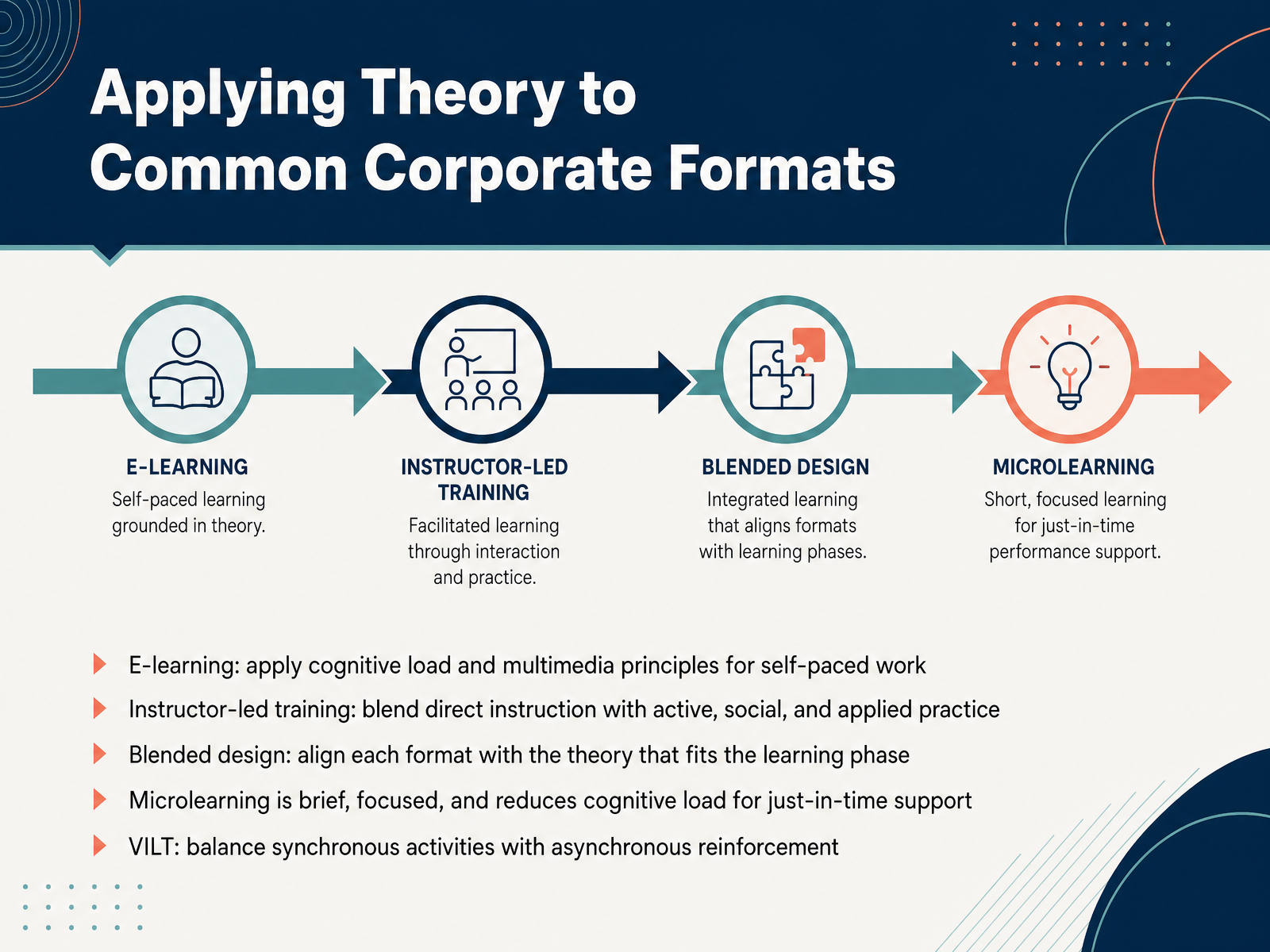
 - 10Applying Theory to Common Corporate FormatsSo how do these theories actually play out in the formats we use every day? For self-paced e-learning, cognitivism is our anchor. We apply Mayer's multimedia principles, like the coherence and signaling principles, to manage cognitive load and keep learners from drowning in extraneous content. We should design for generative processing, giving learners activities to summarize or self-test. For instructor-led training, we blend direct instruction with active and social practice, pulling from constructivism and social learning theory. The live environment is the perfect place for roleplay and collaborative problem-solving, not for lecturing at people. Blended design is where we get strategic. We align each format with the learning phase, using e-learning for knowledge acquisition and ILT for application. Microlearning is a prime example of cognitivism applied. Brief, focused units that reduce cognitive load, perfect for just-in-time support or spaced practice. And for VILT, we need to balance synchronous activities with asynchronous reinforcement to maintain engagement without cognitive overload. Consider using a quick scenario to activate knowledge before the session, and a job aid to follow up after. The key takeaway? Let the theory match the moment.
 illumina-interactive.comcambridge.orgonlinelibrary.wiley.com+22 min
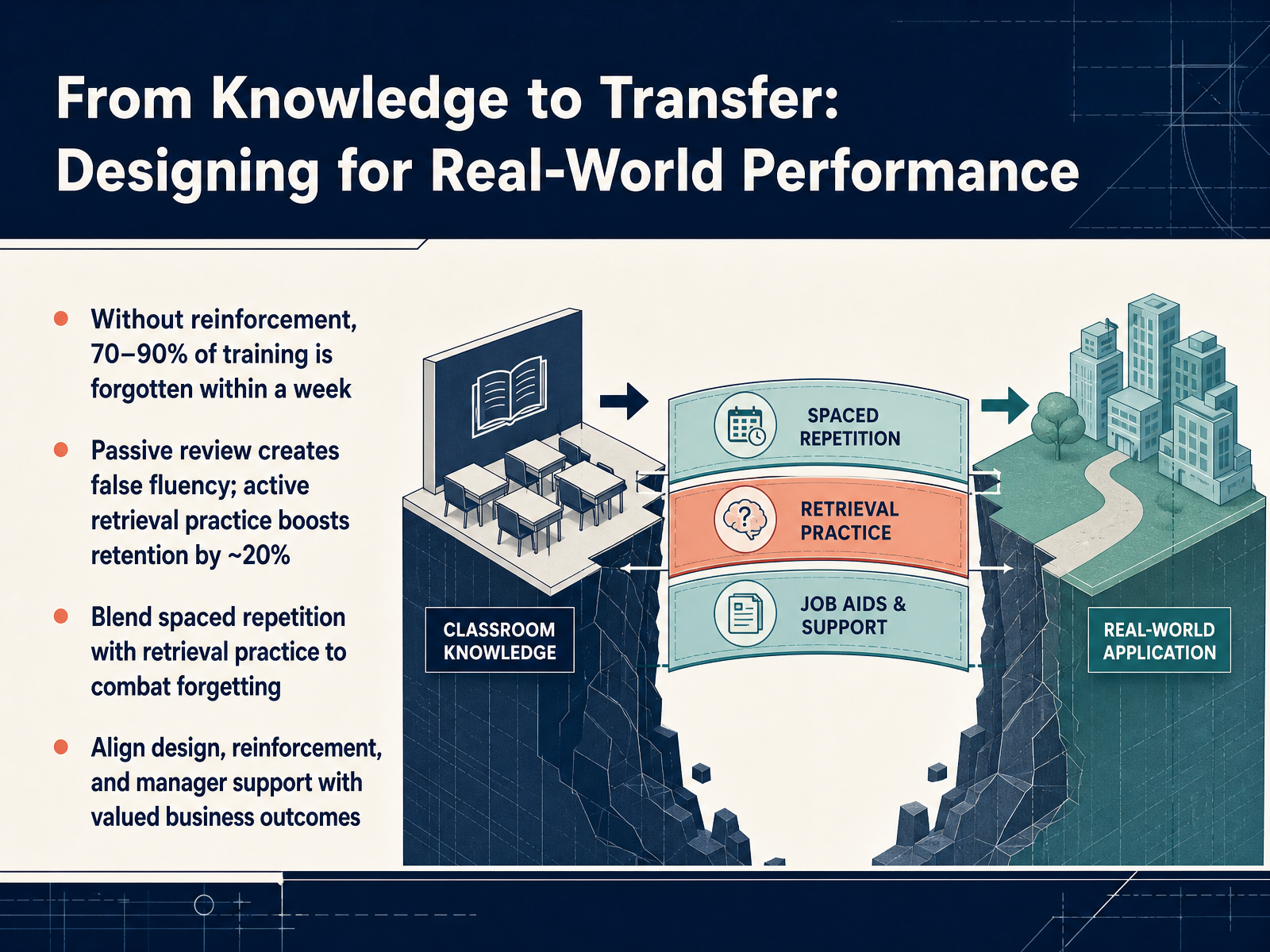
 - 11From Knowledge to Transfer: Designing for Real-World PerformanceLet's be honest about the biggest gap in our work: knowing versus doing. We can design a flawless learning event, but without reinforcement, research shows that up to ninety percent of new knowledge can vanish within a week. That's not a learner failure; it's a design failure. Passive review—re-reading notes or re-watching a video—creates what we call false fluency. It feels familiar, but it dissolves under pressure. Active retrieval practice, on the other hand, forces the brain to reconstruct knowledge, and that single shift can boost retention by roughly twenty percent. The strategy is to combine retrieval practice with spaced repetition. Instead of a one-time event, design a cadence of touchpoints. Day two, a quick quiz. Day seven, a scenario-based decision. Day fourteen, a challenge question. This isn't just about memory; it's about performance. Real-world application requires learners to recall and act under job conditions. So, align your reinforcement schedule, manager support, and coaching efforts with the specific business outcomes you're trying to move. Don't just measure completion; measure application. If your next project is high-stakes, start by defining the target behavior and work backward to design the spaced practice that will make it stick. This brings us to a practical question: how do we choose which theory to apply? Let's look at a decision framework for selecting and combining these approaches.
 2 min
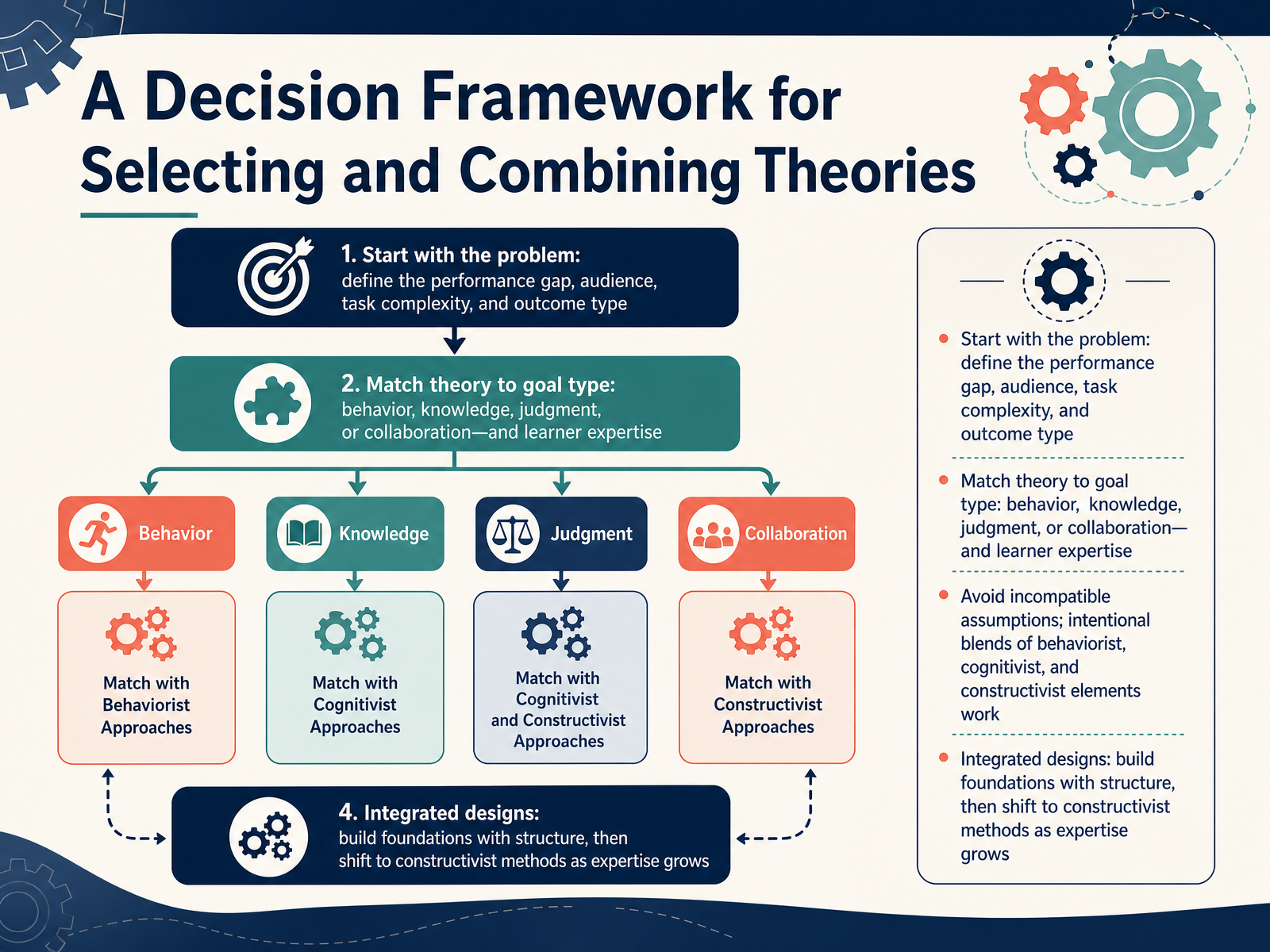
2 min - 12A Decision Framework for Selecting and Combining TheoriesNow let's turn all of that into a practical decision framework. The key is to start with the problem, not the theory. Define the performance gap, the audience's current expertise, the complexity of the task, and the type of outcome you need. Is it a behavior, a piece of knowledge, a judgment call, or a collaborative skill? Once that's clear, you can match the theory to the goal. Behaviorist structure works for building foundational skills and automating procedures. Cognitive strategies, like worked examples and scaffolding, support problem-solving and knowledge retention. And constructivist methods, like scenarios and collaborative projects, are best for developing critical judgment in complex, ill-structured domains. You also need to think about expertise. Novices need the structure and clear guidance that behaviorist and cognitivist approaches provide. As they gain proficiency, shifting to more constructivist methods lets them integrate knowledge and develop expert thinking. Now, about combining theories. Avoid incompatible assumptions. For example, it undermines a design to set rigid, externally motivated goals while expecting free-form, self-directed discovery. But intentional blends work well. Think of it as building foundations with structure, then shifting to constructivist methods as expertise grows. In your next project, start by diagnosing the problem, and let the theory follow from that. Now, let's look at how we can evaluate our learning designs through this theoretical lens.
 onlinelibrary.wiley.comeric.ed.govteachers.institute+22 min
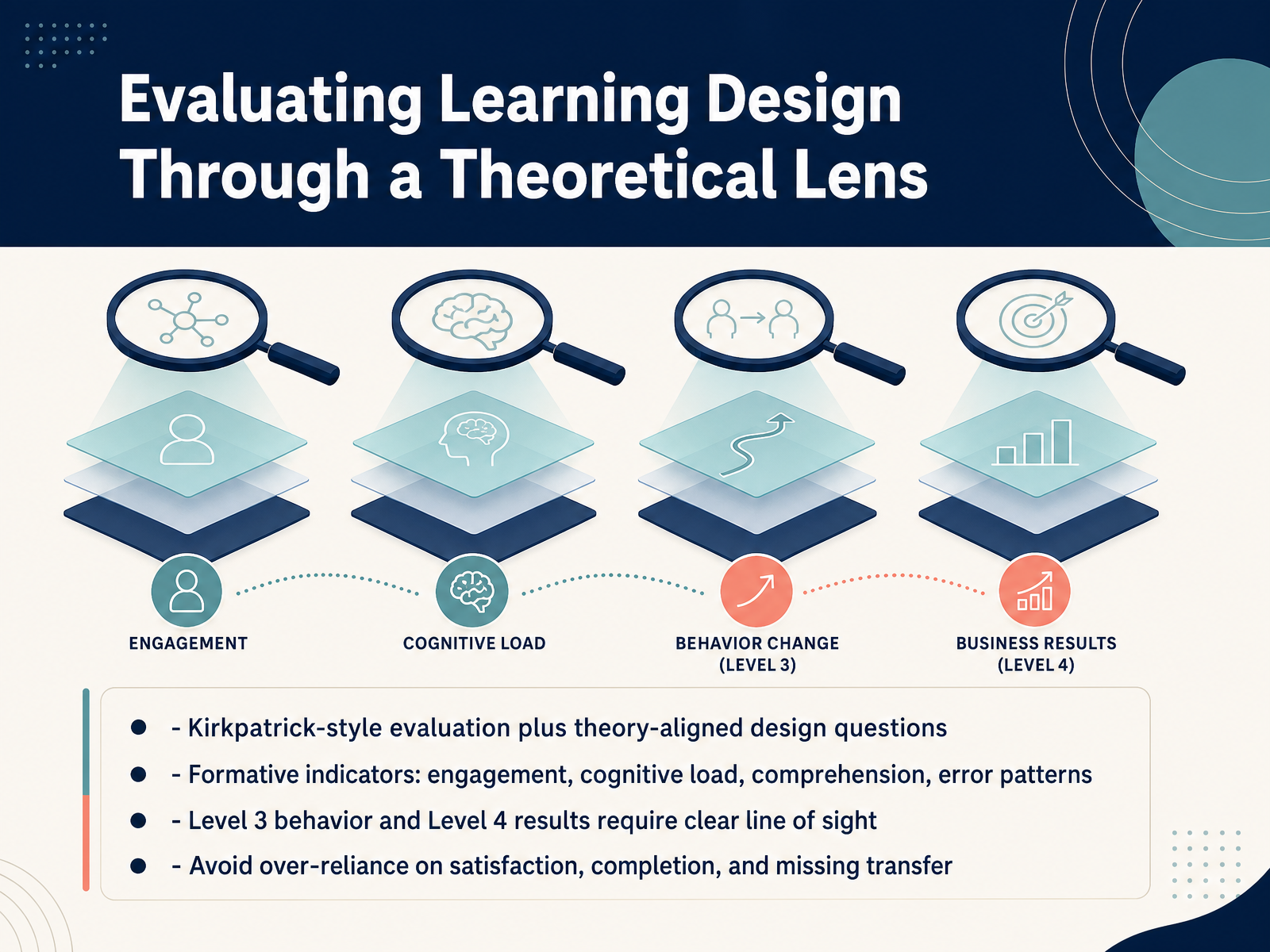
 - 13Evaluating Learning Design Through a Theoretical LensNow let's turn our attention to how we evaluate the learning experiences we design, because this is where theory truly meets practice. A Kirkpatrick-style approach works best when we pair it with questions that reflect our theoretical choices. For example, if you designed a simulation rooted in constructivism, you need formative indicators that look for engagement, cognitive load, comprehension, and crucially, the patterns in the errors learners make. These early signals tell you if your design is working before you reach the end. But we have to be honest with ourselves. Reaching Level 3, behavior change, and Level 4, results, requires a clear line of sight from the learning objectives to the business metrics. That means defining what success looks like on the job, often weeks or months after the training event. The easiest trap is over-relying on satisfaction scores and completion rates. A happy learner who never applies the skill is not a successful outcome. Those numbers only tell us about the learning event itself, not about its value. So, as you build your next evaluation plan, start by asking what behavior must change and what business metric will prove it happened.
 1 min
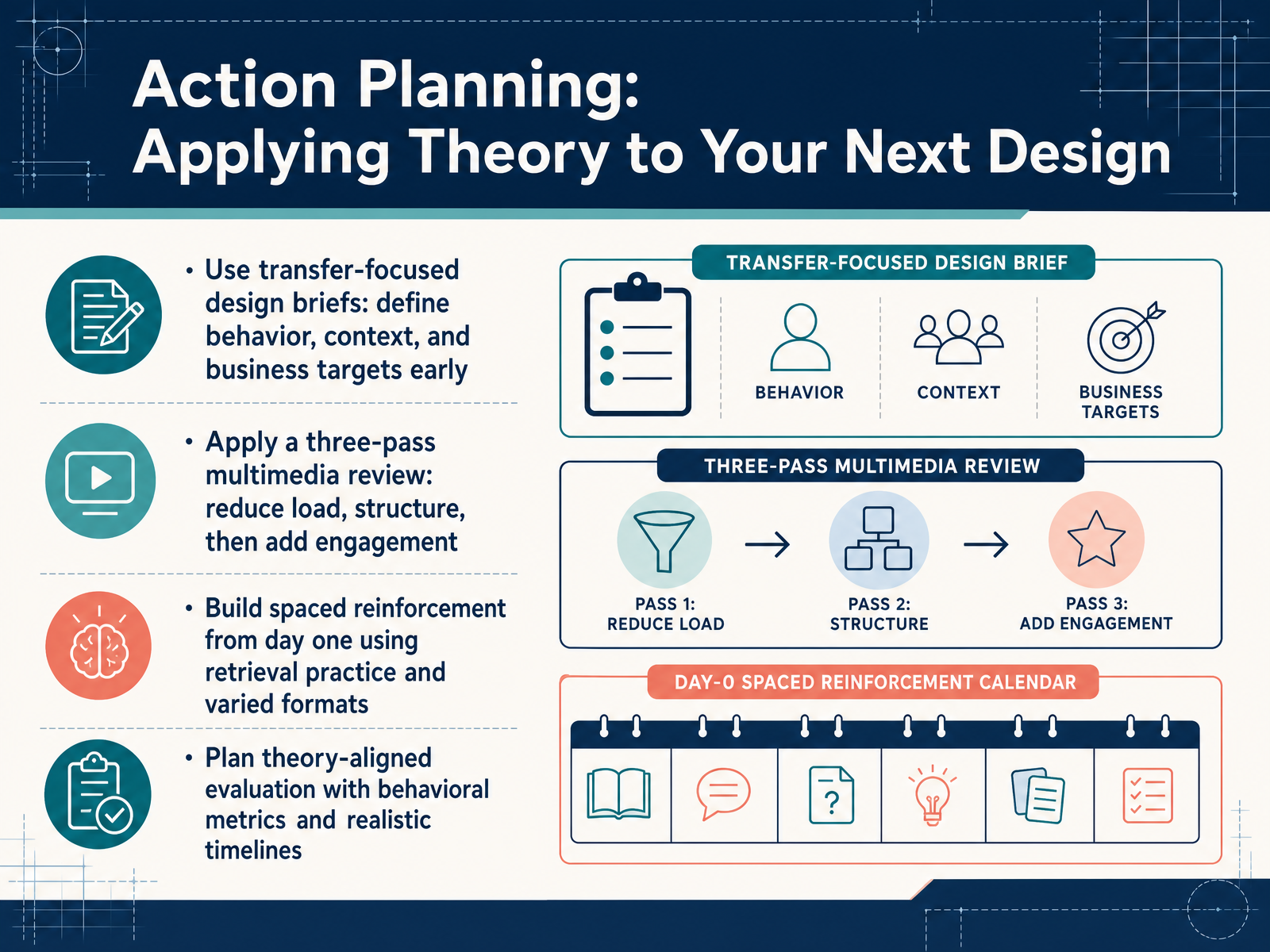
1 min - 14Action Planning: Applying Theory to Your Next DesignSo let's turn all of this into action. Start your next project with a transfer-focused brief. That means naming the behavior, the workplace context, and the business target before you build anything. Next, apply a three-pass multimedia review. First, cut the extraneous load. Second, structure for clarity. Third, add engagement. Don't add bells and whistles until the first two passes are done. Build spaced reinforcement into the design from day one. Use retrieval practice and varied formats to make the learning stick. And finally, plan evaluation that matches the theory. For behaviorism, that might be behavioral metrics. For cognitivism, delayed assessments. And for constructivism, evidence of application in realistic contexts. Choose metrics with realistic timelines that show whether the learning actually transferred. Thanks for joining me. You have the tools, so go put theory into practice.
 illumina-interactive.comcambridge.orgonlinelibrary.wiley.com+22 min
Take the deck with you
Download this course as a file — free, no sign-up needed.
- PDF handoutEvery slide page, ready to print or share.15 pages · 3.9 MBDownload
- Narrated PowerPointThe deck that presents itself — every slide carries the digital human's narration video.15 pages · 16.6 MBDownload
- PowerPoint slidesThe full deck as a .pptx — open it in PowerPoint, Keynote, or Google Slides.15 pages · 3.8 MBDownload
Free to use in your own training — please keep the PersonWise credit page at the end.
Have your own deck? Turn it into a course
Sources consulted
Web sources consulted while building this course.
- Systematic Review of Instructional Theory System in the Digital Age: Paradigms, Characteristics, and Development — sciopen.com
- The intersection of artificial intelligence and instructional design practice: a systematic review | Educational technology research and development | Springer Nature Link — link.springer.com
- Innovative Instructional Design in Contemporary Education: A Systematic Literature Review — digi-journalphils.com
- Types Of Learning Theories: A Guide For eLearning And L&D Pros - eLearning Industry — elearningindustry.com
- Frontiers | Charting the growth of brain-based learning in higher education instructional design — frontiersin.org
- Behaviorism, Cognitivism, Constructivism: Comparing ... — onlinelibrary.wiley.com
- ERIC - EJ471241 - Behaviorism, Cognitivism, Constructivism: Comparing Critical Features from a Design Perspective., Performance Improvement Quarterly, 1993 — eric.ed.gov
- Choosing the Right Learning Approach for Effective Instructional Design • Teachers Institute — teachers.institute
- Behaviorism, Cognitivism, and Constructivism as the Theoretical Bases for Instructional Design | Technium Education and Humanities — techniumscience.com
- Behaviorism, Cognitivism, Constructivism: Comparing Critical Features from an Instructional Design Perspective — doi.org
- Activity theory as framework for analysis of workplace learning technologies: the case of generative AI conversational agents — emerald.com
- Full article: Learning, instruction and assessment in the workplace — tandfonline.com
- Virtual Coworker and Intelligent Tutor: Research on AI Agent-Driven Innovation in Contextualized Teaching Models for Higher Vocational Education | CHEN | Canadian Social Science — flr-journal.org
- VR-Based Workplace Training and Spaces of Learning: A Social Space Study of VR Training for Apprentice Electricians | International Journal for Research in Vocational Education and Training — journals.suub.uni-bremen.de
- Keeping worlds apart to put them back together: VET teachers’ instructional patterns in simulation-based training | Instructional Science | Springer Nature Link — link.springer.com
- Revisiting Multimedia Learning Theory: Fostering Generative Processing in eLearning – Illumina Interactive — illumina-interactive.com
- Multimedia Learning — cambridge.org
- Using multimedia for e-learning — onlinelibrary.wiley.com
- A meta-analysis of Richard Mayer's multimedia learning research: Searching for boundary conditions of design principles across multiple media types - Illinois Experts — experts.illinois.edu
- Research-Based Guidelines for Multimedia Instruction — journals.sagepub.com